
You landed in Cairo. Maybe last week, maybe six months ago. And somewhere between the airport taxi, the bawab downstairs, and the guy at the kiosk who sells you water every morning, you’ve realized something: English gets you through a lot here, but it doesn’t get you through everything.
I’ve taught Arabic to expats living in Cairo for years, and I hear the same story constantly. Someone moves here for work, tells themselves they’ll “pick it up naturally,” and six months later they’re still pointing at things and smiling. It’s not that they’re lazy. It’s that nobody handed them the actual list of phrases that matter — the fifty or so expressions that cover 90% of daily life here.
That’s what this is. Not a grammar course. Not MSA verb conjugations. Just the real, spoken Egyptian Arabic you need to function — and honestly, to stop feeling like a tourist in your own neighborhood.
Do You Actually Need Arabic to Live in Cairo?
This is the question I get asked more than any other, usually from someone still deciding whether to bother.
Short answer: no, you can survive without it. Long answer: survival isn’t the same as living well.
Cairo has a huge expat and diplomatic community, and in places like Zamalek, Maadi, or New Cairo, plenty of people speak enough English to get you a coffee or a cab. But step outside that bubble — which happens constantly, because Cairo doesn’t stay inside its bubbles — and English thins out fast. Your bawab probably doesn’t speak it. Neither does the guy fixing your AC, or the pharmacist at 11pm, or most Uber drivers once you’re past the small talk.
Here’s the thing nobody tells new arrivals: knowing even broken Egyptian Arabic changes how people treat you. It’s not about fluency. It’s about effort. Egyptians are famously warm, and that warmth multiplies the second you attempt their dialect instead of assuming they’ll meet you in yours. A mangled “ازيك” (izzayak — how are you) said with a smile gets you further than perfect English said with none.
So no, you don’t need it to survive. But you’ll live a smaller, more frustrating version of Cairo without it.
Egyptian Arabic, Not MSA — And Why That Matters
If you’ve googled Arabic courses before landing here, you’ve probably run into Modern Standard Arabic (MSA) — the formal language of news broadcasts, books, and official documents. It is not what your neighbor speaks to you in the elevator.
Egyptian Arabic (Masri) is a completely different animal in terms of vocabulary, pronunciation, and grammar shortcuts, even though it shares the same alphabet. If your goal is ordering food, chatting with your doorman, or understanding what the taxi driver just muttered under his breath, MSA won’t get you there nearly as fast. We’ve broken down the actual differences and when you’d want each one in Egyptian Arabic vs MSA: Which One Do You Really Need? — worth a read if you’re still deciding where to put your study time.
For expats living day to day in Cairo, the answer is almost always Masri first.
The Absolute Basics: Greetings and Politeness
Egyptians greet constantly. Walking into a shop, getting into a cab, running into your building’s security guard for the third time today — all of it comes with a greeting. Skip it and you’ll come across as cold, even if that’s not your intention.
| English | Egyptian Arabic | Sounds Like |
|---|---|---|
| Hello | أهلاً | ahlan |
| Hi (informal, welcome) | أهلاً وسهلاً | ahlan wa sahlan |
| How are you? | إزيك؟ (to a man) / إزيك؟ (to a woman, same spelling, softer tone) | izzayak / izzayik |
| I’m fine, thank God | كويس الحمد لله | kwayyes, il-hamdulillah |
| Please | من فضلك | min fadlak |
| Thank you | شكراً | shukran |
| You’re welcome | العفو | al-‘afw |
| Excuse me / sorry | آسف | aasef |
| Yes / No | آه / لأ | aah / la |
| Goodbye | مع السلامة | ma’a as-salama |
Small tip: “الحمد لله” (il-hamdulillah, “thank God”) comes up constantly, even in casual answers to “how are you.” Drop it into your responses and people notice — it’s a cultural marker, not just a religious one.
If you want a fuller rundown of the small talk that opens doors here — how to introduce yourself, ask where someone’s from, that kind of thing — we wrote a whole piece on it: Common Egyptian Introductions and Everyday Small Talk.
Getting Around: Taxis, Uber, and Directions
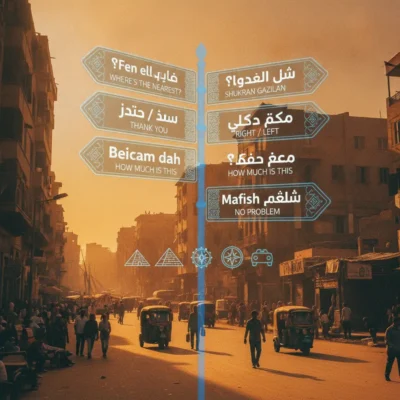
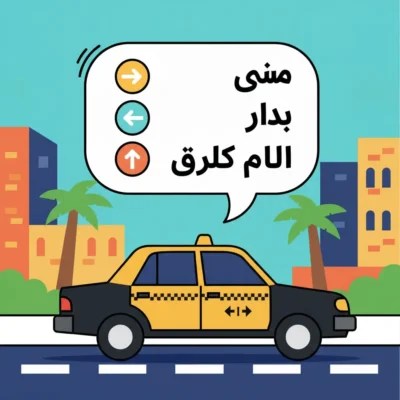
Cairo traffic needs its own warning label, and getting around is where most expats hit their first real language wall. Even with Uber and Careem doing most of the heavy lifting now, drivers still call, ask for directions, or need you to clarify a pin that dropped somewhere vague.
Key phrases:
- فين؟ (fein?) — Where?
- قد إيه؟ (ad eih?) — How much?
- يمين / شمال / على طول (yameen / shemal / ‘ala tool) — Right / left / straight ahead
- هنا كويس (hina kwayyes) — Here is fine (great for telling a driver where to stop)
- قريب / بعيد (arayyeb / ba’eed) — Close / far
- استنى لحظة (istanna lahza) — Wait a moment
Honestly, this is one area where a little Arabic saves you real money too. Drivers are far less likely to take the “scenic route” with a foreign passenger who clearly understands directions and can say “دي مش الطريق” (dee mesh il-taree’ — this isn’t the way).
We put together a much longer, dedicated guide covering airport pickups, taxi negotiations, and street directions in Egyptian Arabic for Getting Around Cairo: Airport, Taxi & Directions — genuinely one of the more practical reads if you’re new here.
Dealing With Your Bawab and Apartment Life
If you’re renting in Cairo, you have a bawab — the building doorman/caretaker — and he is, whether you asked for it or not, now part of your daily life. He’ll hold your packages, know your comings and goings, and often be the person you need when something in the apartment breaks at 9pm on a Thursday.
A few phrases that come up constantly:
- في مشكلة في الشقة (fee mushkila fil-‘a’a) — There’s a problem in the apartment
- المياه/الكهربا مقطوعة (il-mayya / il-kahraba ma’tou’a) — The water/electricity is cut off
- ممكن تساعدني؟ (mumken tesa’edni?) — Can you help me?
- باب الشقة مقفول (bab il-shaa mafool) — The apartment door is locked
- فلوس البواب (floos il-bawwab) — The doorman’s tip/fee
There’s real etiquette here too — tipping expectations, how landlords communicate, what “maintenance” actually means in a Cairo building. We covered all of it, phrases included, in Egyptian Arabic for Housing: Renting and Daily Life, which is worth bookmarking before you sign a lease, not after.
Markets, Shopping, and Bargaining
Bargaining isn’t optional in a lot of Cairo’s markets — it’s the actual system. Walking into Khan el-Khalili or a street market and paying the first price quoted isn’t politeness, it’s just… expensive.
- بكام ده؟ (bikam da?) — How much is this?
- غالي أوي (ghali awi) — Very expensive
- ممكن أقل؟ (mumken a’al?) — Can it be less?
- آخر كلام (aakher kalam) — Final offer
- حاضر، ماشي (hader, mashi) — Okay, deal
I’ll be straight with you — bargaining well isn’t really about vocabulary, it’s about tone and patience. But you can’t even start the negotiation without the basic words, and a seller who hears you attempt Arabic will usually take you more seriously from the first sentence, not just at the final price.
For a much deeper dive into markets, grocery shopping, and the specific etiquette around bargaining (when it’s appropriate, when it’s not, and how not to overdo it), check out Ordering Food and Shopping in Egypt: Phrases and Bargaining Tips.
Restaurants, Cafes, and Ordering Food
Cairo runs on food and coffee, and most cafes and street vendors won’t have an English menu, or the menu won’t match what’s actually available that day.
- عايز/عايزة… (ayez / ayza…) — I want… (ayez if you’re male, ayza if female)
- الحساب من فضلك (il-hisab min fadlak) — The check, please
- من غير… (min gheir…) — Without…
- سخن / بارد (sokhn / barid) — Hot / cold
- تاني واحد (tani wahed) — One more / another one
- مية الطعم (miyya al-ta’m) — Delicious (literally “100% the taste” — very common compliment)
Use “ayez / ayza” constantly. It’s the single most useful phrase-starter in daily Cairo life, whether you’re at a café, a pharmacy, or a phone shop.
Emergencies and Health: The Phrases You Hope You Never Need
You probably won’t need these often. But when you do, you need them fast, and fumbling through a translation app in a stressful moment is genuinely worse than knowing five key phrases cold.
- محتاج مساعدة (mehtag mosa’da) — I need help
- اتصل بالإسعاف (etassel bil-is’af) — Call an ambulance
- أنا تايه (ana tayeh) — I’m lost
- فين أقرب صيدلية؟ (fein a’rab saydaleyya?) — Where’s the nearest pharmacy?
- أنا حاسس إني تعبان/تعبانة (ana hases inni ta’ban / ta’bana) — I feel sick
Memorize these before you need them. Not after.
Numbers: The Silent Survival Skill
Nobody thinks about numbers until they’re standing at a checkout counter with no idea what the cashier just said. Prices, phone numbers, addresses, time — it’s all numbers, constantly.
| 1 | واحد | wahed |
|---|---|---|
| 2 | اتنين | itnein |
| 3 | تلاتة | talata |
| 4 | أربعة | arba’a |
| 5 | خمسة | khamsa |
| 10 | عشرة | ashara |
| 20 | عشرين | ashreen |
| 100 | مية | miyya |
Learn these before anything else on this list, honestly. You’ll use them more than every other phrase combined.
Mistakes Expats Keep Making
A few patterns I see over and over, and they’re worth naming so you can skip them:
Learning MSA when you meant to learn Masri. This is the single biggest waste of time I watch expats make. You buy a beginner Arabic app, work through it for months, and then land in Cairo to discover your neighbor doesn’t talk like the app taught you. Egyptian Arabic and MSA overlap, but they’re not interchangeable in daily conversation.
Being embarrassed to try. Your accent will be rough. Your grammar will be wrong. Say it anyway. Egyptians are remarkably forgiving of mistakes and genuinely appreciative of the attempt — the embarrassment is almost always in your head, not on their face.
Only learning “polite” phrases. You also need the ones for pushing back — “this isn’t the price we agreed on,” “I said without onions,” “that’s not what I asked for.” Passive vocabulary gets you fed. Assertive vocabulary gets you fed correctly.
Treating Arabic like a checklist instead of a habit. Fifteen phrases memorized once won’t stick. Ten minutes of actual practice most days will.
How Long Does It Actually Take to Get Comfortable?
People want a number, so here’s an honest one: most expats who put in consistent, short daily effort get to a real “survival comfortable” level — meaning taxis, markets, small talk, and basic problem-solving without panic — in about two to three months. Not fluency. Comfortable functioning.
That timeline shrinks a lot with actual guided lessons instead of solo app-hopping, mostly because a teacher corrects the mistakes you don’t know you’re making and focuses your limited study time on what you’ll actually use this week, not some abstract curriculum.
If you’re not sure where your current Arabic stands — maybe you took a few classes years ago, or you’ve picked up some words just from being here — it’s worth taking the free Arabic placement test before you commit to a study plan. It tells you exactly where to start instead of guessing.
Where to Go From Here
Everything above will get you through a normal week in Cairo. But a phrase list, no matter how good, has a ceiling. At some point you’ll want to actually hold a conversation — with your bawab, your colleagues, the guy who’s fixed your AC three times now and clearly has opinions about it.
That’s a different thing than memorizing fifty phrases off a page. It comes from real, structured practice with someone who corrects you and pushes you past “surviving” into actually communicating. Our Colloquial Egyptian Arabic course is built specifically for people in your position — expats living the actual Cairo experience, not tourists passing through. Lessons are one-on-one, live, with native Egyptian teachers who know exactly which phrases matter for your daily life here, because they live it too. You can see current schedules and options on the pricing page.
You’ve already made the harder decision — moving to a new country. Learning enough Arabic to feel like you actually live here, instead of just occupying an apartment in it, is the easy part from here.
Start the expatriate journey with a language that stops being a wall and starts being a bridge. Begin your Egyptian Arabic course today.