I still remember the first time I watched a foreign student try to buy mangoes from a street cart in Cairo using only Modern Standard Arabic. The seller stared at him like he’d just recited poetry. Nice poetry. Wrong moment.
Here’s the thing — Egypt doesn’t run on textbook Arabic. It runs on Masri. The dialect people actually use when they’re hungry, hunting for a good price, or trying to figure out if that shirt is really “genuine leather.” If you’re heading to Egypt, or even just love the culture from afar, this is the stuff that gets you fed and gets you a fair price. No fluff. Just what you need.
I’ll walk you through real phrases for restaurants, cafes, street food, grocery shopping, and the market — plus how bargaining actually works, because it’s not what most guidebooks tell you.
Why This Matters More Than You’d Think
You can survive in Cairo with English. Lots of people speak it, especially in touristy spots. But the second you use even broken Egyptian Arabic to order your koshary or haggle over a scarf, something shifts. Prices drop. Smiles get bigger. People stop treating you like a walking wallet and start treating you like a guest.
Honestly, that shift alone is worth memorizing twenty phrases.
If you want the fuller foundation behind all this — greetings, small talk, the basics that come before ordering anything — go check our 50 most common Egyptian Arabic phrases. This article builds on top of that. Consider it the “survival extension pack” for eating and shopping.
Ordering Food: Restaurants and Street Food
Let’s start with the fun part. Food.
Egyptian restaurants and street stalls don’t expect fancy grammar. They expect clarity and a bit of warmth. Here’s your core toolkit.
Getting a table / starting the order
- عايز أوضة لإتنين (‘ayez oda l-etnein) — “I want a table for two.” (Say ‘ayza if you’re a woman.)
- المنيو لو سمحت (el-menu law samaht) — “The menu, please.”
- إيه أحسن حاجة عندكم؟ (eih ahsan haga ‘andokom?) — “What’s your best dish?”
Egyptians love this question. It opens up a whole conversation, and half the time you’ll get something off-menu recommended to you.
Placing your order
- عايز الفراخ المشوية (‘ayez el-farkha el-mashwiya) — “I want the grilled chicken.”
- من غير بصل لو سمحت (min gheir basal law samaht) — “Without onions, please.”
- ده حار قوي؟ (da har ‘awi?) — “Is this very spicy?”
- ممكن كوباية مية؟ (mumkin kubbaya maya?) — “Can I get a glass of water?”
Street food specifically
Street carts move fast. Nobody’s waiting for you to conjugate a verb correctly. Point, say the item, say the quantity, done.
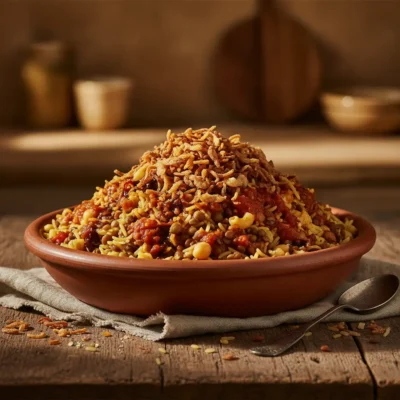
- واحد كشري لو سمحت (wahed koshari law samaht) — “One koshary, please.”
- بكام الفول؟ (bikam el-foul?) — “How much is the fava beans?”
- زيادة لو سمحت (ziyada law samaht) — “A bit extra, please.” (Egyptians say this constantly — it means “add more” and works for pretty much any food.)
Finishing up
- الحساب لو سمحت (el-hesab law samaht) — “The bill, please.”
- ده أكل جامد قوي (da akl gamed ‘awi) — “This food is really great.” (A compliment that’ll make any cook’s day.)
I’ll be straight with you — you don’t need perfect pronunciation here. Waiters and street vendors deal with foreigners mangling Arabic all day. What actually matters is trying. That effort alone earns you patience and sometimes an extra portion.
Ordering at a Cafe (Ahwa Culture)
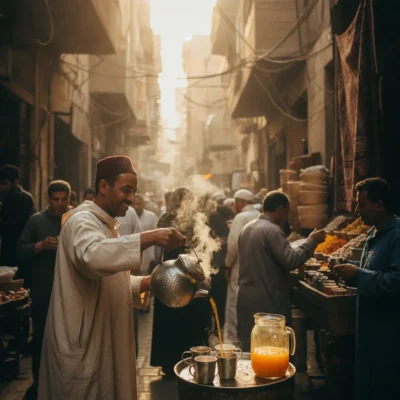
The ahwa — the classic Egyptian coffee shop — runs on its own rulebook. This isn’t Starbucks. Half the seating is on the sidewalk, the tea comes strong, and the shisha smoke is part of the deal whether you smoke or not.
- قهوة سادة (‘ahwa sada) — coffee with no sugar
- قهوة عالريحة (‘ahwa ‘al-riha) — coffee with a tiny bit of sugar
- قهوة مظبوط (‘ahwa mazbut) — medium sugar (the safest default order)
- شاي كشري (shay koshary) — strong tea, no milk
- عايز شيشة تفاح (‘ayez shisha tuffah) — “I want an apple-flavored shisha.” (Swap tuffah for whatever flavor you like.)
If you’re wandering Cairo and need to navigate your way to one of these cafes, or figure out a taxi fare on the way, our guide on getting around Cairo covers exactly that — directions, taxis, and the phrases that keep drivers honest.
Grocery Shopping and the Local Market (Souk)
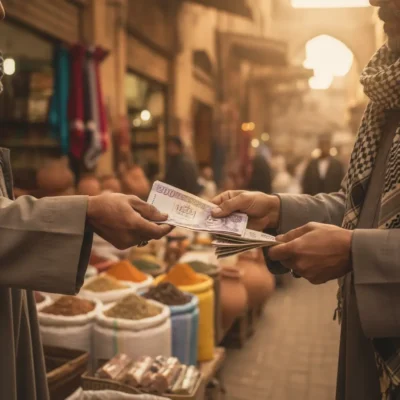
Grocery stores in Egypt range from small corner shops (bakala) to full supermarkets. The phrases barely change, but the vibe does.
- عندكم عيش طازة؟ (‘andokom ‘eish taza?) — “Do you have fresh bread?”
- فين الجبنة؟ (fein el-gebna?) — “Where’s the cheese?”
- عايز كيلو طماطم (‘ayez kilo tamatem) — “I want a kilo of tomatoes.”
- ده بتاريخ إيه؟ (da bi-tarikh eih?) — “What’s the expiry date on this?”
- ممكن كيس؟ (mumkin kees?) — “Can I get a bag?”
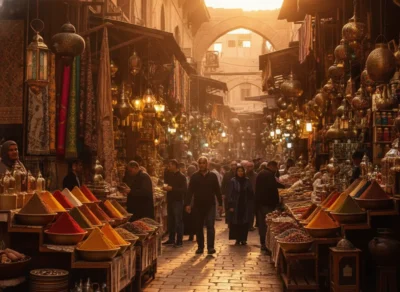
At an open-air souk, things get louder, friendlier, and way more personal. Vendors will call out to you, joke with you, sometimes hand you a free sample before you’ve even asked for anything.
- بكام الكيلو؟ (bikam el-kilo?) — “How much per kilo?”
- ده طازة؟ (da taza?) — “Is this fresh?”
- هاخد التلاتة دول (hakhod el-talata dol) — “I’ll take these three.”
Now Let’s Talk Bargaining — Because Nobody Explains This Right
Here’s the thing nobody tells you before you land in Egypt: bargaining isn’t rude. It’s expected. It’s basically a social ritual, and skipping it in the right places can actually feel strange to the seller.
But — and this is important — bargaining doesn’t happen everywhere. Know the difference or you’ll embarrass yourself.
Where you SHOULD bargain:
- Tourist markets (Khan el-Khalili, souvenir shops)
- Street vendors selling clothes, bags, souvenirs
- Taxis without a meter
- Some smaller, independent shops
Where you should NOT bargain:
- Supermarkets and chain stores (prices are fixed, full stop)
- Restaurants (the menu price is the price)
- Pharmacies
- Government offices, obviously
I’ve seen tourists try to haggle at a grocery store checkout. The cashier just looks confused. Don’t be that person.
How an Actual Bargaining Exchange Sounds
Let’s say you’re eyeing a leather bag in a market stall. Here’s roughly how it plays out.
You: بكام ده؟ (bikam da?) — “How much is this?” Seller: ثلاثمية جنيه (talatmiya geneh) — “300 pounds.” You: غالي قوي. ممكن أقل؟ (ghali ‘awi. mumkin a’al?) — “That’s too expensive. Can it be less?” Seller: طيب، مايتين وخمسين (tayeb, mitein wa khamsin) — “Okay, 250.” You: هاديلك مايتين (hadeelak mitein) — “I’ll give you 200.”
From there, you meet somewhere in the middle. Nobody expects you to win by half. A good rule of thumb: offer around 40-50% of the first price they quote, and expect to land somewhere around 65-75% of the original.
Useful bargaining phrases:
- غالي قوي (ghali ‘awi) — “Too expensive”
- أرخص شوية (arkhas shweya) — “A bit cheaper”
- ده آخر سعر؟ (da akher se’r?) — “Is that your final price?”
- خليها بـ… (khaleeha bi…) — “Make it…” (used right before you name your counter-offer)
- ماشي، اتفقنا (mashi, ittafa’na) — “Okay, deal.”
One more thing — bargaining works better with a smile than with a stern face. Egyptians treat it as friendly back-and-forth, almost like a game both sides enjoy. Get tense or rude about it and you’ll lose whatever goodwill got you the discount in the first place.
Real Questions People Actually Ask About This
“Is it disrespectful to bargain in Egypt?” No. In the right settings, it’s expected, and skipping it sometimes reads as odd rather than polite. Just don’t try it in supermarkets or restaurants.
“How do I know if a price is already fair?” You mostly learn by asking a few vendors the same question before buying. If three sellers quote wildly different prices for the same item, the first one was probably inflated for you specifically — which, again, isn’t personal. It’s just the opening move.
“What if I don’t understand the number they say back?” Ask them to write it down. عايز أشوفه مكتوب (‘ayez ashufu maktub) — “I want to see it written.” Nobody minds this. Numbers get lost fast when you’re new to the sounds.
“Do waiters expect a tip on top of the bill?” Yes, generally. A tip (called baksheesh in a broader sense) is standard, usually around 10%, sometimes handed directly rather than added to the check.
“Can I just point at food instead of speaking?” You can, and it works. But even a single phrase like ‘ayez da (“I want this”) changes the interaction completely. It signals you’re trying, not just gesturing.
A Few Mistakes to Avoid
Skip the textbook MSA here. Saying “urid” (أريد) instead of “‘ayez” (عايز) for “I want” will get you understood, technically, but it’ll sound like you walked out of a 1980s language cassette. Egyptians will still help you — they’re generally patient people — but you’ll sound noticeably stiff.
Also, don’t over-apologize before every question. A quick “low samaht” (please) is enough. You don’t need three sentences of preamble just to ask where the salt is.
And don’t assume every “no” bargaining response is final. Egyptians often say “لا، مينفعش” (la, ma-yinfa’sh — “no, it’s not possible”) as an opening move, not a closing one. Give it one more gentle push before walking away.
Building This Into Something You Actually Remember
Learning ten phrases the night before your flight gets you through one meal. It won’t stick. What actually works is small, consistent practice — a few minutes a day, spread over weeks, so the phrases move from “memorized” to “automatic.”
That’s exactly what we lay out in our daily Arabic study routine — a simple structure for fitting real Arabic practice into a normal, busy life. If you’re serious about sounding natural in markets, cafes, and restaurants rather than just surviving them, that routine is the next step.
And if you want to know exactly where you stand before diving in, our free Arabic level test tells you in a few minutes — no guessing, no wasted time on material that’s either too easy or way over your head.
The Bottom Line
Ordering food and shopping in Egypt isn’t about perfect grammar. It’s about a handful of practical phrases, a bit of confidence, and knowing when bargaining is a game versus when it’s just awkward. Learn ‘ayez, learn bikam, learn how to push back gently on a price, and you’re already ahead of most visitors.
Start small. Practice daily. And when you’re ready to build real fluency instead of just memorized phrases, our Colloquial Egyptian Arabic course is built exactly for this — real conversations, real dialect, taught by native Egyptian teachers who know exactly what you’ll actually need in the street, not just in a textbook.
Start your daily vocabulary habit today, and the next time someone hands you a menu in Cairo, you won’t be guessing.