Your Egyptian friend texts you “ta3ala bokra” and you have no idea what just happened.
You know some Egyptian Arabic. Maybe you’ve even had a few conversations. But the second someone sends you a WhatsApp message, it’s a different language. Numbers show up in the middle of words. Letters get dropped. Words get shortened until they barely look like the ones you studied.
Here’s the thing — chat Egyptian Arabic isn’t a separate dialect. It’s the same Egyptian Arabic you already know, just written the way people actually type it when they’re rushing between messages, not writing an essay. Once you crack the pattern, it stops being confusing and starts being kind of fun.
This article walks you through exactly how Egyptians text — the number code, the greetings, the one-word replies, the religious phrases that show up in almost every conversation, and a real example so you can see it all in context.
Two Ways Egyptians Actually Text
Before the phrases, you need to know there are two systems running at once.
1. Arabic script. Plenty of people type in actual Arabic letters, especially now that phone keyboards make it easy. تمام، عامل ايه، ماشي — normal Arabic script, just informal Egyptian words instead of formal ones.
2. Arabizi (Arabic chat alphabet). This is Arabic written with Latin letters and numbers, because for years Arabic keyboards weren’t standard on every phone. So people improvised. Sounds that don’t exist in English got a number instead. “3ala fein” instead of “على فين.” It stuck, and honestly, a lot of younger Egyptians still text this way out of habit, even with Arabic keyboards available.
You’ll see both in the same conversation, sometimes from the same person in two different messages. So you need to recognize both.
The Number Code: How Arabizi Actually Works
This is the part that throws learners off the most. It looks like math. It’s not. Each number represents an Arabic letter that doesn’t have a clean English equivalent — usually because the number’s shape kind of resembles the Arabic letter.
| Number | Arabic Letter | Sounds Like |
|---|---|---|
| 2 | ء (hamza) | a glottal stop, like the pause in “uh-oh” |
| 3 | ع (ain) | a deep throat sound, no English equivalent |
| 5 | خ (kha) | like the “ch” in the Scottish “loch” |
| 6 | ط (ta) | a heavier, thicker “t” |
| 7 | ح (ha) | a breathy “h” from the throat |
| 8 | ق (qaf) — sometimes | used less often, varies by person |
| 9 | ص (sad) | a heavier “s” |
So when someone texts “3arfa” they mean عارفة (I know, feminine). “7abibi” is حبيبي (my dear/babe). “2eh” is ايه (what). Once you see the pattern a few times, your brain starts auto-translating it without effort.
Honestly, don’t stress about memorizing this table cold. Read a few real chats and it clicks faster than any list ever will.
Common Greetings You’ll See First
These are the openers. Almost every chat starts with one of these, in script or Arabizi.
| Egyptian Arabic | Arabizi | Meaning |
|---|---|---|
| ازيك | ezayak / ezayek | How are you (m/f) |
| عامل ايه | 3amel eh | What’s up / how’s it going |
| صباح الفل | sabah el ful | Good morning (literally “morning of jasmine”) |
| مساء الفل | masa2 el ful | Good evening |
| اخبارك ايه | akhbarak eh | What’s your news / what’s new with you |
| فين من زمان | fein men zaman | Where have you been, it’s been a while |
If you want a deeper breakdown of tone and politeness in these kinds of exchanges, our guide on politeness in Egyptian Arabic covers how yes, no, please, and sorry actually get used day to day — which matters just as much in text as it does out loud.
The One-Word Replies That Run Every Conversation
Egyptian chats run on short confirmations. Nobody writes full sentences to say “okay.” Learn these five and you can already follow half a conversation.
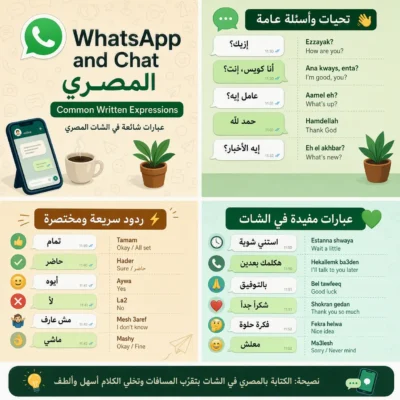
- تمام (tamam) — okay, fine, all good
- ماشي (mashi) — alright, sounds good (literally “walking,” as in “it’s moving along”)
- اوكيه / اوك (oki / ok) — yes, exactly what it looks like
- يلا (yalla) — let’s go, come on, hurry up
- خلاص (khalas) — done, that’s it, enough
You’ll see these stacked together constantly. Someone will send “تمام يلا خلاص” as one message meaning roughly “okay let’s go, that settles it.” It’s not extra words for style. It’s just how the rhythm of the conversation works.
Religious Phrases in Everyday Chats
Here’s something that surprises a lot of learners — religious expressions show up constantly in casual texting, even in conversations that have nothing to do with religion. This isn’t formality. It’s just built into how Egyptians speak and write.
- ان شاء الله (in sha2 Allah) — God willing. Used for literally any future plan. “See you tomorrow, in sha2 Allah.”
- الحمد لله (el hamdulillah) — thank God / praise God. The default answer to “how are you.”
- ربنا يسهل (rabbena yesahel) — may God make it easy. Said when someone’s dealing with something stressful.
- يعطيك العافية (ye3teek el 3afya) — may God give you strength. Often said after someone finishes a task or does you a favor.
- ماشاء الله (masha2 Allah) — an expression of appreciation or admiration, often after good news.
If you skip these, your Arabic will sound technically correct but oddly flat to a native speaker. They’re not optional extras — they’re the connective tissue of the conversation.
Chat Slang and Shortcuts You’ll See Constantly
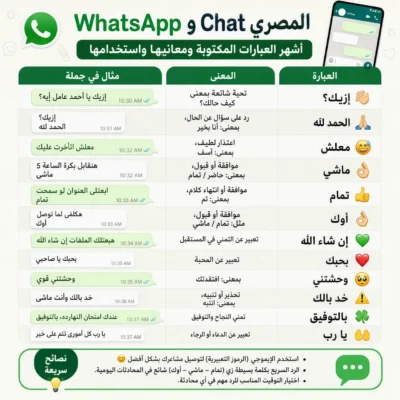
- لسه (lessa) — not yet, still. “لسه واصل” — I haven’t arrived yet.
- بجد (be jad) — seriously, for real. Used to add emphasis or ask “really?”
- ايوه (aywa) — yes (more casual and common than نعم in chat)
- معلش (ma3lesh) — it’s okay, never mind, sorry about that
- بص / بصي (boss / bossy) — look (m/f), used to grab attention before a point
- هو ايه (howa eh) — what is it / what’s going on
- ع فكرة (3ala fekra) — by the way
These are the words that make Egyptian text feel like Egyptian text instead of a textbook. None of them are formal. All of them are used dozens of times a day.
A Real WhatsApp Conversation, Broken Down
Here’s what an actual exchange looks like, with the translation right underneath each line.
Sara: عاملة ايه؟ فين من زمان 😅 (3amla eh? Fein men zaman) — How are you? Where have you been, it’s been ages!
You: الحمد لله تمام، شغل كتير الفترة دي (el hamdulillah tamam, shoghl keteer el fatra di) — All good, thank God, been really busy with work lately.
Sara: ماشي، تعالي بكرة نتقابل؟ (mashi, ta3ali bokra netqabel?) — Alright, want to meet up tomorrow?
You: ان شاء الله، هقولك على الميعاد بعدين (in sha2 Allah, ha2ollek 3al mi3ad ba3dein) — God willing, I’ll tell you the time later.
Sara: تمام يلا 🙏
Notice how much emotional lifting the short words do. There’s no long sentence anywhere. It’s fast, warm, and full of shared understanding — which is exactly the culture behind it. If you’re navigating this kind of daily back-and-forth as someone actually living in Egypt or dealing with Egyptian family and friends regularly, our post on survival Egyptian Arabic for expats living in Cairo pairs well with this one.
Mistakes Learners Make With Chat Egyptian
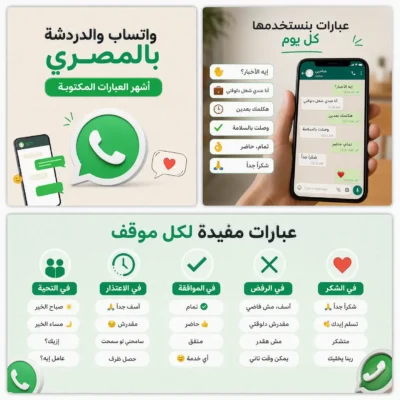
Trying to type in formal grammar. Chat Egyptian drops a lot of the grammatical markers you’d use in Modern Standard Arabic. Typing a full grammatically “correct” sentence in chat can come across stiff, almost like texting in legal language.
Ignoring the numbers. Some learners see “3” or “7” in a word and just skip it mentally, assuming it’s noise. It’s not. It’s carrying real pronunciation information. Skip it and you’ll misread half the message.
Overusing “please” and formal politeness. Chat is casual by nature. Piling on formal courtesy words where a native speaker would just say “تمام” can feel oddly distant, like you’re speaking to a stranger instead of a friend.
Assuming every Arabizi writer spells things the same way. They don’t. “Enty” and “enti” are both “you” (feminine). “3ayza” and “ayza” both mean “I want” (feminine). There’s no single official spelling — it’s phonetic and personal. Don’t get stuck trying to find “the correct way.” There isn’t one.
Questions People Actually Ask About This
Why do Egyptians use numbers when texting in Arabic instead of just typing in Arabic script? Mostly habit at this point, plus speed. Arabizi started because early phones didn’t support Arabic keyboards well. Even now that every phone does, a huge number of people grew up typing this way and it’s simply faster for them — the same reason some people never switch from typing “u” for “you” in English.
Is it rude or lazy to text using Arabizi instead of proper Arabic? Not at all. It’s the standard casual register for texting, the same way lowercase, no punctuation, and abbreviations are completely normal in an English text between friends. Using perfect MSA in a casual WhatsApp chat would actually feel more out of place.
What does “5” mean in Arabic chat? It represents خ, a raspy sound made in the back of the throat, similar to the “ch” in the Scottish word “loch.” You’ll see it in words like “5alas” (خلاص).
How do you say “ok” in Egyptian Arabic chat? “تمام” (tamam), “ماشي” (mashi), or just “اوك” (ok) — all three are used constantly and interchangeably.
Is chat Egyptian Arabic different from spoken Egyptian Arabic? Not really — it’s the same words and grammar, just written informally with shortcuts. If you can understand someone speaking casual Egyptian Arabic, you’re already halfway to reading their texts. The main new skill is decoding the Arabizi number system.
Where to Go From Here
Reading chat phrases is one skill. Actually holding a conversation — texted or spoken — is another. If you want to build real comfort with everyday Egyptian Arabic instead of just recognizing a few phrases, that’s exactly what our Colloquial Egyptian Arabic course is built for. You’ll learn the vocabulary, the grammar shortcuts, and the cultural context behind expressions like the ones in this article — with a native teacher correcting you in real time, not a chatbot guessing at your pronunciation.
Not sure where your Egyptian Arabic actually stands right now? Take the free Arabic placement test first. It takes a few minutes and tells you exactly where to start instead of guessing.
Curious what a course actually costs? Check the pricing page for current plans, or meet the people who’d be teaching you on the teachers page.
Want to keep going?
- 📖 Politeness in Egyptian Arabic: Yes, No, Please, Sorry →
- 🌍 Survival Egyptian Arabic for Expats Living in Cairo →
- 👪 Talking to In-Laws in Egyptian Arabic: Useful Family Phrases →
- 🎬 How to Understand Egyptian Arabic in Movies and TV Shows →
- 📿 Interested in reading and reciting instead of chatting? Our Quran Online Classes cover a completely different kind of written Arabic — the classical kind.