
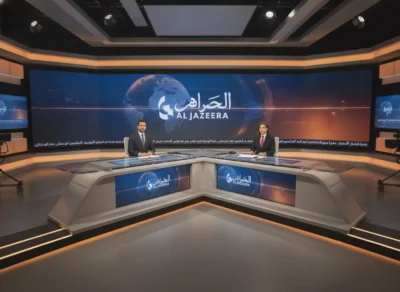
You turn on Al Jazeera. The presenter is speaking clearly, no slang, no mumbling. And you still can’t follow it.
That’s not a “you” problem. It happens to almost every Arabic learner at some point, even good ones. Here’s the thing — news Arabic is basically its own dialect. It’s not the Arabic you learn in a beginner textbook, and it’s definitely not the Arabic your friend from Cairo texts you. It’s a formal, fast, vocabulary-dense version of Modern Standard Arabic (MSA/Fusha), built for headlines and packed sentences. You can study Arabic for two years and still get lost in the first ten seconds of a bulletin. I’ve seen it happen constantly.
The good news — no pun intended — is that news Arabic is actually one of the more learnable “hard” skills in the language. It repeats itself. The same 200 or so words show up over and over: minister, source, according to, announced, security council, agreement, region. Once you know that vocabulary, a huge percentage of what confused you just clicks into place. This article walks through exactly how to get there.
Why News Arabic Feels Like a Different Language
Let’s be honest about why this is hard, instead of pretending it isn’t.
It’s formal MSA, spoken fast. Most learners meet MSA slowly, one sentence at a time, in a classroom or a textbook dialogue. News anchors don’t slow down for you. They talk at native speed, with zero pauses for you to process.
The sentences are long and stacked. A single news sentence might contain three or four clauses joined together — “the minister said that… following a meeting in which… according to sources close to…” By the time you reach the end, you’ve lost the beginning.
The vocabulary is specialized. Nobody teaches you the word for “ceasefire” or “summit” or “spokesperson” in a beginner course. But the news uses these words constantly, and if you don’t know them, the sentence collapses even if you understand every other word in it.
Word order flips on you. News Arabic leans heavily on verb-subject-object order and passive constructions — “it was announced that,” “it was agreed upon” — which don’t map onto how English sentences are built. If verb-first sentences already throw you off, our guide on nominal vs. verbal sentences in Arabic is worth reading before you dive into news content, because news Arabic is verbal-sentence-heavy almost by default.
None of this means you’re bad at Arabic. It means news Arabic is its own skill, and it needs its own practice.
What “News Arabic” Actually Is
Al Jazeera, BBC Arabic, France 24 Arabic, Sky News Arabia — they all use MSA. Not Egyptian, not Gulf dialect, not Levantine. Straight Fusha, the same grammatical system you’d find in a newspaper or a formal speech.
That’s actually good news for you. It means news Arabic is consistent. It doesn’t shift depending on which country the anchor is from, the way spoken dialects do. A minister in Morocco and a minister in Iraq get described with the exact same MSA vocabulary on air. Learn the system once, and it applies across the entire Arab news landscape.
If your MSA foundation still feels shaky, that’s the actual starting point — not the news itself. We wrote a full guide on the Modern Standard Arabic course we teach if you want to see what a structured path looks like before you throw yourself at live broadcasts.
The Core Vocabulary That Shows Up Constantly
I’ll be straight with you — you don’t need 5,000 words to follow the news. You need about 150 to 250 high-frequency words, and they repeat in almost every single bulletin. Here’s a starter set worth memorizing first.
People and roles
- وزير (wazeer) — minister
- رئيس (ra’ees) — president
- متحدث باسم (mutahaddith bi-ism) — spokesperson
- مصادر (masaadir) — sources
Actions news loves
- أعلن (a’lana) — announced
- صرّح (sarraha) — stated / declared
- أكد (akkada) — confirmed
- ندد (naddada) — condemned
- دعا إلى (da’aa ila) — called for
Politics and conflict
- اتفاق (ittifaaq) — agreement
- هدنة (hudna) — truce / ceasefire
- قمة (qimma) — summit
- أزمة (azma) — crisis
- مجلس الأمن (majlis al-amn) — security council
Connectors that glue sentences together
- وفقاً لـ (wafqan li) — according to
- بحسب (bihasab) — according to
- في أعقاب (fi a’qaab) — in the wake of
- من جهته (min jihatihi) — for his part
Notice something? Most of these are verbs and nouns, not grammar. That’s the whole trick. Once “أعلن” and “أكد” and “وفقاً لـ” are automatic, entire sentences stop feeling like a wall of noise, because you can hang the rest of the sentence off words you already recognize.
A Step-by-Step Method That Actually Works

Don’t just throw on Al Jazeera and hope for the best. That’s how people burn out after two days. Here’s a progression that builds comprehension without wrecking your motivation.
Step 1: Start with headlines, not broadcasts
Headlines are short, self-contained, and use the exact same vocabulary as full reports — just compressed. Read five headlines a day from Al Jazeera’s website before you ever touch video. You’ll start recognizing the recurring words fast, because headlines repeat structure constantly: “X announces Y,” “X condemns Y,” “X and Y reach agreement on Z.”
Step 2: Watch with Arabic subtitles on, not English
If the broadcast offers Arabic captions, use them. Reading along while listening trains your brain to connect the sound to the written word, which is exactly the skill news comprehension depends on. English subtitles feel comforting but they train a completely different skill — translation, not listening.
Step 3: Pick one segment and replay it
Choose a two-minute clip. Watch it once with no pausing, just to see what you catch. Then watch it again, pausing every sentence, writing down words you don’t know. Then watch it a third time with zero pausing. That third watch will feel noticeably easier than the first, and that gap is your progress made visible.
Step 4: Build a personal news vocabulary list
Every time a word repeats across two or three different clips, it’s worth learning properly. Politics vocabulary is smaller than people think — after about a month of doing this, you’ll notice the same 30 or 40 words showing up in nearly everything you watch.
Step 5: Read a transcript alongside the audio
Al Jazeera and BBC Arabic both publish written articles that mirror their broadcast topics. Read the article first, then watch the related segment. Comprehension jumps massively when you’ve already seen the vocabulary in writing.
If you want this turned into an actual daily habit instead of a one-off project, our 15-minute daily Arabic study routine is built around exactly this kind of short, consistent practice — you can swap in news clips once you’ve got the foundation from steps 1 through 3 down.
Why Al Jazeera Specifically Is a Good Starting Point
Honestly, a lot of learners assume Al Jazeera is one of the harder channels to start with, because of its reputation for dense political coverage. In practice, it’s actually a solid entry point for a few reasons.
Its anchors speak clear, formal MSA with minimal regional accent bleed — closer to “textbook” Fusha than some regional channels. It publishes huge amounts of written content that matches its broadcast topics, so you can cross-reference text and audio easily. And its topic range is broad enough that you’ll eventually hit subjects you already care about, which makes the vocabulary stick faster than random practice ever will.
BBC Arabic is a good second channel to add once Al Jazeera starts feeling manageable — slightly slower pacing, and useful for comparing how the same story gets covered differently.
And if Al Jazeera still feels too fast right now, that’s fine. Start somewhere gentler and work up:
- BBC Arabic — noticeably slower delivery, clearer enunciation, and a lot of learners find its anchors easier to parse than Al Jazeera’s in the first few weeks.
- France 24 Arabic — its segments run shorter, which means less time for a sentence to spiral before you lose the thread. Good for short, low-pressure listening reps.
- Radio Sawa — a radio station rather than TV, but useful precisely because of that. The vocabulary skews simpler and more conversational than the heavier political coverage on the big news channels, so it’s a gentler entry point if straight news feels overwhelming.
None of these are “beginner” channels exactly — they’re all still MSA at native speed. But the pacing and vocabulary load differ enough that starting with the easier ones and working toward Al Jazeera is a completely reasonable strategy, not a shortcut.
The Mistake Almost Everyone Makes
People treat news Arabic like a listening problem. It’s usually not. It’s a vocabulary problem wearing a listening costume.
Here’s what I mean — if you already knew the word “قمة” (summit), you’d hear it fine even at native speed, because your brain isn’t spending energy decoding an unfamiliar sound. The words that trip you up aren’t unclear because the anchor spoke too fast. They’re unclear because you’ve genuinely never learned them. That’s why vocabulary-first practice, not “just listen more,” is what actually moves the needle.
The second mistake is jumping straight into live, unscripted news — interviews, panel debates, press conferences — before headlines and prepared bulletins feel manageable. Scripted news is slower, cleaner, and more predictable in structure. Save the messy stuff for later.
Where Grammar Actually Matters Here
You don’t need to master every grammar rule in Arabic before you can follow the news. But a few structural patterns pull way more weight than others in this specific context:
- Verb-first sentences (VSO order). News Arabic almost always opens with the verb — “announced the minister that…” instead of “the minister announced that…” Once your ear expects this, sentences stop feeling backwards.
- Passive voice. “It was decided,” “it was reported” — this construction is everywhere in news writing because it’s the formal, distanced tone journalism uses.
- Long noun chains (idafa). News loves stacking nouns together — “minister of foreign affairs of the country,” strung as one connected phrase rather than broken up with prepositions the way English does it.
If sentence structure like this is still unfamiliar territory, it’s worth spending time on before news content, not during it. That’s exactly what our guide to Arabic sentence structure covers, and it’ll make the news suddenly feel a lot less like a foreign puzzle.
Real News Sentences, Broken Down

Vocabulary lists only get you so far. Here’s what actually happens when you put those words into real sentences — because this is the part where most learners freeze up, even with the vocabulary sitting right there in their memory.
أعلنت وزارة الصحة اليوم عن ارتفاع درجات الحرارة (“The Ministry of Health announced today a rise in temperatures.”)
Break it apart and it’s simple: أعلنت (announced) + وزارة الصحة (Ministry of Health) + اليوم (today) + عن ارتفاع درجات الحرارة (about a rise in temperatures). One verb, one subject, one topic. Notice the verb comes first — that’s the VSO pattern again, and once you expect it, this sentence takes about two seconds to parse instead of ten.
أكد المتحدث باسم الحكومة أن الاجتماع سيعقد غداً (“The government spokesperson confirmed that the meeting will be held tomorrow.”)
Same shape: أكد (confirmed) + المتحدث باسم الحكومة (the government spokesperson) + أن (that) + الاجتماع سيعقد غداً (the meeting will be held tomorrow). That little word أن is doing a lot of work — it’s the hinge that connects “who said it” to “what they said,” and it shows up constantly in reported speech. Once you spot أن, you know a second clause is coming, which means you can start predicting instead of scrambling to catch up.
That’s really the whole skill. News sentences look intimidating as one long block, but they almost always break down into: verb, who did it, and what they said or did. Train yourself to hunt for those three pieces first, and the rest of the sentence stops feeling like it’s ambushing you.
Realistic Timeline
People want a number, so here’s an honest one, not a marketing one.
If your MSA is already at a solid intermediate level — you can read simple articles and hold a conversation — expect roughly two to three months of dedicated practice (headlines daily, one clip a few times a week) before full bulletins start feeling like language instead of noise.
If you’re earlier than that, closer to beginner or early-intermediate, build your MSA foundation first. Trying to force news comprehension before your grammar and core vocabulary are solid is like trying to sprint before you can jog — it’s frustrating, and it teaches you to guess instead of understand. A structured course speeds this up considerably, because a teacher can correct the specific gaps that are slowing you down instead of you guessing at what to study next.
What comes after the 3-month mark?
So say you’ve put in the work — headlines daily, a few clips a week, the vocabulary is sticking. What’s next?
This is usually where full bulletins start feeling like language instead of noise. Prepared, scripted segments stop being a struggle. That’s genuinely worth pausing to notice, because it’s a real milestone, not a small one.
The next step from here is unscripted content — interviews, panel debates, press conferences. This is a different challenge entirely. People talk over each other, they trail off mid-sentence, they use filler words the way anyone does when they’re not reading from a script. It’s messier, slower to adjust to, and honestly a little humbling after the confidence scripted news gave you. Don’t be surprised if your comprehension dips for a couple of weeks when you make that switch — that’s normal, not a sign you’ve regressed.
Start with a single interview segment, one guest, one topic, rather than a multi-person panel. Build from there the same way you built with headlines: repeat listens, write down what trips you up, move forward once it stops tripping you up. The method doesn’t change. Only the material gets harder.
FAQ
Do I need to know a dialect to understand Arabic news? No. News broadcasts use MSA, not dialect. You can understand Al Jazeera fluently while still struggling with everyday Egyptian or Levantine conversation — they’re genuinely separate skills.
Why can I read Arabic news articles but not follow the spoken broadcast? Speed and sound recognition, mostly. Reading gives you unlimited time to process each word. Listening doesn’t. The fix is repeated listening practice on short clips, not more reading.
Is Al Jazeera harder to understand than other Arabic news channels? Not really — if anything, its anchors tend to speak clearer, more formal MSA than some regional alternatives, which makes it a reasonable place to start rather than something to avoid.
How many words do I actually need to follow most news broadcasts? Somewhere around 200 to 300 high-frequency news words gets you a long way. It’s less about total vocabulary size and more about knowing the specific words journalism uses constantly.
Should I use English subtitles to help at first? Use them sparingly, if at all. They train translation, not comprehension. Arabic subtitles or transcripts train the skill you’re actually trying to build.
Where to Go From Here
News Arabic isn’t a separate language you have to learn from scratch. It’s your existing MSA, applied to a specific, repetitive vocabulary set, spoken at full speed. Build the core news vocabulary, get comfortable with verb-first sentences, and practice with short clips before full bulletins — and Al Jazeera stops being a wall of noise and starts being genuinely useful content.
If your MSA foundation needs work before any of this clicks, that’s exactly what our Modern Standard Arabic course is built for — one-on-one lessons with native Egyptian teachers, working from wherever your level actually is. Not sure where that is? Take the free Arabic placement test first, or check the pricing page to see what fits your schedule.
Develop your understanding of media Arabic — start with a free trial lesson in Modern Standard Arabic.