

If you’ve been staring at Arabic sentences wondering why some start with a noun and some start with a verb — and why it seems to change the whole meaning — you’re not losing your mind. This is one of the first real grammar walls beginners hit. And honestly, once someone explains it to you in plain English (not a grammar textbook), it clicks in about five minutes.
So let’s do that.
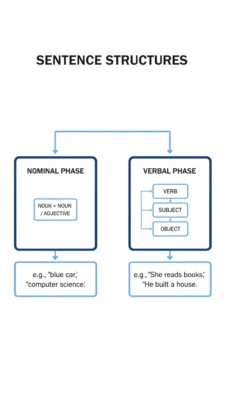
Arabic sentences come in two flavors: nominal (جملة اسمية) and verbal (جملة فعلية). That’s it. Every single Arabic sentence you’ll ever read falls into one of these two buckets. No third option. No exceptions hiding around the corner.
Here’s the thing — English doesn’t really make this distinction. We just have sentences. Arabic actually cares about what kind of sentence you’re building, and that choice changes word order, verb placement, and sometimes even the vibe of what you’re saying. Once you get this, a huge chunk of “why is Arabic word order so weird” confusion just disappears.
What Is a Nominal Sentence (الجملة الاسمية)?
A nominal sentence starts with a noun. Not a verb. A noun, a pronoun, or a name.
That’s the whole rule. If the sentence opens with something that isn’t a verb, it’s nominal.
Structure: Subject (مبتدأ) + Predicate (خبر)
Example: الكتابُ جميلٌ (al-kitābu jamīlun) “The book is beautiful.”
Notice something? There’s no verb “is” in there. Arabic doesn’t need one in the present tense. “الكتاب” (the book) is your subject, “جميل” (beautiful) is your predicate, and Arabic just… connects them. No linking verb required. This trips up a lot of English speakers early on because we’re trained to expect a “to be” verb everywhere.
Another one:
أنا طالبٌ (anā ṭālibun) “I am a student.”
Again — no verb. Just “I” + “a student.” Arabic assumes the “am” is understood.
This is one of the reasons nominal sentences are often the first structure taught to beginners. There’s less moving parts. You’re not conjugating anything. You’re just placing two pieces side by side.
What Is a Verbal Sentence (الجملة الفعلية)?
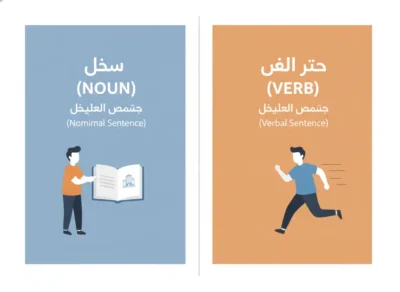
A verbal sentence starts with a verb. That’s the rule, mirror image of the first one.
Structure: Verb (فعل) + Subject (فاعل) + Object (مفعول به, if there is one)
Example: ذَهَبَ الولدُ إلى المدرسةِ (dhahaba al-waladu ilā al-madrasati) “The boy went to school.”
See the order? Verb first (“went”), then the subject (“the boy”), then the rest. If you tried to translate this word-for-word into English you’d get “Went the boy to school,” which sounds like something out of a fantasy novel. But in Arabic, that’s completely normal, everyday sentence structure.
Here’s another:
تَكْتُبُ الطالبةُ الدرسَ (taktubu al-ṭālibatu ad-darsa) “The student is writing the lesson.”
Verb first again (“is writing”), then who’s doing it (“the student”), then what’s being written (“the lesson”).
I’ll be straight with you — this verb-first order is probably the single biggest culprit behind that “wait, I read the whole sentence and I’m still not sure what’s happening” feeling beginners describe. Your brain wants the subject first because that’s how English works. Arabic just doesn’t care what your brain wants.
The Core Difference, In One Sentence
Nominal sentences answer “what is this thing like / what is this thing?” Verbal sentences answer “what is happening / what did someone do?”
If you’re describing a state, identity, or quality — nominal. If you’re describing an action — verbal.
Side-by-Side Comparison
| Feature | Nominal Sentence (جملة اسمية) | Verbal Sentence (جملة فعلية) |
|---|---|---|
| Starts with | Noun, pronoun, or name | Verb |
| Basic structure | Subject + Predicate | Verb + Subject + Object |
| Main components | مبتدأ (mubtada’) + خبر (khabar) | فعل (fi’l) + فاعل (fā’il) |
| Present tense “to be” | Not needed | Not needed |
| Typical use | Descriptions, identity, ongoing states | Actions, events, things that happened or are happening |
| Feels like (in English) | “The house is big.” | “The man ran to the store.” |
Why This Actually Matters (Not Just Grammar for Grammar’s Sake)
Here’s where a lot of grammar explanations lose people — they explain the rule and never explain why you’d care.
You’ll care the moment you try to read a real Arabic news article, a WhatsApp message from a friend, or even a children’s book, and half the sentences feel backwards. Once you can instantly spot “oh, this sentence opened with a verb, so I should expect the subject right after it” — reading gets dramatically faster. You stop re-reading the same line three times.
It also matters for writing. If you write a sentence starting with a noun when you meant to describe an action, native speakers will still understand you, usually. But it can sound off, like saying “The dog, it ran” instead of just “The dog ran.” Technically fine. Just not how it’s naturally said.
Common Questions Learners Actually Ask About This
“Does word order in Arabic actually matter, or can I just put things wherever?”
It matters more than you’d think, especially for beginners. Classical Arabic has case endings that theoretically let you shuffle word order without losing meaning — that’s true. But in practice, and especially in Modern Standard Arabic as it’s actually written and spoken today, verb-first order for verbal sentences and subject-first order for nominal sentences is the standard you’ll see almost everywhere. Learn the standard pattern first. Worry about flexible word order later, once you actually know what you’re being flexible with.
“Can a sentence switch from nominal to verbal halfway through?”
Sort of, and this confuses people. What actually happens is a nominal sentence can contain a verbal sentence inside its predicate. For example: “الرجلُ يذهبُ إلى العمل” (the man, he-goes to work) is technically nominal because it starts with a noun (“the man”), but the predicate itself (“يذهب إلى العمل”) is a mini verbal sentence describing what he does. Arabic grammar allows this nesting. It’s not a rule violation — it’s just layered structure. You’ll get comfortable spotting this with exposure.
“Why does the verb sometimes agree with the subject and sometimes not?”
This is a real pattern, not randomness. In verbal sentences, when the verb comes before the subject (the normal order), the verb only agrees in gender — not number. So “went the boys” uses the singular masculine verb form even though “boys” is plural. But if the subject comes before the verb (which happens in some structures), the verb agrees fully in both gender and number. This one genuinely trips up intermediate learners because it looks inconsistent until you know the rule.
“Is one type more ‘correct’ or more advanced than the other?”
No. They’re not a beginner-versus-advanced thing. They’re just two tools for two different jobs. You’ll use both constantly, often in the same paragraph, sometimes in the same sentence. Fluent Arabic speakers switch between them without thinking about it, the same way you don’t consciously choose between “is” and “runs” in English.
A Few More Real Examples to Lock This In

Nominal: البيتُ كبيرٌ — The house is big. هي مدرّسةٌ — She is a teacher. القطة تحت الطاولة — The cat is under the table.
Verbal: أكلَ الطفلُ التفاحةَ — The child ate the apple. تسافرُ العائلةُ غداً — The family is traveling tomorrow. قرأتُ الكتابَ أمس — I read the book yesterday.
Read through those a couple times out loud. Not silently. Out loud. Your ear needs to start recognizing the rhythm of verb-first versus noun-first just as much as your eyes need to recognize it on the page. That’s honestly how this stuff actually sticks — not from staring at a table, but from hearing and saying enough examples that the pattern becomes automatic.
The Mistake Most Learners Make With This Topic
They memorize the definitions and never actually practice building sentences with them. You can recite “nominal starts with a noun, verbal starts with a verb” perfectly and still freeze up the first time you try to write “I went to the market” in Arabic, because knowing the rule and applying it under pressure are two completely different skills.
The fix isn’t more explanation. You’ve got the explanation now. The fix is reps. Take five simple English sentences — a mix of “is/are” statements and action sentences — and try converting them into Arabic, deciding first whether each one should be nominal or verbal before you even think about vocabulary. Do that daily for a week and this stops being a “rule you remember” and becomes a “thing you just do.”
If you want a simple way to build that kind of daily practice into your schedule without it eating your whole evening, our 15-minute daily Arabic study routine is built around exactly this kind of short, consistent grammar practice — including sentence structure work like this.
Where This Fits Into the Bigger Picture
Nominal and verbal sentences aren’t an isolated topic you learn once and move past. They’re the skeleton that everything else in Arabic grammar hangs off of — verb conjugation, case endings, agreement rules, question formation, all of it assumes you already know which type of sentence you’re dealing with. If you want the fuller picture of how grammar and writing connect from the very first letter up through building real sentences, our guide on Arabic grammar and writing walks through that whole progression.
And if you’re just starting out and haven’t built your first nominal sentences yet, our complete starting guide for Arabic beginners covers exactly where sentence structure fits into your first few weeks of study.
Not sure whether you’re actually ready for verbal sentence structures yet, or if you should keep drilling nominal ones a bit longer? That’s exactly what a free Arabic placement test is for. Ten minutes, and you’ll know precisely where your grammar foundation actually stands instead of guessing.
The Bottom Line
Nominal sentences start with a noun and describe what something is. Verbal sentences start with a verb and describe what something does. That distinction alone will fix more of your reading confusion than almost any other single grammar rule in Arabic. It’s not complicated. It just needs to actually be explained instead of assumed — which, honestly, most textbooks skip past way too fast.
Get comfortable spotting the two, practice building both, and you’ll notice real Arabic text — news, books, messages from friends — starts making a lot more sense, a lot faster than you expected.
Want to build this into a full, structured understanding of Modern Standard Arabic grammar with a real teacher checking your work? افهم البنية الأساسية — start with our Modern Standard Arabic course and see exactly where you stand with a plan that fits your schedule.