If you’ve started learning Modern Standard Arabic, you’ve probably already bumped into this wall: you know some vocabulary, you can read a few words, and then someone asks you to say “I study” or “she writes” — and you freeze.
Here’s the thing. Present tense verbs (المضارع) are where MSA grammar actually starts making sense. Once you get this pattern, it clicks for almost every verb in the language. I’m not exaggerating. This one grammar rule unlocks hundreds of sentences.
So let’s go through it properly. No shortcuts, no oversimplified “just memorize this list” advice. You’re going to understand why the verb changes shape, not just that it does.
What Does “Present Tense” Even Mean in Arabic?
In English, present tense is simple. “I write.” “She writes.” One word, small tweak, done.
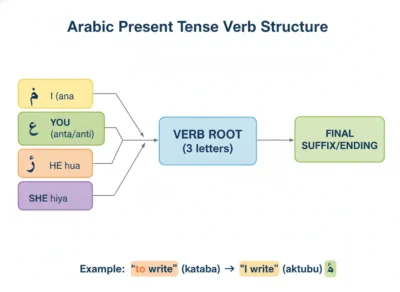
Arabic works differently. The present tense verb — called المضارع (al-muḍāriʿ) — is built from a three-letter root, and then you wrap that root in a pattern depending on who’s doing the action.
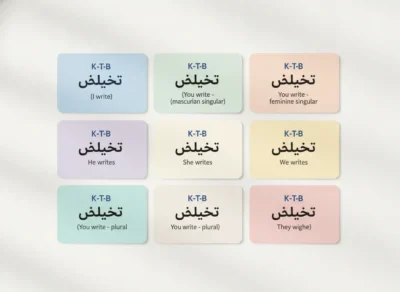
Take the root ك-ت-ب (k-t-b), which carries the meaning of “writing.” From this one root, you get:
- أَكْتُبُ (aktubu) — I write
- تَكْتُبُ (taktubu) — you write (masculine)
- تَكْتُبِينَ (taktubīna) — you write (feminine)
- يَكْتُبُ (yaktubu) — he writes
- تَكْتُبُ (taktubu) — she writes
See what happened? The root ك-ت-ب never moved. What changed is the letters wrapped around it — specifically, the prefix at the front. That prefix is the whole secret of MSA present tense. Learn it once, and you can conjugate almost any regular verb in the language.
The Prefix Rule (This Is 80% of the Work)
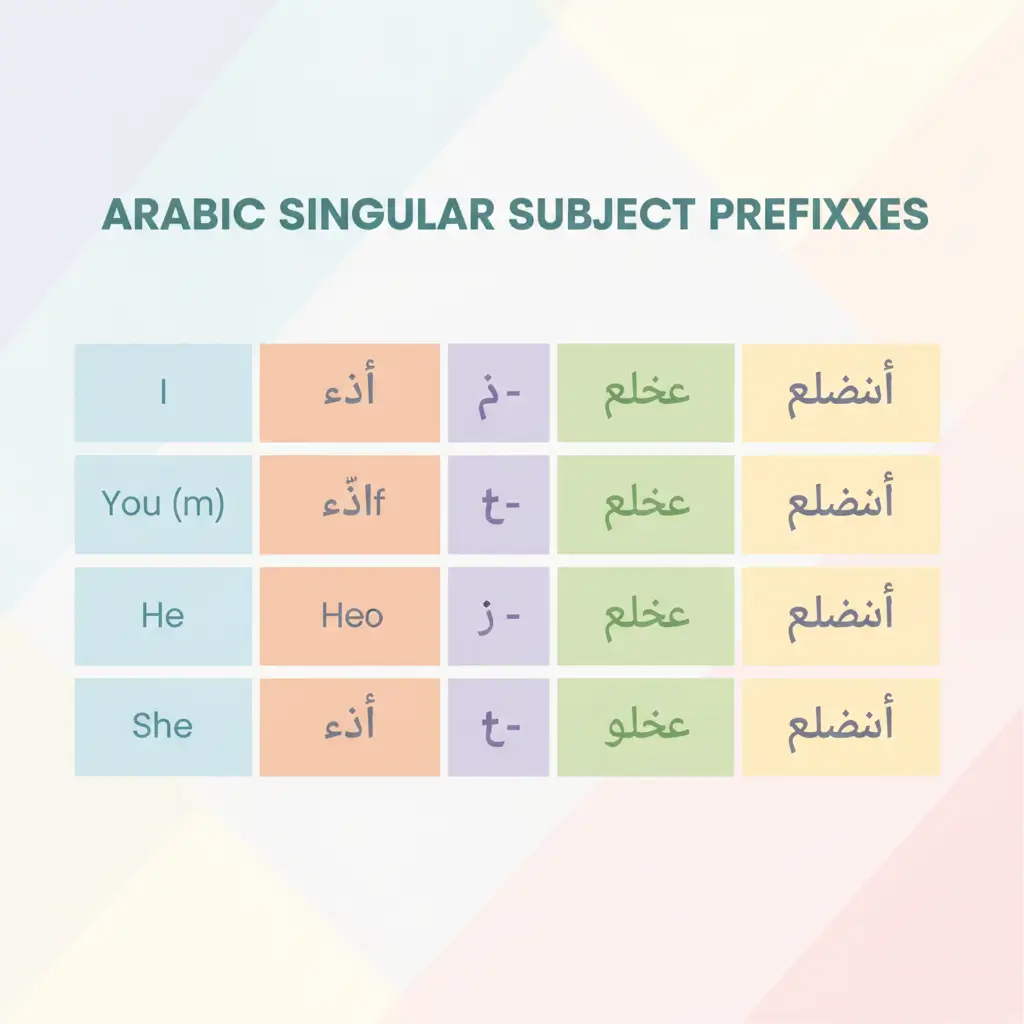
Every present tense verb in MSA gets one of four prefix letters, based on who’s speaking or being spoken about:
| Prefix | Used for |
|---|---|
| أ (a) | I |
| ن (n) | We |
| ت (t) | You (all forms), She |
| ي (y) | He, They |
Honestly, if you memorize just this table, you’ve done the hardest part. Everything else is detail on top of it.
Full Present Tense Conjugation Table
Let’s build the complete picture using the verb يَكْتُبُ (to write), root ك-ت-ب.
| Pronoun | Arabic Verb | Transliteration | Meaning |
|---|---|---|---|
| أنا (I) | أَكْتُبُ | aktubu | I write |
| أنتَ (you, m.) | تَكْتُبُ | taktubu | You write |
| أنتِ (you, f.) | تَكْتُبِينَ | taktubīna | You write |
| هو (he) | يَكْتُبُ | yaktubu | He writes |
| هي (she) | تَكْتُبُ | taktubu | She writes |
| نحن (we) | نَكْتُبُ | naktubu | We write |
| أنتم (you, pl. m.) | تَكْتُبُونَ | taktubūna | You (all) write |
| هم (they, m.) | يَكْتُبُونَ | yaktubūna | They write |
| هن (they, f.) | يَكْتُبْنَ | yaktubna | They write |
A few honest notes here, because I don’t want to hand you a clean table and pretend it’s the whole story:
- Notice “you” (masculine singular) and “she” look identical: تَكْتُبُ. Context tells you which one is meant. This trips up a lot of beginners in their first month, and that’s completely normal.
- The feminine “you” form adds ين at the end. The masculine plural adds ون. These endings matter — drop them and a native speaker will still understand you, but it’ll sound off, kind of like saying “he go” in English.
- هن (they, feminine) is the one form most courses skip teaching properly. It ends in ن with no extra vowel sound. Don’t ignore it just because it’s less common in textbooks — you’ll hear it in the news and in formal writing.
Trying It With Another Verb
One table isn’t enough to build real understanding. Let’s do it again with a different root so the pattern actually sinks in: د-ر-س (d-r-s), meaning “to study.”
- أَدْرُسُ (adrusu) — I study
- تَدْرُسُ (tadrusu) — you study (m.) / she studies
- تَدْرُسِينَ (tadrusīna) — you study (f.)
- يَدْرُسُ (yadrusu) — he studies
- نَدْرُسُ (nadrusu) — we study
Same prefixes. Same pattern. Different root, different meaning. This is why Arabic grammar rewards you for learning the system instead of memorizing individual verbs one by one. Once the pattern is automatic, new verbs stop being scary.
If you want to see this play out in a full sentence, one of our students’ favorite early sentences is:
أَنَا أَدْرُسُ الْعَرَبِيَّةَ. (Anā adrusu al-ʿarabiyyah.) — I am studying Arabic.
Simple structure. Subject, then verb, then object. That’s the backbone of most MSA sentences you’ll write as a beginner.
Negating the Present Tense
You’ll need this fast, because “I don’t understand” comes up in real conversation a lot sooner than most textbooks admit.
To negate a present tense verb in MSA, you place لا (lā) directly before it:
- لا أَفْهَمُ (lā afhamu) — I don’t understand
- لا يَكْتُبُ (lā yaktubu) — He doesn’t write
- لا نَدْرُسُ (lā nadrusu) — We don’t study
That’s it. No conjugation change, no extra rule. لا goes in front, and the verb stays exactly as it was. This is one of the rare places in Arabic grammar where the rule really is that simple.
The Mistakes Beginners Make (And Why They Happen)
I’ll be straight with you — almost every beginner makes the same three mistakes with present tense verbs. Here’s what they are and why they happen.
Mistake 1: Forgetting the prefix changes with gender. Students often learn أَكْتُبُ for “I write” and then try to reuse that same form for everyone. But the prefix has to shift — ت for “you” and “she,” ي for “he” and “they.” Skipping this is the single most common error I see.
Mistake 2: Dropping the final vowel sounds. Those short vowels at the end (like the ُ in يَكْتُبُ) carry grammatical meaning. Learners often skip them because they’re small and easy to miss when reading. But they’re part of correct MSA. If your goal is formal reading, writing, or speaking, don’t treat them as optional extras.
Mistake 3: Mixing up “you” (masc.) and “she.” As I mentioned earlier, these two forms look the same in writing: تَكْتُبُ. This isn’t a mistake you’re making — it’s just genuinely ambiguous out of context, and even native learners rely on context clues. Don’t stress over it. Just know it’s normal.
How Long Does This Actually Take to Learn?
Honestly? If you already know your Arabic alphabet and basic vocabulary, most students get comfortable with regular present tense verbs within 2 to 3 weeks of consistent practice — not mastery, but comfortable enough to build real sentences without stopping to think every time.
Irregular verbs (the ones with a weak letter like و or ي in the root) take longer, because the pattern shifts slightly. But don’t worry about those yet. Get the regular pattern solid first. It’s the foundation everything else builds on.
If you’re looking for a realistic study plan instead of guessing how much time to spend, our 15-minute daily Arabic study routine walks through exactly when grammar like this should enter your schedule — usually around month two, right after you’ve got the alphabet and basic sentence structure down.
Present Tense vs. Past Tense — A Quick Note
You don’t need to master past tense today, but it helps to know the difference exists. Past tense verbs in MSA (الماضي) use suffixes attached to the end of the root, not prefixes at the front. So كَتَبَ means “he wrote,” while يَكْتُبُ means “he writes.” Different structure entirely. We’ll cover past tense verbs in a separate guide — for now, keep your focus on present tense until it’s automatic.
For the bigger picture of how verb tenses, sentence structure, and writing all connect in MSA, our complete Arabic grammar and writing guide is a good next stop once you’ve got this lesson down.
Frequently Asked Questions
Is MSA present tense the same across all Arab countries? Yes. This is one of the advantages of learning MSA — the present tense conjugation rules are standardized and understood the same way whether you’re reading a newspaper in Cairo, Riyadh, or Beirut. Spoken dialects simplify or shorten these forms, but the MSA structure itself doesn’t change by country.
Do I need to learn every pronoun form, or just the common ones? Start with أنا (I), أنتَ/أنتِ (you), هو/هي (he/she), and نحن (we). Those five cover the vast majority of everyday speech and writing. Add the plural forms once the singular ones feel automatic — trying to learn all nine at once tends to slow people down rather than speed them up.
Why does the verb sometimes start with a different letter than I expect? That usually means you’re looking at an irregular verb — one where the root contains a weak letter (و, ي, or ء) that shifts the pattern. Regular verbs like كتب and درس follow the rules in this guide exactly. Irregular ones need their own lesson, which we’ll cover separately.
How is this different from Egyptian Arabic present tense? Egyptian Arabic (and most spoken dialects) drop many of the short vowel endings and often add a بـ (bi) prefix before the verb — so “I write” becomes باكتب (baktub) instead of أَكْتُبُ. If you’re comparing the two, our MSA vs. Egyptian Arabic guide breaks down exactly where they overlap and where they split.
What’s the best way to practice this without a textbook? Pick five verbs. Conjugate each one across all the pronoun forms out loud, every day, for a week. Then start using them in your own sentences about your actual day — “I study,” “I write,” “I understand.” Active use beats passive review every time.
Where to Go From Here
Present tense is the piece that turns vocabulary into actual language. Once you can say what you’re doing right now — studying, writing, learning, understanding — full conversations start feeling within reach instead of distant.
If you’re not sure exactly where you stand, our free Arabic placement test takes about five minutes and tells you precisely what to study next, instead of guessing.
And if you’d rather have someone correct your conjugation in real time instead of second-guessing yourself alone, that’s exactly what our MSA classes are built for.
ابدأ دراسة الأفعال → Modern Standard Arabic