If you’ve been staring at Arabic verb tables and feeling your brain melt a little, I get it. I’ve watched hundreds of students hit the same wall around week 6 or 7 — right when the alphabet starts feeling comfortable and then, bam, verbs show up and everything falls apart again.
Here’s the thing: Arabic past tense verbs are actually one of the easier parts of the grammar. I know that sounds like a lie. It’s not. The present tense is where things get messy, with prefixes and jussive moods and all kinds of headaches. The past tense (الماضي — al-māḍī) is mostly just… adding an ending. That’s it.
Let me walk you through it the way I’d explain it in a real lesson, not the way a textbook would.
Why Arabic Past Tense Feels Harder Than It Is
Most learners come into Arabic already carrying English baggage. In English, past tense means “-ed” at the end (mostly), and you’re done. Simple.
In Arabic, past tense means the verb changes shape depending on who did the action. Not just the pronoun — the gender, and whether it’s one person, two people, or a group. So instead of one form of “wrote” for every subject, you get ten or eleven different forms.
That’s the part that scares people. But once you see the pattern, it clicks fast. I promise you’re not learning ten random words. You’re learning one root and a handful of endings.
Start With the Root — Everything Comes From There
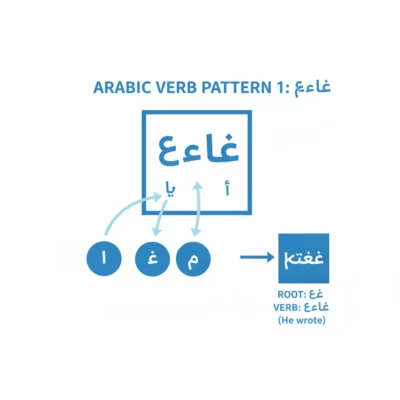
Almost every Arabic verb is built on a root of three consonants. Take the root ك ت ب (k-t-b). That root carries the idea of “writing.” From it you get:
- كَتَبَ (kataba) — he wrote
- كِتَاب (kitāb) — book
- كَاتِب (kātib) — writer
- مَكْتَب (maktab) — office/desk
Once you understand this, verb conjugation stops looking like memorization and starts looking like pattern recognition. You’re not learning new words every time. You’re recognizing the same three letters wearing different clothes.
For the past tense specifically, the “he” form of the verb — كَتَبَ (kataba) — is your base. Dictionaries list verbs this way for a reason. Every other past tense form is built by adding a suffix to that base.
Want the fuller picture of how Sarf (word patterns) and Nahw (sentence grammar) fit together in MSA? We cover that in more depth in our guide to Arabic grammar and writing, which is worth reading alongside this one.
The One Rule That Makes Past Tense Click
Here it is, the whole secret: past tense verbs in Arabic take suffixes, not prefixes.
Present tense verbs add letters to the front (that’s why you see أ، ن، ي، ت at the start of present tense verbs). Past tense verbs only change at the end. Once that separation is clear in your head, you’ll stop mixing the two tenses up — which, honestly, is the single most common mistake I see in early lessons.
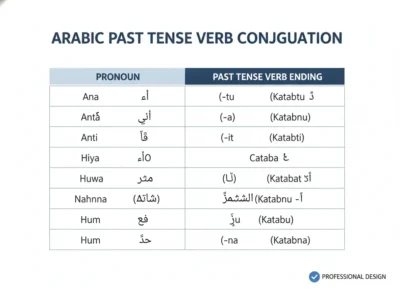
Let’s look at the full conjugation of كَتَبَ (kataba — “to write”) in the past tense.
Full Past Tense Conjugation Table (كَتَبَ — to write)
| Pronoun | Arabic | Transliteration | Meaning |
|---|---|---|---|
| هو (he) | كَتَبَ | kataba | he wrote |
| هي (she) | كَتَبَتْ | katabat | she wrote |
| أنتَ (you, m.) | كَتَبْتَ | katabta | you wrote (m.) |
| أنتِ (you, f.) | كَتَبْتِ | katabti | you wrote (f.) |
| أنا (I) | كَتَبْتُ | katabtu | I wrote |
| هم (they, m.) | كَتَبُوا | katabū | they wrote (m.) |
| هنّ (they, f.) | كَتَبْنَ | katabna | they wrote (f.) |
| أنتم (you all, m.) | كَتَبْتُمْ | katabtum | you all wrote (m.) |
| أنتنّ (you all, f.) | كَتَبْتُنَّ | katabtunna | you all wrote (f.) |
| نحن (we) | كَتَبْنَا | katabnā | we wrote |
| هما (they two) | كَتَبَا | katabā | they two wrote |
Look at what’s actually happening here. The root ك ت ب never moves. Only the tail end changes. That’s the whole game.
A tip that saves people a lot of pain: learn the “I,” “you (m.),” and “he/she” forms first. Those cover probably 80% of what you’ll actually say in conversation and writing in your first few months. The dual forms (هما) and the plural feminine forms (هنّ، أنتنّ) can wait — they show up far less often, especially outside of very formal writing.
Negating the Past Tense (Where People Actually Get Stuck)
Honestly, this is the part that trips up more students than the conjugation table itself.
There are two ways to say something didn’t happen in Arabic, and they don’t work the same way.
Option 1 — ما + past tense
You just put ما in front of the verb, and nothing else changes.
- ما كَتَبَ (mā kataba) — he did not write
- ما ذَهَبْتُ (mā dhahabtu) — I did not go
This is the simple, direct method. It works and it’s grammatically correct in MSA.
Option 2 — لم + jussive present tense
This one confuses people because it looks like present tense but means past tense. You take لم and follow it with the present tense verb — but in the jussive mood, which usually means dropping the final vowel or ending.
- لَمْ يَكْتُبْ (lam yaktub) — he did not write
- لَمْ أَذْهَبْ (lam adhhab) — I did not go
Here’s the thing nobody explains clearly: لم + jussive is actually the more common and more formal way to negate the past tense in written MSA — newspapers, books, formal speech. ما + past tense is more casual and closer to how it’s used in speech and simpler writing. Neither one is “wrong.” But if you’re reading news articles or formal texts, you’ll see لم constantly, so don’t panic when a “past tense” sentence suddenly looks like it’s using a present tense verb. That’s normal. That’s just how negation works here.
Gender Agreement Isn’t Optional
One thing that catches English speakers off guard: the verb has to match the gender of the subject, every single time, even with names and even with “it.”
- الْوَلَدُ كَتَبَ (al-waladu kataba) — the boy wrote
- الْبِنْتُ كَتَبَتْ (al-bintu katabat) — the girl wrote
Notice the extra ت on the end when the subject is feminine. That little ت is doing a lot of work. Miss it, and a native speaker will still understand you, but it’ll sound off — kind of like saying “she go to the store” in English. Understandable, but clearly not quite right.
This also applies to non-human plural nouns, which get treated as feminine singular in Arabic grammar, no matter how many items there are. So “the books arrived” becomes وَصَلَتِ الْكُتُبُ (waṣalati al-kutubu) — using the feminine singular verb form, even though كتب (books) is plural. This trips up almost every intermediate learner at least once. It’s not a mistake in the sentence. It’s just how Arabic treats non-human plurals.
Weak Verbs: The Part You Can Ignore For Now
I’ll be straight with you — there’s a whole category of “weak verbs” (verbs with و or ي or a doubled letter in the root) that conjugate a little differently in the past tense. Words like قَالَ (qāla — he said) or رَدَّ (radda — he replied) don’t follow the exact same pattern as كَتَبَ.
You don’t need to master these on day one. Learn the regular pattern solid first. Weak verbs are just exceptions layered on top of a rule you already know — they’re a lot easier to absorb once the base pattern is automatic. Trying to learn both at once is how people burn out and quit in month two.
Practice Sentences You Can Actually Use
Reading a rule is one thing. Using it is another. Try building these out loud before you check the answers:
- I studied Arabic yesterday. → دَرَسْتُ الْعَرَبِيَّةَ أَمْسِ (darastu al-ʿarabiyyata amsi)
- She traveled to Cairo. → سَافَرَتْ إِلَى الْقَاهِرَةِ (sāfarat ilā al-Qāhirah)
- We ate at home. → أَكَلْنَا فِي الْبَيْتِ (akalnā fī al-bayt)
- They (m.) didn’t understand the lesson. → لَمْ يَفْهَمُوا الدَّرْسَ (lam yafhamū al-darsa)
If you can build sentences like these without stopping to think for thirty seconds, you’re in good shape. If you’re still translating word by word in your head, that’s fine too — that’s just where you are right now, and it’s completely normal at this stage.
Real Questions People Ask About This (And Straight Answers)
Does Arabic only have one past tense, like English? Basically, yes. Unlike English, which has “I wrote,” “I have written,” and “I had written,” MSA mostly uses one past tense form and relies on context, time words, or extra particles (like قَدْ) to show more nuance. It’s actually simpler than English here, even though it doesn’t feel that way at first.
Do I really need to memorize eleven conjugation forms per verb? Not right away. Learn “I,” “you” (both genders), “he,” “she,” “we,” and “they.” That covers nearly everything you’ll say or write as a beginner and intermediate student. The dual forms and formal plural feminine forms can come later.
Why does the verb sometimes come before the subject in Arabic? Because MSA allows verb-first sentences (الجملة الفعلية) as the default in formal writing, unlike English which is always subject-first. Both orders exist in Arabic, but verb-first is extremely common, especially in news and literature. That’s a separate grammar topic from tense itself, but it’s worth knowing so the word order doesn’t throw you off while you’re focused on conjugation.
Is spoken Egyptian Arabic past tense the same as MSA? Close, but not identical. Egyptian colloquial simplifies some of the MSA endings and drops a few of the more formal forms (like the dual). If your main goal is MSA — for the Quran, formal writing, or academic use — focus on the table above first. The patterns transfer well once you understand the logic.
Where This Fits Into Your Bigger Study Plan
Grammar rules stick a lot better when they’re part of a routine instead of a one-off cram session. If you’re not sure how to fit verb practice into your week without burning out, our daily Arabic study routine guide breaks down exactly how much time to spend where, even if you only have 15 minutes a day.
And if you’ve been learning on your own and you’re not sure whether your grammar foundation is actually solid — or just feels solid — that’s worth checking honestly. A lot of self-taught students carry small errors for years because nobody corrected them early. That’s a hard thing to catch on your own.
Ready to Stop Guessing?
Past tense conjugation is one small piece of a much bigger grammar system, and it’s a lot easier to get right with a real teacher watching for the mistakes you don’t even know you’re making. Our Modern Standard Arabic course is built around exactly this — live correction, structured grammar, and a curriculum that doesn’t throw ten rules at you at once.
Not sure where your grammar actually stands right now? Take the free Arabic placement test — it takes about ten minutes and tells you exactly where to start, instead of guessing.