
If you’ve ever written an Arabic sentence and just guessed which preposition to use — you’re not alone. I see this every single week with new students. Prepositions are tiny words. One or two letters, most of them. And somehow they cause more confusion than verb conjugation.
Here’s the thing — prepositions don’t translate. Not really. English “in,” “on,” “at,” “to,” “with” don’t map onto Arabic in any clean way. You can’t just memorize a list and swap words one for one. Arabic prepositions attach to specific verbs, specific expressions, specific situations — and if you learned English logic first, your brain keeps reaching for the wrong one.
So let’s go through the ones that trip up almost every beginner. Not a boring list. The actual mix-ups, why they happen, and how to stop making them.
Why This Happens in the First Place
I’ll be straight with you — this isn’t a “you’re bad at Arabic” problem. It’s a structural one.
In English, one preposition often does several jobs. “In” covers location (in the house), time (in the morning), and even manner (in a hurry). Arabic splits these functions across different words, and it doesn’t split them the same way English does. So when you think in English first and translate, you guess wrong half the time.
The fix isn’t memorizing a translation chart. It’s learning which preposition goes with which verb, and just accepting some of them as fixed pairs — like vocabulary, not logic.
If grammar mix-ups like this feel familiar, you’re probably making a few other common ones too. Worth checking our full list of beginner Arabic mistakes once you’re done here.
في (fi) vs. ب (bi) — Both Can Mean “In,” But Not Always

This is probably the single most common mix-up I correct in lessons.
في (fi) means “in” in the sense of location or containment.
- الكتاب في الحقيبة — al-kitābu fī al-ḥaqībah — “The book is in the bag.”
ب (bi) attaches directly to the noun (no space) and usually means “with,” “by,” or “using” — not “in.”
- كتبتُ بالقلم — katabtu bil-qalam — “I wrote with the pen.”
Beginners see “bi” and assume it means “in” because it sounds close enough in their head. It doesn’t. If you’re describing something being inside a place, you want في. If you’re describing the tool or method you used to do something, you want ب.
There’s a third option too — بـ can also show up in expressions of price or exchange: اشتريتُه بعشرة جنيهات — “I bought it for ten pounds.” Same letter, totally different job. This is exactly why memorizing “bi = in” breaks the first time you hit a sentence like this.
على (ʿalā) vs. في (fī) — “On” vs. “In,” and Where People Guess Wrong
على (ʿalā) means “on” or “on top of,” and it also covers a bunch of abstract meanings like obligation or responsibility.
- الكتاب على الطاولة — al-kitābu ʿalā al-ṭāwilah — “The book is on the table.”
- عليّ واجب — ʿalayya wājib — “I have a duty” (literally: “on me is a duty”)
Learners usually get the physical meaning fine — “on the table” isn’t hard. Where it falls apart is the abstract stuff. على shows up with feelings, obligations, and even some verbs where English would never use “on.”
- يجب عليك أن تدرس — yajibu ʿalayka an tadrus — “You must study” (literally: “it is obligatory upon you”)
Nobody would guess “on you” makes sense in English. But in Arabic, that’s the standard structure. This is one you just have to accept as a set phrase, not something to reason your way into.
إلى (ilā) vs. لـ (li) — Two Ways to Say “To”
Both of these can translate as “to” in English, and that’s exactly the trap.
إلى (ilā) is directional — movement toward a place.
- ذهبتُ إلى المدرسة — dhahabtu ilā al-madrasah — “I went to school.”
لـ (li) attaches to the noun and usually means “for” or shows possession/purpose, not physical movement.
- هذا الكتاب لي — hādhā al-kitābu lī — “This book is for me / this book is mine.”
- ذهبتُ لأدرس — dhahabtu li-adrus — “I went in order to study.”
Honestly, this is the pair that confuses students the longest, because English “to” covers both jobs — “I went to the store” and “this is to help you” — while Arabic keeps them separate. If there’s physical direction involved, reach for إلى. If it’s purpose, benefit, or possession, reach for لـ.
Learners studying MSA sentence structure hit this one early, usually in the first few months, right around when they start building full sentences instead of memorizing single words.
من (min) vs. عن (ʿan) — “From” vs. “About,” Except When It Isn’t
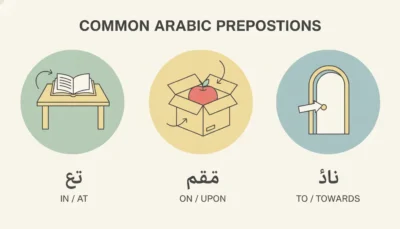
من (min) usually means “from” — origin, source, starting point.
- أنا من مصر — anā min miṣr — “I am from Egypt.”
عن (ʿan) usually means “about” or “concerning.”
- تحدثتُ عن الكتاب — takallamtu ʿan al-kitāb — “I talked about the book.”
These seem easy enough on their own. The mix-up happens with specific verbs. بحث عن (baḥatha ʿan) means “to search for” — not “to search about,” even though عن usually translates as “about.” And سأل عن (saʾala ʿan) means “to ask about” someone’s wellbeing, which does match. There’s no shortcut here except learning the verb-preposition combo as one unit.
مع (maʿa) — The One That’s Actually Simple (Mostly)
مع (maʿa) means “with,” in the sense of accompaniment.
- ذهبتُ مع صديقي — dhahabtu maʿa ṣadīqī — “I went with my friend.”
This one rarely trips people up on its own. The confusion shows up when learners try to use مع where Arabic actually wants ب instead — like tools or instruments. You go “with” a friend using مع. You write “with” a pen using ب. Same English word, two different Arabic words, depending on whether you’re talking about a person or a thing you’re using.
The Real Root Cause: Verbs That “Own” Their Preposition
Here’s what nobody tells beginners early enough — a huge chunk of Arabic prepositions aren’t really about location or direction at all. They’re glued to specific verbs, and the pairing is fixed. You don’t get to choose.
A few common ones:
| Verb | Preposition | Meaning |
|---|---|---|
| بحث عن | ʿan | to search for |
| سأل عن | ʿan | to ask about |
| اهتمّ بـ | bi | to be interested in |
| ساعد على | ʿalā | to help with |
| حصل على | ʿalā | to obtain / get |
| اعتمد على | ʿalā | to depend on |
| فرح بـ | bi | to be happy about |
Notice something? English logic breaks down completely here. “Interested in” becomes اهتمّ بـ — literally “interested with.” “Depend on” uses على, which is fine, but “help with” also uses على, not مع, which is what an English speaker would instinctively grab.
There’s no grammar rule that explains this. It’s memorization, plain and simple. Treat verb + preposition combos as a single vocabulary item, not two separate words you can mix and match.
A Quick Way to Practice This (Without Making It Boring)
Don’t try to memorize a giant preposition chart in one sitting. It won’t stick. Here’s what actually works with our students:
- Learn prepositions attached to verbs, never alone. Don’t just learn عن — learn بحث عن as one chunk.
- Write five sentences a day using one preposition pair. Not ten new ones. One, repeated in different sentences, until it feels automatic.
- Read real sentences and notice the preposition before you translate. Don’t ask “what does this mean in English.” Ask “what’s attached to this verb.”
- Say the pairs out loud. بحث عن. اهتمّ بـ. ساعد على. The rhythm helps it stick better than reading it silently ever will.
This is honestly one of those areas where a teacher catches your mistakes faster than any app or textbook will — because prepositions are exactly the kind of small, silent error that spellcheck and translation tools won’t flag. You’ll write a grammatically “readable” sentence that just sounds off to a native speaker, and you won’t know why until someone corrects it in real time.
If you want a sense of where you currently stand with grammar basics like this, our free Arabic placement test takes a few minutes and tells you exactly what to focus on next — instead of guessing.
Building This Into a Daily Habit
Prepositions aren’t something you master in one lesson. They’re something you absorb slowly, through repeated exposure and correction. If you’re already trying to build consistent study habits, our guide on a 15-minute daily Arabic study routine walks through exactly how to structure short, focused sessions so grammar points like this actually stick instead of sliding out of your head a week later.
Final Word on This
I won’t pretend Arabic prepositions are simple, because they’re not. But they’re learnable, and they follow patterns once you stop trying to force English logic onto them. Learn the verb-preposition pairs as single chunks. Practice them out loud. Get corrected when you’re wrong. That’s really the whole method.
Small words. Big difference in how natural your Arabic sounds. Worth the effort.
Want feedback on your own sentences, in real time, from a native teacher who’ll catch exactly these kinds of mistakes? Our Modern Standard Arabic course is built around live, one-on-one correction — not just drills. Check the certified teachers leading it, or see course pricing to find a plan that fits.