I’ve read a lot of student writing over the years. And I can always spot the same problem in the first paragraph. The vocabulary is fine. The verbs are conjugated right. But every sentence just… stops. Then a new one starts. Nothing connects them.
Here’s the thing — connectors are what turn a list of correct sentences into actual writing. Without them, your Arabic sounds like a phrasebook. With them, it sounds like a person talking.
I’m going to walk you through the connectors my students actually use, grouped by what they do, not by some alphabetical list you’ll forget in five minutes. If you’ve already looked at Arabic prepositions, think of this as the next layer. Prepositions connect words. Connectors connect ideas.
Why Beginners Skip This (And Why That’s a Mistake)
Most beginner courses front-load nouns, verbs, and maybe question words. Connectors get one lesson, if that. I get why — و (and) feels too simple to teach on purpose. Everybody picks it up fast.
But that’s exactly the trap. Students learn و and ف and stop there. Then they hit intermediate level and can’t write two sentences that actually relate to each other. I’ll be straight with you — this is the single most common gap I see between someone who “knows words” and someone who can write a paragraph.
So let’s fix it properly.
Addition: Building One Idea on Top of Another
و (wa) — and
The most common word in the Arabic language, full stop. It attaches directly to what follows, no space.
أنا أدرس العربية وأحب القراءة. ana adrus al-‘arabiyya wa uhibb al-qira’a I study Arabic and I love reading.
One thing that trips people up: و can join two full sentences, not just two words. In English you’d sometimes use a period instead. In Arabic, و holding two clauses together is completely normal and honestly preferred in formal writing.
أيضاً (aydan) — also, too
Goes at the end of the sentence (or clause) it’s modifying.
هو يتكلم الفرنسية، ويتكلم الإنجليزية أيضاً. He speaks French, and he speaks English too.
كذلك (kadhalik) — likewise, also
A bit more formal than أيضاً. You’ll see it a lot in news writing and essays.
زاد الطلب على المنتج، وزاد السعر كذلك. Demand for the product increased, and the price increased likewise.
Contrast: Setting Up an “But Actually…”
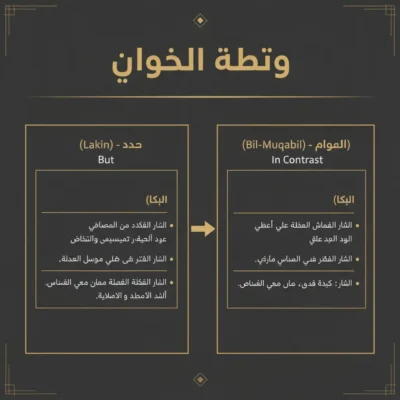
This is where a lot of students freeze, because Arabic has more than one way to say “but,” and they’re not interchangeable.
لكن (lakin) — but
The everyday, general-purpose “but.” Works in speech and writing.
أريد أن أذهب، لكن الوقت متأخر. I want to go, but it’s late.
لكنّ (lakinna) — but (with a grammatical twist)
Same meaning, different job. لكنّ is one of the “sisters of إنّ” — a small group of particles that go directly before a noun and put it in the accusative case. If you’ve read our piece on negation in Modern Standard Arabic, you already know Arabic likes these small grammatical particles that quietly change the word after them. This is the same family.
الطعامُ لذيذٌ لكنَّ السعرَ مرتفعٌ. The food is delicious but the price is high.
Notice: the noun right after لكنّ takes a fatha ending. That’s the rule. Most students at conversational level just use لكن and skip this — that’s fine for speaking, but if you’re writing formally, know the difference exists.
بل (bal) — rather
This one corrects the first part of the sentence. It’s used after a negative statement to say “not that — this instead.”
لم يذهب إلى العمل، بل ذهب إلى المستشفى. He didn’t go to work, rather he went to the hospital.
رغم أنّ / بالرغم من أنّ (raghma anna / bi-raghmi min anna) — although, despite the fact that
رغم أنّه متعَب، استمرّ في العمل. Although he was tired, he kept working.
Cause and Result: The “Why” Connectors
لأنّ (li’anna) — because
Another إنّ sister — the noun after it gets that same accusative marking.
تأخّرتُ لأنَّ الطريقَ كان مزدحماً. I was late because the road was crowded.
بسبب (bi-sabab) — because of
Used before a noun, not a full clause. This is the mistake I see constantly — students try to put a full sentence after بسبب when it only wants a noun phrase.
Wrong pattern: بسبب الطريق كان مزدحماً ❌ Right: تأخّرتُ بسبب الازدحام. (I was late because of the traffic.) ✅
If you want a full clause, switch to لأنّ.
لذلك (li-dhalik) — therefore, so
Points backward at a reason you already gave, then delivers the result.
كان الجو ممطراً، لذلك بقينا في المنزل. It was rainy, so we stayed home.
إذن (idhan) — so, then (as a conclusion)
More conversational, often used in response to something someone just said.
“نفدت التذاكر.” “إذن سنذهب غداً.” “The tickets are sold out.” “So we’ll go tomorrow.”
Time and Sequence: Putting Events in Order
ثم (thumma) — then, after that
Marks a clear step after another one. Common in instructions, stories, and recipes.
استيقظتُ، ثم شربتُ القهوة، ثم ذهبتُ إلى العمل. I woke up, then I drank coffee, then I went to work.
بعد ذلك (ba’da dhalik) — after that
A bit more spaced out in time than ثم. Use it when there’s a gap, not an immediate next step.
عندما (‘indama) — when
Introduces a clause about the time something happened.
عندما وصلتُ، كان الجميع نائماً. When I arrived, everyone was asleep.
بينما (baynama) — while, whereas
Two meanings worth knowing. It can mark two things happening at the same time, or it can mark a contrast — closer to “whereas.”
بينما كنتُ أطبخ، كان هو يقرأ. While I was cooking, he was reading.
Condition: If This, Then That
إذا (idha) — if (real, likely conditions)
إذا درستَ كل يوم، ستتقدّم بسرعة. If you study every day, you’ll progress fast.
لو (law) — if (hypothetical, unlikely, or contrary to fact)
This is the one students mix up with إذا the most. لو is for things that didn’t happen or probably won’t.
لو كنتُ في القاهرة، لزرتُ الأهرامات. If I were in Cairo, I would visit the pyramids.
Quick test: if you can add “but I’m not/wasn’t” to the English version and it still makes sense, you probably want لو.
Purpose: The “In Order To” Connectors
لكي / كي (li-kay / kay) — in order to, so that
Followed by a subjunctive verb form.
أدرس كل يوم لكي أتقن العربية. I study every day in order to master Arabic.
حتى (hatta) — until / so that
Double meaning depending on context — “until” a point in time, or “so that” as a purpose. Context makes it obvious which one is meant.
انتظرتُ حتى وصل القطار. (until — a point in time) اجتهدتُ حتى أنجح. (so that — a goal)
A Real Paragraph Using These Connectors
Let’s put it together, because a list of rules doesn’t stick the way an example does.
بدأتُ تعلّم العربية منذ ستة أشهر، وكان الأمر صعباً في البداية. لكنّني لم أستسلم، بل واصلت الدراسة يومياً. عندما بدأتُ أفهم الجُمل الطويلة، شعرتُ بالفخر. ورغم أنّ الطريق ما زال طويلاً، فأنا متأكد أنني سأتقن اللغة، لأنّني أستمتع بالتعلّم، وليس لأنّني مجبر عليه.
I started learning Arabic six months ago, and it was hard at the start. But I didn’t give up — rather I kept studying daily. When I started understanding long sentences, I felt proud. And although the road is still long, I’m sure I’ll master the language, because I enjoy learning, not because I’m forced to.
Read that paragraph again and count the connectors. Six of them, in five sentences. That’s what natural writing looks like — not because you’re trying to show off vocabulary, but because ideas actually relate to each other in real life.
Frequently Asked Questions
Can I start a sentence with و?
Yes. It’s extremely common in Arabic, more so than starting a sentence with “and” in English. News articles, stories, even formal essays do it constantly.
Is it wrong to use لكن instead of لكنّ?
No, not for speaking or casual writing. لكن without the shadda is simpler and totally acceptable. لكنّ (with the shadda, triggering the accusative) shows up more in formal or written Arabic, and you’ll be expected to recognize it even if you don’t produce it yourself early on.
What’s the real difference between إذا and لو?
إذا is for conditions that could realistically happen. لو is for things that are hypothetical, unlikely, or already didn’t happen. “If it rains tomorrow” is إذا. “If I were rich” is لو.
Do I need to memorize the إنّ sisters just for connectors?
Not all of them at once. You just need to know that لأنّ and لكنّ behave differently from a word like لأن spoken casually — the noun right after them takes an accusative ending in formal Arabic. In everyday speech, plenty of native speakers relax this rule too. Learn it, recognize it, use it when your writing needs to be more formal.
Why does my writing still sound choppy even though I know these words?
Usually it’s not the connector — it’s the order. Try writing the cause first, then use لذلك for the result, instead of jumping straight to the result and explaining later. Arabic likes to build ideas in the order they logically happen. And honestly, this is something a teacher catches faster than you’ll catch it yourself, just by reading a paragraph out loud with you.
Where Connectors Fit Into Your Bigger Study Plan
You don’t need to master all of these in one sitting. Pick two or three from each category, use them in your next few writing exercises, and let the rest sink in through reading. If you’re not sure where these fit into your overall level, our free Arabic placement test will tell you exactly what to focus on next — some students need more foundational grammar first, others are ready to jump straight into connectors and paragraph-level writing.
Connectors are a small part of a much bigger skill: writing in Modern Standard Arabic with actual flow, not just correct isolated sentences. If you want to see how this fits into a daily habit instead of a one-time grammar lesson, check out our 15-minute daily Arabic study routine — connectors are exactly the kind of thing that clicks with short, consistent practice rather than a single long study session.
And if you’ve been working through related grammar — question words, relative pronouns, or personal pronouns — connectors are the piece that ties all of it together into real sentences instead of grammar drills.
Improve Your Writing
Reading a list of connectors is one thing. Using them naturally, without stopping to think, is another. That second part comes from actually writing and getting corrected — which is exactly what a live teacher is for. Our MSA teachers work through this with students at every level, one-on-one, and catch the small habits that hold your writing back before they become permanent.