

If you’ve been studying Modern Standard Arabic for a while, you’ve probably hit this wall already. You’re reading a sentence, you understand every word in it, and then you get to the negation and your brain just stops. Is it لا? Is it ما? Why does this one have لم in front of it and the verb looks… wrong?
I’ll be straight with you — negation in Arabic isn’t hard because the rules are complicated. It’s hard because English gives you one tool (the word “not”) and Arabic gives you four or five, and each one only works in a specific spot. You can’t just pick your favorite and slap it in front of every verb. That’s the part nobody explains clearly when you’re starting out, and it’s the part that actually matters.
So let’s fix that. By the end of this, you’ll know exactly which negation particle goes where, why the verb sometimes changes shape when you negate it, and how to stop guessing.
Why Arabic needs so many negation words
Here’s the thing — Arabic negation isn’t random. Each particle is tied to a specific tense or sentence type. Once you see the pattern, it actually makes negation easier than English in some ways, because the negation word tells you the tense automatically. You don’t even need a time marker sometimes. The negation does double duty.
The main players you need to know:
- لا (lā) — negates present tense verbs, and general/habitual statements
- ما (mā) — negates past tense verbs (mostly informal/spoken, but you’ll see it in MSA too)
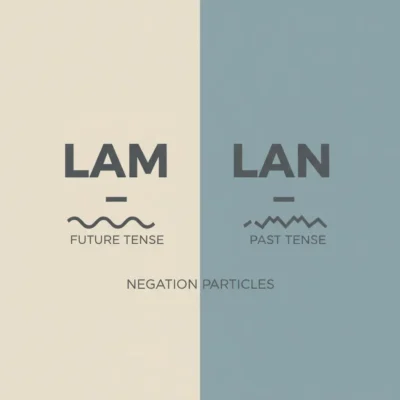
- لم (lam) — the “proper” MSA way to negate the past
- لن (lan) — negates the future
- ليس (laysa) — negates nominal sentences (the ones without a verb)
That’s it. Five words. Learn what each one is for, and negation stops being scary.
Negating present tense verbs with لا
Start here because it’s the one you’ll use constantly. To say you don’t do something, or something isn’t happening right now, you put لا directly before the present tense verb. No changes to the verb itself. It stays exactly as it would in a positive sentence.
أنا لا أفهم (anā lā afham) — “I don’t understand”
هو لا يعمل هنا (huwa lā ya’malu hunā) — “He doesn’t work here”
لا أُحِبُّ القهوة (lā uḥibbu al-qahwa) — “I don’t like coffee”
Notice something? The verb keeps its regular ending. أفهم stays أفهم. This is the easy one. If you only remember one negation rule today, make it this one: present tense + لا, nothing else changes.
لا also does something else useful — it’s the word you use for general or habitual negation, like “I never” or “I don’t usually.” Arabic doesn’t need a separate word for “never” in most casual contexts; the present tense plus لا already covers a lot of that ground depending on context.
Negating the past with ما — and why you’ll see it everywhere

ما is technically more associated with spoken dialects, but don’t write it off for MSA. You’ll see it in plenty of formal writing, in the Quran, in classical texts, and in casual news commentary. It’s a legitimate MSA past-tense negator, it’s just not the “textbook preferred” one.
ما ذهبتُ إلى السوق (mā dhahabtu ilā al-sūq) — “I didn’t go to the market”
ما قرأتُ الكتاب (mā qara’tu al-kitāb) — “I didn’t read the book”
The good news with ما: the verb stays in its normal past tense form. No conjugation gymnastics. You just drop ما in front and you’re done. This is exactly why so many learners lean on it — it’s low effort and it works.
Negating the past with لم — the one that actually trips people up
Okay, this is where it gets real. لم is considered the more correct, more formal MSA way to negate the past, and it’s everywhere in news writing, academic Arabic, and formal speech. But here’s the catch nobody warns you about early enough: لم doesn’t go with the past tense verb. It goes with the present tense verb, and it flips that verb into the jussive mood (المجزوم).
I know. It sounds backwards. Let me show you why it’s not as bad as it sounds.
لم أذهب إلى السوق (lam adhhab ilā al-sūq) — “I didn’t go to the market”
See that? أذهب, not ذهبت. You’re using the present-tense form of the verb (the “I go” form), but لم pushes it into meaning “I didn’t go” — past, negative. The jussive mood usually shows up as a small change at the end of the verb. For a lot of common verbs it just drops the final vowel or short ending.
هو لم يكتب الرسالة (huwa lam yaktub al-risāla) — “He didn’t write the letter”
Compare يكتبُ (he writes, present) with يكتب in that sentence — the ending damma is gone. That’s the jussive doing its job.
Why does this exist at all? Honestly, it’s just how Classical Arabic grammar developed, and MSA inherited it. Once you drill five or six common verbs through it, the pattern clicks and you stop having to think about it. It becomes muscle memory, the same way irregular verbs in any language eventually just… sit in your brain correctly.
Quick comparison so this sticks:
| Meaning | With ما (easier) | With لم (more formal) |
|---|---|---|
| I didn’t write | ما كتبتُ | لم أكتب |
| She didn’t go | ما ذهبت | لم تذهب |
| They didn’t understand | ما فهموا | لم يفهموا |
Both are correct. لم just reads more polished, more “written Arabic.” If you’re prepping for formal writing, exams, or reading the news, لم is the one to prioritize.
Negating the future with لن
This one’s actually the most forgiving of the bunch, because there’s just one rule to remember: لن also triggers a mood change, but this time it’s the subjunctive (المنصوب), not the jussive. Small difference in the ending, but worth knowing they’re not the same shift.
لن أذهب غدًا (lan adhhab ghadan) — “I will not go tomorrow”
لن يفهم هذا (lan yafham hādhā) — “He will not understand this”
If you want the deeper breakdown of how future tense actually works in MSA — including the difference between سـ and سوف, and why لن is the only way to negate them — I already wrote a full guide on our future tense in Arabic post. Worth a read if this is still fuzzy.
Negating nominal sentences with ليس
Now here’s a sentence type that trips up a lot of learners for a completely different reason — Arabic nominal sentences don’t have a verb “to be” in the positive form. So how do you negate something that has no verb to negate?
You use ليس. It’s technically a “deficient verb” whose whole job is to negate these no-verb sentences.
الجو ليس باردًا (al-jaw laysa bāridan) — “The weather isn’t cold”
هي ليست طالبة (hiya laysat ṭāliba) — “She isn’t a student”
Notice ليس conjugates like a verb even though it’s negating a sentence that had no verb to begin with. It agrees with gender (ليس for masculine subjects, ليست for feminine), and the word after it usually takes the accusative case ending.
If nominal versus verbal sentences still feel shaky to you in general, that’s worth sorting out before you go further with negation, because it decides which negation tool you even reach for. I go through it properly in our nominal vs verbal sentences article.
Negating commands with لا
Telling someone not to do something uses لا too, but paired with the jussive form of the verb, same mood لم uses.
لا تذهب! (lā tadhhab!) — “Don’t go!”
لا تتكلم بسرعة (lā tatakallam bi-sur’a) — “Don’t speak fast”
This is different from negating a regular present-tense statement. It’s a command, so the verb drops into jussive here too. Same mechanism as لم, different trigger word.
Negating nouns and adjectives with غير
Sometimes you’re not negating a full action — you’re negating a single word, like “non-” or “un-” in English. That’s where غير (ghayr) comes in, roughly meaning “other than” or “not.”
هذا غير صحيح (hādhā ghayr ṣaḥīḥ) — “This is incorrect / not correct”
شخص غير معروف (shakhṣ ghayr ma’rūf) — “An unknown person”
Think of غير as attaching to a single word the way “un-” or “non-” attaches to English words, rather than negating a whole clause.
Negating “there is / there isn’t” — the one everyone forgets to ask about
Nobody asks me about this one until they already need it mid-conversation, so let’s cover it now. Arabic has a specific structure for saying “there is no such thing,” and it’s different from every negation pattern above. It’s called لا النافية للجنس — “the لا that negates the entire category.”
لا شكَّ في ذلك (lā shakka fī dhālik) — “There is no doubt about that”
لا أحدَ هنا (lā aḥada hunā) — “There is no one here”
The noun right after لا drops its tanween and takes a fatha ending, no “the” article involved, and the whole thing reads like a blanket statement — not “I don’t have doubt” but “doubt does not exist, period.” It’s a stronger, more absolute kind of negation than the everyday لا you use with verbs.
For softer, everyday “there isn’t” statements — the kind you’d actually say out loud about a specific situation — you’ll more often hear ليس هناك (laysa hunāka), literally “it is not there.”
ليس هناك وقتٌ (laysa hunāka waqtun) — “There isn’t time”
ليس هناك مشكلة (laysa hunāka mushkila) — “There isn’t a problem”
Both structures technically mean “there isn’t,” but لا النافية للجنس leans formal and absolute, while ليس هناك is what you’ll actually reach for in normal writing and speech. Know both, but lean on ليس هناك until the formal one feels natural.
Putting it all together — one situation, five negations
Let’s take a single idea — “I didn’t go to work today” — and see how differently it reads depending on which negation angle you’re using, just so the contrast is obvious in one place instead of scattered across the article.
لم أذهب إلى العمل اليوم — formal, written MSA, the version you’d see in a news-style account of events.
ما ذهبتُ إلى العمل اليوم — same meaning, less formal tone, still perfectly valid MSA.
لن أذهب إلى العمل غدًا — future version: “I will not go to work tomorrow.”
لا أذهب إلى العمل أيام الجمعة — habitual version: “I don’t go to work on Fridays.”
العمل ليس بعيدًا عن هنا — a related nominal negation just to show the shift: “Work isn’t far from here.”
Same rough topic, five completely different grammatical tools depending on tense and sentence type. That’s really the whole skill here — not memorizing five words, but recognizing which situation you’re in fast enough to grab the right one without stopping to think.
The mistakes I see constantly
Honestly, almost every mistake with Arabic negation comes down to one of these three things:
Mixing up لم with the past tense verb form. People write لم ذهبت instead of لم أذهب. Remember — لم always pairs with the present-tense shape of the verb, never the past-tense conjugation, even though the meaning is past.
Using لا for the past. لا is present tense territory. If you catch yourself writing لا ذهبت, stop — you want لم أذهب or ما ذهبت instead.
Forgetting ليس is needed for nominal sentences. Learners sometimes try to just stick لا in front of a nominal sentence out of habit from English. It doesn’t work the same way. ليس is doing a specific job there that لا can’t do.
None of these are really “hard” mistakes once you’ve seen them named out loud. They’re just easy to make on autopilot, especially early on when you’re translating in your head from English instead of thinking in Arabic sentence patterns.
A quick reference you’ll actually use
| Sentence type | Negation word | Verb form used |
|---|---|---|
| Present tense | لا | Present, unchanged |
| Past tense (formal) | لم | Present tense, jussive |
| Past tense (common) | ما | Past, unchanged |
| Future tense | لن | Present tense, subjunctive |
| Nominal sentence | ليس | Conjugates like a verb |
| Command | لا | Present tense, jussive |
| Single noun/adjective | غير | N/A |
Screenshot that table. Seriously. It’ll save you more headaches than any explanation I can write here.
How to actually get this into your head
Reading a table like the one above won’t make it stick on its own — you knew that already, probably. What works is drilling one negation particle at a time until it’s automatic, then layering the next one in. Don’t try to master all five in one sitting.
A realistic approach: spend a few days just on لا with present tense verbs until it’s boring and obvious. Then move to لم, since it’s the one that needs the most rewiring. Save ليس for once nominal sentences feel comfortable on their own.
If you don’t already have a rhythm for practicing grammar points like this, our post on building a daily Arabic study routine walks through how to structure short daily sessions so grammar like this actually sinks in instead of fading by next week.
Where you stand right now
If you’ve read this far, you already understand negation better than a lot of people who’ve been studying MSA for months without ever seeing it laid out this directly. The particles aren’t random. They’re tied to tense and sentence type, and once that clicks, you stop guessing and start applying the rule automatically.
Not sure which stage of MSA grammar you’re actually at? Our free Arabic placement test takes a few minutes and tells you exactly where to focus next — whether that’s negation, verb conjugation, or something further back in the basics.
And if you’d rather have someone walk you through this kind of grammar in real time instead of piecing it together from articles, that’s literally what our teachers are there for. You can check our course options and pricing whenever you’re ready to move past the guesswork stage and actually get corrected in real conversation.
Understand negation easily — that’s the whole point of breaking it down this way. Five words, five jobs, no more guessing.