arabic gender rules Every Arabic noun has a gender. Not just people. Not just animals. Everything. Your table. Your pen. The sun. The moon. All of it is either masculine or feminine, whether that makes any logical sense to you or not.
I’ll be straight with you — this trips up almost every beginner. English doesn’t really do this (besides “he” and “she” for people), so your brain isn’t wired to think this way yet. You pick up a word like “book” and you don’t ask yourself “but what gender is it?” In Arabic, you have to. Every single time.
Here’s the good news. The rules for spotting gender in Modern Standard Arabic (MSA) are actually pretty consistent. Once they click, they click for good. This article is going to walk you through exactly how to tell masculine from feminine, how gender changes your adjectives and verbs, and which words break the rules (because a few always do).
Why Gender Even Matters in Arabic
Quick reality check before we get into the rules: gender in Arabic isn’t just a label you memorize and forget. It changes how you build the whole sentence around that word.
If a noun is feminine, the adjective describing it has to be feminine too. The verb attached to it changes form. Even numbers change depending on the gender of what you’re counting. So getting gender right isn’t a small grammar detail — it’s load-bearing. Mess it up, and the whole sentence sounds off, even if every individual word is correct.
That’s actually the part nobody tells beginners. You can know 500 words in Arabic and still sound wrong constantly, because you never learned how gender ripples through the sentence. Let’s fix that.
The Basic Rule: Look for the ة
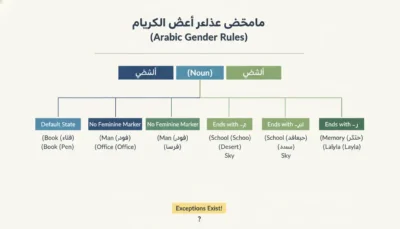
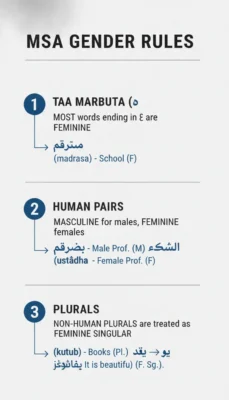
Most of the time, spotting feminine nouns in Arabic comes down to one letter: ة (tāʾ marbūṭa). If a noun ends in it, it’s almost always feminine.
| Arabic | Transliteration | Meaning | Gender |
|---|---|---|---|
| مَدْرَسَة | madrasa | school | Feminine |
| سَيَّارَة | sayyāra | car | Feminine |
| طَاوِلَة | ṭāwila | table | Feminine |
| مُعَلِّمَة | mu’allima | teacher (female) | Feminine |
No ة at the end? Most of the time, that means the noun is masculine.
| Arabic | Transliteration | Meaning | Gender |
|---|---|---|---|
| كِتَاب | kitāb | book | Masculine |
| بَيْت | bayt | house | Masculine |
| قَلَم | qalam | pen | Masculine |
| بَاب | bāb | door | Masculine |
If you only remember one rule from this entire article, remember this: ة at the end = usually feminine. No ة = usually masculine. That covers a huge chunk of Arabic vocabulary right there.
Now, “usually” is doing some work in that sentence. Let’s get into the exceptions, because Arabic — like every language — has them.
Feminine Words That Don’t End in ة
Here’s the thing people don’t expect: plenty of feminine nouns don’t have the ة at all. You just have to know them.
1. Most body parts that come in pairs.
This one actually makes sense once you see the pattern — hands, eyes, ears, feet. Nature gave you two of them, and Arabic treats that pair as feminine.
| Arabic | Transliteration | Meaning |
|---|---|---|
| يَد | yad | hand |
| عَيْن | ‘ayn | eye |
| أُذُن | udhun | ear |
| رِجْل | rijl | foot/leg |
2. Country and city names.
Almost every country and city in Arabic is treated as feminine, regardless of spelling.
| Arabic | Transliteration | Meaning |
|---|---|---|
| مِصْر | Miṣr | Egypt |
| القَاهِرَة | Al-Qāhira | Cairo |
| لُبْنَان | Lubnān | Lebanon |
3. A short list of common words you just memorize.
These don’t follow a visible pattern. You learn them the way you learn irregular verbs in English.
| Arabic | Transliteration | Meaning |
|---|---|---|
| شَمْس | shams | sun |
| نَار | nār | fire |
| رِيح | rīḥ | wind |
| أَرْض | arḍ | earth/ground |
| حَرْب | ḥarb | war |
Honestly, this short list is worth writing on a flashcard and just drilling until it’s automatic. There aren’t that many of them — maybe 15-20 that come up often — and once you know them, you’re covered for 95% of what you’ll read.
Masculine Words That Do End in ة
Yes, this happens too. A small number of words end in ة but are actually masculine — usually because they refer to a male person or a specific role.
| Arabic | Transliteration | Meaning |
|---|---|---|
| خَلِيفَة | khalīfa | caliph |
| عَلَّامَة | ‘allāma | great scholar |
These are rare. Don’t lose sleep over them. Just know they exist so you’re not confused the first time you hit one.
How Gender Changes Your Adjectives
This is where gender stops being a “just memorize it” thing and starts actually affecting how you speak. In Arabic, the adjective has to match the gender of the noun it’s describing. Every time.
To make an adjective feminine, you usually just add ة to the masculine form.
| Masculine | Feminine | Meaning |
|---|---|---|
| كَبِير (kabīr) | كَبِيرَة (kabīra) | big |
| جَمِيل (jamīl) | جَمِيلَة (jamīla) | beautiful |
| صَغِير (ṣaghīr) | صَغِيرَة (ṣaghīra) | small |
Watch how this plays out with real nouns:
- الكِتَابُ كَبِيرٌ. (al-kitābu kabīrun) — “The book is big.” (masculine noun + masculine adjective)
- السَّيَّارَةُ كَبِيرَةٌ. (as-sayyāratu kabīratun) — “The car is big.” (feminine noun + feminine adjective)
Same meaning, same structure, but the ending on the adjective flips depending on what it’s describing. This is the part where a lot of learners freeze up when speaking, because they’re translating word-for-word from English and forgetting the adjective needs to shift too. It becomes automatic with practice — but only if you practice it on purpose, not just passively.
How Gender Changes Your Verbs
Verbs shift too, based on whether the subject is masculine or feminine. This shows up constantly, so it’s worth locking in early.
Take the verb “to write” — كَتَبَ (kataba):
| Subject | Arabic | Transliteration | Meaning |
|---|---|---|---|
| He wrote | كَتَبَ | kataba | — |
| She wrote | كَتَبَتْ | katabat | — |
| He writes | يَكْتُبُ | yaktubu | — |
| She writes | تَكْتُبُ | taktubu | — |
Notice the pattern in the present tense: masculine subjects usually take a يَـ (ya) prefix, feminine subjects take a تَـ (ta) prefix. That single letter swap is the difference between “he studies” and “she studies,” and it shows up in basically every verb you’ll ever conjugate in Arabic. If you want to go deeper on how present-tense verbs actually work — not just the gender piece — it’s worth sitting down and drilling the full conjugation pattern separately.
What About Dual and Plural?

Quick note here because people always ask. Gender still applies in the dual (talking about exactly two of something) and the plural, but the endings change again.
- Feminine dual: add ـتَانِ or ـتَيْنِ depending on the sentence position
- Masculine sound plural: ـونَ or ـينَ
- Feminine sound plural: ـاتٌ
Example — “teachers” (female, plural): مُعَلِّمَات (mu’allimāt). See the ـات ending? That’s your feminine plural marker, and it shows up constantly once you start reading real Arabic text.
I’m not going to turn this into a full plural lesson — that’s a whole topic on its own. But know this: gender doesn’t disappear once you move past singular nouns. It follows the word everywhere.
Common Mistakes Beginners Make With Gender
Mistake 1: Assuming logic applies. You’ll want “sun” to be masculine because, I don’t know, it feels big and powerful. It’s feminine. Arabic gender isn’t tied to how something feels to you — it’s tied to grammatical patterns you have to learn.
Mistake 2: Forgetting to change the adjective. Saying السَّيَّارَةُ كَبِير instead of السَّيَّارَةُ كَبِيرَةٌ is one of the most common errors out there. The noun is feminine, so the adjective has to be too. This mismatch is honestly one of the fastest ways to sound like you’re still translating from English in your head instead of thinking in Arabic.
Mistake 3: Ignoring the exceptions until they cause confusion. A lot of learners memorize “ة equals feminine” and never learn the flip side — the feminine words without ة. Then they hit شَمْس or يَد in a sentence and the whole thing falls apart because the adjective doesn’t match what they expected.
Mistake 4: Trying to memorize gender and grammar rules all at once. This one’s more about how you study than what you study. Trying to absorb every gender exception in one sitting doesn’t work. It’s the kind of thing that needs spaced, daily repetition — a little bit each day, not a cram session.
A Simple Practice Drill
Try this. Take five nouns you already know. Write each one down, mark whether it’s masculine or feminine, then write one sentence using an adjective that matches. Like this:
- كِتَاب (masculine) → الكِتَابُ جَدِيدٌ. (“The book is new.”)
- مَدْرَسَة (feminine) → المَدْرَسَةُ جَدِيدَةٌ. (“The school is new.”)
Do this daily for a week with new words, and gender agreement stops being something you calculate and starts being something you just feel. That’s genuinely how it clicks — not from reading the rules once, but from using them over and over until your brain stops needing to think about it.
Quick Reference: Gender Cheat Sheet
| Situation | Rule |
|---|---|
| Noun ends in ة | Usually feminine |
| Noun has no ة | Usually masculine |
| Body parts that come in pairs | Feminine, even without ة |
| Country/city names | Feminine, even without ة |
| Adjective describing a feminine noun | Add ة to the masculine adjective |
| Verb with a feminine subject (present tense) | Use the تَـ prefix |
| Verb with a masculine subject (present tense) | Use the يَـ prefix |
| Feminine sound plural | Ends in ـات |
Print this out, keep it near your notebook, and check it every time you’re unsure. Eventually you won’t need it.
Where This Fits Into Your Bigger Arabic Journey
Gender rules aren’t something you master in isolation — they’re one piece of the grammar backbone that holds up everything else you’ll learn in Modern Standard Arabic. If you’re still early in your studies, it helps to know where gender fits alongside other foundational skills, like building family vocabulary (which is packed with gendered nouns, by the way — brother/sister, son/daughter, all of it) or learning to read Arabic handwriting so you can actually spot that ة when it’s written by hand and not in a textbook font.
And if you’re not sure whether you’re ready for gender rules yet, or whether you should be reviewing something more basic first, that’s exactly what a level check is for.
Not sure where you stand? Take the free Arabic placement test — it takes a few minutes and tells you exactly what to focus on next, instead of guessing.
The Bottom Line
Arabic gender isn’t random, even when it feels that way at first. Most of it comes down to one letter — ة — and a short list of exceptions you can genuinely memorize in a week if you’re consistent about it. The part that actually takes time is training yourself to carry that gender through the whole sentence: the adjective, the verb, the plural. That’s not a memorization problem. That’s a repetition problem.
Don’t try to learn every rule and every exception in one sitting. Pick five words. Practice them. Add five more tomorrow. That’s genuinely how fluent speakers built this skill too — nobody downloaded the whole grammar system overnight.
If you want someone to actually correct you when you get the gender agreement wrong — because self-study alone won’t catch every mistake — that’s where working with a real teacher makes the difference. Our MSA course is built around exactly this kind of foundational grammar, taught one-on-one so you get corrected in real time instead of repeating the same mistake for months. Check the pricing page to see what fits your schedule.
Grammar doesn’t have to be the wall people think it is. Learn it the right way, and it just becomes part of how you think in Arabic.