

msa pronunciation rules I’ve had this conversation more times than I can count. A student comes to me after six months of self-study. They can read. They know grammar tables better than some of my colleagues. And then they open their mouth to speak, and I can’t understand half of what they’re saying.
It’s not because they’re bad at Arabic. It’s because nobody told them pronunciation isn’t optional homework you get to later. In MSA, pronunciation is the grammar. Change one vowel and you change the meaning, the tense, or the subject of the sentence. Skip a rule like sun-letter assimilation and native speakers will clock you as a beginner in one sentence, every time.
So let’s fix that now, before it turns into a habit you have to unlearn later.
Why This Can’t Wait Until “Later”
Here’s the thing — most courses teach pronunciation as a side note. A footnote under the alphabet chapter. Then they rush you into vocabulary and grammar because that’s what feels like “real progress.”
But Arabic pronunciation rules aren’t decoration. They carry actual grammatical weight:
- كَتَبَ (kataba) — he wrote
- كُتِبَ (kutiba) — it was written
Same three letters. Different vowels. Completely different meaning. Active voice versus passive voice, decided entirely by sound.
I’ll be straight with you — if you build your foundation without these rules, you’re not building slower. You’re building wrong. And bad pronunciation habits are brutal to fix once your mouth has practiced them a thousand times. It’s a lot easier to learn this right the first time than to retrain your tongue at month eight. If you want a sense of how pronunciation fits into your very first weeks of study, our guide on the correct order for learning Arabic walks through exactly when to bring it in.
Rule 1: Short Vowels (Harakat) Aren’t Optional — They’re the Meaning
Arabic script doesn’t normally write short vowels in adult texts. But when you’re learning, they’re written as small marks above and below the letters, and you absolutely need to know them cold.
- Fatha (َ) — a short “a” sound, like the “u” in “cup”
- Damma (ُ) — a short “u” sound, like the “oo” in “book”
- Kasra (ِ) — a short “i” sound, like the “i” in “sit”
- Sukoon (ْ) — no vowel at all. The consonant is pronounced flat, with no sound after it.
Most beginners treat these as decorative. They’re not. Watch what happens to the word درس (d-r-s):
- دَرَسَ (darasa) — he studied
- دَرْسٌ (darsun) — a lesson
One is a verb. One is a noun. Same three letters, different job in the sentence, because of the vowels.
Practical tip: when you’re reading a new word, say the vowel sound out loud before you say the full syllable. Slow it down. “Da… ra… sa.” It feels clunky at first. It stops feeling clunky in about two weeks if you do it daily.
Rule 2: Long Vowels Change the Length, Not Just the Sound
Arabic also has long vowels — alif (ا), waw (و), and yaa (ي) when they’re acting as vowel extenders rather than consonants. These aren’t just “longer” versions of short vowels for style. The length is meaningful.
- كتب could relate to “he wrote” (kataba)
- كاتب (kaatib) means “writer” — that extra alif changes the whole word
If you rush your long vowels and shorten them to match English speech patterns, you’ll mispronounce a huge chunk of common words without realizing it. English speakers do this constantly because English doesn’t really distinguish vowel length the same way. Arabic does. Hold the sound. Count it in your head if you have to — one full beat longer than a short vowel.
Rule 3: The Emphatic Letters — Your Tongue Needs a New Position
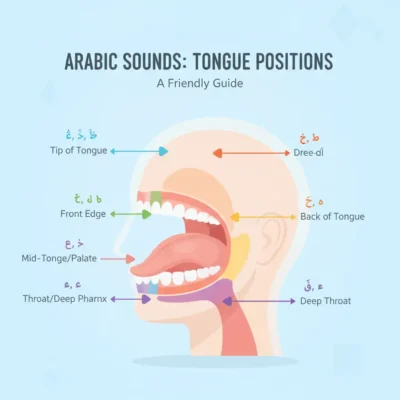
This is where most Western learners hit their first real wall. Arabic has a set of “heavy” or emphatic consonants that don’t exist in English at all: ص (Saad), ض (Daad), ط (Taa), ظ (Dhaa).
Each one has a “light” twin that’s easier for English speakers:
| Heavy (Emphatic) | Light (Regular) |
|---|---|
| ص (Saad) | س (Seen) |
| ض (Daad) | د (Dal) |
| ط (Taa) | ت (Ta) |
| ظ (Dhaa) | ذ (Thal) |
The difference isn’t subtle to a native ear, even though it might sound almost identical to you at first. Emphatic letters are produced with the back of your tongue pulled up and back, and the whole sound gets a heavier, darker quality. Compare سَلام (salam, “peace”) with صَلاة (salat, “prayer”). Confuse those two letters and you’ve confused two words that show up constantly in everyday speech and in religious contexts.
Honestly, this is one of those things you can read about all day and still not get right. It needs to be heard and imitated, ideally with someone correcting you in real time. Self-study gets you 80% of the way. A native speaker gets you the last 20%, which happens to be the part that makes you sound like you actually know Arabic instead of just knowing about it.
Rule 4: Throat Letters — Sounds English Doesn’t Have
Arabic pulls several sounds from deep in the throat that simply don’t exist in English. The main ones to master early:
- ع (Ayn) — a voiced sound from the pharynx. Not a glottal stop, not an “a,” a distinct constriction in your throat.
- ح (Haa) — a breathy, forceful “h” from the throat, different from the soft ه.
- خ (Kha) — like the “ch” in the Scottish “loch” or the German “Bach.”
- غ (Ghayn) — a gargling sound, similar to the French “r.”
These four sounds trip up almost every English speaker in the first few months, and that’s completely normal. Nobody gets ع right on day one. If you want a deeper breakdown of exactly which letters are hardest for English speakers and why, our piece on Arabic letters that are difficult to pronounce goes through each one individually.
My honest advice: don’t try to perfect these from a description in an article, including this one. Get a recording of a native speaker saying them, and mimic the mouth shape and throat position, not just the sound. Record yourself. Compare. It’s uncomfortable at first. That discomfort is doing more for your accent than another hour of flashcards ever will.
Rule 5: Shadda — When One Letter Does Double Duty
The shadda (ّ) is a small mark that sits above a letter and means “double this consonant.” It’s not a stylistic flourish — skipping it changes real words.
- دَرَسَ (darasa) — he studied
- دَرَّسَ (darrasa) — he taught (someone else)
Same root, same vowels mostly, but that doubled ر completely shifts the meaning from “studying” to “teaching.” If you flatten the shadda and pronounce it like a single letter, you’ll say one word while meaning another, and a native listener will genuinely hear a different word, not just an accent.
When you see a shadda, hold the consonant sound slightly longer than you normally would, almost like you’re pausing on it before releasing into the next vowel.
Rule 6: Sun Letters and Moon Letters (This One Surprises Everyone)
This rule alone will instantly upgrade how natural you sound, and almost nobody teaches it early enough.
Arabic has the definite article “the” — ال (al). But when it comes before certain letters, called “sun letters” (ت ث د ذ ر ز س ش ص ض ط ظ ل ن), the ل of “al” isn’t pronounced at all. Instead, the following letter doubles.
- الشمس is written “al-shams” but pronounced ash-shams (the sun)
- الرجل is written “al-rajul” but pronounced ar-rajul (the man)
With “moon letters” (the rest of the alphabet), you pronounce ال exactly as written:
- القمر is pronounced al-qamar (the moon), exactly as spelled
Learners who skip this rule pronounce every single “al-” the same way, and it’s one of the fastest ways to sound like you’re reading off a page instead of actually speaking Arabic. Native speakers do this assimilation automatically and unconsciously. You need to make it conscious first, then let it become automatic through repetition.
Rule 7: Tanween — The Hidden “N” Sound
Tanween is the doubling of a short vowel mark at the end of a word, and it adds an “n” sound that doesn’t appear anywhere in the spelling:
- كِتَابٌ (kitaabun) — a book (nominative)
- كِتَاباً (kitaaban) — a book (accusative)
- كِتَابٍ (kitaabin) — a book (genitive)
This shows up constantly in formal, grammatically correct MSA, especially in news broadcasts and written texts read aloud. It signals the grammatical case of the noun. Skip it, and your Arabic will sound flat and a bit clipped compared to how a trained speaker delivers it. You don’t need to master case grammar to start noticing and reproducing this sound — just get comfortable adding that light “n” where it belongs.
Rule 8: Qalqalah — The “Bounce” Letters
Five letters — ق ط ب ج د — get a small echoing bounce when they appear with a sukoon (no vowel), especially at the end of a word or syllable. Instead of cutting the sound off flat, you let it echo very slightly. This is subtle, and honestly, it matters more in Quranic recitation than in everyday MSA speech. But if you’re aiming for a genuinely polished, native-sounding delivery — the kind used in news reading or formal speech — it’s worth training your ear for it early rather than picking it up as an afterthought.
The Mistakes I See Constantly

After years of teaching, the same handful of errors show up again and again:
- Flattening emphatic letters into their regular twins. ص becomes س, ط becomes ت. This is the single most common accent giveaway.
- Shortening long vowels to match English rhythm. English speakers rush. Arabic rewards holding the sound.
- Ignoring the shadda entirely. People read doubled consonants as single ones because English doesn’t do this.
- Pronouncing every “al-” the same way, ignoring sun-letter assimilation.
- Substituting ع and ح with sounds that exist in English, because the throat position feels unnatural at first.
None of these are signs you’re bad at Arabic. They’re signs your mouth learned English first, and English didn’t prepare it for this. That’s fixable. It just takes deliberate, repeated correction — not passive exposure.
How to Actually Practice This (Not Just Read About It)
Reading a list of rules won’t rewire your pronunciation. Here’s what actually works, based on what I see move the needle for real students:
- Say every vowel out loud, every time you read. Don’t read silently in your head. Your mouth needs the repetition, not just your eyes.
- Record yourself daily, even for two minutes. Play it back. You’ll hear things you didn’t notice while speaking.
- Isolate one hard letter per week. Don’t try to fix ع, ح, ص, and ض all at once. Pick one. Drill it in isolation, then in words, then in full sentences.
- Get corrected by a native speaker regularly. This is the part self-study genuinely can’t replace. You can’t hear your own emphatic letters the way a trained ear can. If you’re not sure where your pronunciation currently stands, our free Arabic level test is a quick way to find out before you build a study plan around it.
- Build it into a daily routine, not a weekend project. Fifteen focused minutes a day beats an occasional two-hour cram session, every time. If you want a ready-made structure for this, take a look at our 15-minute daily Arabic study routine — it’s built specifically around MSA fundamentals like these.
A Quick Word on MSA vs. Dialect Pronunciation
If you’re also planning to pick up a spoken dialect like Egyptian Arabic down the line, know that pronunciation habits shift between MSA and dialects — some letters are pronounced differently, some sounds soften. That’s a separate topic, but it’s worth understanding early so you’re not confused later about why your MSA teacher and a friend from Cairo say things slightly differently. Our guide to Arabic dialects breaks down exactly how MSA and colloquial speech relate to each other.
Common Questions About MSA Pronunciation

Is Arabic pronunciation really that different from English? Yes, more than most learners expect going in. English and Arabic share very few consonant sounds one-to-one. The emphatic letters and throat sounds genuinely don’t have equivalents in English. That’s not meant to discourage you — it just means you should expect a real learning curve here, not a quick pass.
Can I learn correct pronunciation just from apps and videos? You can get partway there. Apps are fine for exposure and recognition. But without a real person correcting your mouth position and listening for your specific mistakes, you’ll likely lock in small errors without realizing it, because you genuinely can’t hear your own accent the way someone else can.
How long does it take to sound natural in MSA? Most consistent students start sounding noticeably more accurate within two to three months of focused daily practice. Full, natural-sounding fluency takes longer and really benefits from ongoing correction, not a one-time lesson.
Do I need to learn Quranic tajweed rules to speak good MSA? No. Tajweed is its own detailed system built specifically for Quranic recitation. MSA pronunciation borrows some overlapping ideas, like qalqalah, but you don’t need full tajweed training to speak clear, correct MSA.
Why can’t I hear the difference between letters like س and ص myself? Because your ear was trained on English sound categories your whole life, and English doesn’t distinguish these two sounds at all. This is completely normal and it’s exactly the kind of gap that improves fastest with a teacher who can point it out in real time, rather than through solo listening practice.
Where to Go From Here
Pronunciation isn’t a separate skill you bolt onto Arabic later. It’s woven into the grammar, the meaning, and honestly, into how seriously native speakers take you as a learner. Get the rules above into your daily practice now, while your habits are still forming, and you’ll save yourself months of retraining down the road.
If you want structured, corrected practice instead of guessing whether you’re getting it right, our Modern Standard Arabic courses are built around exactly this — native teachers who catch the small stuff before it becomes a habit. حسّن النطق — come work on it with us.