
Arabic dialects are the living, spoken heart of the Arabic language — and they’re completely different from what most learners study. If you want to have real conversations, build genuine friendships, or thrive in an Arab country, you need a dialect. This guide covers everything: what dialects are, which one fits your goals, and exactly how to start learning it today — whether you’re studying at home or abroad.
Not sure which dialect matches your situation? Take our free Arabic placement test and get a personalized recommendation in minutes.
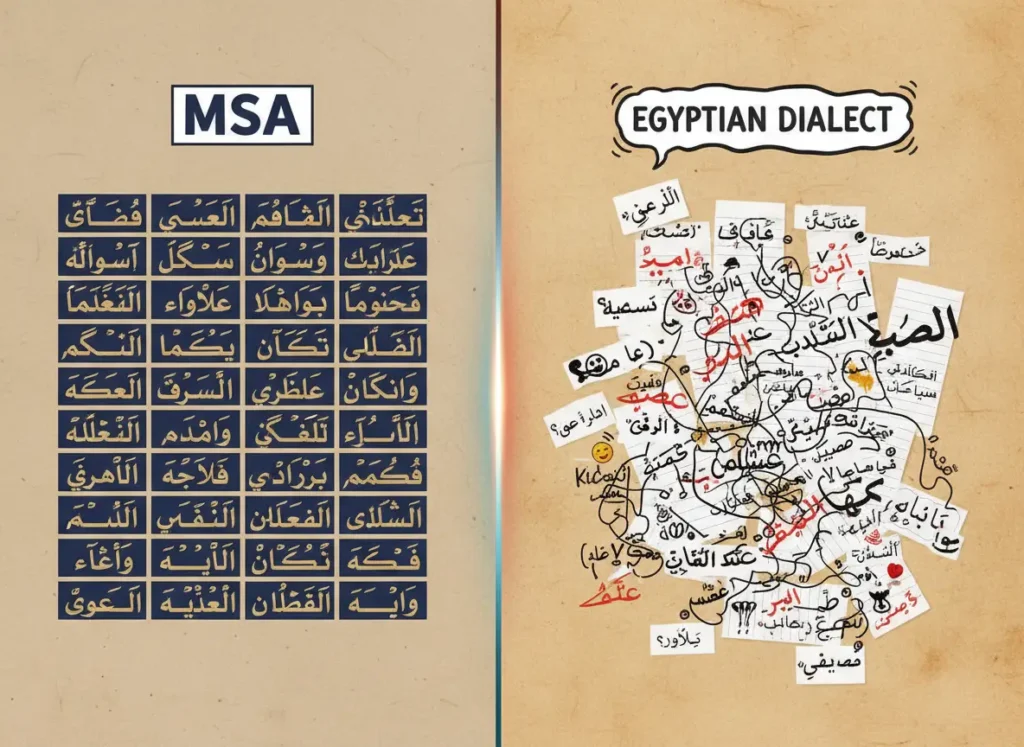
MSA vs. Arabic Dialects: The Most Important Thing You’ll Ever Learn
Here’s the thing most courses won’t tell you upfront: no Arab country uses Modern Standard Arabic (MSA) in daily life.
Not one.
A person in Cairo speaks Egyptian Arabic. Someone in Casablanca speaks Moroccan Darija. A colleague in Beirut speaks Lebanese Arabic. When educated Arabs attend a conference or read the news — yes, they switch to MSA. But at home, at work, with friends, and in shops? They speak their local dialect.
This is called diglossia — the coexistence of two distinct varieties of the same language. Understanding this one fact changes everything about how you should approach Arabic.
Here’s a simple way to think about it:
| MSA (الفصحى) | Dialects (العامية) | |
|---|---|---|
| Where you’ll see it | Books, news, official speeches | Daily conversation, social media, music, films |
| How it sounds | Formal, complex, uniform | Relaxed, regional, human |
| Why you need it | Reading, writing, formal contexts | Actually talking to people |
MSA is the elegant formal suit. Your dialect is what you actually wear every day.
The biggest mistake beginners make? Choosing only one.
The solution is Dual Proficiency — and it’s simpler than it sounds:
- Months 1–2: Learn the Arabic alphabet and basic MSA sentence structure.
- Month 3 onwards: Start layering your chosen dialect on top. Use MSA as your reading foundation. Use the dialect for speaking.
- The 60/40 Rule: Spend 60% of your study time on your dialect (for speaking ability) and 40% on MSA (for literacy and comprehension).
Want a deeper breakdown of MSA vs. dialects for your specific goals? Read our full comparison: Modern Standard Arabic Online: The Honest 2026 Guide.
The 5 Major Arabic Dialect Families — Explained Clearly

There are dozens of local varieties, but Arabic dialects cluster into five major families. Here’s what you actually need to know about each one.
Egyptian Arabic (مصري) — The Most Widely Understood Dialect
Where: Egypt. Over 100 million speakers.
The vibe: Confident, funny, direct. Egypt has dominated Arab cinema, music, and TV for over a century — which means Egyptian Arabic is understood across the entire Arab world. Even someone in Morocco or Iraq will follow an Egyptian conversation without much trouble.
Key pronunciation features:
- The letter ج (jeem) becomes a hard G — so جمل (camel) sounds like gamal
- The letter ق (qaf) becomes a glottal stop ‘ — so قلب (heart) sounds like ‘alb
- Negation uses ما…ش — ما عرفش means “I don’t know”
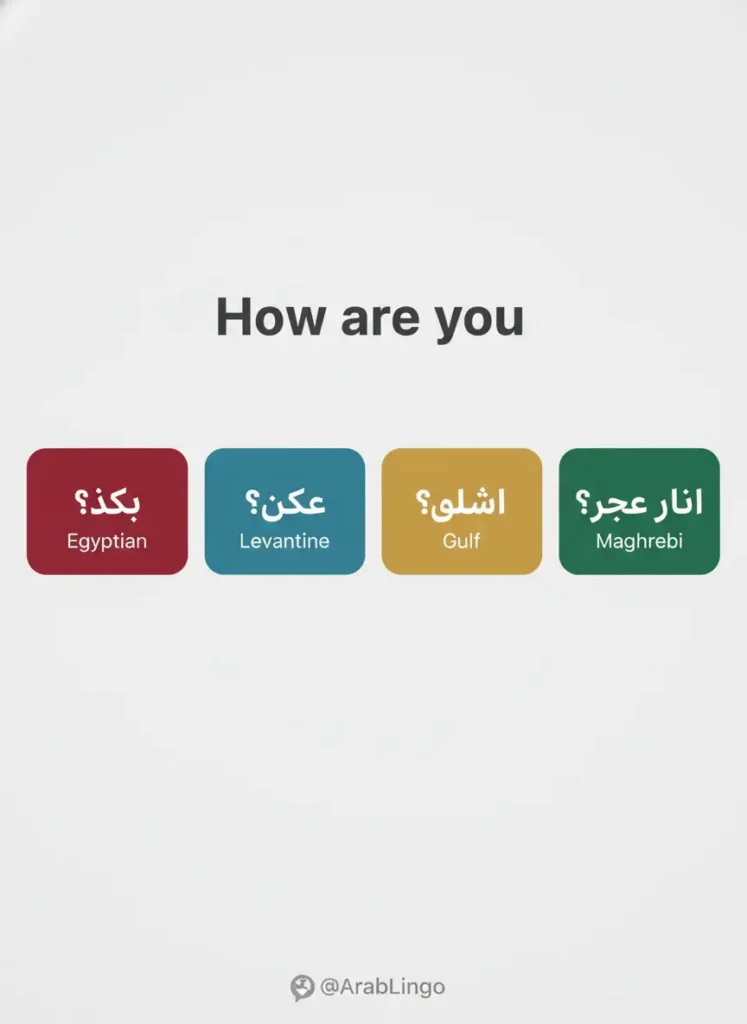
Key phrase: إزاي؟ (izzay?) — “How are you?”
Who should learn it?
- Anyone who wants the most transferable dialect in the Arab world
- Lovers of Arabic film, music, and pop culture
- People traveling to or working in Egypt
- Beginners who aren’t sure which dialect to pick
Egyptian Arabic also has the most available learning resources — tutors, courses, media, apps. It’s the easiest dialect to find support for.
For a deep dive into pronunciation, grammar, and the most effective learning methods, read: Learn Egyptian Arabic: The Best Full Guide.
Levantine Arabic (شامي) — The Melodic Business Dialect
Where: Jordan, Palestine, Lebanon, Syria.
The vibe: Polite, musical, and professional. Levantine is often described as the most “melodic” Arabic dialect. It’s also a common choice in regional business environments because it’s clear and relatively close to MSA in structure.
Key features:
- Softer sounds than Egyptian Arabic
- The ق (qaf) becomes a glottal stop in most urban areas
- Distinctive future tense marker رح — رح أروح means “I will go”
- Grammar that feels close to what MSA learners already know
Key phrase: شو؟ (shu?) — “What?”
Who should learn it?
- Professionals working across the Middle East
- NGO workers, journalists, and diplomats in the Levant
- Learners who want a dialect close to MSA for a smoother transition
- Anyone drawn to Jordanian, Lebanese, or Syrian culture
Levantine also has excellent media — Syrian and Lebanese dramas are wildly popular, and podcasts like “Sarde After Dinner” make listening practice genuinely enjoyable.
To get started with Jordanian Arabic specifically, read: The 10 Tips to Learn Jordanian Arabic Online.
Gulf Arabic (خليجي) — The Language of Economic Power
Where: UAE, Saudi Arabia, Qatar, Kuwait, Bahrain, Oman.
The vibe: Traditional yet global. Gulf Arabic carries deep Bedouin heritage while being spoken in some of the world’s most economically powerful cities — Dubai, Riyadh, Doha. If your career touches finance, tech, energy, or luxury hospitality in the GCC, this is your dialect.
Key features:
- The ق (qaf) becomes a G sound — قهوة (coffee) becomes gahwa
- The ك (kaf) can become a Ch (چ) sound in some contexts
- Rich vocabulary around hospitality, trade, and desert life
Key phrases:
- شلونك؟ (shlonak?) — “How are you?”
- ويش؟ (wesh?) — “What?”
Who should learn it?
- Professionals relocating to or working in Gulf states
- Anyone in finance, energy, tech, or luxury tourism in the GCC
- Expats wanting genuine social integration in the UAE, Qatar, or Saudi Arabia
Gulf Arabic resources have grown significantly in recent years. For a full breakdown of tools and strategies, read: The 10 Best Ways to Learn Gulf Arabic Online.
Iraqi Arabic (عراقي) — The Poetic Soul
Where: Iraq.
The vibe: Deep, expressive, and resilient. Iraqi Arabic sits at a fascinating crossroads — it shares features with both Gulf and Levantine dialects while carrying its own distinct Mesopotamian character. If you love history, poetry, and cultural depth, Iraqi Arabic will captivate you.
Key features:
- Famous for its چ (Ch) sound — a defining feature of the dialect
- The ق (qaf) in Baghdad is typically a G
- Rich vocabulary borrowed from Persian, Turkish, and Aramaic, reflecting thousands of years of cultural exchange
Key phrase: شلونك؟ (shlonak?) — “How are you?” (same word as Gulf, but with a completely different intonation and rhythm)
Who should learn it?
- Professionals in development, reconstruction, or diplomacy in Iraq
- Heritage learners reconnecting with Iraqi roots
- Academics and historians studying Mesopotamian culture
- Anyone fascinated by Iraq’s rich literary and musical tradition (Iraqi Maqam music is extraordinary)
For resources, tools, and a structured approach to learning this dialect, see: The 10 Resources to Learn Iraqi Arabic Online Fast.
Maghrebi Arabic (مغربي / دارجة) — The Adventurous Challenge
Where: Morocco, Algeria, Tunisia, Libya.
The vibe: Fast, rhythmic, and unlike anything else in the Arabic-speaking world. Maghrebi dialects are a tapestry of Arabic, Berber (Amazigh), and French (or Spanish in some areas) — which makes them fascinating, unique, and genuinely challenging for learners coming from MSA.
Key features:
- Very fast speech with many short vowels dropped entirely
- Heavy borrowing from French: la cuisine becomes كوزين, le bureau becomes البيرو
- Berber influence: بزاف (bezzaf) means “a lot”
- Sounds quite different from Eastern Arabic dialects
Key phrase: واش؟ (wash?) — “What?” (Morocco and Algeria)
Who should learn it?
- Travelers and professionals focused on North Africa
- French speakers — your background gives you a genuine advantage here
- Heritage learners from Morocco, Algeria, Tunisia, or Libya
- Adventurous learners who want a rewarding challenge
Honest warning: Maghrebi is the hardest dialect for most learners. But if this is your target region, it’s absolutely worth it. For the Algerian variant specifically, read: Best Way to Learn Algerian Arabic Online.
Quick Phrase Comparison Across All 5 Dialects
| Phrase | Egyptian | Levantine | Gulf | Iraqi | Maghrebi |
|---|---|---|---|---|---|
| “How are you?” | إزيك؟ izzayk? | كيفك؟ keefak? | شلونك؟ shlonak? | شلونك؟ shlonak? | لاباس؟ labas? |
| “What?” | إيه؟ eh? | شو؟ shu? | ويش؟ wesh? | شنو؟ shnu? | واش؟ wash? |
| “I don’t know” | ما عرفش ma3rafsh | ما بعرف ma ba3ref | ما أدري ma adri | ما أعرف ma a3ref | ما ناضرش ma nadrsh |
| “Good/Fine” | كويس kwayyes | منيح mneeh | زين zayn | زين zayn | مزيان mzyan |
How to Choose Your Dialect: A 5-Step Framework
This is the most important decision you’ll make as an Arabic learner. Don’t guess. Work through these five steps.
Step 1: What Is Your Primary Goal?
- Travel and tourism → Learn the dialect of your destination
- Business and career → Gulf for the GCC; Levantine or Egyptian for pan-regional work
- Family and heritage → The choice is already made. Learn your family’s dialect
- Media and culture → Egyptian for classic cinema; Levantine for modern TV series
Step 2: Where Will You Actually Use It?
- Single country → Learn that country’s dialect
- Regional work (multiple countries) → Egyptian (most widely understood) or Levantine (clear, business-friendly)
- Gulf states specifically → Gulf Arabic, full stop
Step 3: What Resources Are Available?
- Easiest to find resources: Egyptian, then Levantine
- Medium and growing: Gulf Arabic
- More specialized: Iraqi and Maghrebi (require more intentional searching)
If you’re a beginner with limited time to hunt for resources, Egyptian Arabic is the practical choice.
Step 4: How Transferable Does It Need to Be?
| Dialect | Transferability |
|---|---|
| Egyptian | Highest — understood across all 22 Arab countries |
| Levantine | High — especially in business contexts |
| Gulf | Growing — due to economic influence |
| Iraqi | Regional — essential in Iraq |
| Maghrebi | Mostly local — but French speakers gain extra reach |
Step 5: Be Honest About the Challenge Factor
- Easiest transition from MSA: Levantine, then Egyptian
- Moderate challenge: Gulf, Iraqi
- Highest challenge: Maghrebi dialects
Your answer: Write this down — “I am learning [Dialect] because [Primary Goal].” That sentence will keep you focused when studying gets hard.
How to Learn Arabic Dialects at Home: Practical Strategies That Work
You don’t need to move to Cairo or Amman to get fluent. In 2026, you can learn an Arabic dialect effectively from home — if you use the right methods.
Here’s what actually works.
1. The 20-Minute Daily Media Rule
Spend 20 minutes every single day consuming native content in your target dialect. Not studying. Consuming. Watch, listen, absorb.
- Egyptian: Classic films (Omar Sharif era), modern series, Amr Diab music, Egyptian comedy shows
- Levantine: Syrian and Lebanese dramas (Bab Al-Hara), “Sarde After Dinner” podcast, Fairuz music
- Gulf: Emirati and Saudi YouTube vloggers, Khaleeji music playlists on Spotify, Gulf TikTok reels
- Iraqi: Iraqi talk shows on YouTube, traditional Maqam music, Iraqi stand-up
- Maghrebi: Algerian and Moroccan Rai music, Darija YouTube channels, North African films
Don’t wait until your vocabulary is “good enough.” Start now. Your brain picks up patterns before you consciously recognize them.
2. Master the Core 200 First
Every dialect has roughly 200 high-frequency words that make up about 70% of daily conversation.
Learn those first. Everything else can wait.
Use spaced-repetition apps — Anki is free and excellent. Build a deck specifically for your target dialect’s core vocabulary. Spend 10 minutes a day on it. By week 6, you’ll recognize the skeleton of almost every sentence you hear.
3. The Shadowing Technique
This one builds your accent faster than anything else.
- Find a short audio clip (1–2 sentences) from a native speaker in your dialect
- Listen once
- Pause
- Repeat it aloud, copying the exact pronunciation, rhythm, and intonation
- Do this for 5–10 minutes daily
You’re building muscle memory. Your mouth is learning the physical shapes of the dialect. It feels awkward at first. It stops feeling awkward by week 3.
4. Find a Dialect-Specific Tutor
This is non-negotiable if you want to progress past a basic level.
Don’t settle for a generic “Arabic” tutor. Find a native speaker from your target region who teaches their own dialect to learners.
At Alphabet Arabic Academy, our teachers are native Egyptian Arabic speakers — certified, experienced, and trained specifically in teaching Arabic to non-native learners. We have students from 80 countries and a 4.9/5 rating on Trustpilot. View our course pricing options to find a plan that fits your schedule and budget.
5. A Realistic Weekly Schedule
Here’s what 20–30 minutes a day actually looks like in practice:
- Monday / Wednesday / Friday: 20 minutes Anki flashcards (Core 200 vocab) + 10 minutes shadowing
- Tuesday / Thursday: 30-minute lesson with your tutor
- Saturday: Watch one episode of a show in your target dialect (no subtitles if possible)
- Sunday: Free listening session — music, podcast, or YouTube. Don’t overthink it. Just enjoy
Consistency beats intensity every single time.
Common Mistakes Arabic Dialect Learners Make (And How to Fix Them)
Let me tell you about Omar.
He’s a Syrian-American who grew up hearing Arabic at home — but never speaking it. He could understand his grandmother’s Lebanese dialect when she spoke slowly. But responding? Reading? Writing? Nothing.
He tried learning MSA first. “That’s what everyone recommends, right?” Three months later, he could read some news headlines. But he still couldn’t talk to his grandmother.
Then he switched. He chose Levantine Arabic — her dialect. Not the “standard” version. The one she actually spoke.
He found a Lebanese tutor. Focused on the Core 200 words first. Spent 20 minutes daily listening to Fairuz and Lebanese podcasts. Shadowed short clips until his mouth learned the rhythm.
Six weeks later, he called his grandmother. Not to practice. Just to talk.
He told her about his day. In Arabic. Her dialect.
She cried, he told me later. “I’ve waited years to hear you speak like this.”
That’s the difference between learning *about* Arabic and learning to *live* in it.
Omar didn’t learn every dialect. He learned his grandmother’s.
You don’t need to learn them all either. Just the one that connects you to the people you care about.
Mistake 1: Learning Two Dialects at the Same Time
I see this constantly. A learner starts Egyptian Arabic, gets curious about Levantine, and suddenly they’re mixing the two into something no native speaker has ever heard.
The fix: Commit to one dialect for your first year. One. Build the foundation completely before you add anything else.
Mistake 2: Ignoring Culture Entirely
Language without culture is just vocabulary. You’ll sound technically correct but socially tone-deaf.
The fix: Learn why tea (شاي) is central to Iraqi hospitality. Understand how Egyptian humor (فكاهة) works — the timing, the self-deprecation, the wordplay. Know that refusing food in a Gulf home isn’t rudeness, it’s ritual. Culture makes the language make sense.
Mistake 3: Over-Relying on Google Translate
Google Translate is okay for MSA words. It’s genuinely unreliable for dialect. It misses idioms, tone, context, and the soul of how people actually speak.
The fix: Use translation apps for isolated words. Use a real tutor and real media for learning how to speak.
Mistake 4: Being Afraid of “Wrong” Pronunciation
Saying ج as a hard G in Egyptian Arabic isn’t a mistake — it is Egyptian Arabic. Saying gahwa instead of qahwa isn’t wrong — it’s Gulf Arabic.
The fix: Embrace the dialect’s sounds fully. Natives don’t want you to speak their dialect like a formal speech. They want to hear you try. That effort means everything.
Mistake 5: Thinking MSA and Dialect Are Enemies
Some learners go all-in on dialect and completely ignore MSA. Others focus purely on MSA and never learn to speak naturally. Both miss the point.
The fix: Remember the 60/40 rule. They support each other. MSA gives you roots. The dialect gives you branches. You need both.
Who Is This Guide For?
This guide is for you if:
- You’ve been studying MSA and can’t understand anyone when you visit an Arab country
- You’re planning to work, live, or travel in the Arab world and want to actually connect with people
- You’re a heritage learner who wants to speak with your family in their dialect
- You’re a professional in business, NGO work, journalism, or diplomacy in the region
- You’re starting from scratch and want to make the smartest possible first choice
This is NOT for you if:
- Your only goal is reading classical Arabic texts or the Quran (MSA study is what you need — though understanding dialects will still help you)
- You’re looking for a one-size-fits-all “Arabic” course with no specific dialect focus
- You want results without consistent daily practice
Success Stories: What Happens When You Choose Strategically
Michael’s Gulf Breakthrough
Michael was an American engineer in Dubai who’d learned Egyptian Arabic first. Useful, but it didn’t get him invited anywhere. After switching to Emirati Arabic with focused resources, things changed. Within six months, he was following office banter, understanding jokes, and — crucially — received an invitation to a colleague’s home for the first time. That single moment transformed his professional relationships.
Lisa’s NGO Effectiveness
Lisa worked for an NGO in Jordan and committed to Levantine Arabic from her first day on the ground. Within five months, she was conducting field interviews without an interpreter. The trust she built was measurable — her projects moved faster because communities saw her as a person, not a foreign representative behind a translator.
Ahmed’s Heritage Reclaimed
Ahmed was a second-generation Iraqi-American who’d grown up disconnected from his family’s dialect. After working through Iraqi Arabic resources consistently for eight months, he could finally understand his grandparents’ stories, their jokes, their expressions. He described it as “getting my family back.”
Frequently Asked Questions
Q1: Which Arabic dialect should I learn first as a complete beginner?
Egyptian Arabic is the safest starting choice for most beginners. It has the most resources, the most available tutors, and the widest reach across the Arab world. If you have a specific destination or career goal in mind, choose that region’s dialect instead — but when in doubt, start Egyptian.
Q2: Can I understand other dialects once I learn one?
Yes, partially — and more than you’d expect. Egyptian Arabic speakers are understood almost everywhere, so your comprehension will grow naturally. Between Gulf and Levantine there’s meaningful overlap. Maghrebi dialects are the most distinct — even other Arab speakers sometimes struggle to follow them.
Q3: How long does it take to have a basic conversation in a dialect?
With consistent daily practice of 20–30 minutes plus weekly lessons, most learners can hold a basic conversation in 3–4 months. Functional fluency — understanding fast speech, jokes, and nuance — typically takes 12–18 months. The timeline depends heavily on consistency, not intensity.
Q4: Is it possible to learn an Arabic dialect entirely online?
Completely. In 2026, the tools available for online dialect learning are better than ever — native tutors on demand, dialect-specific media, language exchange apps, and AI pronunciation tools. Many of our students at Alphabet Arabic Academy have reached full conversational fluency without ever visiting an Arab country. The key is finding a tutor who actually speaks and teaches your target dialect, not just “Arabic” in general.
Q5: Do I need to learn MSA before starting a dialect?
No — but learning the alphabet and basic MSA sentence structure first (about 4–6 weeks) makes dialect learning significantly easier. The two systems support each other. Think of MSA as the grammar skeleton and the dialect as the living muscles on top.
Q6: Is Maghrebi Arabic really that different?
Honestly, yes. Maghrebi dialects — especially Moroccan Darija and Algerian Arabic — are distinct enough that even Arabic speakers from Egypt or Jordan can struggle to understand them at full speed. The French and Berber vocabulary is substantial. That said, French speakers have a real advantage, and the learning process is deeply rewarding if North Africa is your destination.
Conclusion: Choose Your Dialect, Start Today
Arabic dialects aren’t a barrier between you and the Arab world. They’re the actual doors into it.
MSA will help you read the newspaper. A dialect will help you make a friend.
Sarah — from the introduction of this guide — eventually found her way. She mastered Egyptian Arabic and now runs a successful business in Cairo. But she always says the same thing: “I wish I’d known to choose my dialect strategically from day one. It would have saved me a year of feeling lost.”
You have that knowledge now.
You know the five dialect families. You know how to choose. You know what to do in the first 30 days.
The only thing left is to start.
Ready to take the first step? Take our free Arabic placement test and find out exactly which level and which dialect path is right for you. It takes 5 minutes and gives you a personalized roadmap.
Or if you’re ready to start learning with a native tutor, view our course plans and pricing — lessons start from $60/month with full materials included.
Explore Our Dialect-Specific Deep Dives: