
So you want to learn Arabic. Great. But before you download an app or buy a textbook, there’s something you need to figure out first.
What order do you learn it in?
This sounds like a small question. It’s not. Get the order wrong and you’ll spend months building habits that hold you back. Get it right and everything clicks faster than you expected.
I’ve been teaching Arabic online for years. And the number one reason I see beginners quit isn’t difficulty. It’s confusion. They don’t know where to start, so they start everywhere at once — and go nowhere.
This article fixes that.
Why Order Actually Matters in Arabic
Arabic isn’t English. You can’t just start “picking it up” casually and expect progress. It has a different script, a root-based grammar system, and sounds that don’t exist in most other languages.
If you try to speak before you can read, you’ll mispronounce words and build bad habits you’ll spend years unlearning. If you jump into writing before you understand the basics, you’ll feel lost immediately.
Honestly, the order isn’t magic. But it creates a foundation. Each skill you learn supports the next one. Skip steps and you’re building a house without a floor.
Here’s the order I recommend — and why.
Step 1: Learn the Arabic Alphabet First (Before Everything Else)

I’ll be straight with you — this is where most beginners want to skip ahead, and it’s a mistake.
The Arabic alphabet is not optional. It’s not “something you can do later.” It’s the code you need to read literally anything in Arabic. Without it, you’re completely dependent on transliteration (writing Arabic words in English letters), and transliteration is a trap.
Why is transliteration a trap? Because:
- It doesn’t reflect how Arabic actually sounds
- No real Arabic material uses it
- It makes you dependent on a crutch you’ll eventually have to drop anyway
- It slows your progress significantly
The good news? The Arabic alphabet has only 28 letters. With focused practice, most beginners can recognize all 28 letters in 1–2 weeks. Not master them — recognize them. That’s enough to start reading simple words.
How long should you spend here? 2–4 weeks of daily practice, 20–30 minutes a day. That’s it.
Don’t move on until you can read basic words out loud without looking letters up.
Step 2: Listening and Pronunciation (At the Same Time as Reading)
Here’s the thing most courses get wrong — they separate listening from reading in Arabic, as if they’re two different phases. They’re not. They work together, especially at the beginning.
Once you know the alphabet, you need to connect letters to sounds. That means listening to Arabic while reading it.
Arabic has sounds that don’t exist in English:
- The ع (ayn) — a deep, voiced sound from the throat
- The غ (ghayn) — like a French “r” but deeper
- The خ (kha) — like clearing your throat
- The ح (ha) — a breathy, sharp “h” sound
- Emphatic consonants like ص, ض, ط, ظ
If you’re learning Modern Standard Arabic (MSA), correct pronunciation matters more than people admit. MSA is formal Arabic — used in news, books, education, and official settings. Mispronouncing core sounds will make your Arabic sound off, even if your grammar is perfect.
What to do at this stage:
- Listen to a teacher pronounce each letter
- Repeat aloud immediately
- Record yourself and compare
- Don’t move on from a sound until your mouth can actually make it
This phase runs alongside alphabet learning and continues into the next steps. Your ear and your mouth both need training.
Step 3: Vocabulary and Simple Reading (Weeks 3–8)
Now you can read Arabic script. You know (roughly) how to make the sounds. What next?
Start building vocabulary. Small, useful words. Common nouns. Numbers. Greetings. Basic verbs.
At this stage, reading and vocabulary grow together. When you see a word written in Arabic, sound it out, hear it from a teacher or audio, and connect it to a meaning. That triple connection — visual + audio + meaning — is how language actually gets stored in your brain.
Important note for Arabic specifically: Arabic doesn’t usually write short vowels. The letters ا, و, ي represent long vowels, but short vowels (the little marks above and below letters, called harakat or tashkeel) are often left out in regular text.
This means two things:
- Start with fully vowelized texts — these have all the vowel marks included, making reading much easier
- Understand that reading Arabic for fluent speakers involves guessing short vowels from context — you’ll develop this over time
Don’t panic about this. Start with vowelized material, then gradually reduce it as your vocabulary grows.
Step 4: Speaking — Start Earlier Than You Think
A lot of learners wait too long to speak. They say “I’m not ready yet.” They want to be confident before they open their mouths.
That’s backwards.
You need to speak early — not because you’ll be good at it, but because speaking teaches you things listening and reading can’t. It shows you which sounds your mouth actually struggles with. It forces your brain to retrieve words under pressure, which strengthens memory. And it reveals gaps in your understanding faster than any test.
When is “early enough” to start speaking?
In my experience: after 3–4 weeks. You don’t need much. You need:
- The ability to read Arabic letters
- A small vocabulary (even 50–100 words is enough)
- A patient teacher or speaking partner
You’re not trying to have a conversation at this point. You’re trying to say words correctly, make basic sentences, and get real-time feedback from someone who knows Arabic.
If you’re learning MSA, this is where working with a native Arabic teacher is worth every dollar. Speaking without feedback is practicing mistakes. Speaking with feedback is building skills.
Step 5: Basic Grammar (Not Too Early, Not Too Late)
Arabic grammar has a reputation. People hear about roots, verb patterns, case endings, and masculine/feminine agreement, and they immediately feel overwhelmed.
Here’s my honest take: Arabic grammar is actually quite logical. It’s not random like English spelling. Once you understand the system, things make sense. The problem is when people try to learn grammar before they have any vocabulary or listening exposure.
Grammar with zero vocabulary is just memorizing abstract rules. You learn a rule, but you have no examples in your mind for it to attach to. It evaporates fast.
The better approach:
Start noticing grammar patterns in the vocabulary and sentences you already know. Then, around week 6–8, begin explicitly learning:
- Masculine and feminine nouns
- How pronouns attach to words
- Basic verb conjugation in the present tense
- Sentence structure (Arabic often puts the verb first)
For MSA specifically, grammar is central to the language. Unlike spoken dialects, MSA uses full case endings and formal grammar rules. If you’re planning to learn Modern Standard Arabic, you’ll need to invest in grammar — but at the right time, with real context.
Step 6: Writing — Last, But Not Least
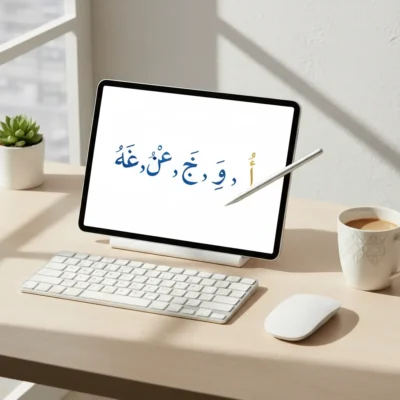
Writing is last in the order. Not because it’s least important, but because it requires everything else to be in place first.
To write Arabic well, you need:
- To know the alphabet (obviously)
- To understand how letters connect (Arabic is cursive — letters change shape depending on their position in a word)
- Some vocabulary to write with
- At least basic grammar so your sentences make sense
Most beginners can start practicing writing individual letters and simple words during the alphabet phase. But writing actual sentences and paragraphs comes later — after you’ve built a foundation in reading, listening, and speaking.
One thing that surprises learners: Arabic is written right to left. This feels strange at first, but most people get used to it within a week or two of consistent practice. It becomes natural quickly.
The Full Order, Summarized
Let’s put it all together clearly:
| Phase | What You’re Doing | Approximate Timeline |
|---|---|---|
| 1 | Arabic alphabet + letter sounds | Weeks 1–2 |
| 2 | Pronunciation + listening | Weeks 2–4 (ongoing) |
| 3 | Vocabulary + simple reading | Weeks 3–8 |
| 4 | Speaking — basic sentences | Weeks 4–8 (ongoing) |
| 5 | Grammar — structured learning | Weeks 6–12 |
| 6 | Writing — sentences and beyond | Weeks 8+ |
These aren’t rigid boxes. There’s overlap. In fact, there should be overlap. By week 6, you’re doing all four skills simultaneously — reading, listening, speaking, writing — just with different levels of focus.
The Biggest Mistake Beginners Make
I’ve seen this pattern hundreds of times.
Someone starts learning Arabic. They’re motivated. They spend a week on the alphabet. Then they download an app that throws them into speaking immediately — before they can read properly. Or they watch YouTube videos passively for weeks without ever opening their mouth. Or they buy a grammar textbook and read chapter after chapter without touching actual Arabic.
Each of these breaks the order. And each of them leads to the same place: frustration, plateau, and usually quitting.
Here’s the thing — consistency beats intensity every single time. Thirty minutes a day, in the right order, with a real teacher giving feedback, will get you further than three hours a day of random studying.
MSA vs. Dialects: Does the Order Change?
Good question.
The order above works for Modern Standard Arabic (MSA) — the formal, written Arabic used across the Arab world. MSA is what you learn if you want to read Arabic news, understand the Quran’s language structure, study Arabic at university, or communicate formally across different Arab countries.
If you’re learning a specific dialect (Egyptian Arabic, Levantine, Gulf, etc.), the order is similar but with some differences:
- Dialects have no standard written form, so writing is less critical early on
- Speaking and listening become even more central from the start
- You still need the alphabet if you want to read anything in Arabic (signs, menus, social media)
- Grammar is less formal but still matters
Not sure which version of Arabic is right for you? A free Arabic placement test can help you figure out where you are and what direction makes sense for your goals.
How Long Does It Actually Take?
Let’s be realistic.
Arabic is listed by the US Foreign Service Institute as one of the hardest languages for English speakers — roughly 2,200 hours to reach professional proficiency. That sounds terrifying. But that’s for professional-level work in a diplomatic context.
If your goal is to read Arabic text, have real conversations, understand the news, and communicate with Arab speakers? That’s achievable in 1–3 years of consistent study. Not 2,200 hours of pure torture — just daily, structured practice.
What speeds it up:
- A structured curriculum (not random apps and YouTube)
- A real teacher with feedback
- Consistent daily practice — even 30 minutes counts
- Speaking early and often
- Not skipping the alphabet phase
What slows it down:
- Starting with transliteration
- Passive listening without active practice
- Studying grammar before you have vocabulary
- Taking long breaks (weeks or months)
So Where Do You Actually Start?
If you’ve read this far, here’s your action plan:
Day 1: Start with the Arabic alphabet. Learn the 28 letters. Just the shapes. Connect them to sounds. Practice writing them. Do nothing else for the first week.
Week 2: Start connecting letters to simple words. Hear them spoken by a native teacher. Repeat aloud. Start training your ear.
Week 3–4: Begin speaking — even if it’s just alphabet drills and single words with a teacher. Get feedback.
Month 2+: Build vocabulary, start reading simple sentences, begin basic grammar. Keep speaking every week.
If you want a structured path through all of this — with native teachers who know how to teach non-Arabic speakers — check out the Modern Standard Arabic courses at Alphabet Arabic Academy. The courses take you from zero to confident communicator, step by step, in the right order.
You can also check our pricing page to see what fits your budget, or take a free Arabic level test if you’ve already started learning and want to know where you actually stand.
Final Thought
Learning Arabic isn’t about talent. It’s not about being “a language person.” It’s about following the right order, consistently, with good guidance.
The people who succeed aren’t the ones who studied the hardest in the first month and then burned out. They’re the ones who built the foundation correctly — alphabet, then sounds, then vocabulary and reading, then speaking, then grammar, then writing — and kept showing up.
Start with the alphabet. Everything else follows.
Ready to try it with a real teacher? Book a free trial lesson with Alphabet Arabic Academy and start your Arabic journey the right way: 👉 Try a Free Trial Lesson