
You stare at the page. The letters look like waves. Or maybe like a drawing a child made with their eyes closed.
You think: “How is anyone supposed to read this?”
I get it. I’ve seen hundreds of beginners sit exactly where you’re sitting right now. And the truth is — Arabic looks scary before you understand how it works. But once you do? It starts to click.
This article is going to walk you through reading your first real Arabic sentence. Not just the alphabet. Not just random letters. An actual sentence, step by step.
Let’s go.
Step 1: Understand How Arabic Actually Works
Before you read a single word, you need to know three things about Arabic. These three things explain everything.
1. Arabic reads right to left.
Yes, the opposite of English. Left to right feels natural to you because you grew up with it. Right to left will feel weird for about two weeks. Then it becomes normal. Don’t overthink it.
2. Arabic is mostly written without short vowels.
This is the part nobody warns beginners about. In Arabic books, newspapers, and websites — the short vowel marks (called harakat حركات) are usually missing. Beginners need them. Advanced readers don’t. For now, we’ll use fully vowelized text so you can actually read.
3. Arabic letters change shape depending on their position.
The same letter looks different at the beginning, middle, and end of a word. It sounds like a nightmare. It’s actually not that bad once you’ve seen a few examples.
OK. Now you’re ready.
Step 2: Learn the Three Short Vowels First
I’ll be straight with you — you can’t read Arabic without knowing these. They’re the engine behind every word.
There are three short vowels in Arabic:
| Vowel | Symbol | Sound | Example |
|---|---|---|---|
| Fatha | ـَ | “a” as in “cat” | بَ = ba |
| Kasra | ـِ | “i” as in “bit” | بِ = bi |
| Damma | ـُ | “u” as in “put” | بُ = bu |
And there’s one more sign you need:
Sukun (ـْ) — this means no vowel. The letter is silent at the end, or it forms a closed syllable.
That’s it. Four symbols. Once you know these, you can technically read any fully vowelized Arabic word out loud — even if you don’t know what it means yet.
Step 3: Meet the Letters in Your First Sentence
We’re going to read this sentence:
الْبَيْتُ كَبِيرٌ
(Al-baytu kabīrun)
Meaning: “The house is big.”
Why this sentence? Because it’s simple. Two words. A noun and an adjective. No verb needed — Arabic often drops “is” completely. And it shows you exactly how Arabic sentence structure works.
Let’s break it down.
Step 4: Break the Sentence Into Pieces
Word 1: الْبَيْتُ (Al-baytu) — “The house”
Start from the right.
أ + لْ = Al-
This is alif lam (ال) — the Arabic equivalent of “the.” It’s a prefix, not a separate word. And that little sukun on the lam (لْ) tells you the lam has no vowel — you go straight from “al” into the next letter.
بَ = ba
The letter ba (ب) with a fatha on top. Read it: ba.
يْ = y
The letter ya (ي) with a sukun. No vowel after it — it becomes a long “ay” sound when combined with the ba before it.
تُ = tu
The letter ta (ت) with a damma. Read it: tu.
Put it together: Al-bay-tu. Say it out loud. It means “the house.”
Word 2: كَبِيرٌ (Kabīrun) — “Big”
كَ = ka
Kaf (ك) with a fatha. Easy: ka.
بِ = bi
Ba (ب) with a kasra. Read: bi.
يـ = ī
Ya (ي) without a sukun here — it stretches the bi sound into a long bī.
رٌ = run
Ra (ر) with a special double damma on top called tanwin (ـٌ). It adds an “n” sound at the end. So it’s not just ru — it’s run.
Put it together: Ka-bī-run. It means “big.”
Step 5: Read the Full Sentence
Now put both words together, reading right to left:
الْبَيْتُ كَبِيرٌ
Al-baytu kabīrun.
The house is big.
Say it again. Slower this time. Feel where each sound lives.
Al — bay — tu — ka — bī — run.
That’s your first Arabic sentence. You just read it.
Step 6: Understand the Grammar (It’s Simpler Than You Think)
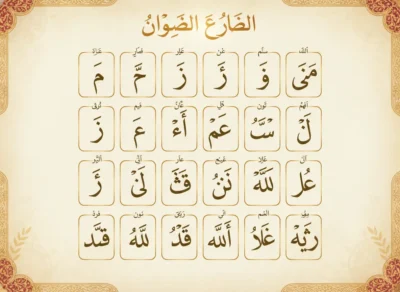
Here’s the thing about Arabic sentence structure that surprises most beginners.
Arabic doesn’t need a verb to say “the house is big.”
In English, you need “is.” In Arabic, you just put the noun next to the adjective and the meaning is implied.
الْبَيْتُ كَبِيرٌ = The house [is] big.
This is called a nominal sentence (جملة اسمية). It’s one of the most common sentence types in Arabic — especially in the Quran and in formal written Arabic (Modern Standard Arabic).
Once you understand this, reading short Arabic sentences becomes much easier.
Step 7: Try Two More Sentences
Don’t stop at one. Let’s cement this.
Sentence 2: الْوَلَدُ سَعِيدٌ
Al-waladu saʿīdun.
The boy is happy.
- الْوَلَدُ = the boy
- سَعِيدٌ = happy
Same structure. Noun + adjective. No verb.
Sentence 3: الْكِتَابُ جَدِيدٌ
Al-kitābu jadīdun.
The book is new.
- الْكِتَابُ = the book
- جَدِيدٌ = new
You see the pattern now, right?
The definite article (ال) attaches to the noun. The adjective gets tanwin at the end. The whole thing makes a complete sentence.
Common Mistakes Beginners Make When Reading Arabic
Honestly, most of these are avoidable. But almost everyone makes them.
Mistake 1: Ignoring the vowel marks.
Beginners sometimes try to skip the harakat and guess. Don’t. At this stage, every mark matters. Read exactly what’s written.
Mistake 2: Reading left to right by accident.
It happens, especially when you’re tired. If a word sounds wrong, check your direction.
Mistake 3: Confusing letters that look similar.
Arabic has a few letter groups that look almost identical. The difference is the dots. ب، ت، ث — these are the same base shape with 1, 2, or 3 dots. Pay attention to the dots. They’re not decoration.
Mistake 4: Rushing.
I see this constantly. People try to read fast before they can read accurately. Slow down. Accuracy first. Speed comes later on its own.
Mistake 5: Not reading out loud.
Arabic is a spoken language. Reading silently at the beginning slows you down. Say the sounds. Hear yourself. Your mouth needs practice too.
What Comes After Your First Sentence?

OK so you read your first sentence. What now?
Here’s the honest answer: you need to build the foundation properly.
And if you’re wondering about the method — here it is, simple and direct: learn the letters, learn the vowels, then read real sentences starting from the right. That’s it. That’s the method. Everything else is just practice on top of that foundation.
Reading one sentence is a win. But to actually read Arabic — books, Quran, news, messages — you need:
- All 28 letters and their different forms
- The vowel system (harakat) solid in your memory
- Common patterns — most Arabic words follow predictable root patterns
- Practice with real text, not just made-up examples
This doesn’t happen in a day. But it also doesn’t take years if you have the right structure.
If you’re not sure where you stand right now — whether you’re a complete beginner or already have some foundation — take our free Arabic placement test. It takes about 10 minutes and tells you exactly which level to start from.
A Note on Modern Standard Arabic vs. Colloquial Arabic
Quick thing worth saying.
The sentence we read today — الْبَيْتُ كَبِيرٌ — is Modern Standard Arabic (MSA). This is the Arabic used in books, news, the Quran, and formal writing. It’s the backbone of the language.
It’s different from spoken Egyptian Arabic or Lebanese Arabic, which have their own vocabulary and grammar patterns.
If your goal is to read — books, Quran, newspapers, formal documents — MSA is where you start. If your goal is to have conversations with native speakers in a specific country, you’ll eventually want to learn the dialect too.
But for reading? Start with MSA. Every time.
Your Next Steps
Let’s keep this simple.
- Practice the three sentences from this article until you can read them without stopping
- Work on the 28 letters if you haven’t already — you can’t read without them
- Get a teacher who can correct your pronunciation in real time — this matters more than most people think
Want to know which level fits you best before committing to anything? Check out our course pricing — it’s laid out clearly so you’re not guessing.
And if you want to meet the people who’ll actually be teaching you, take a look at our teachers page first.
Ready to read your first page — not just your first sentence? جرّب درسًا تجريبيًا — try a free trial lesson with one of our teachers. No pressure. Just Arabic.
Reading Arabic isn’t magic. It’s a system. And systems can be learned.
You already read your first sentence today. That’s not nothing. That’s the start of something real.