arabic alphabet vs pronunciation So you’ve decided to learn Arabic. Great.
And like most beginners, the first thing you did was Google “Arabic alphabet” and start memorizing letter shapes.
Stop for a second.
Not because that’s wrong. But because there’s something most beginners don’t understand before they start — and it ends up costing them weeks, sometimes months, of going in the wrong direction.
Here’s the honest truth: Learning the Arabic alphabet without understanding pronunciation is like buying a car without wheels. You have the shape. You have no movement.
The question isn’t just “what are the Arabic letters?” It’s this: Should you learn the Arabic alphabet first, or focus on pronunciation first?
Let me give you the answer now, then I’ll prove it to you.
The Mistake Most Beginners Make (And Why You Might Be Making It Right Now)
Here’s what usually happens.
You open a beginner’s guide. You see 28 letters. You start memorizing shapes. You practice writing ب and ت and ث over and over. Maybe you learn the names of the letters too.
Two weeks later, you can kind of recognize the alphabet. You feel good.
Then you try to actually speak a word in Arabic.
It comes out completely wrong.
You try again. Nothing. You try a third time, and your roommate asks if you are okay.
You close the app.
Why? Because you’ve been learning shapes without understanding sounds.
That’s the gap. And it’s a big one.
What’s the Actual Difference Between the Alphabet and Pronunciation?
Let me make this simple.
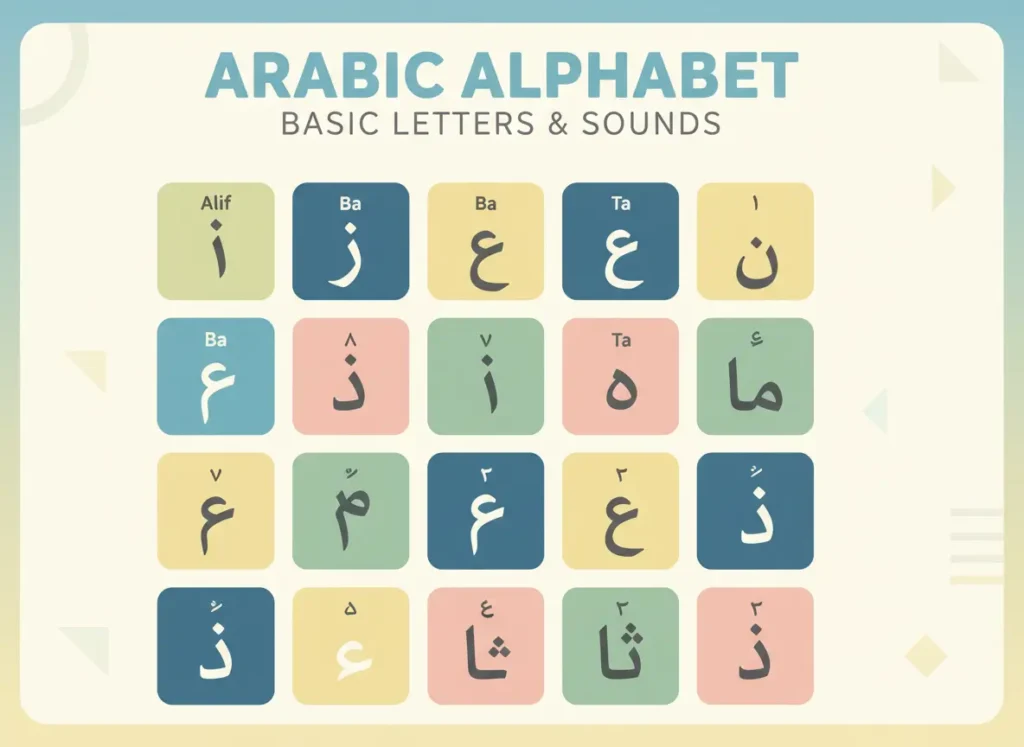
The Arabic alphabet is the written system. 28 letters. Each one has a shape — actually four shapes depending on where it falls in a word. You read and write with the alphabet.
Arabic pronunciation is how those letters sound. And this is where it gets interesting, because Arabic has sounds that don’t exist in English. At all.
Letters like:
- ع (ayn) — a kind of constricted vowel sound from deep in your throat
- غ (ghayn) — like the French “r” but stronger
- ح (ha) — a breathy, whispered “h” from the back of your throat
- خ (kha) — like clearing your throat softly
None of these have an English equivalent. You can’t “just sound it out” like you do in Spanish or Italian.
So here’s the thing: you can memorize every single letter in the Arabic alphabet — know the shape, know the name, know the position — and still have absolutely no idea how to pronounce a word correctly.
So Which Comes First? (The Honest Answer)

Honestly? You need both — but in the right order and with the right balance.
Phase 1: Learn letters AND sounds together.
Don’t separate them. When you learn the letter ب (ba), don’t just learn the shape. Learn how it sounds. Practice saying it. Get that sound into your mouth and your ear at the same time as the visual shape.
Here’s the trap most beginners fall into: treating Arabic like a secret code to decode — memorizing letter names and shapes, hoping the sounds will sort themselves out later.
They won’t.
Phase 2: Focus extra attention on the sounds that don’t exist in English.
There are about 8–10 Arabic letters whose sounds are genuinely new for English speakers. These are the ones that need real practice — ideally with a native speaker giving you real-time feedback.
Letters like: ع، ح، خ، غ، ق، ص، ض، ط، ظ
Here’s the honest truth: If you breeze past these without really nailing the pronunciation, you’ll spend the rest of your Arabic journey sounding wrong. And it’s much harder to unlearn bad pronunciation habits than to get them right at the start.
Phase 3: Start reading as soon as you know 7–10 letters.
You don’t need to finish the alphabet before you start reading words. As soon as you know a handful of letters, start sounding out simple words that use only those letters. It speeds up your learning dramatically.
The 7 Trickest Arabic Letters for English Speakers (And How to Say Them Right)
Instead of listing all 28 letters (which you can find in our complete alphabet guide), let me focus only on the letters that actually confuse beginners.
These are the letters that have no equivalent in English. Master these, and your Arabic pronunciation will be better than 80% of learners.
1. ع (Ain)
- The mistake: Say it like a simple ‘a’ or ignore it completely.
- The truth: This sound comes from deep in your throat. Imagine someone gently pressing on your throat while you say a very low “a”.
- Practice trick: Say “a” normally. Then, tighten your throat muscles and try again. That strange, creaky sound is ع.
2. ح (Haa)
- The mistake: Say it like the English ‘H’ in “hello”.
- The truth: ح comes from the middle of your throat. It sounds like a whisper, or like fogging up a window.
- Practice trick: Open your mouth and breathe out warmly, like you are fogging a mirror. That is ح.
3. غ (Ghain)
- The mistake: Say it like a hard ‘G’ or ignore it.
- The truth: غ is the French ‘R’. It comes from the very top of the throat.
- Practice trick: Gargle water. That vibration? That is غ.
4. خ (Khaa)
- The mistake: Say it like ‘K’ or ‘H’.
- The truth: خ sounds like the ‘CH’ in the Scottish word “Loch” or the German “Bach”.
- Practice trick: Whisper “K” but force air through the back of your throat.
5. ق (Qaaf)
- The mistake: Say it like ‘K’ or ‘G’.
- The truth: ق comes from the very back of your tongue touching your soft palate.
- Practice trick: Say “coo” (like a pigeon). Feel where your tongue touches. Now push that touch further back until it clicks.
6. ص (Saad) – The “Heavy” S
- The mistake: Say it like normal ‘S’ (س).
- The truth: ص is a “heavy” or “emphatic” S. Your whole mouth tightens and lowers.
- Practice trick: Say “saw” with a wide, heavy mouth. Do not let your lips spread into a smile.
7. ض (Daad) – The Letter Only Arabic Has
- The mistake: Say it like ‘D’ or ‘D’ with a lisp.
- The truth: ض comes from the side of your tongue touching your upper back teeth.
- Practice trick: Say “duck”. Now, keep your tongue wide and press the side of your tongue against your upper left or right molars.
Quick Real-World Examples (Since You Asked)
How do Muslims say “I love you”?
In Modern Standard Arabic: أُحِبُّكَ (uhibbuka — to a male) or أُحِبُّكِ (uhibbuki — to a female).
Informally in Egyptian Arabic: بحبك (bahibbak — to a male) or بحبك (bahibbik — to a female).
Notice how the letters are the same underneath — ح ب — but the pronunciation (and the short vowels) shift between MSA and dialect.
How do Egyptians say “let’s go”?
يلا (yalla). Short, punchy, universal. You’ll hear this everywhere in Egypt — and across the Arab world honestly, since Egyptian Arabic is the most widely understood dialect.
How Many Hours Does It Actually Take to Learn Arabic?
Let me be straight with you. The honest answer depends on what you mean by “learn.”
The US Foreign Service Institute (FSI) classifies Arabic as a Category IV language — the hardest category for English speakers. Their estimate is 2,200 classroom hours to reach professional working proficiency.
I know that sounds terrifying. But here’s context:
| Your Goal | Approximate Hours | What You Can Do |
|---|---|---|
| Learn the alphabet + basic pronunciation | 10-15 hours | Recognize all letters and their sounds |
| Pronounce all letters correctly (including the tough ones) | 20-30 hours with a teacher | Sound out any word slowly. A native speaker understands you. |
| Hold a 2-minute conversation | 60-80 hours | Introduce yourself, where you’re from, your job |
| Read a short news headline | 150-200 hours | Feel a real sense of achievement |
| Watch a movie with Arabic subtitles (50% understanding) | 400-600 hours | Notice real progress |
The most important number: The first 20-30 hours decide if you continue or quit.
In those early hours, you don’t need an app. You need a real human who can hear your mistakes and correct your throat position.
The Most Common Mistakes Beginners Make (And How to Fix Them)

Let me share real mistakes from real learners on Reddit and Quora.
Mistake #1: “I learned the alphabet, but I still can’t read.”
Why this happens: You learned letter names, not letter sounds inside words.
The fix: After every 3-4 letters, practice reading real short words.
Example: After learning ب (B), ت (T), ن (N), practice reading بنت (bint – girl) and تبن (tibn – straw).
Mistake #2: “I cannot hear the difference between س (Seen) and ص (Saad).”
Why this happens: Your brain filters out sounds that don’t exist in English.
The fix: This is called “minimal pair training.” You need a native speaker to say the two sounds side-by-side while you guess which is which.
Mistake #3: “I practice every day with an app, but I freeze when a real person speaks.”
Why this happens: Apps teach you isolated words. They don’t teach you to process fast, connected speech.
The fix: From week one, listen to natural Arabic even if you understand nothing. Let your ears get used to the rhythm.
Mistake #4: Learning letter names instead of letter sounds.
The fix: Focus on the sound, not the name. The name is “ba” — but what matters for reading is the sound it makes in a word.
Mistake #5: Not getting pronunciation feedback early.
The fix: You can’t fix what you can’t hear. A native speaker in the first few weeks will save you from habits that take years to correct.
Your 4-Week Action Plan (To Avoid Wasting Time)
This plan assumes you study 5-6 hours per week. Follow it, and you will be ahead of 90% of beginners.
Week 1: Letters & Sounds (The first 8 letters)
- Focus: ا، ب، ت، ث، ج، ح، خ، د
- Daily task (30 min): Learn the sound of each letter, not just the name. Use a mirror to watch your mouth and throat.
- Pronunciation target: Master ح (the throaty H) and خ (the ‘Loch’ sound).
Week 2: More Letters & Real Words (Letters 9-16)
- Focus: ذ، ر، ز، س، ش، ص، ض، ط
- Daily task (30 min): After learning each letter, practice reading 3-4 real words that use only the letters you know.
- Pronunciation target: Master the difference between س (normal S) and ص (heavy S).
Week 3: The Difficult Letters (The ‘Special’ Ones)
- Focus: ظ، ع، غ، ف، ق، ك، ل، م
- Daily task (30 min + voice recording): Record yourself saying ع، غ، ق. Compare your recording to a native speaker’s.
- Pronunciation target: Master ع (the throat squeeze) and ق (the back-of-the-tongue ‘k’).
Week 4: Review, Reading, and Real Listening
- Focus: Last letters ن، هـ، و، ي and comprehensive review.
- Daily task: Read one short sentence every day. Then, listen to a 1-minute Arabic clip without subtitles.
- End-of-month test: Can you read 10 random Arabic words out loud without help?
MSA or Egyptian Arabic — Which Should You Start With?

This is the real practical question behind the whole alphabet vs pronunciation debate.
The Arabic alphabet is the same for both. So is the overall structure of the language. What differs is vocabulary, some grammar patterns, and pronunciation.
Start with MSA if: you want to read the Quran, access classical texts, work in formal Arab settings, or build a foundation that transfers across all dialects.
Start with Egyptian Arabic if: your primary goal is conversation, you have Egyptian family or friends, or you want the fastest path to being understood across the most of the Arab world.
Here’s a quick comparison:
| Phrase | In MSA | In Egyptian Arabic |
|---|---|---|
| How are you? | كيف حالك؟ (Kayfa haluk?) | إزيك؟ (Izayyak?) |
| Let’s go | لنذهب (Linadhhab) | يلا بينا (Yalla beena) |
| I love you | أحبك (Uhibbuk) | بحبك (Bahebbak) |
Either way, learn the alphabet and pronunciation together, from day one.
But Still Feeling Stuck? You Need A Teacher’s Ear.
Let me be honest with you.
You can watch 100 YouTube videos about the letter ع. You will still not know if you are saying it correctly. Because you cannot hear your own mistake. Your brain filters out sounds that do not exist in your native language.
A native teacher can.
In one 30-minute session, a teacher can:
- Hear exactly where your tongue and throat are positioned.
- Give you one small adjustment (e.g., “Pull your tongue back 1 centimeter”).
- Hear the difference instantly and confirm you have fixed it.
Your Next Step (Concrete and Simple)
You have two choices right now:
Choice A: Open YouTube again. Watch random videos. Practice alone for 3 weeks. Wonder if you are making progress.
Choice B: Take the 4-week action plan above. Spend 30 minutes each day. Then, at the end of week 2, take 60 minutes and try a free lesson with a real teacher. Let them check your pronunciation before you learn bad habits that take months to unlearn.
The alphabet will not run away. The pronunciation patterns are waiting for you.
Start with the correct method – alphabet and pronunciation together – and save yourself 200+ hours of frustration.
Frequently Asked Questions (From Real Reddit & Quora Threads)
Q1: How do Muslims say “I love you”?
In MSA: أحبك (Uhibbuk – to a male / Uhibbuki – to a female). In Egyptian: بحبك (Bahebbak – to a male / Bahebbik – to a female).
Q2: How do Egyptians say “let’s go”?
يلا (Yalla) or يلا بينا (Yalla beena).
Q3: How many hours to learn Arabic to read the Quran?
To read the Arabic script of the Quran (without understanding every word): 30-50 hours. To recite with proper Tajweed: 100-150 hours.
Q4: Can I learn Arabic in 3 months?
You can learn conversational basics in 3 months (about 120 hours). You can introduce yourself, order food, ask for directions. But fluency in 3 months? No. Anyone promising you that is selling a dream.
The Bottom Line
Look. The Arabic alphabet isn’t the hard part. 28 letters, learned systematically, with a little time daily — most people nail the basics in 4–6 weeks.
Pronunciation is where people struggle. Specifically, those 8–10 sounds that don’t exist in English. Those need practice. Real practice, with real feedback.
So when someone asks me “should I learn the alphabet or pronunciation first” — I always say the same thing: don’t pick. Learn both together. But don’t let yourself sprint through the shapes and ignore the sounds. That’s the trap.
Start right. Take the free Arabic level test to understand exactly where you are right now.
Or if you’re ready to start learning with a real teacher who will get your pronunciation right from day one, check out our Arabic teachers and course options.
The foundation matters more than the speed. Build it right.
Was this article helpful? Which Arabic letter do you struggle with the most? Let me know in the comments below, and I will write a detailed pronunciation guide for that specific letter.
This article was written by Alphabet Arabic Academy, an online Arabic academy founded in 2017. We specialize in Modern Standard Arabic, Quranic Arabic, and Egyptian dialect.