
Most people who want to learn Arabic spend more time researching how to start than actually starting. Stop researching. Start doing arabic for beginners first 30 days .
They compare apps. Browse Reddit threads. Watch five YouTube videos about “the best method.” And then three weeks later, they’ve learned approximately nothing.
I get it. The language looks complicated. There’s a lot of conflicting advice out there. And nobody tells you clearly: start here, do this, then this.
That’s what this article does.
No fluff. No “Arabic is a beautiful language” padding. Just a real, week-by-week plan for your first 30 days — built around what actually works for beginners, not what sounds good on paper.
By Day 30, you’ll recognize the Arabic alphabet, know 100+ words, speak your first real phrases, and know exactly what to focus on in Month 2.
That’s realistic. That’s achievable. But only if you follow the plan instead of just bookmarking it.
First: Which Arabic Are You Actually Learning?

This is the decision nobody tells beginners to make — and it’s the most important one.
Arabic isn’t one language in practice. It exists in two forms that are genuinely different from each other.
Modern Standard Arabic (MSA / Fusha) is the formal, written language. Newspapers. Academic texts. Official documents. No Arab country uses it as their everyday spoken language — but it’s the shared standard across all 22 Arab countries. If you want to read the Quran in Arabic, study Arabic literature, or work in media or academia across the Arab world, MSA is your path.
Egyptian Arabic (and other spoken dialects) is what people actually say out loud. Egyptian Arabic specifically is the most widely understood dialect across the entire Arab world — because of Egypt’s dominance in film, TV, and music. If you want to travel, have real conversations, connect with Arab friends or family — start with Egyptian Arabic.
Here’s a quick comparison to help you decide:
| Modern Standard Arabic | Egyptian Arabic | |
|---|---|---|
| Used for | Reading, writing, formal speech | Daily conversation, travel, culture |
| Understood by | All educated Arabs | Nearly all Arabs |
| Difficulty (spoken) | Harder to sound natural | More natural quickly |
| Difficulty (reading) | Standard — same script | Same script, more vocab variations |
| Best for | Quran, academia, journalism, MSA exams | Travel, friendship, conversation, TV |
| Learning resources | Widely available | Very widely available |
Make this decision before Day 1. Everything else depends on it.
And if you’re not sure? Take our free Arabic level test — it helps us place you correctly and gives you a starting point based on where you actually are, not where you think you are.
For a deeper look at MSA specifically, check out our Modern Standard Arabic course page.
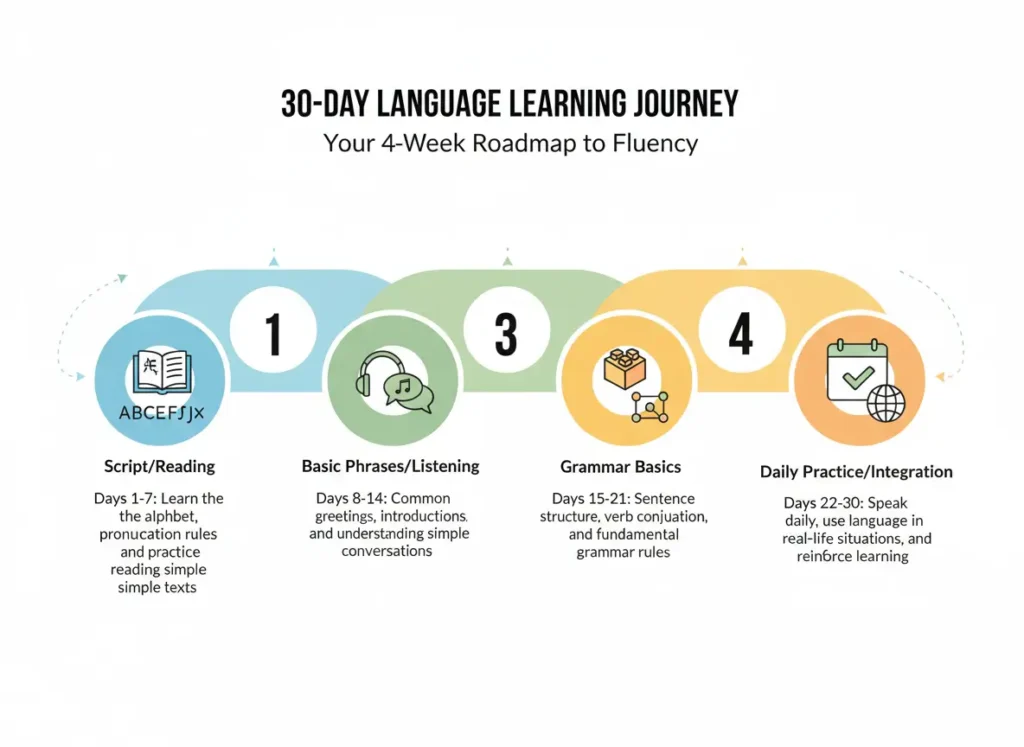
Your 30-Day Plan at a Glance
| Week | Focus | Daily Time | What You’ll Have by the End |
|---|---|---|---|
| Week 1 | Arabic alphabet + first 50 words | 30 min | Recognize all 28 letters, decode simple words |
| Week 2 | 20 core phrases + pronunciation | 30 min | Speak short sentences, handle greetings |
| Week 3 | Listening + shadowing habit | 30–40 min | Improved ear for real Arabic speech |
| Week 4 | Real conversations + first lesson | 30–45 min | First real exchange, clear plan for Month 2 |
Each week builds on the one before it. Skipping Week 1 makes Week 2 harder. Skipping Week 2 makes Week 3 hollow. Follow it in order.
Week 1 (Days 1–7): The Alphabet and Your First 50 Words
Why You Can’t Skip the Alphabet
I know. The Arabic script looks intimidating. And a lot of beginners want to just use phonetic English spellings and start speaking.
Don’t do this.
Phonetic spellings are a crutch that limits you immediately. The second you see a menu, a street sign, a WhatsApp message in Arabic — you’re helpless. And you’ll never break the habit once it forms.
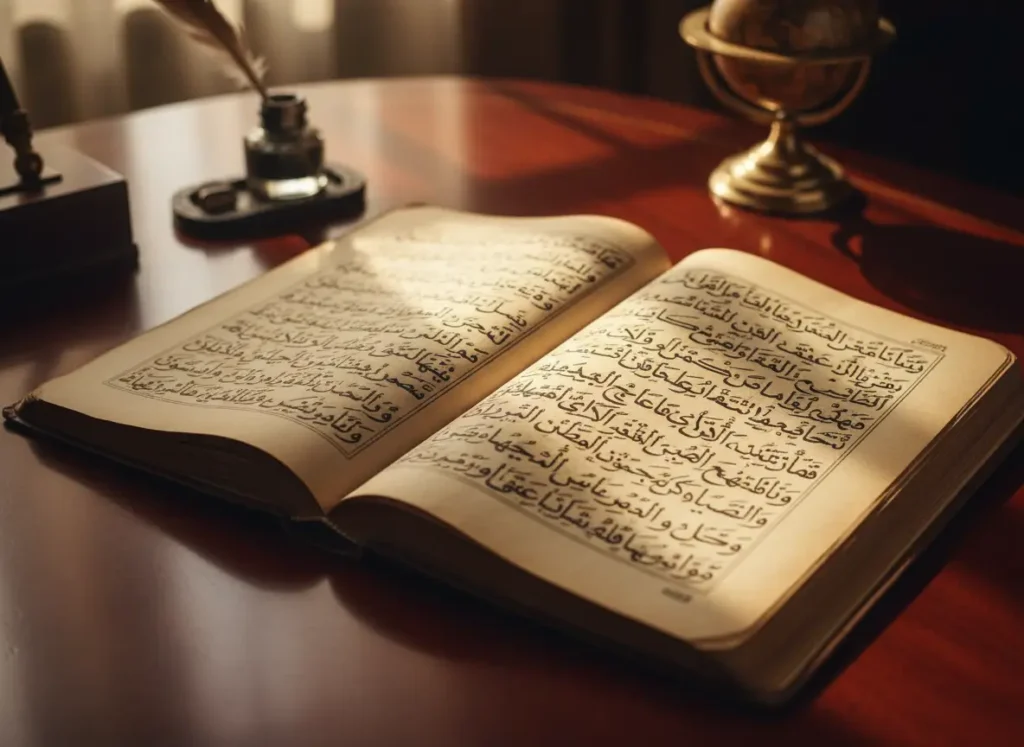
The Arabic alphabet has 28 letters. Most connect together in a flowing script, and letters change shape slightly depending on their position in a word (beginning, middle, or end). Sounds complicated. But here’s the truth: most committed beginners recognize all 28 letters within 5–7 days. Not master them. Recognize them.
That’s your Week 1 goal.
Day-by-Day for Week 1
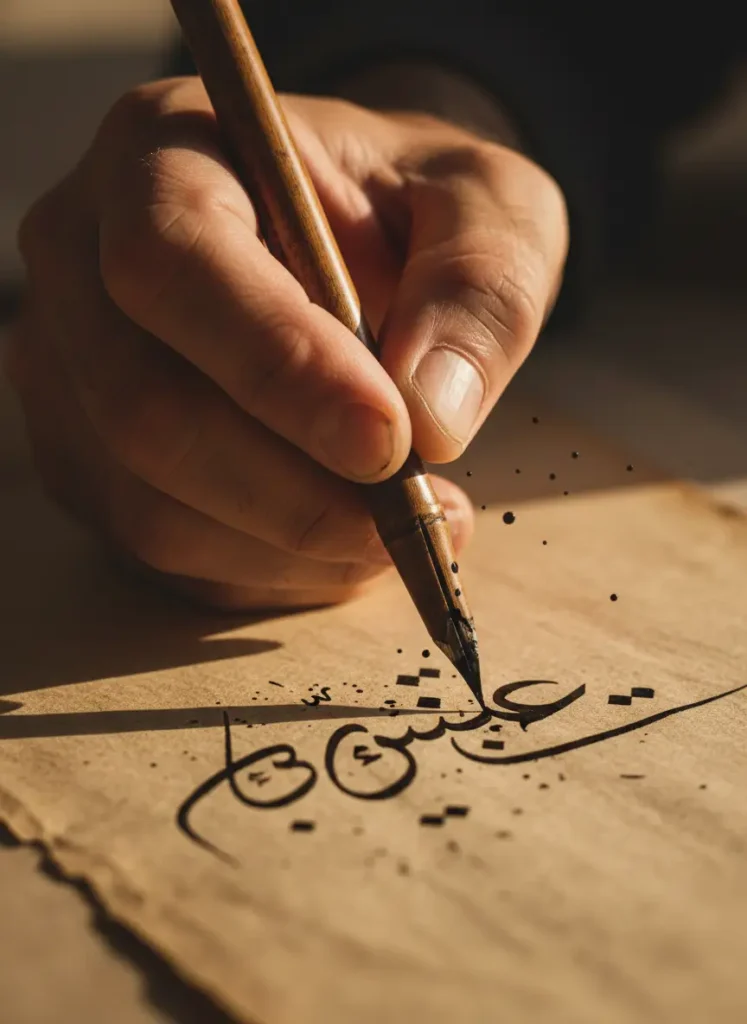
Days 1–2: Learn letters 1–14. Write each one by hand 10 times. Seriously — handwriting. Research consistently shows it builds deeper memory than typing. Don’t worry about letter names yet. Focus on shape + sound.
Days 3–4: Learn letters 15–28. Start connecting previously learned letters. Learn which letters are “connectors” and which aren’t — knowing this early prevents a lot of confusion.
Days 5–6: Practice reading simple 2–3 letter words out loud. You won’t understand them. That’s fine. The goal is phonetic decoding — turning symbols into sounds.
Day 7: Write the full alphabet from memory. Check your work. Mark the ones that gave you trouble. Review those three times before the day ends.
First 50 Words: Build Around Your Goal
Alongside the alphabet, start building your first vocabulary bank.
Don’t use a random frequency list. Choose 50 words connected to why you’re learning Arabic:
- Travel goals? Greetings, directions, numbers, food, transport.
- Family connection? Family members, feelings, home vocabulary, daily routines.
- Quran/MSA? Core Quranic vocabulary, common MSA verbs, religious terms.
Use spaced repetition. The free Anki app creates flashcard decks that show you words at scientifically optimized intervals. 5–10 minutes of Anki per day anchors vocabulary better than an hour of passive re-reading.
By end of Week 1: recognize all 28 letters, decode simple words aloud, recall 40+ of your 50 words. These are your benchmarks.
Week 2 (Days 8–14): Phrases, Pronunciation, and Your First Spoken Sentences
Start Speaking Before You Feel Ready
Honestly, this is where most beginners stall.
They tell themselves “I’ll speak when I know more.” But that moment never arrives. Fluency doesn’t precede speaking — it follows it.
Starting Day 8, you speak out loud every single day. To yourself. In the car. To a mirror. Anywhere. The goal isn’t accuracy — it’s getting your mouth and throat used to Arabic sounds. Several of which don’t exist in English.
The Sounds That Will Trip You Up
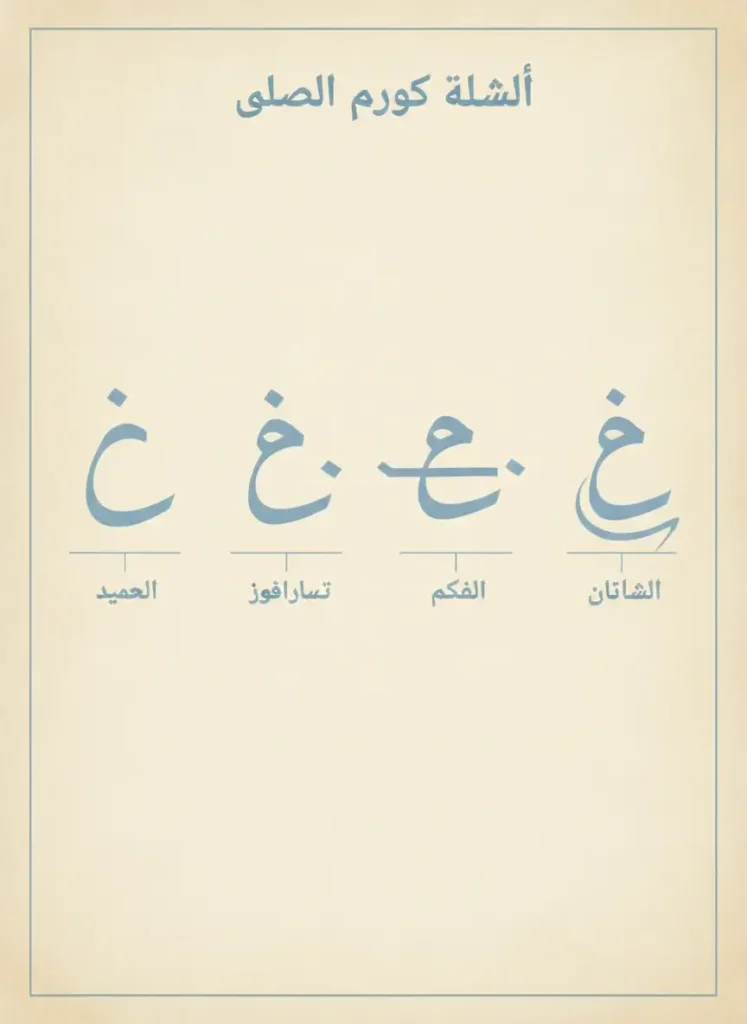
Two letters catch nearly every English speaker: ع (ain) and غ (ghain).
The ain is a voiced constriction produced deep in the throat. Nothing in English is close to it. The ghain is guttural — similar to a French R but further back.
Don’t panic about these in Week 2. Just listen to native speakers producing them, attempt them yourself, and know your pronunciation will improve with time. This is exactly why a native Arabic teacher is so valuable early on — they can hear what you’re actually doing wrong and fix it in real time. No app can do that.
20 Phrases Every Beginner Needs
Learn all 20 this week. Say each one out loud 10 times. Record yourself and compare to a native speaker.
- Ahlan wa sahlan — Welcome / Hello
- Sabah el-kheir / Masa el-kheir — Good morning / Good evening
- Izayak / Izayik — How are you? (male / female)
- Tamam, walhamdulillah — Fine, thank God
- Ismi… — My name is…
- Ana min… — I am from…
- Law samaht — Please / Excuse me
- Shukran / Afwan — Thank you / You’re welcome
- Mish fahim / Mish fahma — I don’t understand (m/f)
- Tikallim bi-bute, min fadlak — Please speak slowly
- Mumkin…? — Is it possible…? / Can I…?
- Fein…? — Where is…?
- Bikam da? — How much is this?
- Tayib — Okay / Good
- Inshallah — God willing (used constantly in daily Arabic)
- Yalla — Let’s go / Come on
- Habibi / Habibti — My dear (m/f — warm, not always romantic)
- Ma’a salama — Goodbye
- Fursa sa’eeda — Nice to meet you
- El-hamdulillah — Praise God / Thank God
These 20 phrases carry you through an enormous range of real Arabic interactions. Knowing them cold is worth more than passively knowing 300 vocab words.
Week 3 (Days 15–21): Listening and Building the Immersion Habit
Your Ear Needs Training Separately From Your Brain
Here’s the thing most beginner resources don’t tell you: knowing a word and hearing it in natural speech are two completely different skills.
You can know a word perfectly on a flashcard and still fail to recognize it when a native speaker says it at full speed, surrounded by other words, with natural rhythm and connected speech.
Arabic makes this harder because its sound inventory is significantly larger than English. Several Arabic sounds have no English equivalent. Your brain — wired for English — will either mishear them or drop them entirely at first.
The fix is early, consistent listening to real Arabic. Not slowed-down lesson audio. Real speech from real native speakers.
Your Week 3 Daily Routine
Daily listening (20–30 min): Choose content with visual context. Egyptian Arabic YouTube channels, Egyptian comedies, cooking shows. You don’t need to understand everything. Let your ear absorb patterns. Don’t force it.
Shadowing (10 min): Pick a 30–60 second clip of natural Arabic speech. Listen three times. Then listen and repeat phrase by phrase, mimicking the speaker’s rhythm, stress, and intonation as closely as possible. Shadowing is one of the most powerful pronunciation tools in any language — and almost no one does it.
Active word hunting (5 min): After any listening session, write down every word or phrase you recognized — even partially. On Day 15 that might be 3 words. By Day 21 it might be 15. Track it. Progress in listening comprehension is real but gradual, and writing it down makes it visible.
Week 4 (Days 22–30): Your First Real Conversation
From Phrases to Actual Exchange
Week 4 is where everything shifts.
You stop practicing in isolation and start connecting language to a real interaction — even a small one.
Here’s a concrete exercise: write a short dialogue. 8–10 lines. Two people meeting for the first time, exchanging basic information. Where are you from? What do you do? Where are you going? Write it using words and phrases you already know. Read it out loud until you can do it without looking. Then try it from memory.
That’s your first real act of Arabic production. Not recognition, not copying — generating language from memory and putting it into the world.
Your Week 4 Milestone: One Real Conversation
The most valuable thing you can do in Week 4 is have one real conversation with a native Arabic speaker.
Not perfect. Not polished. Just real.
At Alphabet Arabic Academy, we offer a free 60-minute trial lesson with certified native teachers — no credit card, no commitment. Meet our Arabic teachers here.
A single session at this stage does three things no amount of self-study can:
- Exposes your actual gaps. You’ll discover quickly which phrases hold under mild conversational pressure and which dissolve the moment a real person is listening.
- Calibrates your pronunciation. A native teacher hears things a recording-and-playback loop misses entirely.
- Gives you a clear direction for Month 2. After one real conversation, you know exactly what to work on next.
One Student Who Did This (And What Happened)
James is a software engineer from the UK. He’d tried Duolingo for four months and had learned almost nothing that stuck.
A friend told him to follow a structured 30-day plan and book one session with a real teacher. He was skeptical.
Here’s what he told us:
“By Day 14 I was saying actual phrases in Egyptian Arabic — not just reciting them from a card, but using them. By Day 30 I’d had my first real lesson and I was hooked. The alphabet was the thing I most dreaded. It took me six days. Six days. I wasted four months on an app before that.”
James’s experience is not unique. The pattern — months of app-based plateau, then rapid progress once a structured plan and native teacher were introduced — comes up again and again.
The difference wasn’t talent. It was structure.
What NOT to Do in Your First 30 Days
Mistake 1: Skipping the Alphabet
The script is your foundation. Without it, you’re dependent on phonetic crutches that limit your access to real Arabic content immediately. Invest the time in Week 1. It really does only take a week.
Mistake 2: Studying Instead of Speaking
Arabic knowledge stored as passive recognition does not automatically convert to speaking ability. Speaking is a separate skill that needs separate practice — starting in Week 2, not Month 3.
Mistake 3: Choosing the Wrong Arabic for Your Goals
Spending six months on MSA when your goal is conversation, or studying dialect when your goal is Quranic reading — wastes enormous time. Make the decision once, make it correctly, and commit. Not sure? Use our free level test and we’ll help you figure it out.
Mistake 4: Treating an App as Your Arabic Course
Apps are useful vocabulary tools. They are not Arabic courses. No app teaches you to think in Arabic, correct your pronunciation, or hold a real conversation. Use them as supplements. Not as the core.
Mistake 5: Staying in Self-Study Mode Too Long
Self-study has a ceiling. The learners who make the fastest progress are those who combine independent practice with real feedback from a qualified native teacher — especially in the early months when habits form and errors solidify. Waiting for Month 6 to take your first lesson means spending 5 months building mistakes.
The Best Tools and Resources for Your First 30 Days
Here’s what actually works. No affiliate nonsense. Just honest picks.
For the alphabet:
- Alif Baa (textbook) — the standard for MSA learners. Well-structured, clear.
- Arabic Alphabet Doctor (YouTube) — free, patient explanations of letter shapes and sounds.
For vocabulary:
- Anki (free) — spaced repetition flashcards. Nothing beats it for long-term retention.
- Quizlet — good for quick drilling, slightly less optimized than Anki.
For listening:
- Egyptian Arabic YouTube channels — search “Egyptian Arabic for beginners.” Look for channels with transcripts or subtitles.
- Yalla نتعلم عربي — simple, clear Egyptian Arabic lessons with slow speech for beginners.
For pronunciation:
- Forvo.com — native speaker audio for individual Arabic words. Free.
- Record yourself — the most underused tool in language learning. Listen back. Compare. Adjust.
For structure and accountability:
- Alphabet Arabic Academy teachers page — real native teachers, structured lessons, flexible scheduling.
- Modern Standard Arabic course — if MSA is your path.
- Arabic courses pricing — to see what regular lessons actually cost.
For figuring out where you stand:
- Free Arabic Level Test — 10 minutes. Tells you exactly which level to start from.
What Realistic Progress Actually Looks Like
I’ll be straight with you: the language learning industry lies about timelines.
Apps promise fluency in three months. Social media shows polyglots who seem to absorb languages overnight. Most learners aren’t like that. And pretending otherwise sets you up to quit when you hit the normal difficulty curve.
Here’s what’s actually realistic:
After 30 days (30–45 min/day, consistent): Recognize the alphabet, know 100–150 words, produce 20–30 phrases with reasonable pronunciation, hold a 3–5 minute exchange on basic topics.
After 3 months (with regular teacher sessions): Conversational survival. Travel situations, introductions, shopping, ordering food, expressing basic opinions.
After 12 months (2–3 weekly sessions + daily independent practice): Genuine conversational comfort. Following most of a natural conversation and participating meaningfully.
The variable that matters most? Not talent. Not intelligence. Consistency. Thirty minutes every day beats three hours every weekend. No exceptions.
FAQ: Arabic for Beginners

1. Can I learn Arabic in 30 days?
No — and anyone who tells you otherwise is selling something. But you can build a real foundation in 30 days: the alphabet, core vocabulary, 20+ phrases, and the pronunciation habits that will either help or haunt you for months. That foundation matters enormously. It determines how fast everything after goes.
2. Should I learn MSA or Egyptian Arabic first?
Depends entirely on your goal. If you want to read, write, work in formal Arabic, or understand the Quran — start with MSA. If you want to talk to people in everyday life — start with Egyptian Arabic. Don’t try to do both at once in Month 1. Pick one. Not sure which? Take the level test.
3. Do I need a teacher in the first 30 days, or can I go solo?
You can go solo for the first three weeks. The alphabet, core vocab, and phrases don’t strictly require a teacher. But by Week 4 — or earlier — a qualified native teacher becomes the fastest thing you can do for your Arabic. One session that corrects your pronunciation habits is worth weeks of solo practice.
4. Which app is actually best for learning Arabic?
Anki for vocabulary. Nothing else comes close for long-term retention. For listening, YouTube and real Arabic content beats any app. Duolingo is fine for gamified reinforcement but it will not teach you to have a conversation. Treat apps as supplements, not courses.
5. How much time per day do I actually need?
30 minutes. Every day. That’s it. Consistency matters far more than session length. 30 minutes daily for 30 days = 15 hours of focused practice — that’s enough to build a real foundation if those 15 hours are structured and intentional.
Your Next Step
You now have a full 30-day plan. Week by week. Day by day.
The one thing left is to actually start.
Not tomorrow. Not “when things slow down.” Today. Right now. Open a notebook and write the first 8 Arabic letters. Say ahlan wa sahlan out loud three times. Create your first 5 Anki cards.
That’s Day 1. It takes 10 minutes.
And if you want to start from the right level — not too easy, not overwhelming — take the free Arabic level test before your first lesson. It tells us exactly where you are, so your first session actually moves you forward.
Want to go even deeper on how to structure your Arabic learning beyond Month 1? Read our full guide: How to Start Learning Arabic from Zero Without Overwhelm.
The learners who reach real Arabic fluency aren’t the ones who waited for perfect conditions. They’re the ones who started imperfectly, adjusted as they went, and kept showing up every day.
Your first 30 days start now.