short vs long vowels in arabic If you’ve just started learning Arabic, vowels probably feel like the most confusing part.
And honestly? They kind of are. At first.
You open a textbook and suddenly there are vowels on top of letters, vowels inside letters, and then whole lessons about “long” and “short” vowels that somehow change the meaning of everything.
It’s a lot.
But here’s the thing — once you get it, you really get it. It clicks in a way that makes the whole language make more sense. And it’s not as complicated as it looks. I promise.
So let’s break it down properly. From scratch. No jargon. No fluff.
First, Let’s Talk About How Arabic Vowels Actually Work
Arabic has two types of vowels: short vowels and long vowels.
That’s it. Two types.
But they’re not just longer or shorter versions of the same sound. They work differently. They look different in writing. And yes — they can change the meaning of a word completely.
The short vowels are small marks written above or below the letters. Most Arabic texts — novels, newspapers, social media — don’t even write them. They’re invisible.
The long vowels, though? They’re actual letters in the word. You can see them. They’re permanent.
This is why beginners struggle. You’re trying to read a word and half the vowels aren’t even there.
But don’t worry. We’ll get to that.
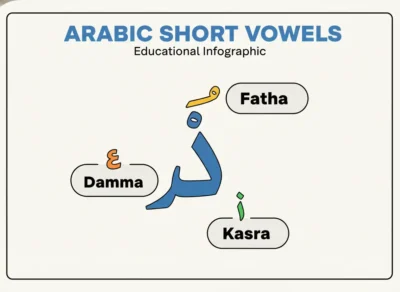
The Three Short Vowels (الحركات القصيرة)
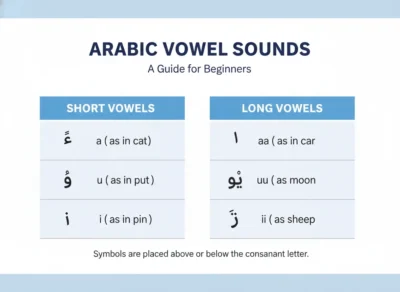
There are three short vowels in Arabic. Just three. Learn them well.
1. Fatha (فَتحة) — the “a” sound
Written as a small diagonal mark above the letter.
It makes a short “a” sound. Like the “a” in “cat” or “hat.”
Example: كَتَبَ (kataba) — he wrote
2. Kasra (كِسرة) — the “i” sound
Written as a small diagonal mark below the letter.
It makes a short “i” sound. Like the “i” in “sit” or “bit.”
Example: كِتاب (kitaab) — book
3. Damma (ضَمَّة) — the “u” sound
Written as a small curl above the letter. Looks a little like a tiny “و.”
It makes a short “u” sound. Like the “u” in “put” or “book.”
Example: كُتُب (kutub) — books
So you’ve got three sounds: a, i, u.
Short. Punchy. Fast. That’s what makes them short vowels — you don’t hold them. You barely linger on them.
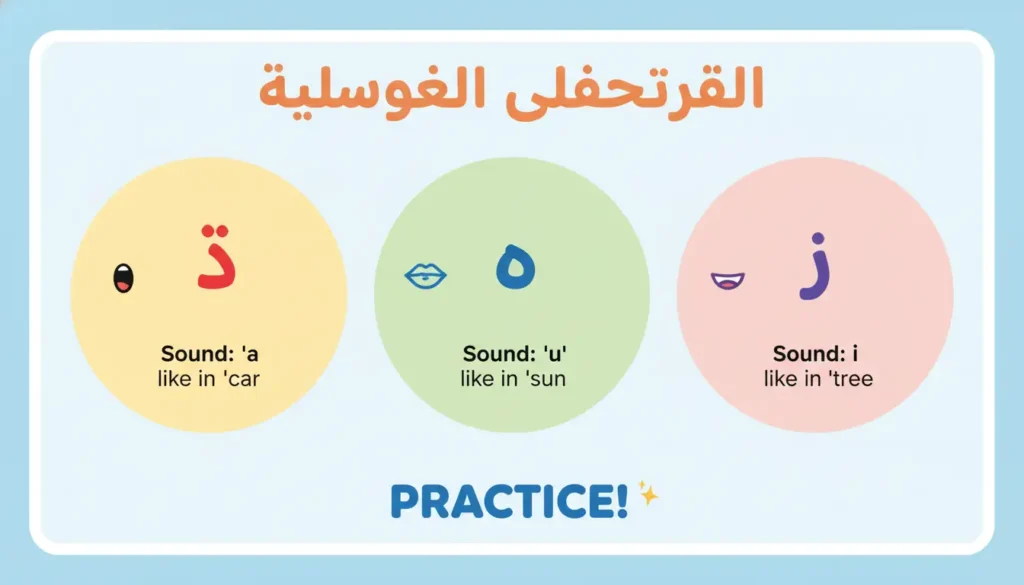
The Three Long Vowels (حروف المد)
Now here’s where it gets interesting.
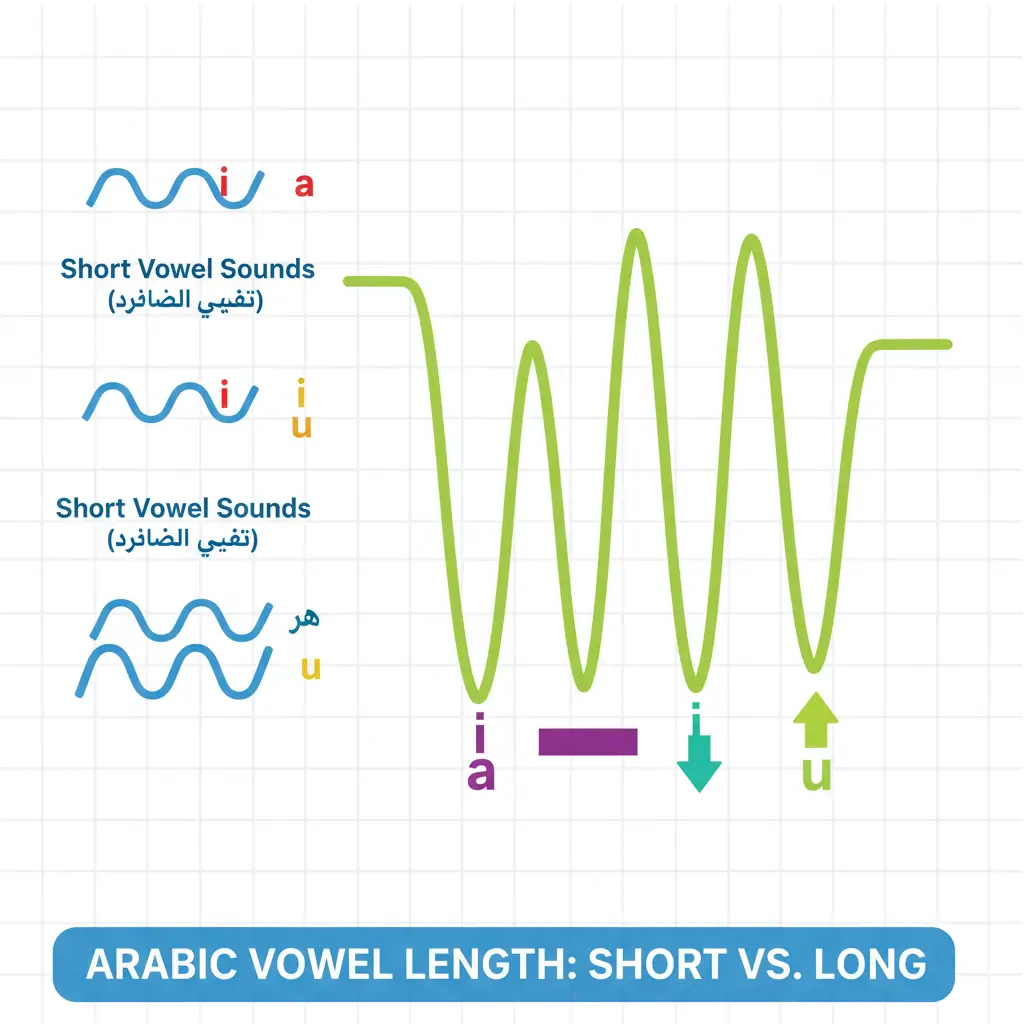
Long vowels are the same three sounds — a, i, u — but you stretch them. Hold them twice as long.
And instead of small diacritic marks, long vowels are written as full letters inside the word.
1. Long “aa” — written with الف (ا)
The letter alif makes a long “aaa” sound. Like “father” or “calm.”
Example: كِتاب (kitaab) — book. See that alif after the ت? That’s your long vowel.
2. Long “ii” — written with ياء (ي)
The letter ya makes a long “eee” sound. Like “see” or “tree.”
Example: كَبِير (kabiir) — big/large. See those two ي at the end? That’s your long “ii.”
3. Long “uu” — written with واو (و)
The letter waw makes a long “ooo” sound. Like “moon” or “food.”
Example: نُور (nuur) — light. That و is your long vowel.
Short vs Long: Side by Side
Let’s put them right next to each other so you can see the difference clearly.
| Short Vowel | Sound | Long Vowel | Sound |
|---|---|---|---|
| Fatha ( َ ) | short “a” | Alif (ا) | long “aa” |
| Kasra ( ِ ) | short “i” | Ya (ي) | long “ii” |
| Damma ( ُ ) | short “u” | Waw (و) | long “uu” |
Same sounds. Different length. Different look in writing.
Why Does Length Actually Matter?
I’ll be straight with you — in some languages, vowel length is a small detail. You can get away with ignoring it.
Arabic is not that language.
In Arabic, vowel length changes meaning. Sometimes completely.
Look at these:
- قَتَل (qatala) — he killed
- قَاتَل (qaatala) — he fought / he battled
One has a short “a” after the ق. The other has a long “aa.” Two totally different words.
Or this one:
- مَلَك (malak) — angel
- مَلِك (malik) — king
- مَلَّك (mallaka) — he made someone a king
Same three root letters. Completely different words. The vowels are doing all the work.
This is actually one of the most fascinating things about Arabic — the root system. Three consonants carry the core meaning, and the vowels shape what that meaning becomes. But that’s a bigger topic for another day.
For now, just know: short and long vowels are not optional details. They’re part of the word. and for the beginners full guide
Can a Short Vowel and a Long Vowel Appear Together?
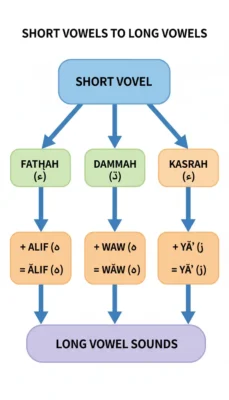
Yes. And this is something a lot of beginners get confused about.
Here’s the quick answer: a short vowel mark (like fatha) can appear on a letter that comes right before a long vowel letter.
That might sound weird. Let me show you.
Take the word كِتاب (kitaab) — book.
- The ك has a kasra under it: short “i” sound
- Then comes ت — no vowel mark on its own
- Then comes ا (alif) — the long vowel “aa”
So you read it: ki-taab. Short “i,” then long “aa.”
The short vowel and long vowel aren’t competing. They’re on different letters. Each letter gets its own sound.
Another example: بَيت (bayt) — house
- ب has a fatha: short “a”
- ي here is acting as a long vowel… but wait, actually in this case bayt has a diphthong, not a pure long vowel. It’s a “ay” sound, like “eye.”
See? Even this has layers. But don’t panic. Your ear will adjust with practice.
The main rule to remember: a short vowel mark sits on a letter. A long vowel IS a letter. They can appear next to each other in the same word. They’re not the same thing.
How Do Fluent Readers Read Without Vowel Marks?
This is probably the most common question I get from beginners.
“How do Arab people read when there are no vowels written?”
Honestly, they just… know. But that sounds frustrating, so let me explain how.
Fluent Arabic readers rely on three things:
1. Context
If you’re reading a news article about politics, and you see the word حكومة, you already know it means “government.” You don’t need the vowels. The context tells you.
2. Grammar knowledge
This one’s big. In Arabic, the vowels on the end of a word tell you its grammatical role — subject, object, possession. Fluent readers know grammar well enough to mentally fill in those endings.
3. Word recognition
After reading thousands of hours in Arabic, certain words become automatic. Like how you don’t sound out every letter when you read “the” in English — you just see it and know it.
So for beginners? Read with full vowel marks as much as possible. Use the Quran (which is always fully voweled), or children’s books, or learning materials that include the short vowel marks. That’s how you build your internal sound map.
Don’t rush to read unvoweled text. That comes later.
The Beginner Trap: Skipping the Vowels
Here’s something I see all the time.
A student starts learning Arabic. They learn the letters. They pick up some words. And they start reading — but they skip the vowel marks because the letters look more “natural” without them.
Bad idea.
If you don’t internalize the vowels early, you’ll develop a habit of guessing. And guessing in Arabic leads to mispronunciation. And mispronunciation leads to misunderstanding — especially in religious contexts or formal settings.
The short vowels are not decorative. They’re not training wheels you remove later. They’re the hidden engine of the language.
Learn them. Use them. Read with them turned on.
A Quick Practice: Can You Hear the Difference?
Let’s try something. Say these out loud:
- كَتَب (kataba) — short “a” sounds throughout. Fast. Clipped.
- كَاتِب (kaatib) — that long “aa” after the ك stretches out. Hold it for a beat.
Now these:
- سَمِع (sami’a) — he heard. Short “i.”
- سَمِيع (samii’) — all-hearing (one of God’s names). Long “ii” — hold that “ee” sound longer.
Feel the difference?
The short vowels keep things moving. The long vowels make you pause, stretch, give weight to the sound.
That rhythm is part of what makes Arabic so beautiful — especially in Quran recitation.
Where to Go From Here
Now you know the difference between short and long vowels in Arabic.
That’s genuinely important. A lot of people learn Arabic for months without really nailing this down.
But vowels are just the beginning.
If you’re serious about building a solid foundation in Modern Standard Arabic — grammar, pronunciation, reading, writing — the best thing you can do is get a proper assessment first. Know where you actually are before diving into random YouTube videos.
We have a free Arabic level test at Alphabet Arabic Academy that takes about 10 minutes. It’ll tell you exactly where to start.
👉 Take the free Arabic level test
And if you want to see how we teach Arabic from zero — structured, step-by-step, with real teachers — check out our course pricing page or meet our teachers.
You don’t have to figure this out alone. That’s literally what we’re here for.