
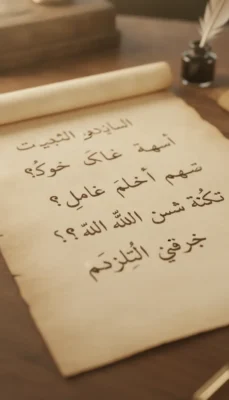
You can read Arabic in a textbook just fine. Clean font, every letter perfect, dots exactly where they should be. Then a friend texts you a photo of a handwritten note, or your teacher scribbles something on a whiteboard, and suddenly it’s like you never learned the alphabet at all.
I get messages about this constantly. “I can read the app but not real handwriting.” Honestly, that’s one of the most common walls beginners hit, and almost nobody talks about it directly. Most guides teach you the printed alphabet and just… stop there. As if that’s the whole job.
It’s not. Printed Arabic and handwritten Arabic are cousins, not twins. Let’s fix that gap.
Why Handwriting Feels Like a Different Language
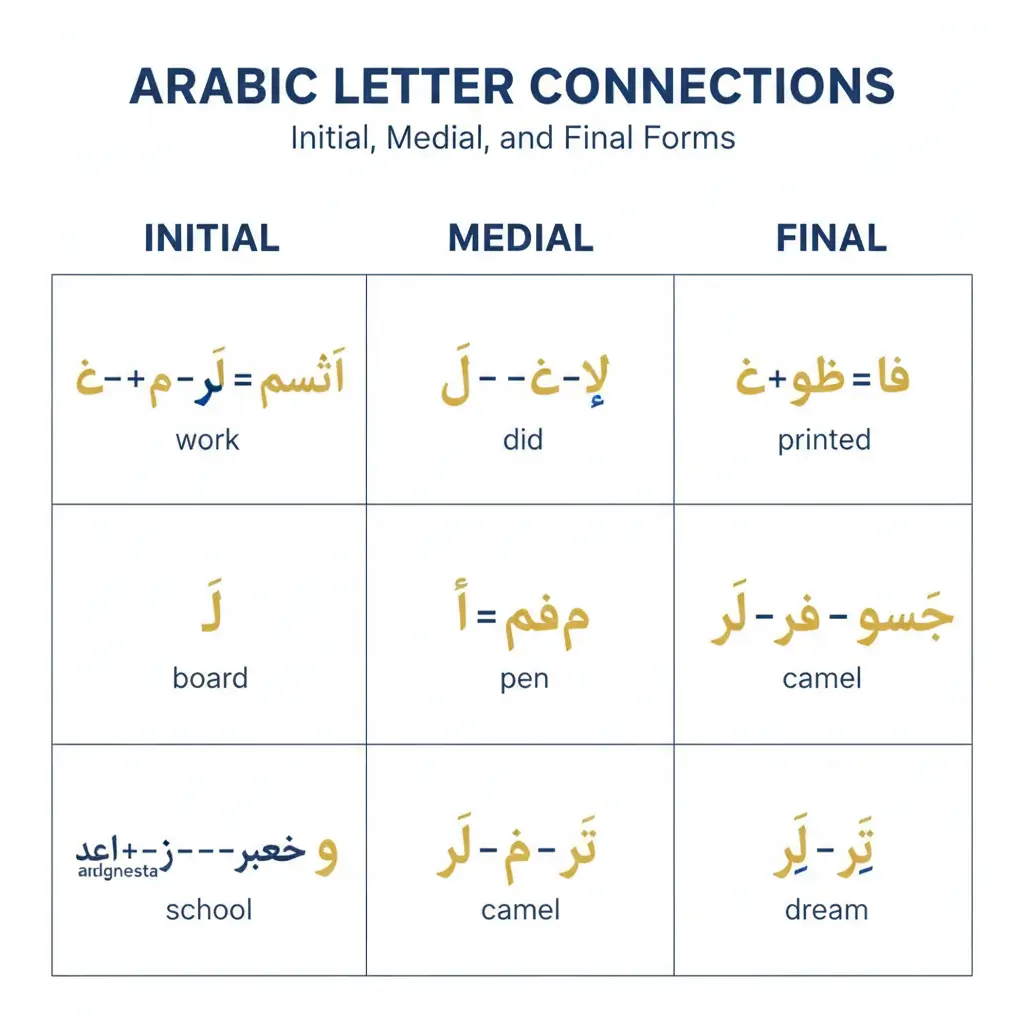
Here’s the thing — Arabic letters already change shape depending on where they sit in a word. Beginning, middle, end, alone. That’s true in print and it’s true in handwriting. But handwriting adds a second layer of change on top of that: personal style.
Think about English for a second. Print “cat” and it looks the same no matter who typed it. Now ask five different people to write “cat” by hand. You’ll get five different versions of the letter A, five different heights on the T, maybe a loop somewhere you didn’t expect. Nobody’s handwriting matches a textbook font exactly.
Arabic handwriting does the exact same thing, except the base letters were already more fluid to begin with, since every letter connects to the next one within a word. So when someone writes fast, or writes in their own personal style, letters stretch, shrink, merge, and sometimes drop their dots completely.
That’s not broken Arabic. That’s just… how people actually write.
The Three Things Beginners Get Wrong
I’ll be straight with you. Most beginners don’t fail at this because handwriting is impossible. They fail because they’re solving the wrong problem.
Mistake one: They only ever practiced print. If every letter you’ve studied came from a printed worksheet or an app, your brain built a very narrow template. The second a letter looks 10% different, recognition breaks down. This is completely normal and completely fixable — you just need exposure to a wider range of shapes.
Mistake two: They panic about missing dots. Skilled Arabic writers often drop the dots when writing fast, especially in casual notes. Ba (ب), Ta (ت), Tha (ث), and Noon (ن) can look almost identical without their dots. Beginners see this and assume they’re reading it wrong. You’re not. Native readers rely on context and word shape more than individual dots — and you can learn to do the same.
Mistake three: They try to read letter by letter. This works in print. It falls apart in handwriting, because connected cursive-style letters blend into each other. You need to start reading in word shapes, not individual letters. More on that below.
Step 1: Lock Down the Printed Alphabet First
I know, I know — you want to skip straight to handwriting. But here’s the honest truth: if your printed-letter recognition isn’t automatic yet, handwriting will feel impossible. You need the base shapes, sounds, and the four position forms (isolated, initial, medial, final) solid in your head before you add a layer of stylistic variation on top.
If you’re still shaky here, this is genuinely worth fixing before anything else. Our Arabic alphabet guide for beginners walks through every letter, every position, with a practice plan attached. Don’t skip this step to feel like you’re moving faster. You’re not — you’re just building a shakier foundation.
Step 2: Learn the Common Handwriting Styles
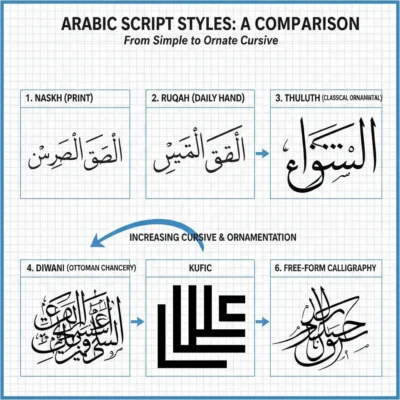
Arabic handwriting isn’t one uniform thing. There are a few recognizable styles you’ll run into again and again:
Ruq’ah is the everyday handwriting style most Arabic speakers actually use — quick, practical, a bit compressed. This is what you’ll see in personal notes, quick messages, and casual writing. If you’re trying to read a friend’s handwriting, this is probably it.
Naskh-influenced handwriting is a bit more formal and closer to print. You’ll see this in more careful, deliberate writing — someone writing slowly, or in more official contexts.
Personal shorthand is just… everyone’s individual quirks. Some people write letters taller. Some flatten curves. Some connect letters that are technically supposed to sit separately in a rushed word. There’s no shortcut here except exposure — the more handwritten Arabic you see, the more your brain builds a flexible template instead of a rigid one.
You don’t need to master calligraphy. You need enough exposure to Ruq’ah specifically, since that’s what real-world handwriting looks like 90% of the time.
Step 3: Learn to Recognize Letters by Their “Skeleton”
Here’s a trick that actually works. Every Arabic letter has a core skeleton — a basic stroke shape — that stays recognizable even when handwriting gets messy. The dots and small marks are the details. The skeleton is the anchor.
For example: Ba, Ta, Tha, and Noon all share a similar base curve. What differs is the number and position of dots (or the absence of dots for none of these — wait, actually Ba has one dot below, Ta has two above, Tha has three above, and Noon has one dot above with a deeper curve). In handwriting, that curve might get stretched or flattened, but it rarely disappears. Train your eye to spot the skeleton first, then hunt for dots second.
Do this exercise: take five handwritten Arabic words — screenshots from social media, a friend’s notes, anything real — and for each letter, ask “what’s the base shape here, ignoring dots?” You’ll notice patterns fast.
Step 4: Read in Word Shapes, Not Individual Letters
This is the single biggest shift beginners need to make. Fluent readers don’t decode Arabic letter by letter, especially in handwriting. They recognize the overall shape of a word the way you recognize the shape of “the” or “and” in English without sounding out each letter.
Practice this with short, high-frequency words first. Words like من (min – from), في (fi – in), and هذا (haadha – this) appear constantly. Once you’ve seen a word’s handwritten shape ten or twenty times, you’ll recognize it instantly — even in someone else’s messy handwriting — without decoding letter by letter.
Step 5: Practice With Real Handwriting, Not Just Textbooks
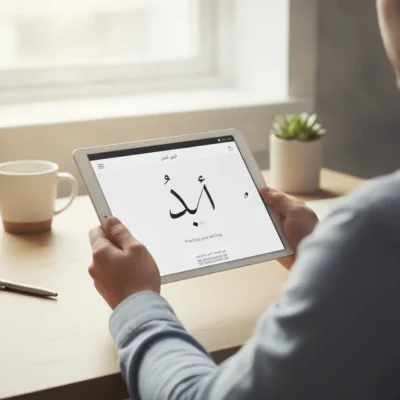
This is where most self-study plans quietly fall apart. Worksheets and apps almost always use printed fonts. If that’s your only source of practice, you’re preparing for a test you’ll never actually take — because real Arabic communication happens in handwriting, texts, and notes.
Go find real samples. WhatsApp screenshots (with permission, obviously), handwritten recipes, old letters, even your teacher’s whiteboard notes. Search Arabic learner communities online — plenty of people share handwriting samples specifically for practice.
And here’s an honest tip nobody tells you: write by hand yourself. A lot. Copying handwritten Arabic — not typing it — trains the same muscle memory that lets you decode someone else’s handwriting later. Your hand learns the natural rhythm of connections, and that rhythm becomes something you recognize when you see it, even in a completely different person’s writing.
Step 6: Build a Daily Habit Around It
Twenty minutes a day beats three hours once a week. That’s not a motivational quote — it’s just how pattern recognition works in your brain. Handwriting recognition is pure pattern exposure, and pattern exposure needs repetition spread across days, not crammed into one session.
A simple daily loop that works:
- Five minutes reviewing letter skeletons and their variations
- Ten minutes reading real handwritten samples, sounding out what you can
- Five minutes copying handwritten words yourself
Do that consistently for a month and you’ll notice a real shift. Not because handwriting magically got easier, but because your brain finally has enough examples to generalize from.
If you want a full structured plan for what to study and when, our complete guide to Arabic grammar and writing breaks down a step-by-step path from alphabet to confident writing — handwriting recognition included.
What About Reading Someone’s “Bad” Handwriting?
Honestly, sometimes handwriting is genuinely messy, even for native speakers. If you’re staring at a note and can’t make sense of it, that’s not always a “you” problem. Context helps a lot here. What’s the topic? What words would make sense in that sentence? Native readers guess from context constantly, and you’re allowed to do the same.
Also — and this matters — don’t be afraid to ask. If it’s a teacher or language partner’s handwriting, just ask them to read it aloud once. Hearing it while looking at it locks the shape into memory far faster than staring at it alone for twenty minutes.
A Quick Note on Handwriting vs. Typing
You might be wondering if you even need this skill if most of your Arabic reading happens on a screen. Fair question. But handwriting recognition still comes up constantly — messages from friends, notes from teachers, signs, forms, even casual social media captions written in a personal style rather than a typed font. Skipping this skill leaves a real gap in functional reading ability, even if your typed-Arabic reading is solid.
Common Questions About Reading Arabic Handwriting
Is Arabic handwriting harder to read than print? Yes, at first. Print is standardized. Handwriting varies by person, speed, and style. But the gap closes fast once you’ve seen enough real samples — usually within a few weeks of consistent exposure, not months.
Do I need to learn calligraphy to read handwriting? No. Calligraphy is decorative and formal. Everyday Arabic handwriting (Ruq’ah style) is simpler and more practical. Focus on that first.
Why do some letters look the same in handwriting? Because dots often get dropped or shrunk when people write fast. Letters like Ba, Ta, Tha, and Noon share a base shape and only differ by their dots — so in rushed handwriting, they can look nearly identical. Context fills the gap.
How long does it take to read Arabic handwriting confidently? With daily practice and real handwriting samples (not just textbook fonts), most learners see a noticeable improvement within 4-6 weeks. Full confidence with varied styles takes a few months of consistent exposure.
Should I learn handwriting recognition before or after typing Arabic? Ideally alongside each other, once your printed-letter recognition is solid. Don’t start handwriting before you know your alphabet cold — you’ll just confuse yourself.
Where This Fits Into Your Bigger Arabic Journey

Reading handwriting isn’t a separate skill floating off on its own — it’s part of genuinely reading Modern Standard Arabic well. The stronger your MSA foundation, the faster handwriting clicks, because you’re not decoding letters and meaning at the same time. You already know the words. You’re just adjusting to how they’re drawn.
If you want that stronger foundation, our Modern Standard Arabic program is built exactly for this — real reading fluency, not just textbook recognition, with native teachers who can put actual handwritten material in front of you and walk you through it live. That’s honestly the fastest way to close this gap. An app can’t hand-write you a note and watch how you read it back. A teacher can.
Not sure where your reading level actually stands right now? Take the free Arabic placement test — it takes a few minutes and tells you exactly where to start. And if you’re curious about course structure and cost, our pricing page lays it all out clearly.
Reading Arabic handwriting isn’t a mysterious talent some people have and others don’t. It’s exposure, plus a shift from letter-by-letter reading to word-shape reading, plus consistency. Give it a real month of daily practice and that “I can’t read real Arabic” feeling starts disappearing for good.
👉 Ready to build real reading fluency, not just textbook recognition? Explore the Modern Standard Arabic course and start reading Arabic the way people actually write it.