
You can read a whole page of Modern Standard Arabic. You know the grammar. You could probably conjugate that verb in your sleep.
Then someone plays you a 30-second news clip and you catch maybe four words.
If that’s you, you’re not broken. You’re just missing the one skill nobody teaches properly: listening.
I’ll be straight with you — this is the most neglected part of learning MSA. Students spend hundreds of hours on grammar tables and maybe ten minutes total actually listening to spoken Arabic. Then they wonder why real Arabic sounds nothing like the Arabic in their head.
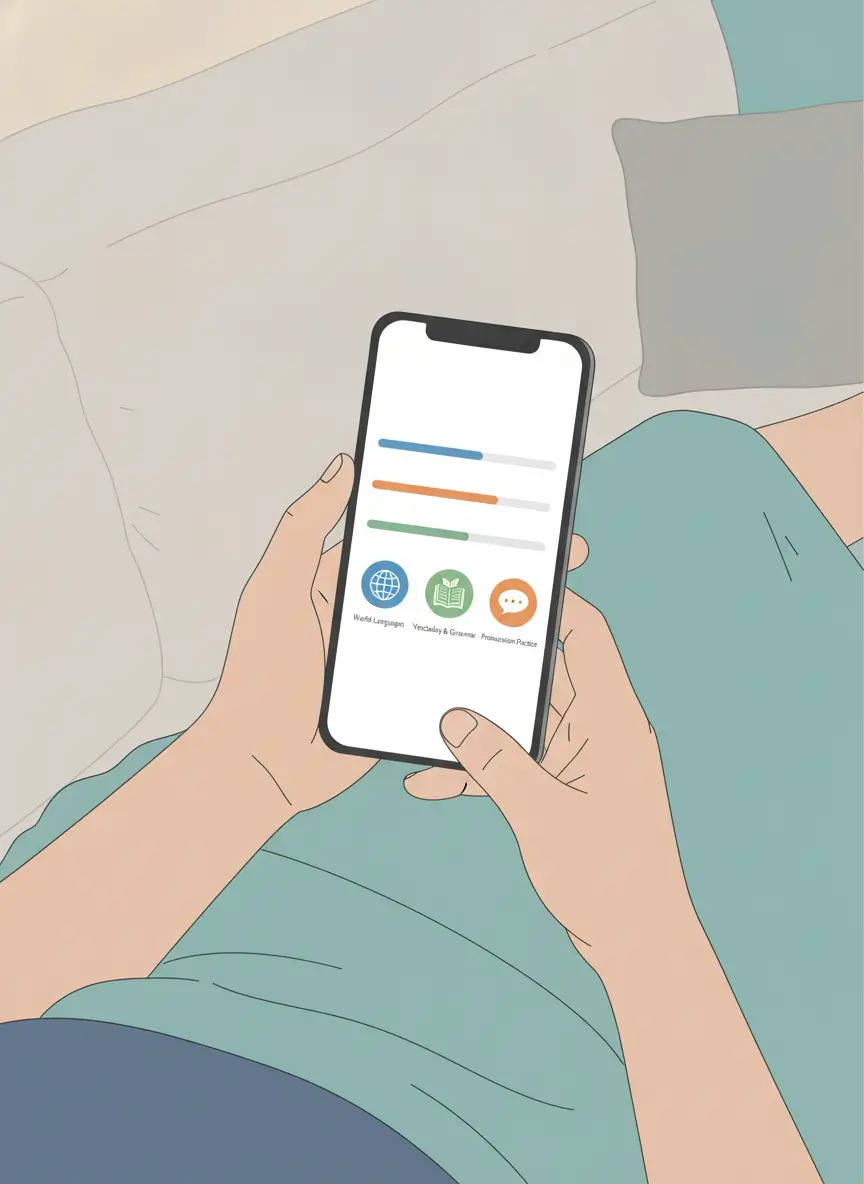
This article fixes that. Real habits. Things you can start today, from your couch, with your phone.
Why Listening Feels So Much Harder Than Reading
Here’s the thing people don’t tell you: reading and listening use completely different parts of your brain’s language system.
When you read, the word just sits there. You can stare at it. Sound it out letter by letter. Take your time.
When you listen, the word is gone in half a second. There’s no pause button on a live conversation. Words blend together. A fast speaker doesn’t wait for you to catch up.
And MSA makes this worse in one specific way — most of what you’ve studied is written MSA, formal and slow. But real spoken MSA, the kind on the news or in a lecture, moves fast and drops some of the pronunciation rules you learned in your textbook.
So no, you’re not bad at Arabic. You’ve just never actually trained this specific skill.
“Why Can’t I Understand Spoken Arabic Even Though I Read It Fine?”
This question shows up constantly. Reddit threads, Quora, Arabic learning forums — same complaint, different words.
The answer is simple and a little annoying: reading skill and listening skill are separate skills. You don’t get one for free by building the other.
Think about it like this. Someone can read sheet music perfectly and still not recognize a song when it’s hummed to them. Different input, different pathway, different training needed.
The fix isn’t “read more.” The fix is “listen more, and listen the right way.” That’s what the rest of this article is about.
Habit 1: Start Below Your Level, Not At It
This is the single biggest mistake I see. Someone finishes month two of MSA and jumps straight into Al Jazeera news broadcasts.
They understand nothing. They get discouraged. They quit listening practice entirely.
Here’s the rule: your first listening material should feel almost too easy. If you’re understanding less than 70% of what you hear, it’s too hard. Drop down a level.
Slow, beginner-focused Arabic content exists for exactly this reason. Use it. Your ego doesn’t need to survive contact with native-speed news yet. It will get there — just not on day one.
Habit 2: Listen to the Same Short Clip Multiple Times
One pass through a clip teaches you almost nothing. Five passes through the same 60-second clip teaches you a lot.
Here’s how to actually do it:
- First listen — no transcript, no pausing. Just try to catch the general idea.
- Second listen — same thing, see if you catch more.
- Third listen — now open the transcript. Read along while listening.
- Fourth listen — cover the transcript again. See how much sticks now.
- Fifth listen (a day later) — come back to it fresh. This is where it really locks in.
Honestly, this feels repetitive on purpose. Repetitive is exactly what trains your ear. One long boring podcast episode heard once teaches you far less than one short clip heard five times.
Habit 3: Shadow What You Hear
Shadowing means listening to a sentence and immediately repeating it out loud, trying to match the speed, rhythm, and pronunciation.
Not translating it. Not thinking about grammar. Just copying the sound, like a parrot.
Why does this work? Because listening and pronunciation are linked. When you can physically produce a sound, your ear gets better at recognizing it. Students who shadow regularly report catching fast Arabic much sooner than students who only listen passively.
Start with something slow — a teacher speaking clearly works well. Pause after each sentence, repeat it, then move to the next one. Ten minutes a day of this does more than an hour of passive background listening.
Habit 4: Know the Difference Between Active and Passive Listening — and Use Both
People argue about which one “works.” Truth is, you need both, and they do different jobs.
Active listening is focused. You’re paying full attention, maybe pausing, maybe taking notes, maybe repeating words. This is where real progress happens. It’s also tiring, so 15–20 minutes is plenty.
Passive listening is background noise — Arabic playing while you cook, drive, or clean. You won’t catch much consciously. But your brain still gets exposed to rhythm, intonation, and common sound patterns. Think of it as priming, not learning.
Don’t confuse the two. If you spend an hour with Arabic playing in the background and call that “an hour of listening practice,” you’re fooling yourself. That hour is passive exposure. It helps, but it’s not the same as the 15 focused minutes where you’re actually working.
Habit 5: Use Transcripts as a Ladder, Not a Crutch
Transcripts are useful. They’re also easy to lean on forever.
Here’s a rule that works: use the transcript to check yourself after you’ve already tried without it. Never read along on your first attempt — you’ll end up reading Arabic and calling it listening.
Over time, force yourself to need the transcript less. Try a clip without it first. Then check what you missed. Then try a similar clip a few days later, completely without it, and see if you improved.
That gap between “understood without help” and “needed the transcript” is basically your listening level, tracked in real time.
Habit 6: Build a Listening Log
You forget your progress if you don’t write it down. And forgetting your progress is exactly what makes people quit — it feels like nothing’s changing, even when it is.
Keep a simple note. After each session, jot down:
- What you listened to
- Roughly what percentage you understood
- Three new words or phrases you picked up
Look back at this after a month. You’ll see the percentage climb. That’s proof, not a feeling. It’s the same logic behind a structured daily habit — if you haven’t seen our piece on building a short daily Arabic routine, it pairs really well with listening practice specifically, since consistency matters more here than almost anywhere else in language learning.
Habit 7: Work Your Way Up to the News — Deliberately
News Arabic is the finish line for a lot of learners, not the starting point. It’s fast, formal, and full of vocabulary you won’t use in daily conversation — politics, economics, geography.
But it’s also incredibly good practice once you’re ready, because it’s pure, dense MSA with almost no dialect mixed in.
Don’t jump in cold. Build up to it in stages: slow beginner clips, then intermediate podcasts, then short news segments with a transcript, then real broadcasts. We wrote a full breakdown of this exact process — worth reading if news Arabic is your goal — in our guide on how to understand news Arabic on channels like Al Jazeera.
Habit 8: Don’t Separate Listening From Everything Else
Listening in isolation only gets you so far. The fastest gains happen when listening feeds into speaking and writing.
Heard a phrase you liked? Say it out loud. Write it down. Use it in your own sentence the next day. This turns a passive skill into an active one, and active skills stick.
Where to Actually Find Listening Material at Home
You don’t need fancy tools. You need consistent, appropriate-level material. A few solid categories, with real examples so you’re not left guessing:
- YouTube channels built for learners — channels like “Learn Arabic with Maha” and “Arabic 101” break things down slowly and clearly, which is exactly what you want early on.
- Slow, learner-focused podcasts — something like “Slow Arabic” or ArabicPod101’s beginner episodes. Built specifically to be understandable at your level, not native speed.
- Al Jazeera Learning Arabic — a dedicated channel for learners, separate from the regular news broadcast. Good bridge material once you’re past the absolute basics.
- Children’s shows in MSA — genuinely useful, don’t skip these out of pride. Simple vocabulary, clear pronunciation, slower pacing than adult content.
- Short audio lessons from a teacher, where pacing and vocabulary are controlled.
- Recited Quran audio, which — even outside of religious study — is some of the clearest, most precisely pronounced Arabic you’ll ever hear, useful for training your ear to formal Arabic sounds. If you want structured guidance around this, our Quran online classes work well alongside general MSA listening practice.
- News, eventually — once you’re ready for it, not before.
Mix these. Don’t live in just one category for months. Availability and content on any given channel or app can shift over time, so treat this as a starting list, not gospel — search around and see what fits your ear.
A Simple Weekly Listening Plan
Here’s a version you can copy exactly. Fifteen to twenty minutes a day, six days a week.
| Day | Focus |
|---|---|
| Mon | New short clip — listen twice, no transcript |
| Tue | Same clip — with transcript, then shadow three sentences |
| Wed | New clip at your level — first pass only |
| Thu | Shadowing practice — 10 minutes, any clip you liked this week |
| Fri | Revisit Monday’s clip without transcript — check improvement |
| Sat | Passive listening — background audio while doing chores |
| Sun | Log your week — write down 5 new words you picked up |
Simple. Repeatable. No decision fatigue, because you already know what today’s session is.
Mistakes That Quietly Kill Listening Progress
Only listening to material that’s too hard. If you’re straining to catch one word in ten, you’re not training your ear — you’re just frustrated.
Never repeating clips. New content every single time feels productive. It’s actually less effective than repetition.
Treating background noise as focused study. Passive exposure has a place. It’s not a replacement for active listening.
Skipping speaking entirely. Listening and speaking reinforce each other. Ignore one, and the other slows down too.
Giving up after a few weeks. Listening comprehension is one of the slowest skills to show visible progress. It can feel like nothing’s happening for a month, and then suddenly a clip that used to be a blur makes sense. That’s normal. Don’t quit right before the breakthrough.
How Long Does This Actually Take?
People want a number, so here’s an honest one, not a marketing one.
Most consistent learners notice a real shift — going from “catching scattered words” to “following the general idea” — somewhere around 8 to 12 weeks of daily focused practice. Getting comfortable with fast native content, like unscripted news or conversation, usually takes several months to a year of regular exposure.
That’s not a discouraging number. That’s just what building a new skill from scratch looks like. Fifteen minutes a day, six days a week, for three months is around 18 hours of focused listening. That’s enough to genuinely change how Arabic sounds to you.
What If You Want Feedback, Not Just Practice?
Self-study gets you far with listening. But there’s a limit — you can’t ask yourself why you missed a word, or get corrected on a sound you’re consistently mishearing.
That’s where working with a teacher helps. A good MSA teacher can slow down deliberately, repeat phrases you’re struggling with, and build listening drills around your specific gaps instead of generic content.
Not sure what level you’re actually at right now? Take the free Arabic placement test first — it’ll tell you exactly where your listening should start. From there, our MSA teachers build listening practice directly into live lessons, and you can check the course pricing to see what fits your schedule.
The Bottom Line
Listening is the skill that makes Arabic feel real. It’s the difference between knowing a language on paper and actually understanding people when they talk to you.
It won’t happen from grammar drills. It happens from repeated, deliberate, slightly-too-easy listening, done consistently, over months, not days.
Start today. Pick one short clip. Listen to it five times. That’s the whole first step.
Ready to build real listening skills with proper guidance? Explore our Modern Standard Arabic course and start improving your listening with structured, level-appropriate practice.