You know that feeling when you learn a new Arabic word, feel proud for about a day, and then it’s just… gone? You didn’t do anything wrong. You just memorized the word the hard way — as a random string of letters with no connection to anything else in your brain.
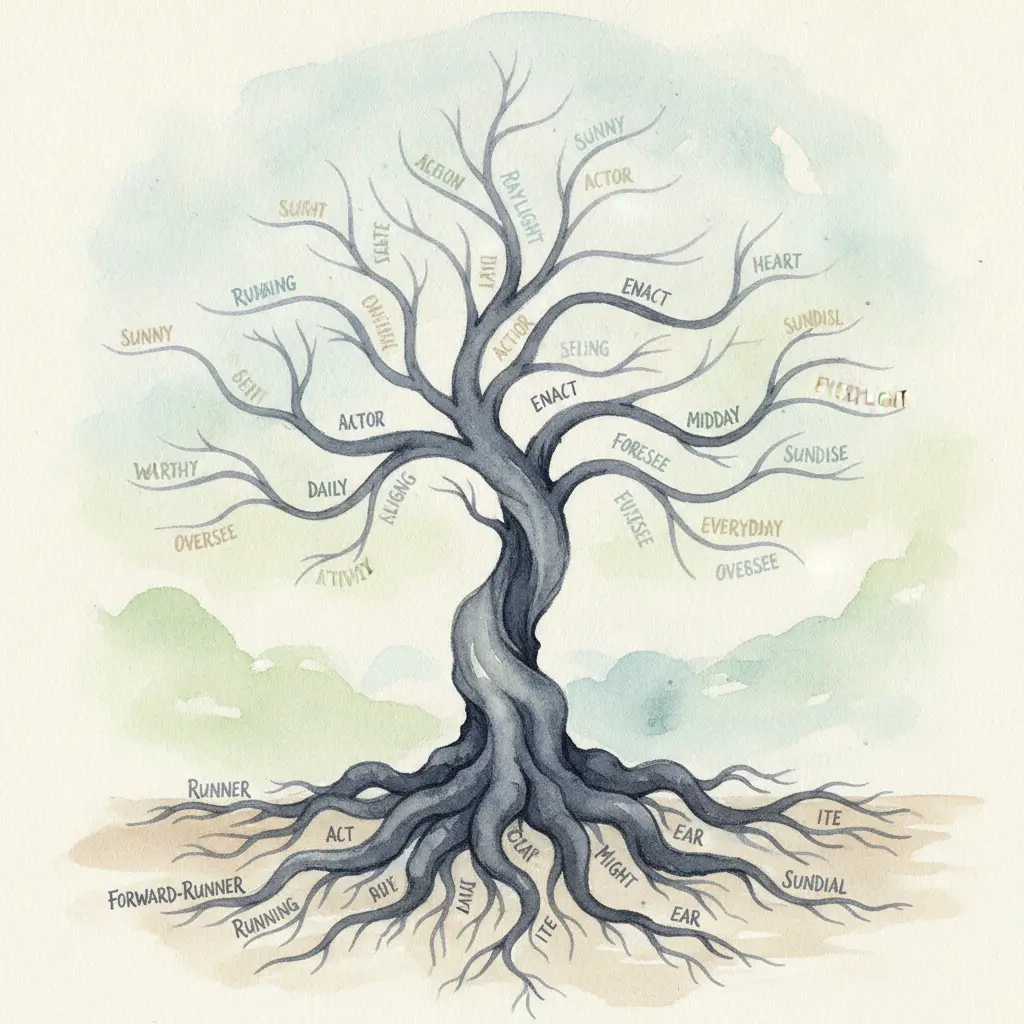
Here’s the thing nobody explains to beginners clearly enough: Arabic doesn’t really work like English. In English, “write,” “writer,” and “written” don’t visually share much except you kind of know they’re related. In Arabic, that connection isn’t a guess. It’s built into the structure of the language itself. Every word grows out of a root — usually three letters — and once you can see that root, you’re not memorizing words one at a time anymore. You’re memorizing families.
I’ve taught Arabic long enough to watch this click for students, and it’s honestly one of the most satisfying moments in a lesson. So let’s get into how it actually works, and how to use it so vocabulary sticks instead of leaking out of your head by Thursday.
What Is an Arabic Root, Really?
Most Arabic words are built from a root of three consonants (sometimes four, but three is the classic pattern). This root carries the core meaning. Everything else — the vowels you add, the letters you attach before or after — shapes that core meaning into a specific word: a noun, a verb, an adjective, whatever you need.
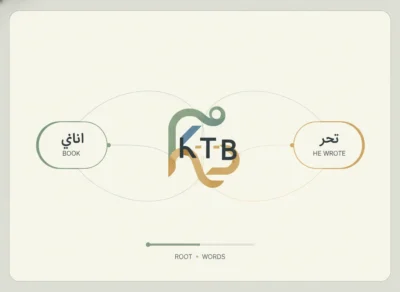
Take the root ك-ت-ب (k-t-b). The core idea here is “writing.” Now watch what happens when you build on it:
- كَتَبَ (kataba) — he wrote
- كِتَاب (kitāb) — book
- كَاتِب (kātib) — writer
- مَكْتَب (maktab) — office / desk
- مَكْتَبَة (maktaba) — library
- مَكْتُوب (maktūb) — written / letter
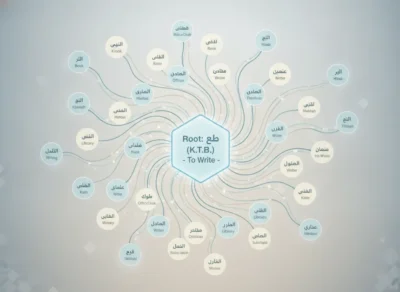
Look at that list again. Six words. One root. If you memorized each one separately, that’s six flashcards with zero connection between them. But if you learn the root first, you’re not learning six unrelated words — you’re learning one idea and five ways it gets dressed up.
That’s the entire trick. Arabic hands you the connections for free. Most learners just never get taught to look for them.
Why This Actually Speeds Up Memorization
I’ll be straight with you — this isn’t just a nice pattern. There’s a real reason it works on your memory, and it’s worth understanding so you trust the method enough to actually use it.
Your brain remembers networks better than isolated facts. This isn’t an Arabic-specific idea — it’s just how memory works. A fact sitting alone with nothing attached to it is easy to lose. A fact connected to five other facts has five paths leading back to it. If you forget “maktaba” (library), but you remember the root k-t-b means writing, and you remember that places often get the م (mim) prefix, you can practically rebuild the word from the pieces. You’re not relying on raw recall. You’re rebuilding from logic.
Recognizing patterns cuts your workload literally in half. Once you know that مَفْعَل and مَفْعَلة patterns often mean “a place where X happens,” you don’t need to memorize maktab (office) and matbakh (kitchen, from ط-ب-خ, cooking) as two separate vocabulary items. You need to know two roots and one pattern. That’s the difference between memorizing 500 random words and memorizing 150 roots that unlock 500 words.
It turns reading into detective work instead of guesswork. When you hit an unfamiliar word in a news article or a Quran verse, most beginners just stop and reach for a dictionary. But if you can pull the root out of an unfamiliar word, you can often guess the general meaning before you even open a translation. That skill alone will make you feel like a completely different level of learner.
How to Actually Study This Way
Okay, so the theory is nice. But how do you turn “learn roots” into something you do on a Tuesday evening with 15 minutes and a notebook? Here’s what I tell students.
1. Stop learning words in isolation. Learn them in families.
When you hit a new word, don’t just write it down and move on. Ask: what’s the root? Then, instead of one flashcard, build a small cluster. Write the root at the top of the page, and underneath it, list every related word you already know or can find. Even three or four words in a family beats twenty unconnected ones.
2. Learn the common patterns, not just the roots
Roots give you meaning. Patterns (called wazn in Arabic grammar) give you word type. Learning that the pattern فَاعِل usually gives you “the person who does the action” — kātib (writer), ṭālib (student, from ط-ل-ب, seeking) — means every time you meet a new root, you already half-know a dozen words before you’ve studied them individually.
A few patterns worth memorizing early:
| Pattern | What it usually means | Example |
|---|---|---|
| فَاعِل | the doer / person who does X | كَاتِب (writer) |
| مَفْعَل / مَفْعَلة | place where X happens | مَكْتَبَة (library) |
| فَعَّال | someone who does X professionally/habitually | نَجَّار (carpenter) |
| مَفْعُول | the thing that had X done to it | مَكْتُوب (written) |
| اِفْتِعَال | reflexive or reciprocal version of X | اِجْتِمَاع (meeting) |
You don’t need to memorize grammar terminology to use this. You just need to notice the shape.
3. When you learn a new root, ask “what else can I build from this?”
Don’t stop at one word. If you just learned دَرَسَ (he studied, root د-ر-س), take thirty seconds and think — or look up — مَدْرَسَة (school), دِرَاسَة (study/studying), مُدَرِّس (teacher). You just turned one flashcard into four, and they all reinforce each other instead of competing for space in your memory.
4. Keep a roots page in your notebook, separate from your regular vocab list
This is a small habit that pays off fast. Instead of one long linear list of words, keep a page where each root gets its own little cluster, and you add to it over weeks as you meet new derived words. Watching that cluster grow is honestly one of the more motivating things about studying Arabic — you can see your vocabulary compounding instead of just piling up.
If you want a full daily structure to build habits like this into your week without it eating your evenings, our 15-minute daily Arabic study routine is built around exactly this kind of short, consistent practice.
A Word of Caution: Roots Aren’t Magic
Here’s the part that gets left out of most “Arabic roots” articles you’ll find online, and it matters. Roots are a shortcut, not a shortcut around actually learning the language.
Some roots have irregular or unexpected meanings once you get past the first couple of derived words — the connection to the “core meaning” gets a little poetic sometimes, and you’ll occasionally shake your head at how someone decided these words belong to the same family. And plenty of very common words are exceptions, or borrowed from other languages, or just don’t follow a clean pattern. Trying to force every word into a tidy root-and-pattern box will slow you down more than it helps.
Use roots as your main strategy, not your only one. They’re a memory tool, not a grammar rulebook you can apply with zero exceptions.
Take the root ق-و-ل (q-w-l), which carries the idea of “saying.” You’d expect a clean, predictable family, and mostly you get one — قَالَ (qāla, he said), يَقُولُ (yaqūlu, he says), قَوْل (qawl, a saying). But then مَقَالَة (maqāla) shows up meaning “article” — as in a newspaper article — which isn’t exactly where you’d guess “saying” would land on its own. It makes sense once you see it (an article is, loosely, a formalized “thing said”), but you probably wouldn’t have predicted it cold. That’s the pattern with roots containing و or ي in the middle — these are called “weak roots,” and they shift and stretch in ways the cleaner three-consonant roots like k-t-b don’t. Expect a few surprises like this along the way, and don’t let one odd derivation make you distrust the whole method.
One place this connects naturally is broken plurals — Arabic doesn’t just add “s” to the end of a word like English does, plurals often reshape the root into a whole new pattern. If that sounds confusing right now, it will make a lot more sense once roots feel familiar, and our guide on broken plurals in Arabic walks through exactly how that connects to what you’re learning here.
Does This Work for Kids Too?
I get this question a lot from parents, usually phrased something like “how do I get my kid to actually enjoy Arabic instead of dreading it.” Honestly, root families are one of the more fun tools for this, because kids like patterns — it turns into a bit of a game. “If k-t-b means writing, what do you think maktab means?” is the kind of question a six-year-old can actually get excited about answering correctly.
That said, if your child is very young — think preschool age — don’t lead with roots and grammar patterns. Start with spoken vocabulary, songs, and repetition, and let the pattern-recognition stuff come in naturally a bit later, once they’ve got a base of words to actually see the connections between. If you’re building an Arabic routine at home for a young child, our guide on kids’ Arabic lessons and activities covers age-by-age ideas that fit before the root system becomes useful.
Roots Matter Even More If You’re Reading the Quran

If part of why you’re learning Arabic is to understand the Quran, roots stop being a nice memory trick and start being close to essential. Quranic Arabic repeats certain roots constantly across different surahs, just dressed in different patterns. Once you recognize a handful of high-frequency roots, huge chunks of the text start opening up, because you’re not meeting new words — you’re meeting familiar roots in a slightly new outfit. If that’s your goal, it’s worth pairing this kind of vocabulary study with structured Quran classes where a teacher can point out these root connections as you read, instead of you having to spot every one yourself.
A Few Tools Worth Knowing About
You don’t need any of these to get started — a notebook and the habit of asking “what’s the root?” will take you far on their own. But once you’re hooked on this way of studying, a few resources make it faster:
- Hans Wehr Dictionary — the standard Arabic-English dictionary, and the reason root-thinking matters so much: it’s organized by root, not alphabetically by whole word. Look up ك-ت-ب once and you see the entire family in one entry, instead of hunting for each word separately.
- Quranic Arabic Corpus — a free online tool that tags every word in the Quran with its root and grammatical breakdown. If your goal is Quran reading, this is genuinely one of the best free resources out there for seeing roots in real context, verse after verse.
- Root-based flashcard apps — several Arabic vocabulary apps let you tag or group cards by root instead of just by lesson number. Even if you’re using a general app like Anki, you can build this yourself — just create a “root family” note type instead of one card per word.
None of these replace a teacher walking you through it, especially for the weird exceptions, but they’re solid to have open while you study.
FAQ
Do I need to learn Arabic grammar before I can use roots? No. You can start noticing roots on day one. Grammar helps you understand why the patterns work the way they do, but you don’t need to wait for it. Beginners benefit from root-spotting immediately.
How many roots does a beginner actually need? There’s no exact number, but a solid working vocabulary for everyday conversation and basic reading is usually built on a few hundred common roots. You’ll pick most of them up naturally just by studying consistently — you don’t need to sit down and memorize a root list from scratch.
Is this method different for Modern Standard Arabic versus Egyptian Arabic? The root system itself is shared — it’s baked into Arabic at a deeper level than any one dialect. But Modern Standard Arabic tends to use the full range of classical patterns more consistently, which is part of why MSA is a strong base for this kind of study. Once you’ve got the root-and-pattern habit from MSA, spotting it in dialect gets a lot easier too.
What if I can’t figure out the root of a word on my own? That’s completely normal at first — it takes practice, and some roots hide behind irregular spelling or weak letters (و and ي) that shift depending on the word. A dictionary organized by root (like Hans Wehr) is a genuinely useful tool here. And honestly, this is exactly the kind of thing that’s ten times faster with a teacher sitting next to you than trying to reverse-engineer it alone.
Learn Smart, Not Just Hard
Memorizing Arabic vocabulary one word at a time is slow, and it doesn’t have to be. Once you start seeing roots, you stop fighting the language and start using its own structure to your advantage. That’s the difference between a student who’s still translating word by word after a year and one who’s actually starting to read.
If you want this kind of pattern-based thinking built into your actual lessons instead of figuring it out alone from articles, our certified teachers build it into every level from the very first class. Not sure where your vocabulary currently stands? Start with the free Arabic placement test — it takes a few minutes and tells you exactly where to focus. Or go straight to Modern Standard Arabic classes and learn smart, with someone who can point out the roots you’d miss on your own. You can also check pricing plans if you want to see what fits your schedule first.