If you learn one thing from a textbook and then land in Cairo airport, here’s what happens. You say the “correct” Modern Standard Arabic greeting to the guy at passport control. He blinks at you like you just recited Shakespeare. Nobody talks like that here.
Here’s the thing — greetings are the first real test of whether you can actually speak Egyptian Arabic, or whether you just studied it. And they’re not hard. You don’t need grammar for this. You need the right words, said the right way, at the right moment. That’s it.
So let’s go through the greetings Egyptians actually use, every day, with real people. Not the ones in a phrasebook. The ones you’ll hear from your doorman, your taxi driver, your neighbor, your teacher.
Why Egyptian greetings don’t sound like your MSA textbook
Most people start with Modern Standard Arabic (MSA) because that’s what’s in the apps and the grammar books. And MSA has its place — it’s the language of the news, of formal writing, of the Quran. But nobody greets their friend on the street with full MSA sentences. It would sound stiff. A bit like walking up to your barber and saying “Good morrow, sir, how fare thee?”
Egyptian Arabic is looser, faster, and full of little words that MSA doesn’t even have. “Izzayak” — how are you — isn’t in MSA at all. It’s pure Egyptian. If you want the fuller picture of how the two differ and when you’d actually use each one, we broke that down in Egyptian Arabic vs MSA: Which One Do You Really Need?. For now, just know this: everything below is what real people say in Cairo, Alexandria, Luxor — anywhere in Egypt — not what’s printed in a formal grammar guide.
The basic hello: Ahlan
Start simple. “Ahlan” (أهلاً) means hi. You can say it to anyone, anytime, in any situation. It’s short, it’s safe, it works.
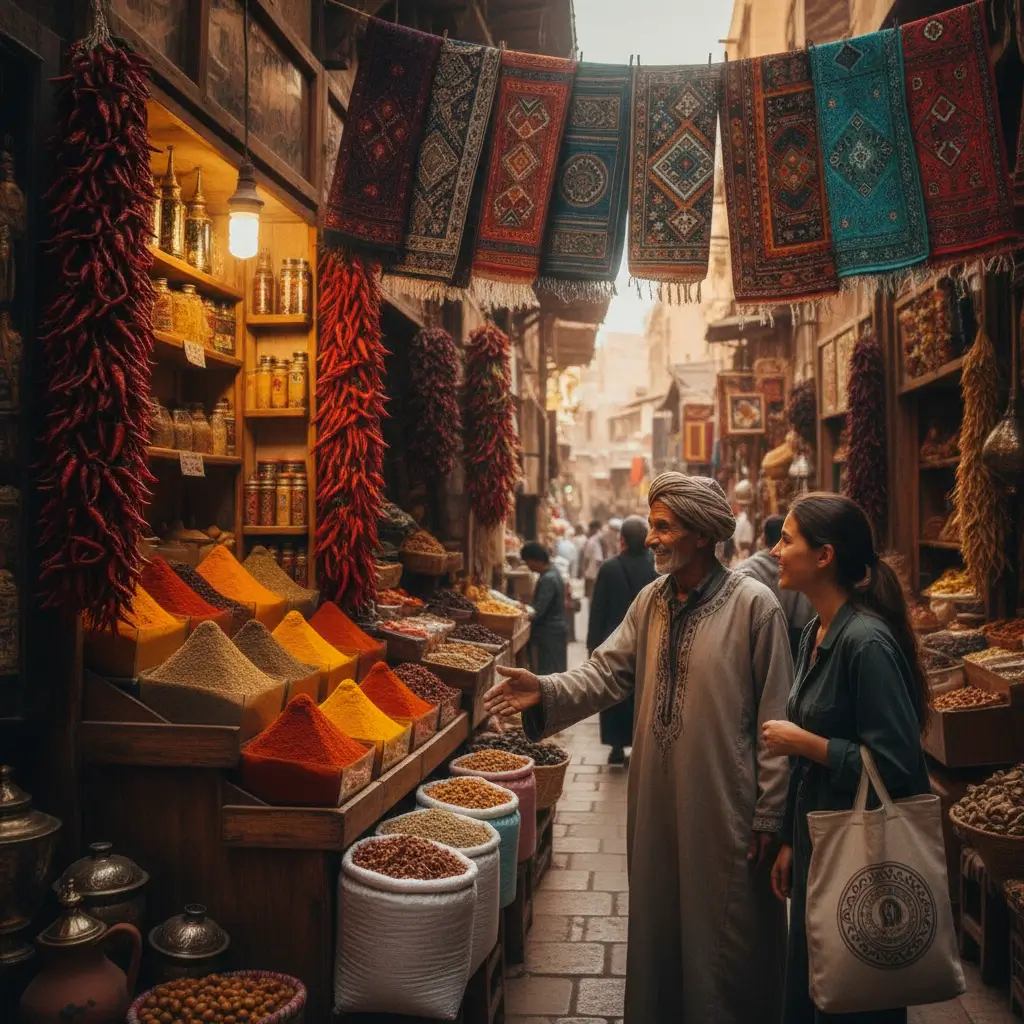
Want to sound a bit warmer? Add “wa sahlan” — “Ahlan wa sahlan” (أهلاً وسهلاً). It roughly means “welcome,” and Egyptians say it constantly when you walk into a shop, a home, a class, pretty much anywhere you’re being received. Shopkeepers say it before they even know what you want to buy. It’s just how hospitality sounds here.
Reply: you can just say “Ahlan” back, or “Ahlan beek” (أهلاً بيك) if talking to a man, “Ahlan beeki” (أهلاً بيكي) to a woman. Don’t overthink it. Even just repeating “Ahlan” is completely normal.
Salamu alaykum — and why the reply actually matters
“Al-salamu alaykum” (السلام عليكم) means “peace be upon you.” It’s used across the Arab and Muslim world, not just Egypt, and honestly, it works at any time of day, in any setting, formal or casual.
The response isn’t optional small talk — it’s a fixed reply: “Wa alaykum al-salam” (وعليكم السلام), “and upon you be peace.” You’ll sometimes hear the longer version, “wa alaykum al-salam wa rahmatullah wa barakatuh,” which adds “and God’s mercy and blessings.” That longer version shows up more in religious or more formal contexts, and among people who know each other well.
I’ll be straight with you — non-Muslim visitors use and hear this greeting in Egypt all the time. It’s a cultural greeting as much as a religious one at this point, and Egyptian Christians use it too in daily life. Nobody’s going to raise an eyebrow if you say it. What would raise an eyebrow is hearing it and not replying at all — that reads as a bit rude, even if it’s just because you didn’t know the response yet. Now you do.
Time-of-day greetings: the ones you’ll use most
This is where Egyptian Arabic gets genuinely nice, because the replies aren’t just “you too” — they’re little poetic call-and-response pairs.
| Time | You say | Meaning | They reply |
|---|---|---|---|
| Morning | Sabah el kheir (صباح الخير) | Good morning | Sabah el noor (صباح النور) — “morning of light” |
| Afternoon/Evening | Masaa el kheir (مساء الخير) | Good evening | Masaa el noor (مساء النور) — “evening of light” |
| Night, parting | Tisbah/Tisbahy ala kheir (تصبح على خير) | Good night | Wa inta/inti min ahlu (وانت من أهله) — roughly, “and you’re one of the good ones” |
A question I see a lot: when exactly do you switch from “sabah el kheir” to “masaa el kheir”? Honestly, there’s no strict clock rule. Most Egyptians shift somewhere around noon to early afternoon, but it’s flexible — nobody’s going to correct you if you say “sabah el kheir” at 1pm. Go with the general feel of the day and you’ll be fine.
One more small thing worth knowing: “kheir” means “goodness,” so both phrases are literally wishing someone a morning or evening full of good things. It’s a nice detail to hold onto — it makes the phrase easier to remember and honestly just nicer to say once you know what you’re actually saying.
Asking “how are you” — and getting it right for gender
This is where a lot of learners trip up, because Egyptian Arabic changes the ending depending on who you’re talking to.
- To a man: Izzayak? (إزيك؟)
- To a woman: Izzayik? (إزيك؟) — written the same, pronounced slightly differently
- To a group: Izzaykom? (إزيكم؟)
It means “how are you,” and it’s probably the single most common thing you’ll hear after “ahlan” in any real conversation. People say it walking past each other, opening a phone call, starting a class, everything.
How to respond:
- “Kwayyes, alhamdulillah” (كويس، الحمد لله) — good, thank God — if you’re a man
- “Kwayyesa, alhamdulillah” (كويسة، الحمد لله) — if you’re a woman
- “Tamam” (تمام) — fine / all good, works for anyone
And here’s a habit worth building early: Egyptians almost always ask the question back. “Kwayyes, alhamdulillah, w inta izzayak?” — good, thank God, and how are you? Leaving that off feels a little abrupt, like you asked a question and then walked away before hearing the answer. Bounce it back. It’s polite, and it’s also just how the rhythm of the conversation works.
You’ll notice “alhamdulillah” — thank God — shows up constantly, even from people who aren’t especially religious. It’s baked into daily speech the way “I’m good, thanks” is baked into English. Don’t read too much into it. Just use it.
Saying goodbye
Just as important as hello. A few options, depending on the vibe:
- Ma’a salama (مع السلامة) — go with safety / goodbye. Works everywhere, safe default.
- Salam (سلام) — a short, casual “bye,” common between friends.
- Bye bye — yes, genuinely, a lot of Egyptians say this in English even mid-Arabic sentence. Don’t be surprised.
- Yalla bye (يلا باي) — “okay, bye,” used when you’re wrapping up a call or conversation. “Yalla” alone means “let’s go” or “come on,” and it gets attached to almost everything.
Formal versus casual — does it actually matter?
Egyptian Arabic is generally less formal than a lot of learners expect. But there are still moments where you’d lean more formal — talking to an older person, a teacher, someone in a professional setting, or someone you’re meeting for the first time in a business context.
In those cases:
- Lean on “Ahlan wa sahlan” over a bare “Ahlan”
- Use “izzayak/izzayik” but soften your tone
- Add a title if you know one — “ostaz” (أستاذ) for a man, “ostaza” (أستاذة) for a woman, both roughly meaning “teacher” or “sir/madam” and used as a polite, respectful address even outside classrooms
With friends, family, people your age, your teacher once you know them — go casual. Egyptians are warm people, and over-formality with someone you already know can actually feel distant, not respectful.
The physical side of greeting someone
Words are half of it. Here’s what actually happens with bodies:
- Handshakes are common between men, and increasingly between men and women in cities, though some more conservative or religious individuals — men and women both — prefer a hand-on-heart nod instead of a handshake with the opposite gender. If you’re unsure, wait half a second and follow their lead.
- Cheek kisses happen between people who know each other well, usually same-gender, sometimes two or three kisses depending on the region and the relationship.
- Hand on heart after a handshake, or instead of one, is a warm, respectful gesture — it basically says “this greeting comes from the heart,” and it’s a lovely one to pick up.
None of this is a strict rulebook. Egyptians are generally relaxed about it and will adjust to you as a foreigner. But knowing the options means you won’t freeze up when someone extends a hand — or doesn’t.
Common mistakes learners make with greetings
I’ll be straight with you, because I’ve seen these a hundred times:
- Using MSA greetings only. Technically correct, socially a little odd. It’s the difference between speaking correctly and speaking naturally.
- Forgetting to bounce the question back. “Izzayak?” gets answered, and then the conversation just… stops. Ask it back.
- Mixing up the gender endings. Izzayak vs izzayik trips people up early on. It’s a small sound difference, but Egyptians will notice, gently correct you, and move on — it’s not a big deal, just practice it out loud.
- Treating “Salamu alaykum” as too religious to use. It’s not. It’s a normal, everyday greeting here, used by people of all backgrounds.
- Staying too formal for too long. If someone’s already being casual with you, match them. Sticking to overly formal Arabic can actually create distance instead of respect.
Questions people actually ask about this
Do I have to reply to “Salamu alaykum” even if I’m not Muslim? You don’t have to, but it’s polite and completely normal to. “Wa alaykum al-salam” works regardless of your own background — it’s a standard greeting exchange in Egypt, used across religions in everyday life.
Is “Izzayak” rude or too casual for someone older? No. It’s the standard way to ask how someone is, at every level of formality. What changes with an older or more senior person is your tone and maybe adding “ostaz” or “ostaza” — not the phrase itself.
What’s the difference between “Ahlan” and “Ahlan wa sahlan”? “Ahlan” is a simple hi. “Ahlan wa sahlan” adds warmth — closer to “welcome.” You’ll hear the second one a lot when you’re entering someone’s space: a shop, a home, an office.
Can I use these same greetings outside Egypt? Some, yes — “Salamu alaykum” travels across the whole Arab world. But “Izzayak,” “Sabah el noor,” and a lot of the specific replies here are distinctly Egyptian. In the Gulf or the Levant, people often respond differently. If you’re focused on Egypt specifically, this list is your foundation.
Practice actually matters more than memorizing
Here’s the thing — you can read this whole list twice and still freeze the first time someone says “izzayak” to you in real life. That’s normal. Greetings feel automatic once you’ve said them out loud fifty times, not after you’ve read them once.
Once you’ve got these down, the natural next step is small talk — what people actually say after “how are you,” how introductions work, how Egyptians ask where you’re from or what you do. We cover that in Common Egyptian Introductions and Everyday Small Talk, which picks up right where this article leaves off.
And if you want a simple structure for practicing a little bit daily instead of cramming once a week, our daily Arabic study routine guide is a good, low-pressure place to start.
Not sure where your Arabic actually stands right now? Take our free Arabic level test — it takes a few minutes and tells you exactly where to start instead of guessing.
Ready to actually use these?
Reading greetings is one thing. Saying them back and forth with a real person, getting corrected gently, hearing how a native speaker actually says “izzayak” at conversational speed — that’s a different skill entirely. That’s what our Colloquial Egyptian Arabic course is built around: real spoken Egyptian, with native teachers, from your very first “ahlan.”
Start talking — your teacher isn’t going to judge your accent. They’re going to be thrilled you’re trying.