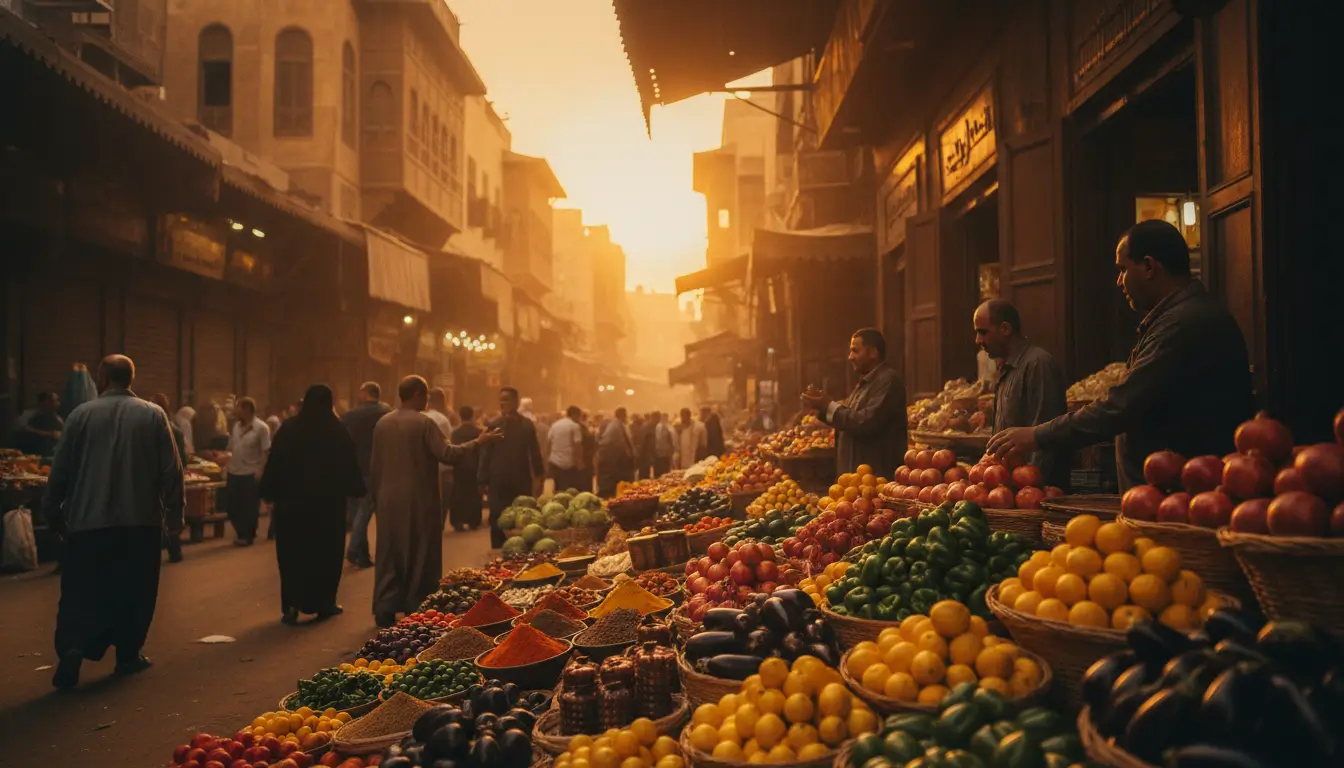

You’re sitting at the dinner table. Everyone’s talking over each other. Someone’s teta (grandma) is telling a story, your mother-in-law just asked you something with a raised eyebrow, and a kid is tugging your sleeve saying something fast in Masri. You smile. You nod. You have no idea what just happened.
Sound familiar?
I get messages like this every week — from people engaged to Egyptians, married into Egyptian families, or just trying to keep up at a friend’s house on a Friday. And here’s the thing: textbook Arabic doesn’t prepare you for this. MSA (Modern Standard Arabic) is what you’ll see on the news. It’s not what your father-in-law says when he wants you to pass the rice.
Family Arabic is a different animal. It’s fast, warm, teasing, and full of shortcuts nobody writes down in grammar books. So let’s fix that.
Why family conversations are their own category
Formal Arabic classes teach you to introduce yourself, order food, ask for directions. Useful stuff. But family life runs on a completely different set of phrases — terms of endearment, respect language for elders, kitchen talk, kid talk, the specific way Egyptians tease each other at the table.
I’ll be straight with you — nobody becomes fluent in family Arabic from an app. You learn it by being in the room, getting corrected mid-sentence by a grandmother who has zero patience for mistakes but all the patience in the world for you personally. Still, you can walk in prepared. That’s what this article is for.
If you’re at the very start of learning the dialect itself — not just family vocabulary but the whole shape of Egyptian Arabic versus MSA — our guide on Egyptian Arabic vs MSA lays out exactly how people in your situation (engaged to an Egyptian, married in, moving to Cairo) usually approach the two together. Worth reading before you go further.
Real questions people actually ask about this
I pulled these from conversations I’ve had with students, plus threads I’ve seen on Reddit and Quora from people in the exact same boat. If one of these is you, keep reading — I’m answering all of them.
“My fiancé’s family speaks fast and I freeze. How do I not look lost at every gathering?”
Honestly, everyone freezes at first. Egyptian family gatherings move at double speed compared to a classroom. The fix isn’t “understand everything” — it’s learning to catch keywords and respond with safe, warm phrases while your ear catches up. More on that below.
“What do I call my mother-in-law? Is there a special word?”
Yes, and getting it right matters more than you’d think.
“How do I talk to my partner’s grandmother without sounding rude?”
Egyptian Arabic has a whole respect register for elders. It’s not hard once you know the pattern — it’s just never taught in beginner textbooks.
“My kids are half-Egyptian. How do I get them comfortable with family Arabic, not just ‘hello’ and ‘thank you’?”
This one comes up constantly, and it deserves its own section too.
“Is it rude to speak MSA at the dinner table instead of Egyptian dialect?”
Short answer: yes, a little. Longer answer below.
Family words that actually get used

Forget the vocabulary list from your phrasebook. Here’s what gets said in real Egyptian homes.
- Mama / Baba — Mom and Dad. Used by kids and adults alike, even grown adults calling their own parents this.
- Teta (تيتة) — Grandma. Warm, affectionate, used constantly.
- Gedo (جدو) — Grandpa.
- Khalto (خالتو) — literally “my aunt” (mother’s side), but also used casually to address any older woman warmly, even outside the family.
- Ammo (عمو) — “My uncle” (father’s side), same deal — also used to address older men respectfully or affectionately.
- Hamati (حماتي) — my mother-in-law. Hamaya (حماي) — my father-in-law. Use these when talking about them. When talking to them directly, most people use a respectful title instead — see the next section.
- Ekhti / Akhouya (أختي / أخويا) — my sister / my brother.
- ‘Eyla (عيلة) — family, in the broad sense — the whole clan, not just your household.
- Beit (بيت) — house, home. “Beit mama” — “mom’s house” — is a phrase you’ll hear constantly, since Sunday family lunch at the parents’ house is practically a national institution in Egypt.
Small note on pronunciation: that “kh” sound (خ) is like the “ch” in the Scottish “loch” — a scrape at the back of the throat, not a hard K. Get comfortable with it early. Family names use it a lot.
How to actually address your in-laws
Here’s where a lot of learners trip up. In Egyptian families, you rarely call your mother-in-law “hamati” to her face. That word is for talking about her to someone else. Directly, you address her the way her own children might, or with a respectful title — often just “mama” once you’re close, or “hagga” if she’s made the pilgrimage to Mecca, which is a real honorific Egyptians take seriously.
Same logic with your father-in-law. Calling him “baba” once the relationship is warm enough is completely normal, and honestly, expected — it signals you consider yourself part of the family, not a guest.
If you’re not sure which stage you’re at, the safest move is to ask your partner directly: “eh a7sen 7aga a2olha lehom?” (إيه أحسن حاجة أقولها لهم؟) — “what’s the best thing to call them?” Egyptians won’t be offended by the question. They’ll usually be touched you asked.
The respect language for elders
Egyptian Arabic has a built-in way of showing respect that goes beyond word choice — it’s baked into the grammar. Talking to an elder, you’ll often hear the plural “you” form used even for one person, similar to how French uses “vous.” It’s a way of elevating the person you’re addressing.
You don’t need to master the grammar of this immediately. What matters more, early on, is tone and a handful of respect markers:
- Add “ya” before someone’s name or title when addressing them directly — “ya teta,” “ya hagg” — it softens everything and sounds warm rather than blunt.
- Never interrupt an elder mid-sentence. This isn’t unique to Arabic culture, but it’s taken seriously at Egyptian family tables specifically.
- “Etfaddal / Etfaddali” (اتفضل / اتفضلي) — “please, go ahead / after you” — said constantly when offering food, a seat, or the floor to speak. Use it liberally with elders and you’ll sound naturally polite.
- “Rabbena yekhaleeh / yekhaleeha” (ربنا يخليه / يخليها) — “may God preserve him/her” — said after mentioning an elder family member, almost automatically, like a verbal habit. Egyptians say this so often it barely registers as religious language anymore — it’s just what you say.
Talking to the kids at the table
If you’re marrying into a family, or you’re raising bilingual kids yourself, the children’s Arabic at the table is its own layer. Kids speak faster, use more slang, and honestly won’t slow down for you the way adults will.
A few phrases that go a long way:
- “Kol / Koli” (كل / كلي) — “eat!” — said by every relative to every child, constantly, at every meal. You’ll hear it so much it becomes background noise.
- “Ya 7abibi / ya 7abibti” (يا حبيبي / يا حبيبتي) — “my darling” — used toward kids (and honestly, toward almost everyone you’re fond of) non-stop.
- “Basita” (بسيطة) — “it’s simple / no big deal” — great for reassuring a nervous or upset kid.
- “Yalla ne’ab” (يلا نلعب) — “let’s play” — an easy way in with younger children who don’t care about your grammar and just want a playmate.
If you’re raising kids in a mixed household and want them comfortable in family settings — not just able to say “hello” but actually able to follow along at Sunday lunch — our guide on teaching Arabic to children breaks down realistic expectations by age, and our kids’ Arabic lessons and activities guide has 30+ screen-free ways to build this into daily life without turning it into homework.
Meal-time phrases you’ll use every single visit
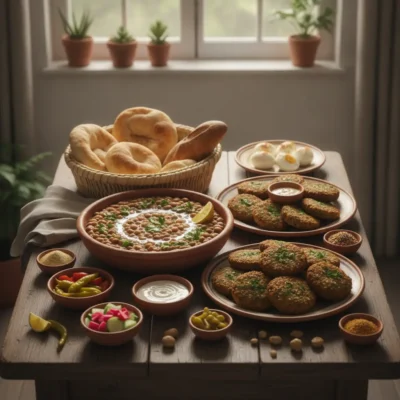
Egyptian hospitality at the table is intense, in the best way. You will be offered food repeatedly, even after you’ve said you’re full. Knowing the script here saves a lot of confusion.
- “Sa7tein” (صحتين) — said before or during a meal, roughly “two healths” — a blessing on the meal.
- “Bel hana wel shefa” (بالهنا والشفا) — the traditional response, “with pleasure and health.”
- “Shabaan / shabaana” (شبعان / شبعانة) — “I’m full” (male/female). Fair warning: this alone often isn’t enough. You may need to say it three or four times, with a hand over your plate, before anyone believes you.
- “Da7ee” (ده حلو) — “this is delicious” — say this about the food and watch the whole room light up.
- “Yislamu edeik” (يسلم إيديكي) — “bless your hands” — said to whoever cooked. This one phrase, more than almost anything else on this list, will earn you real points with whoever’s in the kitchen.
Common family teasing (and how not to take it personally)
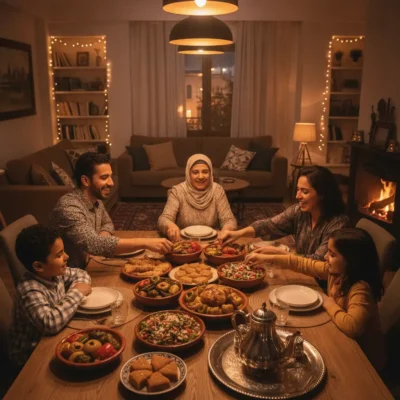
Here’s something nobody warns you about: Egyptian families tease. A lot. It’s a love language, not an insult. If your father-in-law calls you “ya wad” (يا واد — “hey kid,” even if you’re 35) or your sister-in-law jokes about your accent, that’s not rejection. That’s you being folded into the family rhythm.
The best response is usually to laugh and tease back, even clumsily. A simple “enta be teghazzar” (انت بتغزّر — “you’re exaggerating”) with a smile does more for your standing in the family than a perfectly grammatical sentence ever would.
Should you use MSA at family gatherings?
Short answer: no, not if you can help it. Using MSA at a family dinner sounds the way reading from a script would sound at your own family’s Thanksgiving — technically correct, but strange, distant, even a little cold. Egyptian Arabic (Masri) is the language of home. MSA is the language of the news anchor.
This is exactly why people preparing for family situations — engagements, weddings, moving in with in-laws — usually shift their study focus toward the dialect specifically rather than sticking with formal Arabic. If that’s where you are, our full breakdown of the 50 most common Egyptian Arabic phrases is a solid next stop after this article — it covers the everyday greetings and responses that come up outside the family context too, which reinforces everything here.
Building this into a routine that actually sticks
Here’s the part I always tell students, and it’s not glamorous: you won’t absorb family Arabic from one article, one visit, or one wedding. It comes from repetition — actually saying “sa7tein” out loud before you eat alone, actually practicing “yislamu edeik” until it doesn’t feel awkward in your mouth.
If you don’t already have a study rhythm, our 15-minute daily Arabic study routine is built for exactly this kind of steady, low-pressure practice — the kind that turns “I recognize that word” into “I said that word back without thinking.” Fifteen minutes, same time each day, no exceptions. That’s genuinely most of the secret.
Not sure where your Egyptian Arabic actually stands right now — beginner, or further along than you think? Take the free Arabic placement test first. It’ll tell you exactly what to focus on instead of guessing.
The bottom line
Family Arabic isn’t harder than classroom Arabic — it’s just different. It’s warmer, faster, funnier, and full of small respect markers that matter more than perfect grammar. Get “ya hagg,” “yislamu edeik,” and “etfaddali” into your muscle memory, and you’ll walk into that next family lunch a lot less lost than you were at the last one.
And if you want a native Egyptian teacher who can walk you through real family scenarios — not just textbook dialogues, but the actual back-and-forth you’ll face at your in-laws’ table — our teachers at Alphabet Arabic Academy specialize in exactly this. Check our Colloquial Egyptian Arabic course to see how the lessons are structured, or look at course pricing to find a plan that fits.
You’re not just learning a dialect. You’re learning how to belong at the table.