Can kids really learn Arabic — and learn it well? Yes. Research says so. Children under 10 are in the most powerful language-acquisition window of their lives, and Arabic is no exception. This guide covers everything parents need to know: what works, what doesn’t, what age to start, and how to choose the right program teaching Arabic to children for your child — backed by real evidence, not guesswork.
Why Children Learn Arabic Better Than Adults Do
Here’s a fact that might surprise you: your 6-year-old has a language-learning advantage over you. Not because they’re smarter — because their brains are literally wired differently right now.
Neuroscience research shows that children in the critical period (roughly ages 2–12) acquire languages with a naturalness that adults simply can’t replicate. They absorb sounds, patterns, and rhythm without conscious effort. The sounds of Arabic — including ع، ح، خ، ق — that take adults months to master? A child picks them up from a native teacher in weeks.
The Cognitive Case for Arabic Specifically
Arabic isn’t just another language. It’s a right-to-left script with 28 letters, a system of roots that generates thousands of words, and sounds that challenge the brain in ways Latin-based languages don’t. And that’s actually a cognitive advantage.
Studies consistently show that bilingual children — including those learning Arabic — demonstrate superior executive function. That includes better attention control, stronger working memory, and sharper problem-solving skills. These benefits carry across every subject they study.
Learning Arabic also tends to deepen family bonds. For children of Arab heritage, it’s the language of grandparents, of stories, of identity. For Muslim children globally, it’s the language of the Quran — which transforms from recited sounds into genuine meaning.
The Critical Window: Ages 3 to 12
Children who begin Arabic before age 10 typically reach higher ultimate attainment in pronunciation and intuitive grammar than adult learners. That doesn’t mean older learners can’t succeed — they absolutely can. But if your child is young, now is genuinely the best time.
This is why early enrollment matters. Not because of pressure or competition. Because the window is open, and it won’t stay open forever.
A Research-Backed Framework: What Actually Works for Kids Learning Arabic
Not all Arabic teaching methods are created equal. Some work brilliantly for adults but fall flat with children. Here’s what the research — and years of classroom experience — actually says.
1. Communicative Language Teaching (Not Grammar Drills)
Children don’t learn grammar rules and then apply them. They learn by doing — by speaking, listening, making mistakes, and trying again. The most effective children’s Arabic programs focus on meaningful interaction first, with grammar emerging naturally from real language use.
What this looks like in practice: a lesson about food, where the child learns to say “أريد تفاحة” (I want an apple) through role-play and conversation — not by memorizing verb conjugation tables.
2. Play-Based Learning
“Play is the work of childhood.” That’s not just a nice idea — it’s backed by neuroscience. Play triggers dopamine release, creating positive associations with the learning experience. Children in play-based Arabic programs don’t just learn better — they want to come back.
Effective play-based tools include:
- Letter matching games — connecting Arabic letter shapes with their sounds
- Word puzzles — rearranging letters to form simple words
- Vocabulary memory cards — picture on one side, Arabic word on the other
- I Spy in Arabic — “أنا أرى شيئاً أخضر!” (I see something green!)
- Storytelling role-play — acting out simple Arabic stories with props
Our kids’ Arabic lessons and activities guide covers 30+ of these approaches organized by age group — all screen-free and parent-friendly.
3. Native Speaker Instruction
This is non-negotiable. Arabic has sounds that don’t exist in any European language. The only way a child develops accurate pronunciation is through consistent exposure to a native speaker who produces those sounds correctly.
This is why apps alone aren’t enough. Apps provide great supplementary practice. But a certified native Egyptian teacher — someone who grew up speaking Arabic, studied it at university level, and knows how to teach it to children — provides something no algorithm can replicate.
4. Consistency Over Intensity
Research on distributed practice shows that regular, shorter sessions produce far better long-term retention than occasional marathon study sessions. For children, this means 20–30 minutes daily beats 3 hours on Saturday.
Two live lessons per week plus 15 minutes of daily at-home practice is the sweet spot we’ve seen work for hundreds of students. It’s manageable. It’s sustainable. And it produces real results within months, not years.
5. Home Immersion
Research is clear: formal instruction alone — even 3 hours weekly — delivers only about 150 hours of Arabic exposure per year. Native speakers receive 5,000+ hours. The gap matters.
Closing that gap requires creating an Arabic-rich home environment. More on that below.
Arabic for Toddlers (Ages 2–4): Starting Before School
Can a 2-year-old really learn Arabic?
Yes — but not the way you might think. We’re not talking about grammar or writing. We’re talking about exposure, sounds, and familiarity. At this age, the goal is simple: make Arabic feel natural and friendly before formal learning begins.
What Works for Toddlers
Arabic songs and rhymes. This is the single most powerful tool for this age group. A toddler can absorb Arabic vocabulary, rhythm, and pronunciation through a catchy song long before they can read a letter. Think of how children learn nursery rhymes in their native language — the same principle applies.
Label objects at home. Sticky notes on the fridge (ثلاجة), the door (باب), the window (نافذة). Your toddler will see these words daily without any formal instruction. Passive exposure adds up.
Arabic cartoons. Short, animated programs with simple vocabulary and clear pronunciation. Even 10 minutes per day creates meaningful exposure.
Arabic letter toys. Magnetic letters, foam bath letters, wooden alphabet puzzles. Touch + sight + sound = stronger memory formation at this age.
Simple daily greetings. “صباح الخير” (good morning), “تصبح على خير” (goodnight), “شكراً” (thank you). Weave Arabic into daily routines so it feels normal, not special or foreign.
What NOT to Do With Toddlers
Don’t push formal instruction before age 3–4. Don’t use worksheets for a 2-year-old. Don’t correct pronunciation harshly — it creates anxiety. And don’t expect perfection. You’re planting seeds, not harvesting a crop.
Arabic for Kids Ages 5–7: Building the Foundation
This is the golden window. Children at this age are ready for structured instruction, but they still learn best through play, storytelling, and music. It’s the perfect combination.
The Alphabet: Where to Start
Learning to read the Arabic alphabet for kids is the foundation of everything. The good news: with the right method, most children can recognize all 28 letters within 6–8 weeks.
The key is multi-sensory learning:
- See it: colorful flashcards and illustrated charts
- Hear it: alphabet songs where each letter has a sound and a word
- Touch it: tracing dotted letters, using sand trays, or shaping letters with playdough
- Use it: connecting each letter to a word they already know (أ = أسد, ب = بيت)
Don’t rush to connecting letters until recognition is solid. Patience here pays off enormously later.
Vocabulary at This Stage
At ages 5–7, vocabulary learning should always be thematic and contextual. Never teach isolated word lists. Instead:
- A lesson on animals: قطة (cat), كلب (dog), أرنب (rabbit), أسد (lion)
- A lesson on colors: أحمر (red), أزرق (blue), أخضر (green)
- A lesson on food: تفاحة (apple), خبز (bread), ماء (water)
Words in context stick. Words in isolation don’t.
Reading and First Sentences
By month 3–4 of consistent instruction, most children in this age group can read simple 3-letter words. By month 6, they’re reading short sentences with some support. By month 9–12, they’re reading simple illustrated stories independently.
These are realistic milestones — not promises. They assume 2–3 weekly lessons plus at-home practice. Cut the practice, slow the progress.
Arabic for Kids Ages 8–12: Accelerating Toward Fluency
This age group is capable of remarkable progress. Their brains still hold the neuroplasticity advantage of childhood, but they now have longer attention spans, better abstract thinking, and the ability to understand grammatical explanations.
Honestly? This age group is a teacher’s favorite.
What Changes at This Stage
Children ages 8–12 can:
- Engage with longer texts and stories
- Understand and apply basic grammar rules explicitly
- Write paragraphs in Arabic, not just words
- Hold simple conversations on familiar topics
- Begin reading the Quran with proper Tajweed if they started early
The teaching approach shifts. Lessons can include more explicit grammar instruction, writing exercises, comprehension tasks, and structured conversation practice.
The Role of Culture at This Stage
At ages 8–12, children start building identity. For Arab-heritage children, this is when Arabic becomes something deeply personal — not just a school subject but a connection to who they are. For Muslim children, reading the Quran with comprehension transforms their prayers and spiritual life.
This is also when peer pressure can work against language learning. If Arabic feels “uncool” or embarrassing, engagement drops. The best teachers at this stage are those who make Arabic feel like a superpower, not a burden. Our teachers at Alphabet Arabic Academy specialize in exactly that.
Arabic for Teens (Ages 13–17): A Different Approach Entirely
Let me be straight with you: teenagers are a different animal.
Their identity is intensifying (Erikson’s “identity vs. role confusion” stage). They’re more self-conscious. They hate making mistakes in front of people. And if they don’t see the point of something, they check out fast.
But here’s the thing about teens who choose to learn Arabic — they tend to be highly motivated. Whether it’s for the Quran, heritage connection, or future career prospects in the Middle East, teens who want to learn Arabic often make faster progress than younger children precisely because of their analytical abilities.
What Works for Teenagers
Task-based learning. Real-world tasks — write an essay, give a presentation, discuss a topic — work far better than drills for this age group.
Explicit grammar instruction. Unlike young children, teenagers actually benefit from understanding the rules. Arabic’s trilateral root system fascinates many teen learners once they grasp it.
Technology integration. Arabic social media, YouTube channels, podcasts in Arabic, Arabic shows. Teens learn from content that feels relevant to their world.
Autonomy. Give teenagers control over some of their learning. Let them choose topics. Let them set goals. They’re much more engaged when they have ownership.
Peer community. Learning alongside other motivated young people makes Arabic feel social rather than solitary.
Language Classes for Teens: What to Look For
Not every Arabic program for children works for teenagers. Teens need:
- Teachers who treat them as intelligent young adults, not big kids
- Content that’s intellectually stimulating, not just cute and colorful
- Conversation-focused sessions, not just reading and grammar
- A teacher who understands teen psychology as well as Arabic linguistics
Our Arabic for Teens program is structured around exactly these principles. Affordable, live 1-on-1 sessions, flexible scheduling, and teachers who genuinely enjoy working with this age group.
How to Create an Arabic-Rich Home Environment
Formal instruction gives your child the structure. Home gives them the hours. And hours matter enormously.
Here’s the reality: children in classroom-only programs receive roughly 150 hours of Arabic exposure per year. That’s not enough to build real fluency. You need home immersion to close that gap.
The good news? You don’t need to speak Arabic yourself. Many of our most successful families speak zero Arabic at home. What matters is creating an environment where Arabic is visible, audible, and normal.
Practical Daily Habits (15–20 Minutes)
Morning routine in Arabic. “صباح الخير!” (Good morning!) “هل أنت جائع؟” (Are you hungry?) Use the same phrases every day until they become automatic.
Arabic Word of the Day. Write one Arabic word on a sticky note. Put it somewhere visible. Use it in a sentence at dinner.
Arabic during meals. 10 minutes of “Arabic time” where you try to use only Arabic, with gestures and drawings when words fail. It sounds awkward at first. It works.
Bedtime stories. Short Arabic picture books read aloud. At young ages, your child doesn’t need to understand everything — the sound immersion is valuable.
Arabic media in the background. Arabic cartoons, Arabic music, Arabic radio. Even passive exposure matters.
Monthly Arabic Day
Once a month, dedicate a full day to Arabic immersion. Eat lunch with Arabic words for the food. Play games using Arabic. Watch a movie or cartoon in Arabic. Cook a dish and name the ingredients in Arabic.
It sounds ambitious. But families who do this consistently see dramatically faster progress in their children.
Common Mistakes Parents Make When Teaching Kids Arabic
Most of these mistakes come from caring. Parents want their children to succeed, so they push hard, choose the most comprehensive-looking program, and expect fast results. Here’s where that goes wrong.
Mistake 1: Starting With Grammar
Grammar is the adult approach to language learning. Children don’t process it the same way. Start with vocabulary, phrases, songs, and stories. Grammar comes naturally after sufficient exposure.
Mistake 2: Sessions That Are Too Long
A 4-year-old can focus for 10–15 minutes. A 7-year-old maybe 20–25. A 10-year-old perhaps 30–35. Push beyond these limits and you’re not teaching — you’re creating resistance.
Short, frequent, and enjoyable beats long and exhausting every time.
Mistake 3: Correcting Everything
Constant correction kills speaking confidence. It teaches children to stay silent rather than risk a mistake. Let small errors go — especially pronunciation errors in the early stages. Create a safe environment first. Accuracy improves over time.
Mistake 4: Expecting Native-Level Pronunciation Immediately
Arabic contains sounds that genuinely don’t exist in English — ع، خ، غ، ق، ح. These take time to develop. Even with the best native teacher, mastery of these sounds is a process. Be patient. Celebrate progress.
Mistake 5: Giving Up After a Bad Week
Every child has plateaus. There are weeks where nothing seems to stick, where motivation drops, where the lesson is a struggle. That’s not failure — that’s the normal rhythm of language learning. The families who stay consistent through the rough patches are the ones whose children achieve fluency.
Mistake 6: Relying on Apps Alone
Apps are valuable. They’re not sufficient. A 6-year-old needs human interaction, real-time feedback, emotional encouragement, and cultural context that no app provides. Apps supplement great teaching — they don’t replace it.
Who Is This Guide For?
This is for you if:
- Your child is between ages 2–17 and you want to start Arabic properly
- You’re a Muslim family wanting your child to read the Quran with understanding
- Your child has Arab heritage and you want them connected to the language
- You’ve tried apps and YouTube but want something more structured and effective
- You’re homeschooling and need a complete Arabic curriculum for children
- Your child took a few Arabic classes somewhere and stopped — and you want to try again
This is NOT for you if:
- Your child is already at an intermediate or advanced level and needs specialized content
- You’re looking for an adult program for yourself for other age groups
- You want a fully self-paced, no-teacher experience with zero human interaction
Let me tell you about Krestin.She’s a mother of three from Texas. Arabic? She knew nothing. Zero. Her husband is Egyptian-American, and she wanted her children to grow up speaking Arabic. But every time she tried — apps, books, local tutors — nothing clicked. The kids got bored. She got frustrated.Then she found something different. Not a textbook or an app. A teacher who made Arabic feel like a game.Krestin enrolled her oldest daughter, Layla (age 7), in our kids’ program. The first session, Layla was shy. She hid behind her hands. Krestin almost cancelled.But the teacher didn’t push. She just started playing a matching game — picture to Arabic word. Layla peeked through her fingers. Then she pointed. Then she whispered “قطة” (cat).The teacher smiled. “أحسنتِ! Excellent!”That was the turning point.Three months later, Layla was reading short Arabic sentences. Her little brother, Adam (age 5), started asking to join the lessons. He didn’t want to be left out.Now, two years later? Krestin’s children speak Arabic with their father’s family in Cairo. They understand their grandmother without translation. They fight over who gets to call “Baba” first during family video calls.Krestin told me recently: “I used to think I’d failed as a parent because my kids weren’t learning Arabic. Now I realise — I just hadn’t found the right teacher.”Not every child learns the same way. The right method — and the right teacher — changes everything.Krestin’s children are living proof.
How to Choose the Right Arabic Program for Your Child
There’s no shortage of Arabic learning programs. Apps, YouTube channels, local mosque classes, online tutors, academies. How do you know which one actually works?
Here are the questions that matter.
Are the Teachers Native Speakers With Formal Training?
Speaking Arabic and teaching Arabic to children are two very different skills. You want a teacher who has both: native Arabic as a first language, AND formal training in language pedagogy or child education. Our teachers at Alphabet Arabic Academy are Al-Azhar University graduates — arguably the most rigorous Arabic linguistic training available — who specialize in children’s instruction.
Is the Method Age-Appropriate?
A curriculum designed for adults won’t work for a 6-year-old. And a program designed for toddlers will bore a 12-year-old. The program should have age-specific content, pacing, and teaching methods.
What’s the Class Structure?
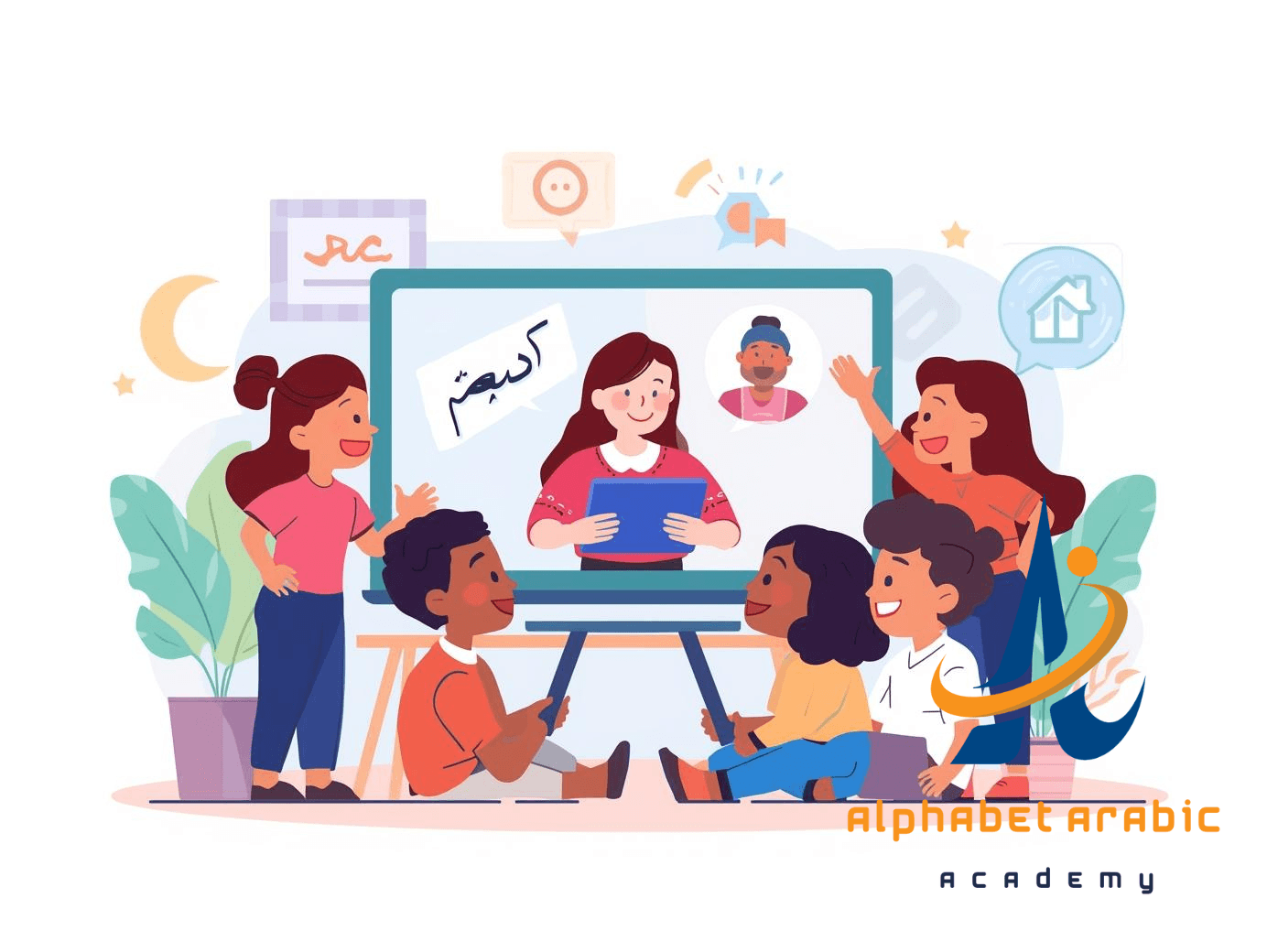
Group classes are fine for some children. But 1-on-1 instruction is what produces the fastest, most consistent results. Your child gets the teacher’s full attention. The lesson adapts in real time to what they understand and what they struggle with. There’s no hiding in the back of the classroom.
Is There a Free Trial?
Any reputable program should offer this. A free trial lets your child experience the teaching style, the platform, and the teacher before you commit financially. We offer a free trial lesson — take the free Arabic placement test first to know exactly where your child stands.
Is It Affordable and Sustainable?
The best program in the world doesn’t work if it’s too expensive to maintain long-term. Our Arabic courses for young learners start at $35/month for the Light plan (4 lessons/month), $70/month for Regular (8 lessons/month), $100/month for Intensive (12 lessons/month), and $135/month for Super Intensive (20 lessons/month). All plans include native Egyptian teachers, bilingual instruction, and free learning materials.
Frequently Asked Questions
Q1: What is the best age to start Arabic for kids?
The earlier, the better — but there’s no bad age. Children ages 3–6 absorb languages fastest and most naturally. Children who start at 7–10 still have a significant neurological advantage over adults. Even teens (13–17) can achieve strong proficiency with the right approach. Don’t let a “late” start stop you from starting.
Q2: How long does it take for a child to learn Arabic?
With 2–3 live lessons per week plus daily at-home practice, most children can read the Arabic alphabet within 6–8 weeks. Basic conversational ability develops over 6–12 months. Reading fluency — being able to read short texts independently — typically takes 12–18 months of consistent study. Full bilingual proficiency is a multi-year process, but every step along the way is genuinely useful.
Q3: Can my child learn Arabic and Quran at the same time?
Yes — and they complement each other beautifully. Quran reading reinforces letter recognition and proper pronunciation. Arabic vocabulary builds Quran comprehension. Many families at Alphabet Arabic Academy combine both programs from the beginning, and it works extremely well. Just make sure your child isn’t overwhelmed — start with one, add the other after a solid 2–3 months.
Q4: Do I need to speak Arabic to help my child?
Not at all. Many of our most successful families speak zero Arabic at home. What you can do — label objects, play Arabic songs, watch cartoons together, show enthusiasm — makes a huge difference without any fluency on your part. Your role is to create the environment and provide the encouragement. The teacher handles the instruction.
Q5: Are online Arabic classes effective for young children?
Yes, when designed properly. Key requirements: short, active sessions; interactive tools like digital whiteboards and games; a teacher who knows how to engage children online; and parental presence for the youngest learners (ages 3–5). Most children adapt to online lessons within 1–2 sessions. Many parents report their children are actually more engaged online than they expected.
Q6: My child tried Arabic before and hated it. Why would this be different?
Usually, children who “hate Arabic” had one of three experiences: lessons that were too long and too boring, a teacher who wasn’t trained for children, or a grammar-heavy approach that made no sense to a young learner. Play-based, age-appropriate, native-speaker instruction changes everything. We’ve enrolled dozens of children who “failed” Arabic somewhere else — and watched them thrive.
Q7: What’s the difference between MSA Arabic and Egyptian Arabic for kids?
Modern Standard Arabic (MSA) is used in books, media, and the Quran. It’s the foundation of literacy. Egyptian Arabic is the spoken dialect — the most widely understood in the Arab world. For most children, especially Muslim families or those seeking Quranic Arabic, we recommend starting with MSA. Conversational Egyptian Arabic can be added later. Our teachers will help you decide during the trial lesson.
Conclusion
Arabic for kids isn’t about pressure, drills, or racing to fluency. It’s about giving your child a gift — the ability to communicate with 400 million people, to read the Quran in its original language, to connect with their heritage, and to develop cognitive advantages that benefit them for life.
The research is clear. The window is open. The method matters.
Start with play. Build with consistency. Choose native teachers. Create an Arabic environment at home. And don’t give up when there’s a hard week — because every hard week is followed by a breakthrough.
Not sure where your child should start? Take the free Arabic level test — it takes 10 minutes and gives you a clear picture of their current level and the right starting point. Or browse our Arabic courses for young learners to find the plan that fits your child’s age, schedule, and goals.
Your child’s first Arabic word is closer than you think.