
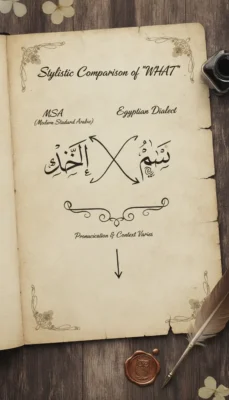
You spent months on Modern Standard Arabic. You can read a newspaper headline. You know your إعراب, your case endings, your ج is a “j” and your ق is a “q.” Then you land in Cairo, or you jump on a call with an Egyptian teacher, and someone says “ازيك” and you just… blink.
That’s not because your Arabic is bad. It’s because MSA and Egyptian Arabic sound like two different languages wearing the same clothes. Same alphabet. Same roots, most of the time. Completely different mouth.
I’ll be straight with you — this catches almost every MSA learner off guard, and it happens for the same handful of reasons every single time. Once you know what’s actually shifting, the confusion clears up fast. So let’s go through it, sound by sound.
Before we go letter by letter, here’s the whole shift at a glance. Bookmark this table — you’ll want to come back to it.
| Letter | MSA Sound | Egyptian Sound | Example |
|---|---|---|---|
| ج | j | g | جميل → gameel |
| ق | q | 2 (glottal stop) | قهوة → 2ahwa |
| ث | th | s / t | ثلاثة → talata |
| ذ | th | z / d | هذا → da |
Now let’s break down why each one happens, because “just memorize the table” won’t get you very far on its own.
The First Shock: ج Isn’t “J” Anymore
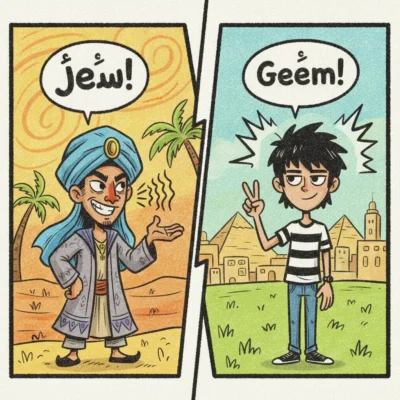
You learned that ج makes a “j” sound, like in “measure” or the French “j.” That’s true in MSA. It’s true in most Arabic dialects too — Levantine, Gulf, Moroccan, all of it.
Egyptian Arabic said no.
In Egypt, ج is a hard “G,” like in “go” or “game.” So جميل (jameel, “beautiful”) becomes gameel. جمل (jamal, “camel”) becomes gamal. Even the word for “Egypt” itself — مصر — isn’t affected by this one, but the country’s most famous exports are: singer Amr Diab isn’t singing about “jamal,” he’s singing about “gamal.” Gamal Abdel Nasser, Egypt’s former president, is a “Gamal” for exactly this reason, not a “Jamal.”
Here’s the thing that trips people up even more: this isn’t a mistake, and it isn’t slang. It’s a full, consistent, historical sound shift specific to Egyptian Arabic. If you learned to read using the MSA alphabet, our guide on the Arabic alphabet for beginners covers exactly where this letter sits and why Egyptian teachers pronounce it differently from teachers in Damascus or Amman.
The Vanishing ق: Welcome to the Glottal Stop
This one’s bigger. In MSA, ق is a deep, back-of-the-throat “q” sound — like the “k” in “Iraq,” but pushed further back. Formal, deliberate, a little heavy.
In everyday Cairo speech, ق mostly just… disappears. It turns into a glottal stop — that little catch in your throat you make in the middle of “uh-oh.” Arabic speakers usually write this sound as “2” when typing in Franco-Arabic.
So:
- قهوة (qahwa, “coffee”) becomes 2ahwa
- قال (qal, “he said”) becomes 2al
- وقت (waqt, “time”) becomes we2t
This is genuinely one of the most disorienting things for someone coming from MSA, because the letter looks totally normal on the page and then just vanishes when an Egyptian says it out loud. You’ll read قلبي and expect “qalbi” and hear “2alby.”
Worth knowing: educated Egyptians and news broadcasters still pronounce the ق properly in formal contexts — reading the Quran, giving a speech, reading MSA text aloud. The glottal stop is a colloquial thing, not a “wrong” thing. Both exist in the same speaker, switched on and off depending on the situation.
Where Did the Interdental Sounds Go?
MSA has ث and ذ — the “th” sounds, like in “think” and “this.” English speakers usually find these two the easiest letters in the whole alphabet, because English already has them.
Egyptian Arabic mostly drops them. ث usually becomes “س” (s) or “ت” (t) depending on the word, and ذ usually becomes “ز” (z) or “د” (d).
- ثلاثة (thalatha, “three”) becomes talata
- ثانية (thaniya, “second”) becomes tanya
- هذا (hatha, “this”) becomes da
- كذلك (kathalik, “likewise”) becomes kaman-ish structures entirely — the word itself barely survives into daily speech
Honestly, this shift is one of the reasons Egyptian Arabic feels “softer” and faster to a lot of learners. Those interdental sounds slow speech down. Cut them, and the rhythm speeds up.
The Missing Case Endings Change the Music of the Sentence
This isn’t a single letter swap — it’s bigger than that, and it’s the one that quietly wrecks people’s listening comprehension even after they’ve memorized every consonant shift above.
MSA sentences carry case endings — the short vowel sounds tacked onto the ends of words that mark grammatical role. الكتابُ جميلٌ. Those little endings (-u, -a, -in) give MSA its formal, almost musical rhythm.
Egyptian Arabic drops nearly all of them in normal speech. الكتاب جميل. No tail sounds. The sentence just… stops. If your ear got trained on MSA’s rhythm, Egyptian speech can feel clipped, almost rushed, even though nothing about the actual word order changed.
This connects to something bigger than pronunciation, honestly — it’s a grammar simplification, not just a sound change. If you want the fuller picture of how much grammar shifts between the two varieties, not just the sounds, our Egyptian Arabic vs MSA comparison breaks down where the two diverge and where they still overlap.
Short Vowels Shift, Long Vowels Shrink
A few more patterns worth flagging, because these are the ones that show up in “why can’t I understand spoken Egyptian even though I read fine” complaints:
Final short “a” sounds often become “eh.” مدرسة (madrasa, “school”) is often pronounced madrasa in MSA reading but shifts toward madrasa/madraseh in casual speech, closer to “eh” at the end.
Stress moves around. MSA and Egyptian Arabic don’t always stress the same syllable in the same word, even when every letter matches. This alone can make a word you know perfectly well on paper unrecognizable by ear for the first few weeks.
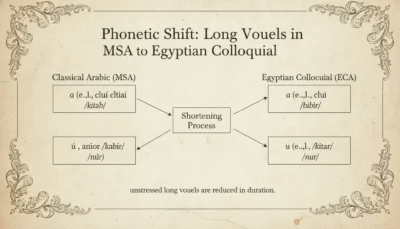
Some long vowels compress. Words that stretch out in careful MSA pronunciation get clipped shorter in fast Cairo speech. This is normal — every spoken language does this to its formal register. English does it too. Nobody says “going to” in casual conversation; they say “gonna.”
Same Sentence, Two Completely Different Sounds
Rules and tables are useful, but nothing makes this click like seeing full sentences side by side. Here’s a handful of everyday sentences in both forms, so you can hear the gap for yourself.
“I want to go to school.” MSA: أريد أن أذهب إلى المدرسة (ureedu an athhaba ila al-madrasa) Egyptian: عايز أروح المدرسة (ayez arouh el-madrasa)
“What is your name?” MSA: ما اسمك؟ (ma ismuka?) Egyptian: اسمك ايه؟ (ismak eh?)
“I don’t understand.” MSA: أنا لا أفهم (ana la afham) Egyptian: أنا مش فاهم (ana mesh fahem)
“How much is this?” MSA: كم ثمن هذا؟ (kam thaman hatha?) Egyptian: ده بكام؟ (da bekam?)
Notice it’s not just pronunciation shifting here — word order changes, question words move, whole grammatical structures get swapped out. عايز isn’t a mispronounced version of أريد; it’s a different word entirely. This is exactly why “just soften your accent” advice doesn’t actually work. You’re not adjusting your MSA, you’re learning a second, parallel way to say the same thing.
A Quick Guide to Franco-Arabic Numbers
If you spend any time texting with Egyptians or reading Egyptian comments online, you’ll run into Franco-Arabic — Arabic written using Latin letters and numbers standing in for sounds English letters can’t represent. This is exactly where that “2” for قهوة above came from, and it’s worth knowing the rest of the system so you’re not lost the first time you see it.
| Number | Represents | Example |
|---|---|---|
| 2 | ق (glottal stop) | 2ahwa = قهوة (coffee) |
| 3 | ع (ayn) | 3arabi = عربي (Arabic) |
| 5 | خ (kha) | 5alas = خلاص (enough/done) |
| 7 | ح (ha, throaty) | 7abibi = حبيبي (my dear) |
| 9 | ص (sad, emphatic s) | ba9al = بصل (onion) — less standard, varies by writer |
A couple of honest caveats here: Franco-Arabic isn’t standardized. Different people use slightly different numbers for the same sound, especially with 9 and sometimes 6 for ط. And it’s built for texting speed, not for learning to read — leaning on it too heavily early on can actually slow down your Arabic script reading, since your brain gets comfortable skipping the alphabet entirely. Use it to understand what your Egyptian friends are texting you. Don’t use it to replace actually learning to read.
Real Questions Learners Actually Ask About This
I see versions of these questions constantly, on Reddit threads, in Quora answers, in messages from our own students in week one of switching to colloquial classes. If you’ve been quietly wondering the same thing, you’re not behind — you’re right on schedule.
“Why does my MSA sound so formal to Egyptians?” Because it is formal. Speaking pure MSA in a Cairo coffee shop is a bit like walking into a bar and ordering in Shakespearean English. People will understand you. They’ll also immediately clock you as a foreigner or a newsreader, and they’ll often switch to simplified Arabic or English to meet you halfway — which, ironically, can slow down your dialect learning if you let it happen every time.
“Is Egyptian Arabic ‘easier’ or is it just different?” Both, honestly. Grammatically, yes, it’s simpler — fewer case endings, more forgiving conjugation patterns. Pronunciation-wise, it’s not easier, just different. You’re not reducing difficulty, you’re trading one set of challenges for another.
“Should I unlearn my MSA pronunciation to sound more Egyptian?” No — and please don’t try. Keep both. Read and write in MSA when the context calls for it (news, formal writing, religious texts), and switch your mouth into Egyptian mode for conversation. Native speakers do this switching constantly without thinking about it. It’s called diglossia, and it’s completely normal, not a contradiction.
“Why do some Egyptians still say ق in certain words?” Because certain formal or religious words kept the ق even in colloquial speech — قرآن (Quran) is the clearest example; nobody says “2ur2an.” Political and intellectual vocabulary borrowed from MSA also tends to keep it. It’s inconsistent by design, which is honestly one of the more frustrating parts of learning this dialect.
Why This Happens (The Short Version)
You don’t need a linguistics degree for this, but a little context helps it stick. Egyptian Arabic developed over centuries as the spoken, everyday version of the language in the Nile Delta and Cairo region, influenced by Coptic (the language spoken in Egypt before Arabic arrived) and shaped by the natural tendency of spoken language to simplify and speed up over generations. MSA, meanwhile, is a standardized written form based closely on Classical Arabic — deliberately preserved for consistency across the whole Arab world.
So MSA stayed formal and full. Egyptian Arabic evolved for speed, for daily use, for jokes and arguments and ordering tea. That’s the whole story in one paragraph. If you want the longer version, along with how other regional dialects diverged too, our guide to Arabic dialects is worth a read.
How to Actually Train Your Ear for This
Knowing the rules is step one. Hearing them automatically is a different skill, and it takes repetition, not memorization. A few things that genuinely help:
- Listen before you speak. Spend a week just listening to Egyptian media — songs, interviews, YouTube — without trying to produce anything. Let your ear adjust to the ق-drop and the ج-shift before you try to say them yourself.
- Read a sentence in MSA, then say it in Egyptian. Take simple sentences you already know and mentally translate the pronunciation, not just the words. This builds the switching muscle.
- Get corrected in real time. This is genuinely the one thing self-study can’t fully replace. You can hear the difference between ق and the glottal stop a hundred times and still not produce it correctly yourself — a teacher catches that in seconds.
If you’ve been building a steady study habit already, our 15-minute daily Arabic study routine is a solid place to slot in dialect listening practice without blowing up your schedule.
Moving From MSA to the Vernacular
Here’s the honest truth: reading about pronunciation differences will only get you so far. At some point you have to open your mouth and get it wrong in front of someone who can correct you. That’s not a flaw in the process — that’s the process.
If you’ve got a solid MSA foundation and you’re ready to actually sound like you’re from Cairo instead of a textbook, our Colloquial Egyptian Arabic course is built specifically for this transition — MSA speakers coming over to the spoken side, with native Egyptian teachers correcting your ق, your ج, and everything else in real time.
Not sure exactly where your pronunciation and comprehension actually stand right now? Take the free Arabic placement test first. It takes a few minutes and saves you from starting in the wrong module. And if you want to see how the colloquial track fits into your budget, the pricing page lays out all the current plans. You can also browse our teachers if you want to see who you’d actually be learning from.
A Quick Note If You’re Studying for Quran or Religious Purposes
Worth flagging separately: none of this applies to Quranic recitation. Tajweed rules preserve the classical pronunciation of every letter, ق included, regardless of what happens in everyday Cairo speech. If your Arabic goal is centered on Quran reading rather than daily conversation, keep that pronunciation separate in your head from what you hear on the street — they’re not meant to match, and that’s fine. Our Quran online classes keep that classical pronunciation intact from day one.
The Bottom Line
None of these shifts mean Egyptian Arabic is a “lazier” or less correct version of the language — that’s a myth learners pick up and should drop immediately. It’s a fully formed, internally consistent spoken variety with its own logic, spoken by well over 100 million people. MSA gives you the skeleton. Egyptian gives you the voice people actually use with their friends, their families, and their taxi drivers.
You don’t have to choose one over the other. Most fluent non-native speakers end up holding both — reading and writing in Fusha, speaking and joking in Masri. The pronunciation shifts stop feeling like exceptions the moment you stop expecting Egyptian Arabic to sound like MSA with a light accent. It’s not that. It’s its own thing. Once you hear it that way, it clicks a lot faster.
FAQ
Do all Egyptian Arabic speakers use the glottal stop instead of ق? Most do in casual speech, but plenty of Upper Egyptian (Sa’idi) speakers actually keep a “g” sound for ق instead, which is a whole separate regional variation on top of everything above.
Will learning Egyptian pronunciation mess up my MSA? Not if you keep practicing both. Think of it as two settings on the same phone, not two different phones. Regular exposure to each keeps them separate in your head.
How long does it take to get comfortable hearing these shifts? Most students report their ear adjusting within a few weeks of regular listening, though producing the sounds naturally themselves usually takes longer — a few months of active speaking practice is typical.