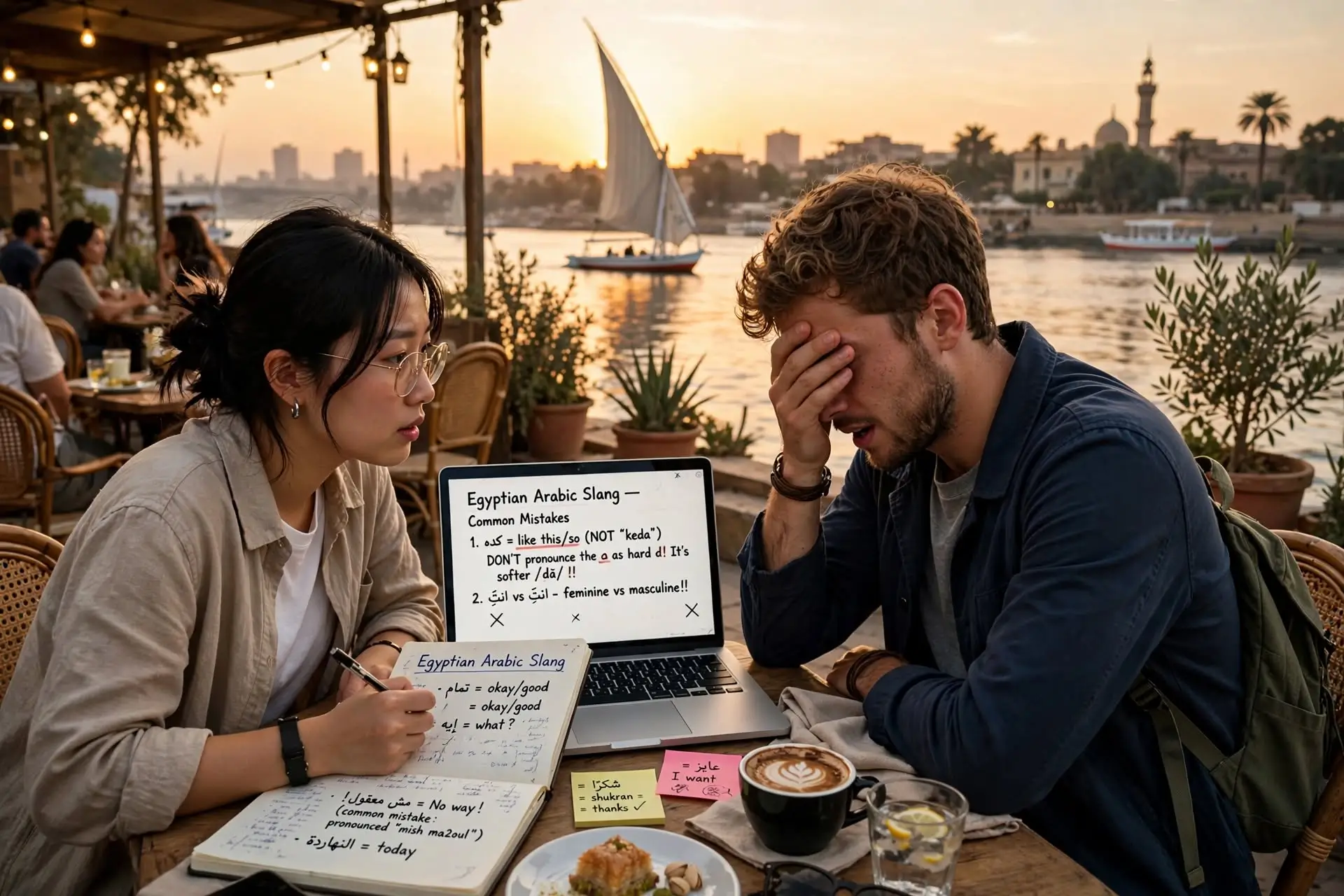

egyptian arabic mistakes You’ve been studying for months. You walk into a shop in Cairo. You say something grammatically perfect. The guy behind the counter smiles, nods, and answers you in English.
Ouch.
Been there? Almost every student I’ve taught has. And I’ll tell you what I tell them: it’s not that you’re bad at Arabic. You’re just good at the wrong Arabic.
Egyptian Arabic is a big deal. According to Wikipedia’s Egyptian Arabic entry, it has around 119 million speakers once you count second-language users, and it’s understood across most of the Arab world thanks to Egyptian movies and music. So it’s worth getting right.
I’ve corrected the same mistakes for years. Different students, different countries, same slips. Below are the 20 that come up most, with a quick fix for each. Read them, spot yours, fix them early. Bad habits are way harder to undo than to avoid.
1. Speaking MSA in everyday conversation
Here’s the thing: this is the number one mistake, and it’s not your fault. Most textbooks teach Modern Standard Arabic (MSA) first.
So you say: أريد أن أذهب إلى المحل (ureedu an athhab ila al-mahall).
An Egyptian says: عايز أروح المحل (3ayez aroo7 el-ma7all).
People will understand you. But you’ll sound like a news anchor ordering falafel. MSA is brilliant for reading and writing. For chatting, it’s a costume.
Quick swaps to start with:
- أريد → عايز (3ayez), I want
- ماذا → إيه (eh), what
- الآن → دلوقتي (delwa2ty), now
- جداً → أوي (awy), very
Not sure where the line between the two falls? Our Egyptian Arabic vs MSA breakdown lays it out.
2. Pronouncing ج as “j”
In MSA, ج sounds like the “j” in “jam.” In Egypt, it’s a hard “g,” like “go.”
- جميل → gameel (beautiful)
- جمل → gamal (camel)
- جديد → gedeed (new)
Say “jameel” in Cairo and you’ll get a polite smile. It’s not wrong in MSA. It’s just not Egyptian. This is also why you’ve always heard the name Gamal Abdel Nasser with a “g.”
If you want the full picture of how sounds shift, read our guide to Egyptian pronunciation vs MSA.
3. Pronouncing ق as “q” everywhere
This one’s a classic. In casual Egyptian speech, ق turns into a glottal stop. That’s the little catch in your throat in “uh-oh.”
- قهوة → 2ahwa (coffee)
- قال → 2al (he said)
- قلب → 2alb (heart)
But don’t swap it for a “k” either. كلب (kalb) means dog. Mix them up and you’ve got a dog where your heart should be.
One exception worth knowing: religious and very formal words keep the real ق. Nobody says “2ur2an” for the Quran. It’s قرآن, always.
4. Mixing up ح, ه, and ع
Three letters, three completely different sounds. English speakers blur them all into a vague “h.”
Real pairs that change meaning:
- هرم (haram) = pyramid vs حرام (7aram) = forbidden
- إيد (eed) = hand vs عيد (3eed) = holiday
Imagine telling someone you love the “forbidden” of Giza. It happens.
The fix: ه is just breath, like fogging a mirror. ح is a tight, airy squeeze in the throat. ع is a deep, voiced squeeze. Practice them one at a time, out loud, with a mirror if you have to.
5. Flattening the “heavy” letters
ص ض ط are emphatic letters. They’re made with the tongue pulled back and flattened, and they make the vowels around them sound deeper.
- تين (teen) = figs
- طين (Teen) = mud
Most learners say both the same way. Egyptians hear the difference instantly. Say them side by side until your mouth feels the change, not just your ears.
6. Using MSA negation words
MSA has لا، لم، لن، ليس. Egyptian Arabic mostly doesn’t bother. You need three tools:
- مش (mish) for nouns, adjectives, and most present or future sentences: أنا مش فاهم (I don’t understand)
- ما … ش wrapped around a verb for the past: ما رحتش (I didn’t go)
- مفيش (mafeesh) for “there isn’t”: مفيش مشكلة (no problem)
Throw a لن into a Cairo conversation and people look around for the camera crew. Simple and consistent wins here.
7. Mixing MSA and Egyptian in one sentence
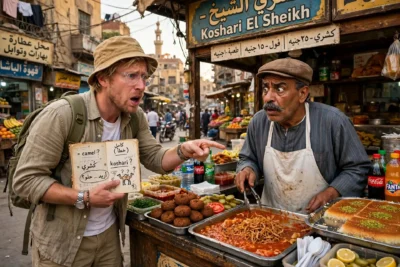
You say: أنا لن أروح بكرة.
It’s half formal, half street. Egyptians do mix registers, but they do it on purpose, for effect. You’ll do it by accident.
Pick one per sentence. For daily life: مش هروح بكرة (mish haroo7 bokra), I won’t go tomorrow. Clean, natural, done.
8. Forgetting the feminine “you”
Everyone defaults to the masculine form. Everyone.
- To a man: إنت بتروح فين؟ (enta betroo7 feen?)
- To a woman: إنتي بتروحي فين؟ (enti betrooHi feen?)
Same with عايز / عايزة, إزيّك / إزيّكِ, and almost every verb. If you’re talking to a woman and use male forms for three months, nobody will correct you out of politeness. They’ll just notice.
9. Misusing the ب prefix
In Egyptian Arabic, ب on a verb marks something habitual or happening now: باكل (ba2kol), I eat. بتروح (betroo7), you go.
The mistake is putting it where it doesn’t belong. After words like عايز، لازم، ممكن، and يلا, drop it:
- ❌ عايز باروح
- ✅ عايز أروح
- ✅ لازم أمشي (I have to leave)
- ✅ ممكن أسأل؟ (Can I ask?)
Simple rule: if another verb-ish word just set the scene, you don’t need ب.
10. Using the MSA future (سـ / سوف)
Textbook Arabic uses سـ and سوف for “will.” Egyptians use هـ or حـ stuck to the verb:
- هروح (haroo7), I’ll go
- هاكل (hakol), I’ll eat
- هنشوف (hanshoof), we’ll see
Two syllables, no formality, and you instantly sound ten times less like a grammar book.
11. Using MSA question words
أين، متى، لماذا، كيف. Beautiful words. Almost nobody in Cairo says them. Here’s the everyday set:
- فين (feen), where
- إمتى (emta), when
- ليه (leh), why
- إزاي (ezzay), how
- مين (meen), who
- كام (kam), how many / how much
And here’s a bonus. The question word often stays at the end, just like in English: اسمك إيه؟ (ismak eh?), “What’s your name?”
12. Getting ده / دي / دول wrong
Egyptian “this” and “these” change by gender, and they usually come after the noun:
- الكتاب ده (el-kitab da), this book
- البنت دي (el-bint dee), this girl
- الناس دول (en-nas dowl), these people
Learners tend to use ده for everything, or they put it before the noun like English. Practice with five objects around you right now. Masculine, feminine, plural. Out loud.
13. Translating word for word from English
This one makes me smile every time. Take “I miss you.” Learners often produce أنا وحشتك, which flips the meaning to “you miss me.”
The Egyptian way is built backwards: إنت وحشتني (enta wa7ashtany), literally “you’ve become absent to me.”
Egyptian Arabic is full of these. Don’t translate sentences. Learn chunks. Treat phrases like معلش (ma3lesh) or خلاص (khalas) as whole units, not puzzles to solve word by word.
14. Borrowing words from other dialects
Maybe you learned from Syrian YouTube. Maybe your friend is from Dubai. Nothing wrong with either. But the words don’t travel.
| Other dialect | Egyptian |
|---|---|
| شو (shu) | إيه (eh) |
| كيفك (keefak) | إزيك (ezzayak) |
| هلأ (halla) | دلوقتي (delwa2ty) |
| وايد (wayed) | أوي (awy) |
Pick your dialect and stay in it for a while. Mixing is fine for advanced speakers. For beginners, it just causes blank stares.
15. Skipping the greeting ritual
Egyptians don’t say “hi” and move on. A greeting is a small exchange:
- إزيك؟ → الحمد لله، إنت عامل إيه؟
- صباح الخير → صباح النور
- شكراً → العفو or ولا يهمك
Skip it and you come across as cold, even if you’re just being efficient. Honestly, the ritual is half the conversation.
We’ve got two guides that cover it well: common Egyptian Arabic greetings and responses and politeness in Egyptian Arabic.
16. Taking “إن شاء الله” as a promise
I’ll be straight with you: this one will cost you time and sanity.
إن شاء الله (inshallah) means “God willing.” In real life it can mean a firm yes, a sincere “I’ll try,” or a gentle way of saying “probably not.” Tone and context tell you which.
Your plumber says بكرة إن شاء الله. Don’t cancel your plans to wait at home.
Listen to how it’s said. Fast and breezy usually means “don’t count on it.” Warm and clear usually means “I mean it.”
17. Ignoring vowel length and rhythm
Vowel length changes meaning. كتب (katab) = he wrote. كاتب (kateb) = writer. Egyptian speech also has its own rhythm, with a musical rise and fall that’s very different from careful MSA reading.
If you pronounce every vowel evenly, like you’re reading aloud, you’ll sound stiff. If you rush through them, you’ll get misunderstood. The sweet spot comes from listening, not rules.
18. Leaning on Franco-Arabic forever
You’ve seen it in texts: 3 for ع, 7 for ح, 2 for the glottal stop. 7abibi, 3arabi, 2ahwa. Fun, fast, and handy for messaging friends.
But it’s a crutch. Stay in Latin letters too long and your Arabic reading never develops. Use it to understand your Egyptian friends’ messages. Don’t use it to avoid learning the alphabet.
19. Learning only from textbooks and never from real speech
Textbook dialogues are slow, clean, and polite. Real Cairo is fast, loud, and full of slang.
You need both. Add real listening early: Egyptian films, series, YouTube, podcasts. It won’t all make sense at first. That’s fine. Your ear is being trained.
Start with our guide to understanding Egyptian Arabic in movies and TV shows. Living in Cairo? Survival Egyptian Arabic for expats gives you the street phrases you’ll use on day one.
20. Waiting until you’re “ready” to speak (and never getting corrected)
This is the big one. Honestly, it’s the one that matters most.
Learners wait. They study grammar, memorize lists, watch videos. And they stay silent because they’re afraid of getting it wrong.
Here’s the problem. Mistakes 2 through 19 don’t fix themselves. You can’t hear your own wrong ج or your flat ط. Someone has to catch it, in the moment, kindly, and show you what it should sound like.
That’s it. That’s the whole secret. Speak early, get corrected, repeat.
Short on time? A small daily habit beats a big weekly cram. Our 15-minute daily Arabic study routine shows how to fit speaking practice into a busy week. And if you’d like a live partner, our Arabic conversation classes are built for exactly this.
Questions Learners Keep Asking
These come up again and again in learner forums and in my own student chats.
Will Egyptians understand me if I speak MSA?
Yes, mostly. They learn it at school and hear it on the news. But they’ll hear it as formal, and they often reply in simpler Arabic or English. It works. It just doesn’t feel natural.
Should I learn MSA or Egyptian Arabic first?
It depends on your goal. Want to chat, travel, or live in Egypt? Start with Egyptian. Want to read news, books, or the Quran? Start with MSA. Plenty of students do both in time, and that’s a great plan.
Why does everyone say “mish” and “mafeesh”?
Because they make negation simple. مش covers most situations, and مفيش means “there isn’t.” It’s one of the easiest parts of Egyptian Arabic once you stop reaching for MSA words.
Is Egyptian Arabic easier than MSA?
Grammar, yes. Fewer case endings, simpler patterns. Pronunciation and slang, not so much. It’s a different kind of hard.
How long until I stop making these mistakes?
With regular speaking and correction, most students notice a real difference within a few weeks. Fully natural takes longer. That’s normal.
Quick Self-Check
Be honest with yourself. How many of these are you doing?
- 1 to 5: You’re in good shape. Polish the details.
- 6 to 12: Perfectly normal. A few months of correction will clean most of it up.
- 13 or more: Don’t panic. You’re a textbook learner who needs to hear real Egyptian. Start speaking now.
Not sure where you stand? Take our free Arabic placement test. It takes a few minutes and tells you exactly where to begin.
Correct Your Words with a Native Egyptian Teacher
Reading a list like this helps. But you can’t hear your own mistakes, and apps can’t catch them either.
In our Colloquial Egyptian Arabic course, you speak from lesson one with a native Egyptian teacher who fixes your ج, your ق, your negation, and your everyday phrases in real time. One-on-one. No guessing.
You can meet the teachers first, or check the pricing page to see how it fits your budget.