
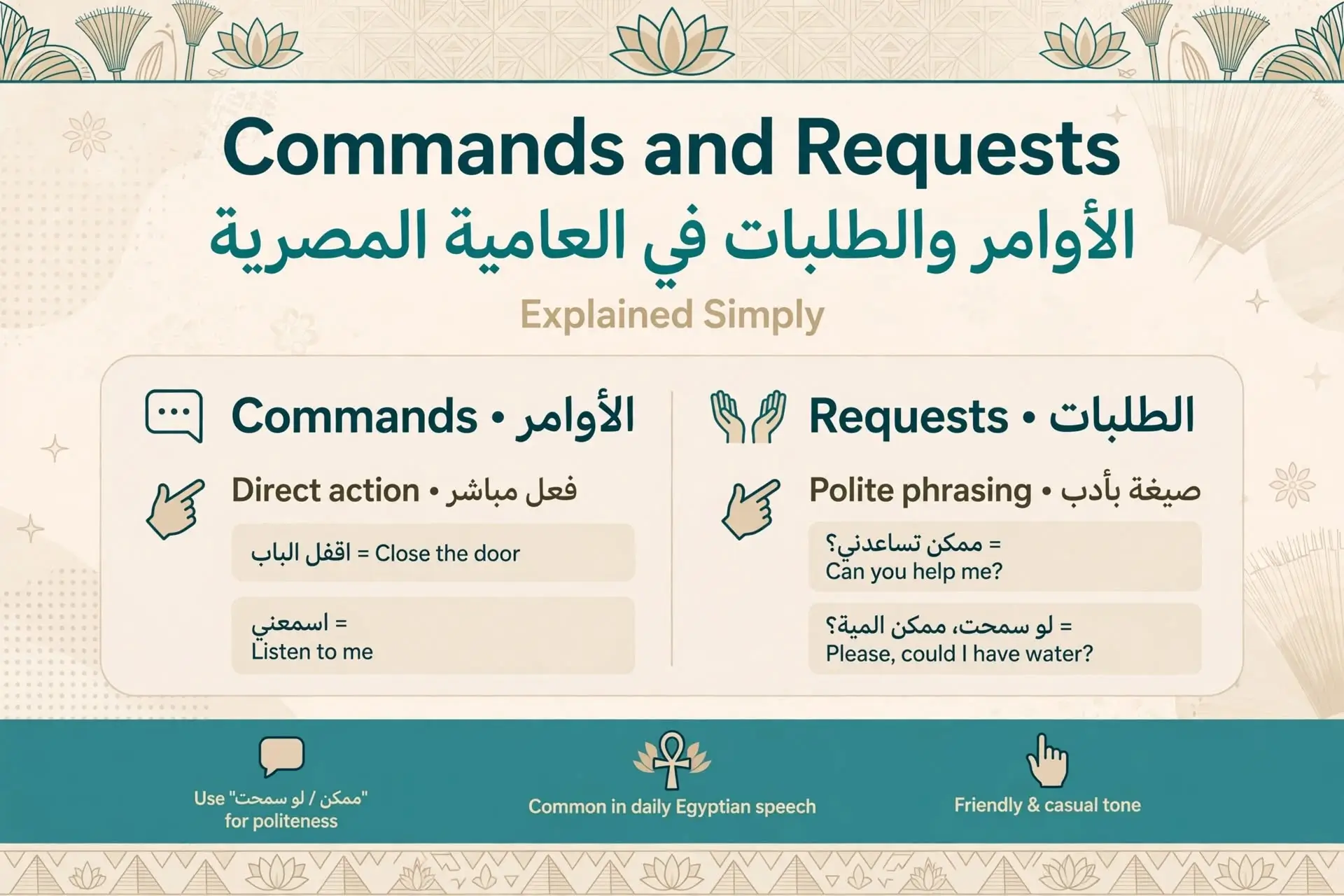
You’re in a Cairo taxi. The driver just missed your street. You know the word for “street.” You know the word for “here.” But the sentence you need is a command, and your brain is still stuck on textbook MSA.
So you say nothing. And you end up three blocks away.
I’ve watched this happen to students more times than I can count. Commands are the most practical thing in any language, and learners tend to skip them until they need them. Then it’s too late.
Good news. Egyptian commands are short, they follow one clear pattern, and Egyptians use them all day without anyone feeling offended. Let’s learn them properly.
The Short Answer
Take the “you” form of the present verb, drop the ti- at the front, and you’ve got a command.
tiktib (you write) becomes iktib (write!). tistanna (you wait) becomes istanna (wait!).
There are three forms, depending on who you’re talking to:
| Who you’re talking to | Ending | Example (write) |
|---|---|---|
| One man | nothing | iktib (اكتب) |
| One woman | -i | iktibi (اكتبي) |
| A group | -u | iktibu (اكتبوا) |
That’s the whole system. Three forms. Not nine, not twelve.
And if you’re wondering about Egyptian Arabic in general, it’s the everyday spoken dialect of Egypt, and it’s widely understood across the Arab world thanks to Egyptian film and music. That’s a big reason people choose it. If you’re still weighing it against formal Arabic, MSA vs Egyptian vs Quranic Arabic will help you decide.
Ten Commands You’ll Use Constantly
Learn these ten, and you can handle most daily situations.
| English | To a man | To a woman | To a group |
|---|---|---|---|
| write | iktib | iktibi | iktibu |
| go | roo7 | roo7i | roo7u |
| eat | kol | koli | kolu |
| take | khod | khodi | khodu |
| come | ta3ala | ta3ali | ta3alu |
| look / see | shoof | shoofi | shoofu |
| wait | istanna | istanni | istannu |
| open | iftah | iftahi | iftahu |
| say | 2ool | 2oli | 2olu |
| bring / give me | haat | haati | haatu |
In Arabic script: اكتب، روح، كُل، خُد، تعالى، شوف، استنى، افتح، قول، هات.
Honestly, some of these look “irregular.” Ta3ala, khod, kol, haat. Don’t fight them. Treat them as vocabulary. You’ll hear them so often that they’ll stick on their own.
Why There’s No b- in a Command
Here’s a mistake I see all the time. Learners know that Egyptian present tense uses b-. So they say biktib and think they’re giving an order.
They’re not. Biktib means “he writes” or “I write.” It’s a statement.
A command drops the b- and drops the person prefix too. That’s why iktib works and biktib doesn’t.
Also, a command isn’t a future tense. If you want to talk about what you will do, that’s a different structure with ha-. A command is something you say right now to the person standing in front of you.
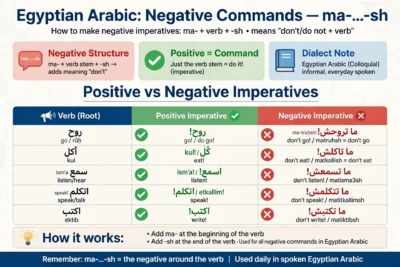
Saying “Don’t”: The Negative Command
Here’s the thing. Positive and negative commands don’t mirror each other in Egyptian. This is the part that trips people up.
You can’t just stick a negative on iktib. Instead, you go back to the “you” present form (without b-) and wrap it:
ma + you-verb + sh
| Who you’re talking to | Don’t write |
|---|---|
| One man | ma-tiktibsh (ماتكتبش) |
| One woman | ma-tiktibish (ماتكتبيش) |
| A group | ma-tiktibush (ماتكتبوش) |
More examples you’ll actually say:
- ماتفتحش الباب. (ma-tiftahsh el-bab.) Don’t open the door.
- ماتنساش. (ma-tinsash.) Don’t forget.
- ماتتأخرش. (ma-tit2akhkharsh.) Don’t be late.
- ماتتأخروش. (ma-tit2akhkharush.) Don’t be late. (to a group)
Notice the -sh at the very end. It always comes last. Even if you add an object pronoun, the -sh moves to the end of everything:
- ماتسيبهاش برة. (ma-tisibhash barra.) Don’t leave it outside.
Don’t skip the -sh. A negative command without it sounds broken, like a half-finished sentence.
If you like seeing how this works across Arabic, Wikipedia has a solid overview of negation in Arabic that shows how the Egyptian pattern compares to other varieties.
The Strong Warning: iw3a
Sometimes ma-…-sh isn’t enough. Sometimes you need the “don’t you dare” version.
Egyptians use اوعى (iw3a) followed by the plain “you” verb:
- اوعى تفتح الباب. (iw3a tiftah el-bab.) Don’t you open that door.
- اوعى تتأخر. (iw3a tit2akhkhar.) Don’t you be late.
It has its own forms too: iw3a for a man, iw3i for a woman, iw3u for a group.
And on its own? اوعى! just means “Watch out!” You’ll hear it in markets, in traffic, and from every mother in Egypt.
I’ll be straight with you. Use iw3a carefully. With a friend, it’s playful. With a stranger, it’s a shout. Save it for real warnings, or for jokes you know will land.
Adding Pronouns: “Look at It,” “Take It,” “Tell Me”
Real commands almost always have an object. In Egyptian, the pronoun just attaches to the end of the verb. No spaces. No extra words.
- شوفها. (shoofha.) Look at it / her.
- خدها. (khodha.) Take it.
- سيبها هنا. (seebha hena.) Leave it here.
- قولّي. (2ool-li.) Tell me.
- هات لي قهوة. (haat-li ahwa.) Bring me a coffee.
- إديني. (iddini.) Give me.
The order is: command, then the pronoun, then (if it’s negative) the -sh at the very end.
Positive: seebha hena. (Leave it here.) Negative: ma-tisibhash hena. (Don’t leave it here.)
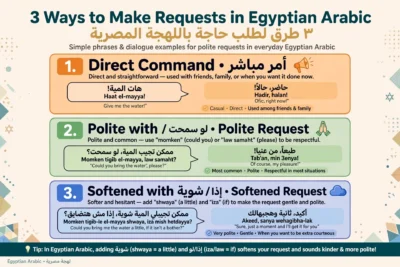
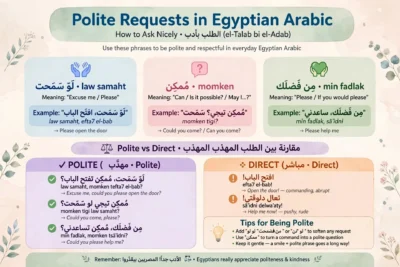
Making It Polite
Now for the question I get the most. “Isn’t a command rude?”
Not in Egyptian. Honestly, it depends on tone and relationship. Among family and friends, a bare command is perfectly warm. “Come eat!” is an invitation, not an order. Egyptians use commands the way English speakers say “come on in.”
But with strangers, or when you’re asking for a favor, you soften it. Here are the tools:
1. Law samaht (لو سمحت). This is your best friend. It means “excuse me” or “please,” and it goes on the front or the back of nearly any request.
- وقّف هنا لو سمحت. (wa22af hena, law samaht.) Stop here, please.
2. Momkin + the “you” verb (no b-). This is the “could you?” version.
- ممكن تساعدني؟ (momkin tisa3edni?) Could you help me?
A small warning. Momkin with an impatient tone sounds demanding, even though the words are polite. Voice matters as much as grammar here.
3. Yarait (ياريت). This means “I wish” or “it would be great if.” It softens both positive and negative requests.
- ياريت ماتتأخرش. (yarait ma-tit2akhkharsh.) Please don’t be late. (literally: I wish you won’t be late)
4. Itfaddal (اتفضل). This one’s flexible. It means “please go ahead,” “here you go,” or “please come in.” Use itfaddali for a woman and itfaddalu for a group.
- اتفضل اقعد. (itfaddal u3od.) Please, sit down.
5. Ba2a (بقى). A tiny word that adds friendliness or a little push. Ta3ala ba2a is “come on then.” Tone matters again.
You’ve also probably heard min fadlak (formal “please”). It exists, and people understand it. But in everyday Egyptian speech, law samaht is far more natural. For more on the small phrases that keep things warm, read Politeness in Egyptian Arabic: Yes, No, Please, Sorry.
Commands in Real Life
Let me give you situations. Not random lists.
In a taxi
- وقّف هنا لو سمحت. (wa22af hena, law samaht.) Stop here, please.
- خد يمين. (khod yemeen.) Turn right. (literally: take right)
- خد شمال. (khod shimal.) Turn left.
- استنى شوية. (istanna shwayya.) Wait a bit.
At a café
- هات لي قهوة لو سمحت. (haat-li ahwa, law samaht.) Bring me a coffee, please.
- ممكن الحساب؟ (momkin el-hisab?) Could I have the bill?
At a family lunch
- اتفضل كل. (itfaddal kol.) Please, eat.
- اتفضلي اقعدي. (itfaddali u3odi.) Please, sit down. (to a woman)
You’ll hear these a lot. And you’ll hear them again, louder, if you say you’re full. If you want the full survival version of dinner-table Arabic, Talking to In-Laws in Egyptian Arabic goes much deeper.
At the pharmacy
- إديني علبة بنادول. (iddini 3elbet panadol.) Give me a box of Panadol.
- قول لي أخده ازاي. (2ool-li akhdo ezzay.) Tell me how to take it.
For clinic and emergency situations, where commands matter even more, see Egyptian Arabic for Clinics, Pharmacies, and Emergencies.
In everyday life in Cairo
- تعالى هنا. (ta3ala hena.) Come here.
- اقفل الباب. (i2fel el-bab.) Close the door.
- ماتنساش المفتاح. (ma-tinsash el-meftah.) Don’t forget the key.
If you’ve just moved and want a broader phrase bank for daily life, Survival Egyptian Arabic for Expats Living in Cairo is the one to read next.
Common Mistakes (And How to Fix Them)
Adding b-. Wrong: biktib! Right: iktib! A command never has b-.
Using MSA commands. In formal Arabic, you’d say uktub or idhhab. In Egyptian, those sound like a lecture or a sign on a wall. Say iktib and roo7.
Putting ma-…-sh on the positive command. Wrong: ma-iktibsh. Right: ma-tiktibsh. The negative uses the “you” present form, not the command.
Forgetting the -sh. Ma-tiktib alone sounds unfinished. Add that final -sh.
Ignoring gender. If you’re talking to a woman, use the -i form. Egyptians will usually understand you with the wrong form. But it sounds off, and it’s an easy habit to fix early.
Using la for “don’t.” MSA says la taktub. Egyptian doesn’t. Use ma-tiktibsh.
Over-apologizing. Some learners soften every command with three extra phrases because they’re scared of being rude. Relax. A friendly bare command is normal. Save the extra softeners for strangers and favors.
Quick Practice
Cover the answers. Try each one.
- Tell a man to wait.
- Tell a woman to come here.
- Tell a group not to be late.
- Ask a taxi driver to stop here, politely.
- Tell a friend (male) to leave it here. (The “it” is feminine.)
- Tell a woman not to forget.
Answers:
- استنى. (istanna.)
- تعالي هنا. (ta3ali hena.)
- ماتتأخروش. (ma-tit2akhkharush.)
- وقّف هنا لو سمحت. (wa22af hena, law samaht.)
- سيبها هنا. (seebha hena.)
- ماتنسيش. (ma-tinsish.)
Got five or six? You’ve got the pattern. Missed a couple? Look at questions 3 and 6 again. The negative is where most people slip.
How to Practice So It Sticks
Reading a table doesn’t make you fluent. Using it does.
Pick three commands a day. Say them out loud to an imaginary person. Man, woman, group. Positive, then negative. It takes about five minutes.
If you struggle to find time, A 15-Minute Daily Arabic Study Routine for Busy Beginners shows you how to structure a short daily session. It’s built around MSA, but the method (review, learn one thing, use it, plan tomorrow) works just as well for Egyptian. Swap in “three commands a day” and you’re set.
Questions Learners Keep Asking
These come up in my classes and in learner communities again and again.
Is the command the same as the present tense? No. A command drops the b- and the person prefix. Biktib is a statement. Iktib is an order.
How do I say “let’s”? Use yalla plus the “we” form of the verb. Yalla nroo7 means “let’s go.” Yalla is also just “come on” or “hurry up” by itself.
Is ta3ala rude? Not at all. It simply means “come.” With a smile, it’s an invitation. With a frown, it’s a command. Same word. Different face.
What’s the difference between ma-tiktibsh and iw3a tiktib? Ma-tiktibsh is a normal “don’t write.” Iw3a tiktib is a stronger “don’t you dare write.”
Do Egyptians really say “please” that much? They say law samaht a lot, and they soften requests all the time. But they also use bare commands warmly with people they know. Tone and relationship decide.
Can I use the command for a woman if I only learned the masculine form? People will understand you. But learn the -i ending early. It takes two minutes and saves you months of correction later.
Where to Go From Here
Commands are one of the quickest wins in Egyptian Arabic. Ten verbs, three endings, one negative pattern. Within a week, you can direct a taxi, order a coffee, and politely tell your friend not to forget his keys.
But I’ll tell you what a table can’t do. It can’t hear you. It can’t correct your ma-tiktibish when you say ma-tiktibsh to a woman. It can’t give you a reason to say these things out loud, over and over, until they feel natural.
That’s what a teacher is for.
If you’re not sure where you stand, take the free Arabic placement test. It takes a few minutes and shows you what to learn next. When you’re ready for a human guide, meet our teachers and look at the pricing page to find a plan that fits your schedule.
Speak more fluently. Start with our Colloquial Egyptian Arabic course, where you’ll practice commands, requests, and everyday conversations with a real teacher, not just on a page.