Nobody studies emergency phrases for fun. You study them because you’re landing in Cairo next month, or you just moved to Alexandria, and a small voice asks: what if something goes wrong?
Good question. Let’s answer it properly.
You don’t need 500 phrases. You need about 40, in the right order, said out loud enough times that they still come out when you’re scared. That’s what this guide gives you.
One rule first. In a real emergency, call first and read later. Numbers come before phrases, so we’ll start there.
How to read the pronunciation
I’m using the chat-style spelling most learners already know:
- 3 = the deep ع sound (like a squeezed “aa” from the throat)
- 7 = ح (a breathy, whispered “h”)
- 2 = the glottal stop, the little catch in “uh-oh.” Cairenes also say this instead of ق.
Don’t stress about perfect sounds yet. Being understood beats being perfect.
Save these numbers before you need them
Egypt’s police hotline is 122, the tourist police is 126, and the ambulance is 123. For fires, call 180. If you smell gas, the gas emergency line is 129.
Want to double-check before you save them? The U.S. Embassy in Egypt lists these hotlines on its official emergency contact page, and you can compare them against your own embassy’s page too.
What about 112? Sources disagree. One guide says Egypt launched 112 as a unified emergency line in October 2022. Another advises using the local numbers because 112 may not work reliably. So stick with 122, 123, and 180. They’re the ones people actually use.
If you’re a visitor, remember 126. The tourist police line often has English support.
One honest warning: numbers can change. Check again before you travel. Two minutes now beats guessing later. Put all of them in your phone today. Not tomorrow.
The first 10 phrases (memorize these cold)
If you learn nothing else, learn this table.
| English | Egyptian Arabic | Say it like |
|---|---|---|
| Help me! (to a group) | الحقوني! | ilha2ooni! |
| Help me! (to one person) | الحقني! | ilha2ni! |
| Help! (shouted, like calling for rescue) | النجدة! | in-nagda! |
| Call an ambulance! | كلموا الإسعاف! | kallemu el-es3aaf! |
| Call the police! | كلموا البوليس! | kallemu el-boolees! |
| I need a doctor | محتاج دكتور / محتاجة دكتور | me7taag doktoor / me7taaga doktoor |
| Come quickly! | تعالوا بسرعة! | ta3alu bi-sor3a! |
| Thief! | حرامي! | 7araami! |
| Fire! | فيه حريقة! | feeh 7aree2a! |
| I’m lost | أنا تايه / أنا تايهة | ana taayeh / ana taayha |
Here’s the thing. Egyptians say ilha2ni and in-nagda far more than the textbook word for “help” (musa3ada). Textbook Arabic will get you understood. Egyptian Arabic will get you helped faster. That gap is exactly why the colloquial dialect matters. If you want the bigger picture of how it differs from formal Arabic, read our guide on speaking Egyptian Arabic in real conversations.
Boy words and girl words (yes, it matters)
Egyptian Arabic changes many words depending on who’s speaking. It’s a small change, and it trips people up.
- A man says محتاج (me7taag), تعبان (ta3baan), عايز (3ayez).
- A woman says محتاجة (me7taaga), تعبانة (ta3baana), عايزة (3ayza).
Just add the -a sound if you’re a woman. That’s it. And if you forget? People will still understand you. Nobody checks grammar during an emergency.
At the clinic (3eyaada)
Most visits start with booking, then describing what’s wrong. Here’s the flow.
Getting in the door
| English | Egyptian Arabic | Say it like |
|---|---|---|
| I want to see a doctor | عايز أشوف دكتور | 3ayez ashoof doktoor |
| I want to book an appointment | عايز أحجز كشف | 3ayez a7gez kashf |
| How much is the consultation? | الكشف بكام؟ | el-kashf bekaam? |
| I have insurance | معايا تأمين | ma3aya ta2meen |
| Where is the emergency room? | فين الطوارئ؟ | feen eṭ-ṭawaari2? |
| Where is reception? | فين الاستقبال؟ | feen el-esti2baal? |
Kashf is the word to remember. It means the checkup or consultation itself, and Egyptians use it constantly. Ask “el-kashf bekaam?” and you sound like you’ve lived there for years.
On money: foreigners at public hospitals are generally expected to show insurance or pay upfront for anything beyond immediate stabilization. So ma3aya ta2meen is a phrase worth having ready.
Saying what hurts
The easiest pattern in Egyptian Arabic is:
عندي وجع في… (3andi wag3 fi…) = “I have pain in…”
Then add your body part with “my” already attached:
| Body part | Arabic | Say it like |
|---|---|---|
| my head | راسي | raasi |
| my stomach | بطني | baṭni |
| my back | ضهري | dahri |
| my chest | صدري | ṣadri |
| my throat | زوري | zoori |
| my ear | ودني | wedni |
| my tooth | سناني | senaani |
| my leg | رجلي | regli |
So “I have pain in my stomach” is 3andi wag3 fi baṭni. You just built a sentence.
Other symptoms
| English | Arabic | Say it like |
|---|---|---|
| I have a fever | عندي سخونية | 3andi sokhooneyya |
| I have a headache | عندي صداع | 3andi ṣuda3 |
| I have a cough | عندي كحة | 3andi ko77a |
| I have diarrhea | عندي إسهال | 3andi es-haal |
| I have stomach cramps | عندي مغص | 3andi maghaṣ |
| I’m dizzy | دايخ / دايخة | daayekh / daaykha |
| I’m going to faint | هيغمى عليا | hayeghma 3aleya |
| I can’t breathe | مش قادر أتنفس / مش قادرة أتنفس | mish 2aader atnaffes / mish 2adra atnaffes |
| I ate something bad | أكلت حاجة وحشة | akalt 7aaga wa7sha |
| I’m allergic to penicillin | عندي حساسية من البنسلين | 3andi 7asaseyya men el-peniseleen |
| I have diabetes | عندي سكر | 3andi sukkar |
| I’m pregnant | أنا حامل | ana 7aamel |
What the doctor will probably ask you
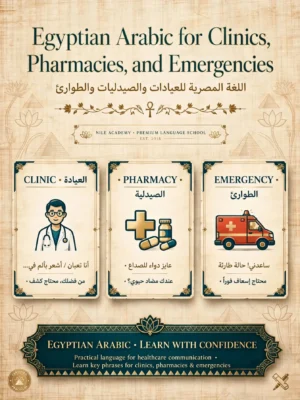
You don’t need to say these. You need to understand them.
- إيه اللي تاعبك؟ (eh elli ta3bak?) = What’s bothering you?
- بيوجعك فين؟ (bey-weg3ak feen?) = Where does it hurt?
- من إمتى؟ (min emta?) = Since when?
- بتاخد أي أدوية؟ (betakhod ay adweya?) = Are you taking any medication?
- عندك حساسية من حاجة؟ (3andak 7asaseyya men 7aaga?) = Are you allergic to anything?
And your answers: من إمبارح (min embaare7, since yesterday), من يومين (min yomeen, for two days), من الصبح (min eṣ-ṣob7, since this morning).
Honestly, this is where learners freeze. They memorize what they want to say and forget the doctor talks back. Practice the listening side too.
At the pharmacy (eṣ-ṣaydaleyya)
Pharmacies are everywhere in Egyptian cities, and pharmacists act as the first stop for small problems. Here’s a detail that surprises people: you call the pharmacist يا دكتور (ya doktoor) or يا دكتورة (ya doktoora). Yes, even at the counter. It’s polite, so use it.
The magic pattern
عايز حاجة لـ… (3ayez 7aaga li…) = “I need something for…”
| English | Arabic | Say it like |
|---|---|---|
| …for a headache | للصداع | lel-ṣuda3 |
| …for stomach cramps | للمغص | lel-maghaṣ |
| …for a cough | للكحة | lel-ko77a |
| …for diarrhea | للإسهال | lel-es-haal |
| …for allergies | للحساسية | lel-7asaseyya |
| …for a fever | للسخونية | lel-sokhooneyya |
So: “3ayez 7aaga lel-ṣuda3” = “I need something for a headache.” Simple. It works.
Other pharmacy phrases
| English | Arabic | Say it like |
|---|---|---|
| Is there a pharmacy open now? | فيه صيدلية مفتوحة دلوقتي؟ | feeh ṣaydaleyya maftoo7a dilwa2ti? |
| I have a prescription | معايا روشتة | ma3aya roshetta |
| Do I need a prescription? | محتاج روشتة؟ | me7taag roshetta? |
| How do I take this? | ده بيتاخد إزاي؟ | da beyetaakhed ezzay? |
| How many times a day? | كام مرة في اليوم؟ | kaam marra fel-yoom? |
| Before / after food | قبل / بعد الأكل | abl / ba3d el-akl |
| Painkiller | مسكّن | mosakken |
| Tablets / syrup / drops | أقراص / شراب / نقط | a2raaṣ / sharaab / no2aṭ |
| Ointment | مرهم | marham |
Roshetta is the Egyptian word for prescription. You’ll hear it constantly.
Now the honest part. Pharmacists in Egypt give a lot of advice across the counter. That’s convenient for a cold or an upset stomach. But if you’ve got a fever that won’t drop, chest pain, or anything that feels wrong, skip the pharmacy and see a doctor. And tell the pharmacist about allergies every single time: 3andi 7asaseyya men…
For official health information and services, the Egyptian Ministry of Health and Population is the place to start. Some pages may be Arabic-only. Treat that as free reading practice.
One tip that isn’t Arabic at all: take a photo of your regular medication’s box. Show it. Names on labels are often the same internationally, and a photo saves a lot of miming.
Other emergencies
Not every emergency is medical. These cover the rest.
| Situation | Egyptian Arabic | Say it like |
|---|---|---|
| There’s been an accident | فيه حادثة | feeh 7aadsa |
| I was robbed | اتسرقت | etsara2t |
| My passport is lost | الباسبور ضاع مني | el-basbor daa3 menni |
| I smell gas | فيه ريحة غاز | feeh ree7et ghaaz |
| I’m at the … hotel | أنا في فندق… | ana fi fondo2… |
| I don’t understand | مش فاهم / مش فاهمة | mish faahem / mish faahma |
| Speak slowly, please | ممكن تتكلم براحة؟ | momken tetkallem bi-raa7a? |
| Do you speak English? | بتتكلم إنجليزي؟ | betetkallem ingleezi? |
| Can you write it down? | ممكن تكتبها؟ | momken tektebha? |
Your location is the most useful thing you can give anyone. Have your exact spot ready: hotel name, nearby landmark, street, and district. Learn to say “ana fi fondo2 …” with your hotel’s name. Practice it. Even better, keep the address in Arabic on your phone.
If you’re a parent
Kids get sick at the worst possible moments. Some phrases for that:
| English | Arabic | Say it like |
|---|---|---|
| My son has a fever | ابني عنده سخونية | ebni 3andu sokhooneyya |
| My daughter has a fever | بنتي عندها سخونية | benti 3andaha sokhooneyya |
| He’s vomiting | بيرجّع | beyraggaa3 |
| He swallowed something | بلع حاجة | bala3 7aaga |
| He fell on his head | وقع على راسه | we2e3 3ala raaso |
| He got burned | اتحرق | et7ara2 |
| He won’t eat | مش عايز ياكل | mish 3ayez yakol |
Swap ebni/benti for your child. For a girl, “he” becomes “she”: 3andaha, bala3it, we2e3et. If you’re raising kids in an Arabic-speaking home and want them learning too, we have separate programs for that.
Real questions learners keep asking
What’s the ambulance number in Egypt? 123. Police is 122, fire is 180, and the tourist police is 126. Save them all.
Do Egyptian doctors and pharmacists speak English? Often, especially in big cities, private hospitals, and tourist areas. But “often” isn’t “always.” Late at night, in smaller towns, or with older staff, don’t count on it. That’s exactly why these phrases exist. If you’re planning longer-term care in Egypt, browse the Ministry of Health and Population website for official information on services.
Should I learn Egyptian Arabic or Modern Standard Arabic for this? For talking to people, Egyptian. For reading forms and formal signs, Modern Standard helps. If you want both, start with speaking and add reading later. Our daily Arabic study routine shows how to split your time.
Can’t I just use a translation app? Use it as a backup. But typing with shaky hands while someone’s in pain is slow. Ten memorized phrases beat a perfect app you can’t open in time.
Do I need to sound perfect? No. Egyptians are patient and generous with learners. Say it loudly, say it simply, point if you need to.
How do I say “I need a doctor” if I’m a woman? Me7taaga doktoor. Add the -a.
Mistakes I see all the time
- Learning only the “textbook” version. MSA phrases are understood, sure. But Egyptians will react faster to the words they use daily.
- Skipping the listening side. Knowing what to say isn’t enough. Learn the doctor’s questions too.
- Forgetting gender endings. Small thing. Fix it early so it becomes automatic.
- Waiting until you arrive. Nobody learns a language at the airport. Start now.
- Never saying phrases out loud. Reading them silently feels like learning. It isn’t. Say them.
How to make them stick
Here’s a plan. It’s boring, and it works.
- Pick 10 phrases from the first table.
- Say each one out loud, three times, every morning. Five minutes.
- Add five new phrases per week from the clinic and pharmacy sections.
- Once a week, act out a fake scene with a friend or teacher. Booking a kashf. Asking for something for a headache. Reporting a lost passport.
That’s it. Consistency wins. And if you want the phrases to sit alongside everyday conversation, our list of 50 common Egyptian Arabic phrases is a good next step.
Ready to learn phrases that actually work?
Not sure where you stand? Take the free Arabic level test and you’ll know in a few minutes. Then check the course options and pricing, or meet our teachers and see who you’d be speaking with.
Learn practical phrases with a real teacher, in real Egyptian Arabic, at your pace.
This guide is for language learning only. It is not medical advice. In a real emergency, call the emergency number first.