
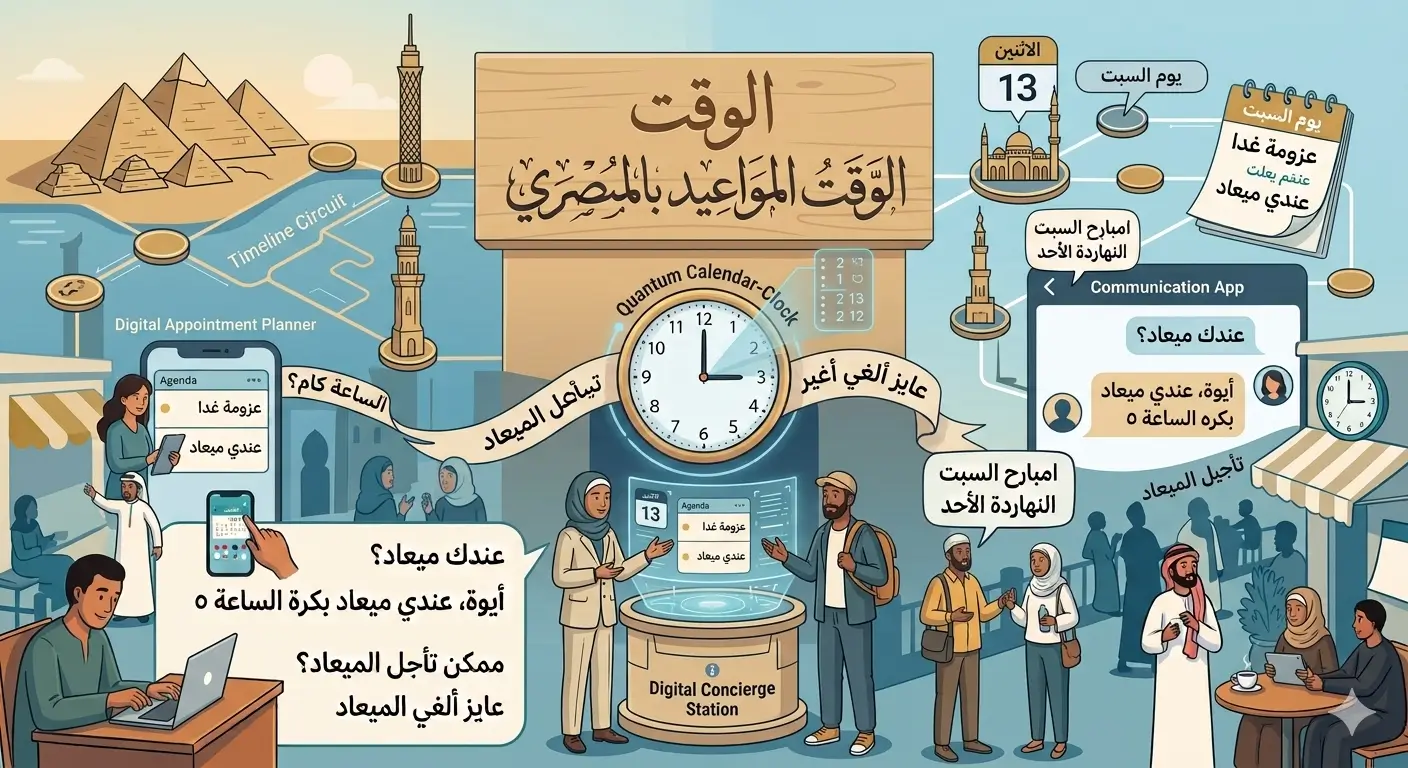

If you’ve searched “time dates in Egyptian Arabic” more than once, I already know what’s going on. You’re trying to teach your kid (or yourself) something that sounds simple in English — “it’s four o’clock,” “see you Tuesday” — and then you open an Arabic textbook and it throws Modern Standard Arabic ordinal numbers at you. الساعة الرابعة. Nobody in Cairo talks like that at the dinner table.
Here’s the thing — Egyptians don’t tell time the “proper” grammar-book way in daily life. They use plain numbers, a couple of shortcuts, and a rhythm that a seven-year-old picks up faster than most adults. That’s what I’m giving you here. No ordinal number gymnastics. Just what people in Egypt actually say when they ask “what time is it” or “what day are we meeting.”
I teach this stuff for a living, so I’ll be straight with you about where kids usually get stuck, and how to skip that.
First, Ask the Right Question
In Egyptian Arabic, “what time is it” is:
الساعة كام؟ el-saa’a kaam? (literally: “the hour, how much?”)
That’s it. Not “kam as-saa’a” like you’ll find in a Standard Arabic app — Egyptians flip the word order and say el-saa’a kaam. If your kid only remembers one phrase from this whole article, make it this one. It’s the door into everything else.
Telling the Hour — the Egyptian Way
Standard Arabic uses ordinal numbers for hours (the “fourth hour,” the “ninth hour”). Egyptian colloquial just uses the plain cardinal number after “el-saa’a.” That’s honestly the best news in this entire article — it means your kid only needs to know how to count.
| Hour | Egyptian Arabic | Pronunciation |
|---|---|---|
| 1:00 | الساعة واحدة | el-saa’a waHda |
| 2:00 | الساعة اتنين | el-saa’a itnein |
| 3:00 | الساعة تلاتة | el-saa’a talata |
| 4:00 | الساعة أربعة | el-saa’a arba’a |
| 5:00 | الساعة خمسة | el-saa’a khamsa |
| 6:00 | الساعة ستة | el-saa’a sitta |
| 7:00 | الساعة سبعة | el-saa’a sab’a |
| 8:00 | الساعة تمانية | el-saa’a tamanya |
| 9:00 | الساعة تسعة | el-saa’a tis’a |
| 10:00 | الساعة عشرة | el-saa’a ‘ashara |
| 11:00 | الساعة حداشر | el-saa’a hidaashar |
| 12:00 | الساعة اتناشر | el-saa’a itnaashar |
Notice “واحدة” (waHda) is feminine, because “الساعة” (the hour) is a feminine word. That’s really the only grammar rule in this whole section. Everything else is just numbers you already learned.
Minutes: Past, To, Half, and the Egyptian “Third”
This is where Egyptian Arabic has one quirky move that most textbooks skip, so pay attention here.
- و (w) means “and” — used for minutes past the hour
- إلا (illa) means “except” — used for minutes to the next hour
- ربع (rob’e) = quarter (15 min)
- نص (noss) = half (30 min)
- تلت (tilt) = a third (20 min) — yes, Egyptians measure time in thirds of an hour too, not just quarters and halves
| Time | Egyptian Arabic | Pronunciation |
|---|---|---|
| 4:05 | الساعة أربعة وخمسة | el-saa’a arba’a w khamsa |
| 4:15 | الساعة أربعة وربع | el-saa’a arba’a w rob’e |
| 4:20 | الساعة أربعة وتلت | el-saa’a arba’a w tilt |
| 4:30 | الساعة أربعة ونص | el-saa’a arba’a w noss |
| 4:40 | الساعة خمسة إلا تلت | el-saa’a khamsa illa tilt |
| 4:45 | الساعة خمسة إلا ربع | el-saa’a khamsa illa rob’e |
See what happened at 4:40? Egyptians jump forward to the next hour and subtract. So 4:40 isn’t “four-forty,” it’s “five minus a third.” That trips up almost every beginner, kids included. Practice this one on its own for a few days before moving on — it’s the single biggest “aha” moment in this whole topic.
Morning, Afternoon, Night — Egyptians Skip AM/PM
Egypt runs on a 12-hour clock in everyday speech, and instead of saying “a.m.” or “p.m.,” people just tack on a time-of-day word:
- الصبح (el-sobh) — morning
- بعد الضهر (ba’d el-dohr) — afternoon
- بالليل (bel-leil) — at night
So “It’s 8 p.m.” becomes: الساعة تمانية بالليل (el-saa’a tamanya bel-leil).
Honestly, this is easier for kids than a.m./p.m. ever was, because it matches how they already think about their day — “after school,” “at night,” “in the morning” — instead of an abstract letter code.
Days of the Week: Numbers Again
Same pattern as the hours — most day names in Arabic come from numbers, and Egyptian colloquial trims them down further.
| English | Egyptian Arabic | Pronunciation |
|---|---|---|
| Sunday | الحد | el-had |
| Monday | الاتنين | el-itnein |
| Tuesday | التلات | el-talat |
| Wednesday | الأربع | el-arba’ |
| Thursday | الخميس | el-khamees |
| Friday | الجمعة | el-gum’a |
| Saturday | السبت | el-sabt |
Two things worth flagging for a kid (or a parent) new to this:
- The week starts on Sunday, not Monday.
- The weekend in Egypt is Friday and Saturday, not Saturday and Sunday. Friday is the day for communal prayer, so it anchors the week differently than it does in the US or UK. If your child ever talks to a pen pal or a teacher in Cairo about “what are you doing this weekend,” this is the fact that keeps the conversation from getting confusing.
Months: The One Surprise Twist
Here’s something a lot of guides get wrong, or just skip. Levantine and Gulf Arabic use older Arabic month names (like كانون الثاني for January). Egyptian Arabic doesn’t. Egypt uses month names that just sound like the English/French ones with an Arabic accent:
يناير (yanaayer – January), فبراير (febraayer – February), مارس (maares – March), أبريل (abreel – April), مايو (maayo – May), يونيو (yonyo – June), يوليو (yolyo – July), أغسطس (aghostos – August), سبتمبر (sebtember – September), أكتوبر (oktobar – October), نوفمبر (nofember – November), ديسمبر (desember – December).
This is honestly a gift for beginners and kids — you already half-know these words. Say them slowly with your kid a couple of times and they’ll stick almost by themselves.
Talking About Dates: Today, Tomorrow, and “When?”
This is the part that turns “telling time” into “actually making plans,” which is what your kid will need if they’re chatting with a teacher, a cousin, or a friend in Egypt.
| English | Egyptian Arabic | Pronunciation |
|---|---|---|
| When? | امتى؟ | emta? |
| Today | النهارده | el-naharda |
| Tomorrow | بكرة | bokra |
| Yesterday | إمبارح | embareh |
| Next week | الأسبوع الجاي | el-esbo’ el-gay |
| Last week | الأسبوع اللي فات | el-esbo’ elli fat |
A full, natural sentence a kid could actually use: الدرس بكرة الساعة أربعة بعد الضهر — “el-dars bokra el-saa’a arba’a ba’d el-dohr” — “The lesson is tomorrow at 4 p.m.” That single sentence covers day, time, and time-of-day, all in the dialect Egyptians actually use.
A Quick Practice Dialogue
A: الساعة كام؟ (el-saa’a kaam?) — What time is it? B: الساعة خمسة إلا ربع. (el-saa’a khamsa illa rob’e.) — It’s quarter to five. A: طيب، إحنا هنتقابل امتى؟ (tayyeb, ehna hanet’abel emta?) — Okay, when are we meeting? B: بكرة، الجمعة، الساعة ستة بالليل. (bokra, el-gum’a, el-saa’a sitta bel-leil.) — Tomorrow, Friday, at 6 p.m.
Read this out loud with your kid a few times a week. That’s genuinely more useful than memorizing the tables above in isolation — time only sticks once it’s attached to a real plan.
Do you want your child to learn correct pronunciation with a native Egyptian teacher? Book a free trial lesson.
Common Questions Learners and Parents Keep Asking
I get some version of these questions constantly, and they come up again and again in Arabic-learning forums too. Quick, honest answers:
Is telling time in Egyptian Arabic different from Modern Standard Arabic? Yes, noticeably. MSA uses ordinal numbers for hours (الساعة الرابعة). Egyptian colloquial just uses the plain number (الساعة أربعة). If your kid is only going to speak with Egyptians, learn the colloquial version first — it’s simpler and it’s what they’ll actually hear.
Do Egyptians use the 12-hour or 24-hour clock in conversation? 12-hour, with a time-of-day word (الصبح، بعد الضهر، بالليل) instead of a.m./p.m. The 24-hour clock shows up on official schedules and some class listings, but nobody says “the fourteen hundred” out loud.
What’s the Egyptian weekend, and why does it matter for scheduling lessons? Friday and Saturday. If you’re booking online Arabic classes for your child and see “Friday” listed as a day off, that’s why — it’s the Egyptian weekend, not a scheduling mistake.
Why do Egyptian month names sound different from what I learned in a Gulf-focused course? Because Egypt (along with Libya and Sudan) uses month names borrowed from European languages, while the Levant and Gulf use older Arabic terms. Both are correct Arabic — they’re just regional.
How do I explain “today, tomorrow, yesterday” to a young kid without overwhelming them? Anchor it to something they already do daily — bedtime, school, a favorite snack. “بكرة إحنا رايحين المدرسة” (tomorrow we’re going to school) sticks faster than a flashcard ever will.
How to Actually Practice This With Your Kid
- Ask “الساعة كام؟” out loud every time you check a clock for a week. Repetition beats worksheets.
- Use a real calendar and point at “النهارده,” “بكرة,” and “إمبارح” every morning.
- Turn the hour numbers into a counting game before you add minutes — don’t stack two new skills at once.
- Keep the a.m./p.m. words tied to real parts of the day (morning coffee, afternoon snack, bedtime), not abstract letters.
None of this needs to happen in one sitting. Spread it over two or three weeks and it holds a lot better than one long cram session.
For the Curious: Where This Stuff Comes From
Two quick reads if you want to go deeper than “here’s the vocabulary”:
- Egyptian Arabic itself, as a dialect, has its own history and status separate from Modern Standard Arabic — Wikipedia’s overview of Egyptian Arabic covers where it came from and why it’s spoken so differently.
- If you’re wondering whether a numbers-based system (like Arabic’s days and hours) actually makes it easier for a kid to grasp time, there’s real research on this. A cross-linguistic study on children’s acquisition of time concepts found that kids who learn a language using numerical day/month names tend to pick up time sequencing earlier than kids learning arbitrary names. Arabic leans numerical too, so that’s good news for your child.
Where to Go From Here
If your child is picking this up well, the next natural step is regular speaking practice with someone who actually talks like this every day — not just a workbook. That’s really the whole point of learning colloquial Egyptian Arabic instead of the textbook version: it’s meant to be spoken, not just recognized on a page.
A few places to go next on our site:
- Not sure where your child’s level actually is? Take the free Arabic placement test first — it takes a few minutes and tells you exactly where to start.
- Curious what a week of lessons looks like once you know the level? Check our Arabic course pricing.
- Want to build daily practice like the kind I mentioned above into an actual habit? Here’s our guide to a daily Arabic study routine.
- Want to see who’d actually be teaching your child? Meet our Egyptian Arabic teachers.
Learn a handful of these phrases this week. Don’t try to master the whole article at once — that’s how kids (and adults) burn out on a language before they even get comfortable with it.