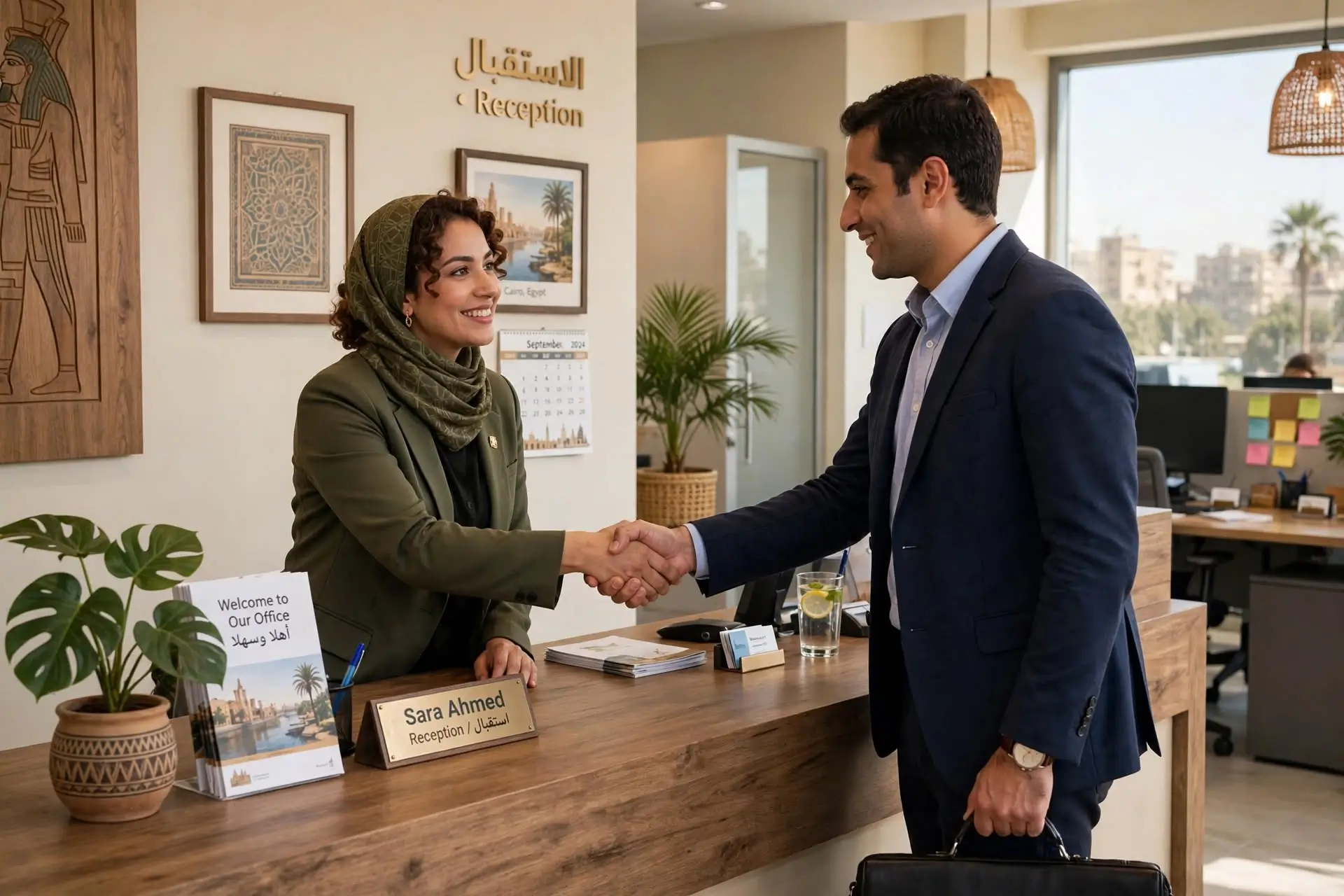
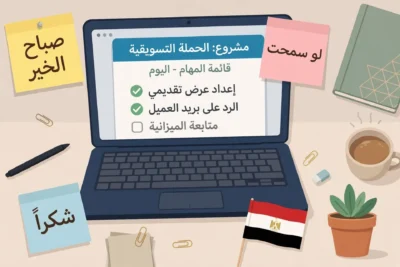
You got the job. Or the client. Or the move to Cairo. Then you walk into your first meeting, and everyone’s speaking an Arabic that looks nothing like the one you studied.
Yeah. That’s the shock.
Egyptian Arabic for work is its own skill. It isn’t textbook Arabic, and it isn’t tourist Arabic either. Nobody’s asking how much the taxi costs. They’re asking if you can send the file by five, or if you’re free for a quick call.
So here’s what you’ll get in this guide. Which Arabic you actually need at work. The phrases for meetings, calls, and emails. The small-talk habits that matter more than grammar. And a 30-day plan that won’t eat your life. I’ll be straight with you about what’s realistic, too.
Egyptian Arabic vs. MSA: Which Do You Need at Work?
Short answer: both. Just not equally.
Egyptian Arabic (Masri) is what people speak. It has around 84 million native speakers and roughly 119 million in total when you count second-language users. It’s also understood across most of the Arab world, largely thanks to Egyptian cinema and music. That makes it a smart pick if your job puts you in touch with people from different countries. You can read more on Wikipedia’s Egyptian Arabic page.
Modern Standard Arabic (MSA, or fusha) is the formal one. Contracts. Official letters. Presentations.
Most professionals end up with a split. Write emails in MSA, speak Egyptian in meetings. Another professional guide puts it well: MSA alone is respected in formal settings but creates social distance, while dialect alone lacks a formal register. I agree with that.
Here’s a wrinkle. In plenty of offices, especially multinational companies, banks, and tech, English does the written work. People also drop English words into Arabic all day. “Meeting.” “Email.” “Deadline.” Nobody blinks. So if you hear it, don’t panic. You’re not misunderstanding anything.
And honestly? Your colleagues aren’t grading your grammar. They’re watching whether you try. Arab business culture notices and rewards visible, consistent effort, and it doesn’t require fluency. That’s good news.
Not sure whether you need the dialect, MSA, or both? Our Colloquial Egyptian Arabic course is built for exactly the spoken side of work life.
Egyptian Arabic Pronunciation: Five Minutes That Save You Weeks
Two sounds trip people up at work.
ج is a hard “g.” In Cairo, this letter is pronounced like a hard g, so “mountain” is gabal, not jabal. So جديد (new) is gedeed, not jedeed.
ق usually becomes a glottal stop. That’s the little catch in your throat in “uh-oh.” In Cairo and the Nile Delta, the classical q sound became a glottal stop. So قهوة (coffee) sounds like 2ahwa. If you’re curious about the details, Wikipedia has a page on Egyptian Arabic phonology.
In this guide, 3 stands for ع and 2 stands for the glottal stop. You’ll see the same numbers in Egyptian chat messages.
Egyptian Arabic Greetings and Office Small Talk
This is the part that matters most. Not the vocabulary. This.
| Arabic | Say it like | Meaning |
|---|---|---|
| صباح الخير | sabaah el-kheer | Good morning |
| صباح النور | sabaah en-noor | Good morning (reply) |
| إزيك؟ | ezzayyak? (m) / ezzayyik? (f) | How are you? |
| الحمد لله، تمام | el-hamdu lillah, tamaam | Fine, thank God |
| عامل إيه؟ | 3aamel eh? (m) / 3amla eh? (f) | How’s it going? |
| أخبارك إيه؟ | akhbaarak eh? | What’s new? |
| اتشرفنا | etsharrafna | Nice to meet you |
| الشرف ليا | esh-sharaf leya | The honor’s mine |
Don’t jump straight into business. A minute of “how are you, how’s the family, how’s work” is normal. Skip it and you can come across as cold, even if you didn’t mean to.
You’ll also get offered a drink. A lot. “شاي ولا قهوة؟” (shay walla 2ahwa?, tea or coffee?). Say “شاي لو سمحت” (shay law samaht, tea please) and you’re set. To a woman, it’s law samahti.
Introducing Yourself and Your Job
| Arabic | Say it like | Meaning |
|---|---|---|
| أنا اسمي… | ana ismi… | My name is… |
| أنا جديد هنا / جديدة | ana gedeed hena / gedeeda | I’m new here |
| أنا بشتغل في قسم المبيعات | ana bashtaghal fi 2esm el-mabee3aat | I work in the sales department |
| أنا مسؤول عن التسويق | ana mas2ool 3an et-taswee2 | I’m in charge of marketing (f: mas2oola) |
| أنا شغال هنا من سنة | ana shaghghaal hena min sana | I’ve worked here for a year (f: shaghghaala) |
One grammar trick makes a huge difference. Put ب (b-) on a verb for the present, and ه (ha-) for the future.
- أنا بكتب التقرير. ana baktib et-ta2reer. I’m writing the report.
- أنا هبعته النهارده. ana hab3atu en-naharda. I’ll send it today.
That’s it. You can already talk about your day.
Egyptian Arabic for Meetings
Meetings are where most learners freeze. So learn these ten lines cold.
| Situation | Arabic | Say it like | Meaning |
|---|---|---|---|
| Starting | خلينا نبدأ | khalleena nebda | Let’s start |
| Jumping in | ممكن أقول حاجة؟ | mumkin a2ool haaga? | Can I say something? |
| Agreeing | أنا معاك | ana ma3aak | I’m with you / I agree |
| Disagreeing softly | أنا مش متفق معاك بالظبط | ana mish muttafe2 ma3aak bez-zabt | I don’t exactly agree |
| Not following | مش فاهم، ممكن توضّح؟ | mish fahem, mumkin twaddah? | I don’t get it, can you clarify? |
| Repeat | ممكن تعيد تاني؟ | mumkin te3eed tani? | Can you say that again? |
| Slow down | ممكن تتكلم بالراحة شوية؟ | mumkin tetkallem bir-raaha shwayya? | Can you speak a bit slower? |
| Deadlines | الديدلاين إمتى؟ | ed-deadline emta? | When’s the deadline? |
| Next steps | إيه الخطوة الجاية؟ | eh el-khatwa el-gaya? | What’s the next step? |
| Wrapping up | تمام، كده اتفقنا | tamaam, kedda ettafa2na | Okay, so we’re agreed |
Speaking to a woman? Add a long “ee” to the verb: te3eedi, tetkallemi, twaddahi. Speaking as a woman? “Fahem” becomes fahma.
Now, the phrase you’ll hear constantly: إن شاء الله (in shaa2 Allah). Sometimes it’s a real, solid yes. Sometimes it’s softer, more like “we’ll see.” Tone and context tell you which. So when a date matters, confirm it: “يعني يوم الخميس الساعة ٣؟” (ye3ni yoom el-khamees es-sa3a talaata?, so Thursday at 3?). Polite. Clear. Nobody’s offended.
Egyptian Arabic for Phone Calls and WhatsApp
| Arabic | Say it like | Meaning |
|---|---|---|
| ألو، صباح الخير | alo, sabaah el-kheer | Hello, good morning |
| مين معايا؟ | meen ma3aaya? | Who am I speaking with? |
| أنا فلان من شركة… | ana fulaan min sharikit… | I’m so-and-so from… company |
| ثانية واحدة | saniya waHda | One second |
| ممكن أسيب رسالة؟ | mumkin aseeb resaala? | Can I leave a message? |
| الصوت مش واضح | es-soot mish waadeH | The audio isn’t clear |
| هرجعلك | harga3lak (f: harga3lik) | I’ll get back to you |
| هبعتلك على الواتساب | hab3atlak 3ala el-whatsapp | I’ll send it on WhatsApp |
A lot of day-to-day work chat happens on WhatsApp, voice notes included. Here’s a tip: answer voice notes with voice notes. It’s free speaking practice, and it gets you used to real speed. You’ll also see “Franco-Arabic” in messages, which is Arabic typed in Latin letters and numbers (3 for ع, 7 for ح). Get used to reading it. It’s everywhere.
Emails: Where MSA Shows Up

Emails are the one place where formal Arabic still leads. You don’t need a lot. A few fixed formulas cover most of it.
تحية طيبة وبعد،
برجاء إرسال التقرير قبل نهاية اليوم.
شكرًا لتعاونكم.
مع خالص التحية،
That means: Greetings. Please send the report before the end of the day. Thank you for your cooperation. Kind regards.
The opener تحية طيبة وبعد and the closer مع خالص التحية work in almost any formal email. برجاء (“please,” formal) is your polite request word. With colleagues you know well, a short, friendly message is fine. Match the tone of whoever wrote to you.
20 Egyptian Arabic Office Words Worth Learning First
| Arabic | Say it like | Meaning |
|---|---|---|
| شغل | shoghl | work |
| شركة | sharika | company |
| مكتب | maktab | office |
| مدير | modeer | manager |
| زميل / زميلة | zameel / zameela | colleague |
| عميل | 3ameel | client |
| اجتماع | egtimaa3 | meeting |
| ميعاد | me3aad | appointment / deadline |
| مشروع | mashroo3 | project |
| تقرير | ta2reer | report |
| عقد | 3a2d | contract |
| فاتورة | fatoora | invoice |
| مرتب | mortab | salary |
| إجازة | egaaza | leave / holiday |
| ميزانية | meezaneyya | budget |
| عرض | 3ard | offer / presentation |
| مهمة | mohemma | task |
| مسؤول | mas2ool | responsible / in charge |
| ملف | malaff | file |
| إيميل | eemeel |
Learn them in sentences, not as a list. “عندي اجتماع الساعة ١٠” (3andi egtimaa3 es-sa3a 3ashra, I have a meeting at 10) sticks far better than “meeting = egtimaa3.”
Common Mistakes When Using Egyptian Arabic at Work
Speaking pure MSA. It’s like reading the evening news to your colleague over lunch. They’ll understand you. It’ll just feel strange.
Overusing معلش. Ma3lesh is great for small stuff: a minute late, a tiny mix-up. For a real mistake, say “أنا آسف، غلطتي” (ana aasef, ghalatti, I’m sorry, my mistake). It sounds more responsible.
Ignoring gender. Arabic changes verbs and adjectives depending on who you’re talking to. Fix this early. It gets harder to unlearn.
Skipping small talk. Covered above. But it’s the mistake I see most, so it’s here twice.
Mixing in Gulf or Levantine phrases. People will understand. It just won’t sound like Cairo. Pick one dialect and stay with it.
A 30-Day Egyptian Arabic Plan That Fits Real Life

Twenty minutes a day. That’s it. If you need help building the habit, this daily Arabic study routine is a good starting frame.
- Week 1: Greetings, small talk, and introducing yourself. Say each line out loud, not in your head.
- Week 2: The meeting phrases. Write ten sentences you’ll actually say in your own meetings.
- Week 3: Phone and WhatsApp. Send voice notes to a tutor or friend.
- Week 4: Role-play a full meeting from start to finish. Then write three short emails using the formulas above.
Want more general conversation practice alongside this? Our guide on speaking Egyptian Arabic conversation covers everyday phrases beyond the office.
Let’s be real about timing. Thirty days won’t make you fluent. It’ll get you through your first meetings without panic. For a longer view, one professional guide estimates 6 to 12 months of consistent study for basic professional ability, and 2 to 3 years for full working proficiency. Treat that as a rough guide, not a rule. Your job, your hours, and your teacher all change the picture.
Questions People Keep Asking
Do I need MSA to work in Egypt?
For speaking with colleagues, no. Egyptian Arabic does the job. For contracts and formal writing, MSA helps. Start with the dialect if your goal is talking to people, then add MSA.
Will my colleagues just switch to English with me?
Some will. Especially in international companies. But they’ll notice and appreciate every Arabic line you use, and that’s how you build trust.
Do I need to read Arabic script?
Not on day one. Transliteration gets you started. But sooner or later you’ll get messages, signs, and documents in Arabic, so learn the alphabet within your first few weeks.
How do I say no politely to a boss or client?
Try “للأسف مش هينفع” (lil-asaf mish hayenfa3, unfortunately it won’t work) or “مش هقدر للأسف” (mish ha2der lil-asaf, I won’t be able to, sadly). Then offer an alternative: “ممكن بكرة؟” (mumkin bokra?, could it be tomorrow?).
Will Egyptian Arabic help me outside Egypt?
Often, yes. As mentioned, it’s widely understood across the Arab world. For business in the Gulf or Levant, you’d still want to pick up the local dialect for social settings.
How do I know what level I’m at?
Take our free Arabic placement test. It takes a few minutes and tells you where to start.
Ready to Develop Practical Arabic Skills?
Reading a guide gets you started. Speaking with a real teacher gets you there.
At Alphabet Arabic Academy, you can practice these exact workplace situations with native teachers. Start with the Colloquial Egyptian Arabic course, meet the teachers, or compare options on the pricing page. You can also browse all our Arabic courses. Every course starts with a free 30-minute trial lesson, no credit card needed.
Pick one meeting phrase from this page. Use it tomorrow. That’s how it starts.
Why Bilingual Skills Matter at Work (Even a Little Egyptian Arabic)
Let’s be practical for a second. Is a second language actually worth the effort?
The U.S. Department of Education’s NCELA looked at this in its report on the economic benefits of multilingualism. It says multilingual employees can reach more people, access a wider range of information, and build products that appeal to a larger audience. It also notes that two research studies found multilingual individuals earn roughly $2,000 to $3,000 more on average. EdEd
But I’ll be straight with you. That same report admits other studies found no statistically significant earnings effect, and that results differ from one local job market to another. So don’t expect a raise the week you learn ezzayyak. It’s US data, too, not Egyptian. Ed
The real payoff at a Cairo desk is simpler. You understand more. Your colleagues trust you faster. And fewer things get lost in translation. That’s worth having, whatever your paycheck does.