Good news first. The future tense in Egyptian Arabic is one of the easiest things you’ll learn. One little sound. That’s it.
The sound is ha.
You put it in front of a present tense verb, and the action jumps into the future. No new endings. No second set of conjugations to memorize. If you can say “I write,” you can say “I will write.”
But here’s the thing. I’ve taught this for years, and learners still trip over it. They stack it with another prefix. They borrow words from MSA that make Egyptians smile. They freeze when they need to say “I won’t.” So let’s fix all of that in one go.
The Short Answer
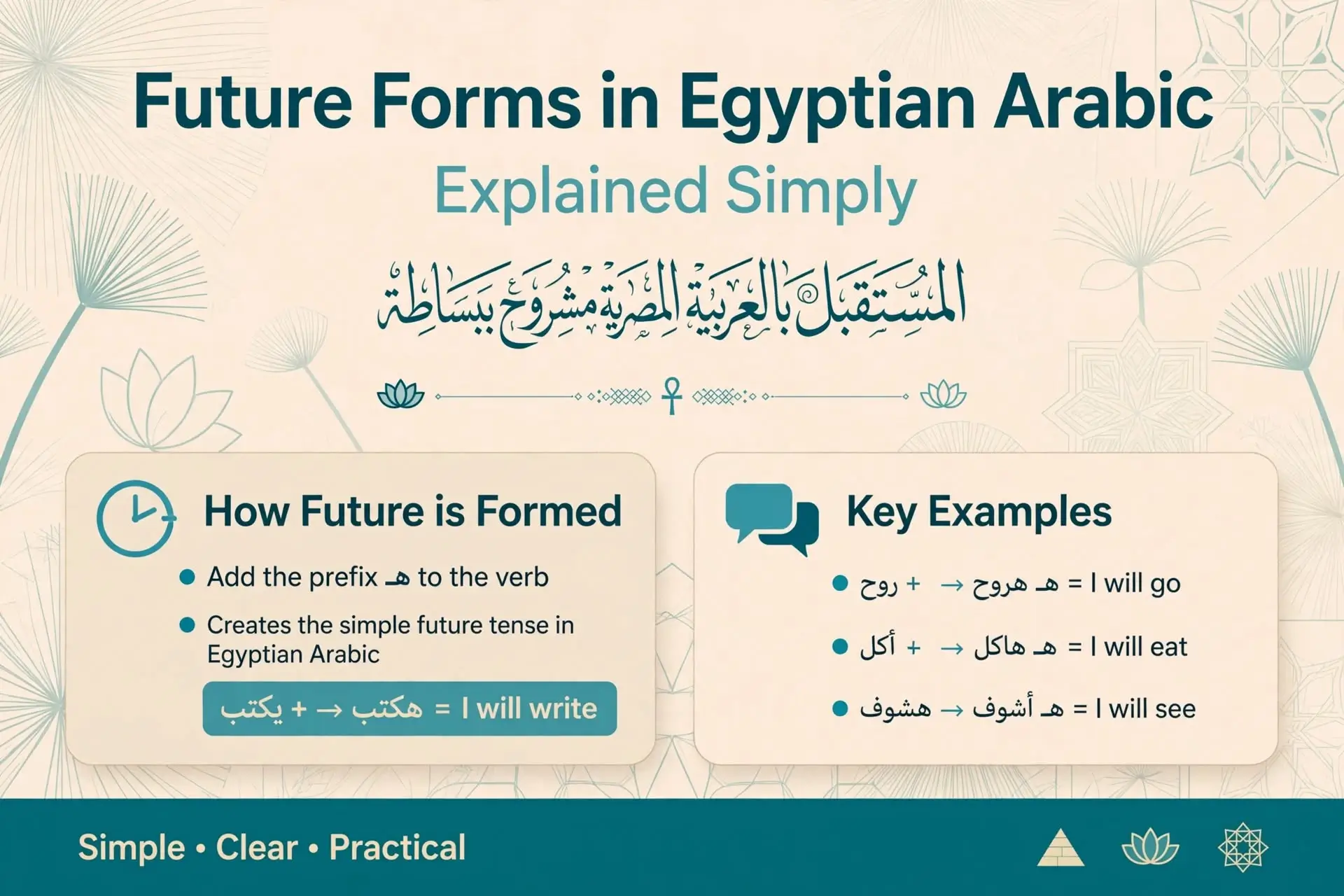
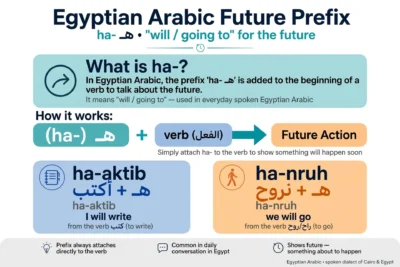
Egyptian future = ha + present verb (without the b-).
| English | Egyptian Arabic | Pronunciation |
|---|---|---|
| I will go | هروح | haroo7 |
| I will eat | هاكل | hakol |
| I will drink | هشرب | hashrab |
| I will write | هكتب | haktib |
Notice something? There’s no “will” word. No “going to.” Just ha, stuck to the verb. Egyptians say it fast, so it sounds like part of the verb itself.
Quick context if you’re new to this dialect. Egyptian Arabic is the everyday spoken language of Egypt, and it’s widely understood across the Arab world, largely because of Egyptian movies and music. That’s why so many learners pick it. And it’s why the future tense matters. You’ll hear it in every film, every taxi, every family lunch.
If you’re still deciding between Egyptian and formal Arabic, read MSA vs Egyptian vs Quranic Arabic: Which One Should You Start With? first. Then come back. I’ll wait.
Step 1: Know the Two Present Tenses
Here’s where most confusion starts. Egyptian has two versions of the present.
- The bare verb. aktib. This is the plain stem.
- The b- verb. baktib. This one means “I write” as a habit, or “I’m writing” right now.
Now add the future:
- aktib = the stem
- baktib = I write / I’m writing
- haktib = I will write
See the pattern? Ha replaces b-. It doesn’t sit next to it. It takes its place.
So the rule you need is simple: take the bare verb, drop any b-, and put ha in front. Done.
I’ll be straight with you. If you only remember one thing from this entire article, remember that. Ha and b- never appear together on the same verb.
Step 2: The Full Conjugation
Let’s use the verb yiktib (to write). Look at how the prefix of the person stays exactly where it was. The “ha” just sits in front.
| Pronoun | Egyptian | Arabic |
|---|---|---|
| ana (I) | haktib | هكتب |
| enta (you, m.) | hatiktib | هتكتب |
| enti (you, f.) | hatiktibi | هتكتبي |
| huwwa (he) | hayiktib | هيكتب |
| hiyya (she) | hatiktib | هتكتب |
| ehna (we) | hanektib | هنكتب |
| entu (you, pl.) | hatiktibu | هتكتبوا |
| humma (they) | hayiktibu | هيكتبوا |
Now the same thing with aroo7 (to go):
| Pronoun | Egyptian | Arabic |
|---|---|---|
| ana | haroo7 | هروح |
| enta | hatroo7 | هتروح |
| enti | hatroo7i | هتروحي |
| huwwa | hayroo7 | هيروح |
| hiyya | hatroo7 | هتروح |
| ehna | hanroo7 | هنروح |
| entu | hatroo7u | هتروحوا |
| humma | hayroo7u | هيروحوا |
Honestly? Don’t memorize both tables. Pick one verb and drill it until it’s automatic. Then swap in new verbs. The pattern doesn’t change. That’s the beauty of it.
Step 3: When the Sounds Melt Together
This part trips people up in listening, not in speaking.
With “I” verbs that start with a vowel sound, the “a” of ha swallows the first vowel of the verb. So:
- ha + akol becomes hakol (I will eat)
- ha + aroo7 becomes haroo7 (I will go)
- ha + aakhod becomes hakhod (I will take)
You’ll often see it written هاكل or هاخد with a long alif, because that’s how it sounds. Same word. Don’t panic if you see two spellings.
One more small thing. Some books write the prefix with ح (like ḥa-), and some with ه. Both exist in print, and they’re pronounced the same in real speech. Egyptians mostly write ه when they text. Pick that one and move on.
Step 4: Add a Time Word
Here’s a question I hear all the time, and I’ve seen it pop up in learner forums too: “My notes say bokra is a future word, but there’s no ha in it. What’s going on?”
Good catch. And the answer is simple. Bokra (tomorrow) isn’t a tense. It’s a time word. It tells you when. The verb, with ha, tells you what happens.
So you get both:
- بكرة هروح الشغل. (bokra haroo7 el-shoghl.) Tomorrow I’ll go to work.
- أنا هسافر بكرة. (ana hasafer bokra.) I’ll travel tomorrow.
Here are the time words worth knowing:
| English | Egyptian | Arabic |
|---|---|---|
| tomorrow | bokra | بكرة |
| the day after tomorrow | ba3d bokra | بعد بكرة |
| later | ba3dein | بعدين |
| soon | orayyeb | قريب |
| next week | el-osboo3 el-gayy | الأسبوع الجاي |
| next month | el-shahr el-gayy | الشهر الجاي |
| next year | el-sana el-gaya | السنة الجاية |
If you want more of these (clock times, days, dates), my guide on time and dates in Egyptian Arabic goes through them step by step.
Step 5: Saying “I Won’t”
Negative future is where learners panic. They shouldn’t. It’s actually easier than the English version.
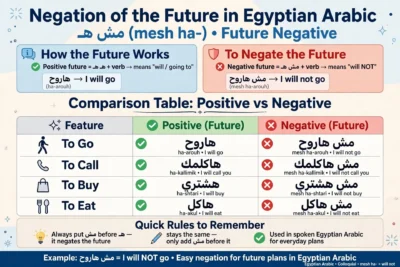
mesh + ha-verb.
- مش هروح. (mesh haroo7.) I won’t go.
- مش هاكل. (mesh hakol.) I won’t eat.
- مش هاجي بكرة. (mesh hagi bokra.) I won’t come tomorrow.
- مش هتيجي؟ (mesh hatigi?) Aren’t you coming?
That’s the whole thing. Mesh goes before the ha-verb, and the verb doesn’t change.
You’ll sometimes hear a wrapped version, with ma- at the front and -sh at the end of the verb. That’s how Egyptians negate past and present verbs, and it occasionally shows up with the future too. But as a learner? Stick with mesh. It’s natural, it’s safe, and nobody will look at you funny.
Step 6: Asking Questions About the Future
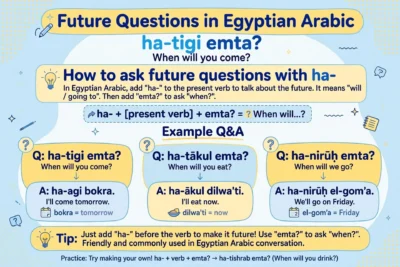
Questions work the same way. Keep the ha-verb and add your question word.
- هتروح فين؟ (hatroo7 feen?) Where will you go?
- هتيجي إمتى؟ (hatigi emta?) When will you come?
- هتاكل إيه؟ (hatakol eh?) What will you eat?
- هنعمل إيه بكرة؟ (han3emel eh bokra?) What will we do tomorrow?
Say them out loud. Seriously. Reading them silently doesn’t count.
Other Ways Egyptians Talk About the Future
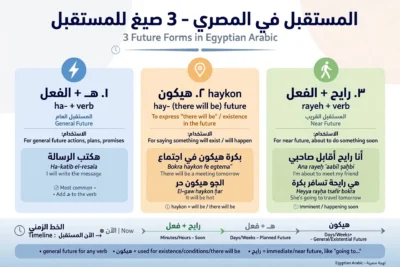
Here’s something textbooks tend to skip. Egyptians don’t use ha for everything. Native speakers mix a few tools depending on what they mean.
1. The bare verb, for offers and suggestions.
- نروح؟ (nroo7?) Shall we go?
- أساعدك؟ (asa3dak?) Want me to help you?
No ha here. You’re not stating a fact. You’re offering.
2. The b- verb plus a time word, for fixed plans.
- بكرة بسافر. (bokra bsafer.) I’m traveling tomorrow.
Think of it like English: “I’m flying out tomorrow.” The plan is already set, so the present works fine.
3. Intention words.
- أنا ناوي أسافر. (ana nawi asafer.) I’m planning to travel.
- عايز أروح. (3ayez aroo7.) I want to go.
These show intention, not certainty. Useful when you aren’t sure it’ll happen.
4. Inshallah.
- هروح بكرة إن شاء الله. (haroo7 bokra, inshallah.) I’ll go tomorrow, God willing.
I’ll be straight with you here. Sometimes inshallah is real hope. Sometimes it’s a polite “maybe.” Tone and context tell you which one. You’ll pick it up fast after a few weeks in Cairo.
“To Be” in the Future
One verb you’ll use constantly: yekoon (to be).
- هكون هناك. (hakoon henak.) I’ll be there.
- هيكون كويس. (hayekoon kewayyes.) It’ll be fine.
- مش هكون فاضي. (mesh hakoon fadi.) I won’t be free.
Egyptian doesn’t need “to be” in the present, so this verb really only appears when you talk about past or future. Which makes it extra useful for planning and making promises.
Common Mistakes (And How to Fix Them)
Stacking ha and b-. Wrong: habaktib. Right: haktib. One prefix per verb.
Using MSA future words. In formal Arabic, learners use sa- or sawfa. In Egyptian speech, those sound like a news anchor reading headlines. Fine for writing and broadcasts. Weird at a café.
Using the Levantine word. Some of you have picked up raH from Syrian or Lebanese shows. Egyptians will understand you. But you’ll sound like you’re from Beirut. Use ha.
Thinking bokra does the work. It doesn’t. You still need the verb with ha.
Forgetting the person prefix. The ha comes first, then the ta-/ya-/na- prefix. So hatroo7, not haroo7 for “you will go.”
Mixing ha with the past tense. Ha only goes with the present form. Never with katabt or rohna or any past verb.
Over-stressing the “h.” The ha in the future is light. It’s a quick, soft breath, not a heavy rasp. If you press hard on it, it sounds forced.
Quick Practice: Turn These Into Future
Cover the answers. Try each one.
- أنا بشرب قهوة.
- هو بيروح الشغل.
- إحنا بنذاكر.
- هي بتيجي النهارده.
- أنا مبروحش الجيم.
Answers:
- أنا هشرب قهوة. (ana hashrab ahwa.) I will drink coffee.
- هو هيروح الشغل. (huwwa hayroo7 el-shoghl.) He will go to work.
- إحنا هنذاكر. (ehna hanzakar.) We will study.
- هي هتيجي بكرة. (hiyya hatigi bokra.) She will come tomorrow. (Notice we swapped “today” for “tomorrow.” Otherwise it wouldn’t be future.)
- أنا مش هروح الجيم. (ana mesh haroo7 el-gym.) I won’t go to the gym.
Got four or five right? You’ve got the rule. Missed a couple? Reread Step 1. It’s almost always the b- that causes it.
How to Practice So It Sticks
Reading grammar doesn’t make you speak. Use it, daily.
Every evening, say three sentences about tomorrow. Out loud. Example: bokra hasha77an el-ahwa, hanzel el-shoghl, hakol koshari. (Tomorrow I’ll make coffee, I’ll go down to work, I’ll eat koshari.) Silly? Yes. Does it work? Absolutely.
Then try watching. Put on an Egyptian film and listen for the ha. You’ll hear it every minute. My guide on how to understand Egyptian Arabic in movies and TV shows shows you how to train your ear. And if you chat with Egyptian friends, WhatsApp and chat Egyptian Arabic will help you read the way people actually type.
Short on time? That’s fine. Fifteen focused minutes beats a long, scattered session. The routine in A 15-Minute Daily Arabic Study Routine for Busy Beginners is built around MSA, but the structure (review, learn one thing, use it, plan tomorrow) works just as well for Egyptian. Swap in “one ha-verb a day” and you’re set.
Questions Learners Keep Asking
I’m pulling these from what students ask me and what keeps coming up in learner communities.
Is ha the same as sa- in MSA? Same job, different sound. Both attach to a present verb and push it into the future. You choose based on the Arabic you’re speaking: sa- for formal, ha- for Egyptian.
Do I need ha in every future sentence? No. For fixed plans, the b- verb plus a time word works. For offers, the bare verb works. Use ha when you’re stating what will happen.
Why doesn’t bokra have ha in it? Because it’s a time word, not a verb. Time words say when. The verb says what.
Can I say ha before every verb? Only present-form verbs. If the action is already done, use the past. No ha.
Is it ه or ح when I write? Both appear in books. In everyday texting and subtitles, ه is far more common.
Do I need to learn the full conjugation first? You need the present tense. If you know baktib and btiktib, you’re close. Drop the b-, add ha, and you’re there.
Where to Go From Here
You don’t need to be perfect with this tense. You need to use it. Start with haroo7, hakol, hashrab. Add mesh. Add a time word. Within a week, you’ll be making plans in Egyptian without thinking about it.
But grammar tables only take you so far. The real change happens when someone listens to you, corrects your ha before it becomes a habit, and gives you a reason to speak. That’s what a teacher does.
If you don’t know where you stand, take the free Arabic placement test. It takes a few minutes and tells you what to study next. Want a human to guide you? Meet our teachers and check the pricing page to find a plan that fits your schedule.
Understand the tenses. Then speak them. Start with our Colloquial Egyptian Arabic course, where you’ll learn the past, present, and future in real conversations, not just tables.