

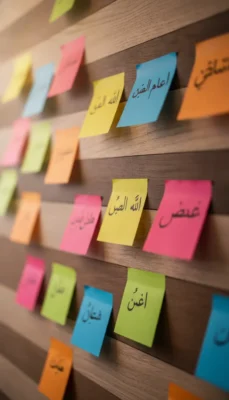
Most Arabic learners practice speaking. A lot of them practice reading. Almost nobody sits down and actually writes.
Here’s the thing — writing is where MSA grammar stops being theory and starts being a skill you actually own. You can nod along to a lesson on case endings and feel like you get it. Then you try to write three sentences about your day and realize you don’t, not really. Writing is the part that exposes the gaps. It’s also the part most learners skip, because it’s slower and it feels less “productive” than another vocabulary app streak.
I’ve taught MSA for years, and the students who write every week — even badly, even just a few lines — improve faster than students doing twice the passive study. Not a little faster. Noticeably faster. So this article is a real, usable weekly routine. Seven days, one focus each day, nothing fancy, nothing that needs a teacher standing over your shoulder (though a teacher helps — more on that later).
If you don’t have a consistent study habit at all yet, start with our 15-minute daily Arabic study routine first, then layer this writing plan on top of it. This routine assumes you’re already spending some time on MSA and want writing to stop being the thing you always skip.
Why writing deserves its own routine

Reading and writing use the same script, but they’re not the same skill. Reading, you recognize. Writing, you have to produce — from nothing, on your own, with no multiple-choice options to lean on. That’s a completely different muscle.
Honestly, this is why so many learners can read a news article reasonably well but freeze when asked to write a two-line email in Arabic. Reading lets you guess from context. Writing doesn’t let you hide. You have to decide the word order, pick the right verb form, get the agreement right, and commit to it on the page.
Writing also cements grammar in a way that flashcards never will. When you write “الطالبةُ تدرسُ” instead of just reading it, your brain has to actively retrieve the noun-verb agreement rule, not just recognize it. That retrieval is what makes it stick.
If you want the grammar-and-writing connection explained properly, our Arabic grammar and writing guide breaks down exactly why the two need to be trained together instead of separately.
Before you start: know your level
Don’t guess at what kind of writing practice you need. A total beginner writing free paragraphs is just guessing and reinforcing mistakes. An intermediate learner still copying single words is wasting time they don’t need to waste.
Take the free Arabic placement test before you build your routine. It takes about ten minutes and tells you honestly where you are — not where you hope you are. Everything below scales up or down depending on your level, and I’ll flag that as we go.
The weekly routine
Seven days, roughly 15–20 minutes a day. You can compress this into fewer, longer sessions if that fits your life better, but daily contact with the page — even short — beats one long Sunday cram session. Muscle memory for writing Arabic script and word order needs frequency, not duration.
Day 1 — Vocabulary in context
Don’t just write word lists. Take 8–10 words you’re currently learning and write one full sentence with each one. Beginners: keep it to simple nominal sentences (اسم + خبر). Intermediate learners: push yourself to use the word in a slightly different context than the one you first learned it in.
This day sets up material for the rest of the week — you’ll reuse these words later, so pick ones you actually want to remember, not random ones off a list.
Day 2 — Sentence structure drill
This is where you deliberately practice the two sentence types: nominal (جملة اسمية) and verbal (جملة فعلية). Write five of each. Not because it’s exciting — it isn’t — but because getting comfortable switching between “the book is beautiful” and “the student studies” builds the instinct for Arabic word order that most learners never fully develop.
If nominal versus verbal sentences still feels shaky, read our full breakdown of nominal vs. verbal sentences before this session. It’ll make the drill actually make sense instead of feeling like copying.
Day 3 — Dictation (سماعي)
Pick a short audio clip — a slow MSA news clip, a podcast segment, or even a recording your teacher gives you — and write down exactly what you hear. Pause and rewind as much as you need. This is uncomfortable at first. Do it anyway.
Dictation does something no other exercise does: it forces your ear and your hand to agree on what a word actually sounds like versus how it’s spelled, which in Arabic is a real gap for learners coming from Latin-script languages. Start with 2–3 sentences if you’re a beginner. Stretch to a full paragraph as you improve.
Day 4 — Free writing
No prompts, no correction, no perfectionism. Set a timer for 10 minutes and write about your day, your week, or literally anything. The rule is simple: don’t stop to look things up. If you don’t know a word, either skip it or write it in English and keep going.
This day is about fluency of production, not accuracy. You’re training yourself to think and write without freezing every time you’re unsure. Accuracy gets fixed on other days. Fluency only gets built by doing it under mild pressure, imperfectly, over and over.
Day 5 — Correction and review
Go back to what you wrote on Day 4 (and honestly, any other day too) and try to fix it yourself before anyone else touches it. Check verb agreement. Check whether your sentence needed to be nominal or verbal. Check your case endings if you’re at that stage.
This step matters more than people think. Correcting your own writing forces you to apply rules actively instead of passively recognizing a correction someone else made. If you have a teacher, this is the piece of writing you bring to your next class — it’s far more useful than asking them to correct a fresh, cold piece of writing you’ve never looked at again.
Day 6 — Copy and imitate
Find a short, simple MSA text — two or three sentences from a children’s book, a news headline, a line from your textbook — and copy it by hand. Then, right underneath, write your own sentence using the same structure but different content.
This sounds too basic to matter. It isn’t. Copying good Arabic sentence by sentence trains your hand and eye for correct structure in a way that reading alone doesn’t. Then imitating it with your own content bridges straight into producing it independently.
Day 7 — Reflect and plan
Light day. Read back over the week’s writing. Note three things: a grammar point that keeps tripping you up, a word you keep misspelling, and one sentence you’re actually proud of. Write those three things down somewhere permanent — not just in your head.
This is also the day to glance at next week and decide if you’re staying at this level of difficulty or pushing further. If broken plurals or agreement rules keep showing up as your weak spot, our guide to broken plurals in Arabic is worth a read before next week’s Day 2.
Where to actually write this
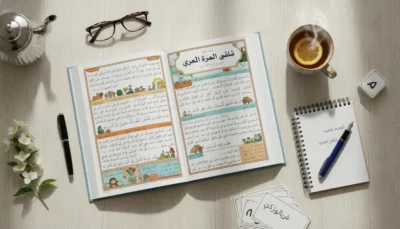
Don’t scatter your writing across random notes apps and loose paper. Keep one dedicated notebook for this routine — physical, if you can manage it. There’s real value in writing Arabic by hand, right to left, rather than typing it, especially early on when letter shapes and connections are still not automatic.
If you’re not sure how to structure a notebook for this kind of practice, we wrote a full guide on it: how to set up the perfect Arabic study notebook. It covers how to separate your mistakes log from your daily writing, which matters more than it sounds like it would.
Mistakes learners make with self-guided writing practice
Only ever writing what you already know. It feels safe. It also means you never grow. Push slightly past your comfort zone on Day 4 and Day 6.
Never going back to old writing. If you never review last month’s entries, you can’t see your own progress, and you’ll keep repeating the same three or four mistakes indefinitely.
Treating every day the same. If every session is “just write something,” you’ll default to whatever’s easiest — usually free writing — and skip the structured drills that actually build accuracy. The variety in this routine exists on purpose.
Skipping correction because it’s uncomfortable. I get it. Nobody loves looking at their own mistakes. But uncorrected mistakes don’t disappear on their own — they calcify. Left alone, a writing habit without correction just trains you to make the same errors more confidently.
The one thing self-study can’t do
I’ll be straight with you — a routine like this will genuinely improve your writing. But there’s a ceiling. You can correct your own obvious mistakes. You can’t always catch the subtle ones, the ones where your sentence is grammatically fine but not how a native speaker would actually phrase it. That distinction is exactly what a teacher is for.
Even one class a week focused on reviewing your Day 5 corrections turns this from a decent self-study habit into real, fast progress. You bring your written work, your teacher tells you what’s actually wrong versus what you think is wrong, and you walk away knowing precisely what to focus on next week instead of guessing.
If you want to add that layer, check the pricing page for a plan that fits, and take the placement test first so your teacher knows exactly where to start with you. Our MSA program is built around structured, level-appropriate writing feedback — not generic corrections copied from a textbook.
Commit to a plan
A routine you follow for three days and abandon does nothing. A routine you follow imperfectly for three months changes how you write Arabic. The seven days above aren’t a rigid law — swap days around, shorten sessions on busy weeks, skip a day here and there. What matters is that you come back to it.
Pick a start date. Get a notebook. Take the placement test if you haven’t already, so you know exactly where Day 1 should actually begin for you. Then commit to one full week before you judge whether it’s working. Most learners can’t yet — that’s exactly why it’s worth starting.