
Most people who start learning Arabic buy a notebook on day one. Good move. But then they open it and just… start writing stuff randomly. Vocabulary here. A grammar rule there. Some doodles in the margin. Two months later, it’s a mess they never look at again.
I’ve seen this happen with students over and over. And it’s not because they’re lazy. It’s because nobody told them how to actually set up the thing.
So let’s fix that.
Why a Physical Notebook Still Matters
I know. You’ve got Anki. You’ve got Notion. You’ve got six different Arabic apps on your phone.
But here’s the thing — writing Arabic by hand is different. Your brain processes it differently. When you write أ with your hand, you’re not just memorizing it. You’re building muscle memory. You’re slowing down enough to actually see the letter.
And for Arabic specifically, this matters more than it does for most languages. The letters connect. They change shape depending on where they sit in a word. The script goes right to left. These things don’t click until your hand has done them a few hundred times.
So yes. Get a notebook. Use it. Don’t let it become a pretty journal you’re afraid to write in.
The First Thing to Decide: Which Arabic Are You Studying?

This comes before anything else.
Are you learning Modern Standard Arabic (MSA) — the formal, written Arabic used in media, books, and official settings? Or Egyptian Arabic? Or Quranic Arabic?
Because your notebook setup changes depending on your answer.
If you’re studying Modern Standard Arabic, you’ll use your notebook for grammar patterns, formal vocabulary, and reading comprehension notes. MSA has case endings, verb conjugation tables, and root systems that benefit from structured sections.
If you’re not sure what level you’re at or which variety to focus on, take the free Arabic placement test first. Seriously. Ten minutes now saves weeks of going in the wrong direction.
What Kind of Notebook Should You Actually Use?
People ask this more than you’d think.
The short answer: A5 size, blank or grid pages, quality paper.
Here’s why:
Blank or grid — not lined. Arabic letters don’t sit on a baseline the way English letters do. Some letters hang below the line (like ي). Lined notebooks feel cramped. Grid paper gives you structure without restriction, and it helps you keep letters proportional when you’re still learning.
A5 size. Not too big, not too small. You can carry it. You can open it flat on a desk. B5 works too. Avoid tiny pocket notebooks — Arabic needs space.
Quality paper. If you’re using a fountain pen or even a thick marker (which many Arabic calligraphy-adjacent learners use), thin paper bleeds. Get something at least 80gsm.
Some students use two separate notebooks — one for vocabulary and one for grammar. That’s fine. But if you’re just starting, one well-organized notebook beats two messy ones.
How to Divide Your Notebook

This is where most people go wrong. They don’t divide it at all.
Here’s a simple system that works:
Section 1: The Alphabet + Pronunciation Reference (First 3–5 pages)
Keep this at the front. Write every letter in all four positions (isolated, initial, medial, final). Add the sound next to each one. Leave a column for your own “memory trick” — whatever helps you remember that letter.
You’ll refer to this constantly in your first month.
Section 2: Vocabulary Pages
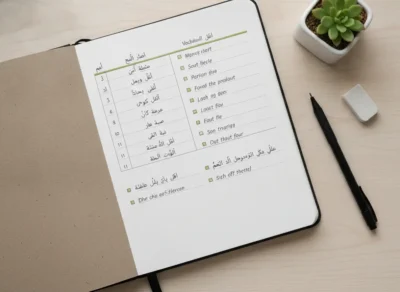
Dedicate the left side of the page to new words. Three columns:
- Arabic (with full vowels/harakat when you’re a beginner)
- Transliteration (only while you’re still learning the script — drop this as soon as possible)
- English meaning + example sentence
Don’t write random vocabulary. Organize it by theme. One page for greetings. One for numbers. One for family words. One for verbs you use all the time.
Honestly, this themed approach is what separates people who actually retain vocabulary from people who just copy words and forget them by Tuesday.
Section 3: Grammar Notes
Arabic grammar has patterns. And patterns are your best friend.
When your teacher explains something — or when you notice something yourself — write it here. Not as a copied rule. In your own words.
Then add 3 real examples underneath. Don’t write “verb + subject + object.” Write:
ذَهَبَ الوَلَدُ إلى المَدرسة (The boy went to school.)
And if you’re studying MSA, you’ll want subsections here for: verb conjugation tables, pronouns, sentence structure, and case endings. The grammar and writing guide on the site goes deep on the structure — worth reading alongside your notebook practice.
Section 4: Daily Writing / Journal Pages
This is the section most students skip. Don’t.
Even 2–3 sentences per day in Arabic. Just write what you did. What you ate. What the weather is like. Doesn’t have to be perfect. Just has to be Arabic.
This section is where your Arabic actually becomes yours. The vocabulary section is borrowed. This section is original.
If you’re following a daily Arabic study routine, block 10 minutes for this. Every day. Non-negotiable.
Section 5: Mistakes Log
At the back of your notebook — not the front — keep a running list of mistakes your teacher corrects.
Date it. Write the mistake. Write the correction. Write why it was wrong in one sentence.
This is one of the most underrated study tools there is. Most students hear a correction and nod and forget it. If you write it down, it sticks. And when you flip back through it before a class, you stop making the same errors again and again.
The Right-to-Left Problem (And How to Handle It)
This is a real thing. Reddit threads full of people asking: “Can I use a normal notebook for Arabic?”
Yes. But you have to be intentional about it.
Option 1: Flip the notebook and start from what feels like the back. Now your Arabic goes naturally right to left, page by page.
Option 2: Use the notebook normally, but on each page, start writing from the right margin. It feels weird for a week. Then it becomes automatic.
Option 3: Get a notebook designed for right-to-left writing. They exist. Some Arabic-specific planners and journals are made exactly for this.
I’d say Option 1 or 2 is fine for most learners. Don’t let the direction thing stop you from starting. Just pick one and be consistent.
What to Write on the First Page
Here’s something small but useful.
Write your goal on page one. In English first. Then in Arabic (even badly, even with help).
Something like: “I’m studying Arabic to read the Quran” or “I want to speak MSA at an intermediate level by December.”
Why? Because six weeks in, when you’re tired and you feel like you’ve forgotten everything — you flip to page one and you remember why you started.
It sounds cheesy. It works.
One Thing Most Guides Don’t Tell You
I’ll be straight with you: the notebook isn’t magic. Setting it up perfectly and then using it once a week won’t get you anywhere.
The system matters. But the habit matters more.
Ten minutes every day with this notebook — adding 3 vocabulary words, writing 2 sentences, noting one grammar thing you learned — beats a beautifully color-coded notebook that you open on Sundays.
And if you’re working with a teacher, use the notebook in class. Write things as they explain them. Don’t rely on lesson notes the academy sends you. Your own handwriting of Arabic is the whole point.
Ready to Structure Your Arabic Studies?
A good notebook is one piece. But it works best when it’s part of a real study plan — with a teacher who corrects your Arabic, pushes your grammar, and builds your speaking alongside your writing.
If you’re serious about Modern Standard Arabic, our MSA course is designed exactly for this: structured, practical, and taught by native Arabic teachers from Al-Azhar University.
Not sure where to start? Take the free placement test and we’ll tell you exactly which level fits you.
Arrange your study — starting with the notebook in your hand and a plan that actually goes somewhere.