

can i Learn Arabic Without Living in an Arab Country Short answer? Yes. Absolutely yes.
And honestly, I’m a little tired of the myth that says otherwise. You’ve probably seen it in forums — someone asks how to learn Arabic and immediately three people jump in saying “you have to move to Cairo” or “there’s no way unless you’re immersed.”
That’s not true. And I’ll show you exactly why.
The Immersion Myth (And Why It’s Partly Wrong)
Look, immersion helps. Nobody’s saying it doesn’t.
But here’s the thing — immersion isn’t magic. It’s just exposure. And exposure? You can create that anywhere. In your bedroom. In your lunch break. In the 20 minutes before you go to sleep.
People move to Arab countries and spend two years there and still can’t hold a basic conversation. Why? Because they hang out with other expats. They use English at work. They go to restaurants where the waiter speaks English to tourists. They weren’t really immersed. They were just physically present.
On the flip side, I’ve seen students who’ve never left their home country reach B2 level Arabic — reading newspapers, watching Egyptian drama without subtitles, having real conversations — all from their living room.
So the question isn’t where you are. The question is what you’re doing with your time.
What You Actually Need to Learn Arabic
Let me break this down simply.
1. Consistent input — in Arabic
Every day, your brain needs to hear Arabic and read Arabic. Not a textbook about Arabic. Actual Arabic. That could be a YouTube channel, a podcast, a TV show, or a teacher talking to you live.
Even 30–45 minutes a day is enough to make real progress. But it has to be consistent. Missing a week here and there kills momentum.
2. Speaking practice — with a real person
This is the one thing you can’t do alone. Apps won’t fix your pronunciation. Duolingo won’t tell you that the way you said a word sounds weird. You need a real Arabic speaker to give you feedback.
And guess what — you don’t need to fly to Egypt to find one. Online Arabic teachers exist. Native speakers are literally one Zoom call away. This is 2025. Distance is not a barrier anymore.
3. Structure — not chaos
A lot of self-learners spend months switching between resources. One week it’s an app. Next week it’s a YouTube channel. Then they buy a grammar book. Then they get confused and restart.
That’s not learning. That’s procrastinating in disguise.
What works is a structured path. A clear sequence that takes you from letters → words → sentences → real conversation. That’s what a proper course does. That’s what a good teacher does.
The Actual Benefits of Learning Arabic at Home

I’ll be straight with you — learning Arabic without living abroad actually has some advantages people don’t talk about.
You control the pace. When you’re abroad and confused, you have to keep up. Nobody waits for you. But at home, you can replay a lesson. Pause a video. Ask a teacher to explain something again without feeling embarrassed.
You pick your Arabic. This is big. Arabic isn’t one language — it’s a family of languages. There’s Modern Standard Arabic (MSA), which is used in news, literature, and formal settings. There’s Egyptian Arabic. Gulf Arabic. Levantine Arabic. If you move to one country, you absorb that country’s dialect. At home, you choose what you want to learn first. You can start with MSA if your goal is reading Quran, Arabic news, or working in a formal Arabic environment — and then add a dialect later.
You don’t burn money on flights and rent. Let’s be realistic. Moving abroad costs a fortune. Online Arabic classes? Fraction of the price.
What Does “Immersion at Home” Actually Look Like?
Great question. Here’s what a real Arabic study week looks like for a serious home learner:
Monday–Friday:
- 30 minutes of live online class with a native Arabic teacher
- 15 minutes listening to an Arabic podcast or watching a short YouTube video in Arabic
- 10 minutes reviewing vocabulary or grammar notes
Weekend:
- Watch one episode of an Arabic TV show or Egyptian series (with or without subtitles depending on your level)
- Review the week’s material
That’s less than an hour a day. And that schedule — if you actually stick to it — will get you conversational in 12–18 months. Not fluent. Conversational. Able to communicate, understand, read basic texts.
Fluency takes longer. But conversational is a real milestone. And it’s 100% achievable without ever leaving home.
The One Thing That Actually Slows People Down
It’s not lack of immersion. It’s not the wrong app.
It’s not knowing where they stand.
A lot of learners waste months studying the wrong things for their level. They’re intermediate but studying beginner material because it feels “safe.” Or they’re complete beginners trying to read Arabic news and getting destroyed.
Before you start any serious study plan, know your level. Take a proper placement test — it takes 10 minutes and saves you months of wasted effort.
👉 Take the free Arabic level test here
“But What About Speaking Practice? I Have No One to Talk To.”
This is the most common worry. And it’s valid.
But again — this is a solved problem.
Online Arabic teachers are available for one-on-one classes. You can book a session at a time that works for you, speak Arabic for 45 minutes with a native speaker, get corrected, ask questions, and build confidence. No travel required. No time zone problem. No awkward café conversations where you’re too nervous to speak.
Our teachers at Alphabet Arabic Academy are native Arabic speakers. Most of them are Egyptian, so you’ll get a mix of clear Modern Standard Arabic and real spoken exposure. That’s actually one of the best combinations you can get.
MSA vs. Dialect — Which Should You Learn First?
Honestly, this is one of the most asked questions and I want to give you a real answer, not a diplomat’s answer.
If your goal is:
- Reading Arabic books, newspapers, or religious texts → Start with MSA
- Understanding Al Jazeera, official Arabic content → Start with MSA
- Traveling and talking to people in daily life → Start with a dialect (Egyptian Arabic is the most widely understood)
- Both → Start with MSA, it gives you the foundation, then add Egyptian Arabic on top
Modern Standard Arabic is the backbone. It’s the written language. It’s what all Arabs understand even if they speak different dialects at home. Think of it like the foundation of a house. You can decorate differently later, but the foundation has to be solid.
Real Talk: How Long Does It Take?
People want a magic number. There isn’t one. But here’s a realistic timeline for someone studying seriously from home:
| Level | Time (Serious Study) |
|---|---|
| Read Arabic letters | 2–4 weeks |
| Basic words and phrases | 2–3 months |
| Hold a simple conversation | 6–9 months |
| Understand Arabic TV with some subtitles | 12–18 months |
| Read a simple Arabic book | 18–24 months |
These are for someone doing 45–60 minutes a day with a structured approach. If you’re studying casually, double the timeline.
And if you want to test where you fall right now — whether you’re a total beginner or have some foundation already — take the free Arabic placement test before you start.
The Tools That Actually Work (And the Ones That Don’t)
What works:
- Live online classes with a native teacher — Nothing beats real conversation practice with real feedback
- Arabic podcasts and YouTube channels — Slow Arabic, Arabic with Sam, Dreaming Spanish-style channels in Arabic
- Structured courses — A clear path from A1 to B2, not random YouTube rabbit holes
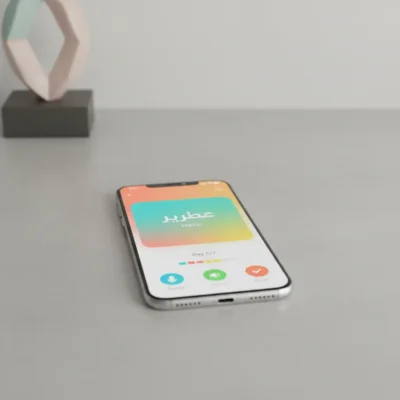
- Flashcard apps (Anki) — For vocabulary, not grammar
What doesn’t work as a main method:
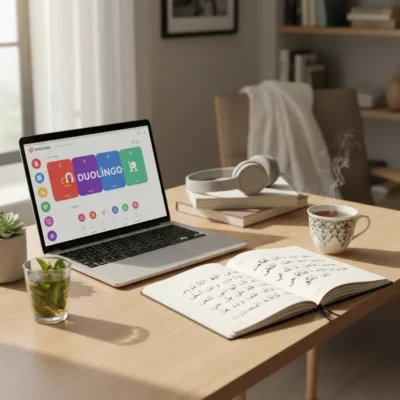
- Duolingo alone — It’s fine for building a habit. Terrible for real language skills
- Grammar books without speaking — You can memorize every rule and still not understand a word of spoken Arabic
- Random YouTube videos with no structure — Input is good, but unstructured input at the wrong level is just frustrating
Can You Really Become Fluent Without Living Abroad?
Here’s my honest take.
Fluency — like the kind where you dream in Arabic and switch effortlessly — that’s going to take longer without immersion. That’s just the reality.
But near-fluency? The ability to read, write, have conversations, understand Arabic media, work in Arabic environments? That’s completely achievable. From home. With a good teacher and a solid plan.
Plenty of linguists and Arabic speakers learned this way. Not because they had a secret trick. Because they were consistent and they found the right structure.
The people who fail at learning Arabic at home aren’t failing because they didn’t move abroad. They’re failing because they had no structure, no accountability, and no real speaking practice.
Fix those three things and location becomes irrelevant.
Ready to Start? Here’s What to Do Next
Step one — know your level. Don’t guess. Take the free Arabic placement test and get a clear starting point.
Step two — look at a structured Arabic course. If you’re a beginner and want real foundations, our Modern Standard Arabic course is built exactly for this. You get a structured curriculum, a native teacher, and actual speaking practice from session one.
Step three — book a free trial class. No commitment. Just come in, meet the teacher, see how an online Arabic class actually feels. You’ll know within 30 minutes if it’s right for you.
👉 Book your free trial class here
You don’t need to move to Cairo. You don’t need to spend thousands on a language immersion program abroad. You need structure, consistency, and someone real to practice with.
That’s it. That’s the whole formula.
And you can do all of it from exactly where you are right now.