
free vs paid arabic learning You’ve got Duolingo on your phone. You’ve got YouTube tabs open. You’ve got a PDF someone shared in a Facebook group. And you’re still not sure if you need to pay for Arabic classes.
Totally fair question. And I’m going to give you a real answer — not the “it depends!” answer that tells you nothing.
Here’s the short version: free resources are great for some things and completely useless for others. Paid learning is worth it at specific stages. Get the timing wrong and you waste either time or money.
Let me break it down.
What Free Arabic Resources Are Actually Good For
Let’s be fair here. Free resources aren’t bad. Some of them are genuinely excellent.
Here’s where free tools actually deliver:
Getting familiar with the alphabet. YouTube videos, free apps, even PDF worksheets — these work fine for learning the Arabic letters. It’s repetitive drilling. You don’t need a teacher watching you trace ب.
Vocabulary on the go. Apps like Anki (free) are great for vocabulary cards. You can memorize 10–20 new words a day with spaced repetition. No class needed for that.
Exposure to the language. Arabic podcasts, YouTube channels, TV shows — all free. Listening to Arabic every day trains your ear. You don’t pay for that.
Basic intro to grammar concepts. There are solid free blog posts and YouTube explanations of Arabic grammar fundamentals. Enough to understand what a root word is, or why verb conjugation works the way it does.
So free isn’t useless. It’s just… limited.
Where Free Resources Fall Apart

Here’s the thing — free resources have a ceiling. And most learners hit that ceiling without even realizing it.
Nobody corrects you. This is the big one. You could be mispronouncing ح and خ for six months straight and Duolingo will never tell you. A teacher knows in five seconds. Bad pronunciation habits are incredibly hard to undo later. I’ve seen students come to me after a year of “self-study” and spend three months just fixing things they got wrong early on.
No feedback on your speaking. You can’t actually practice speaking Arabic with an app. You can listen. You can read. But speaking? That requires another human being. There’s no way around this.
No structure. Free content is scattered all over the internet. A YouTube video here, a grammar post there, a vocab list from somewhere else. You end up hopping around and covering the same basics over and over instead of actually progressing.
You don’t know what you don’t know. This sounds obvious but it’s serious. Arabic has sounds, grammar rules, and script features that most beginners don’t even know they’re missing. A teacher spots the gap immediately. An app doesn’t.
Motivation collapses. When you’re learning alone with no accountability, most people quit within 2–3 months. Not because Arabic is impossible. Because nobody’s waiting for them.
If you’ve been “learning Arabic” with free tools for a while and feel like you’re not moving — that’s probably why.
What About Paid Apps? (Babbel, Pimsleur, Rosetta Stone…)
Before we talk about real courses, let’s address the paid app question. A lot of people think “paid = better.” Not always.
Paid apps like Babbel or Rosetta Stone are better than their free alternatives — better content, better structure, no ads. But they still have the same core problem: no one is correcting you. You’re still learning alone. You’re still not speaking with a real person.
Pimsleur is actually pretty good for pronunciation awareness and basic listening. Worth using as a supplement.
But here’s what I tell every student who asks: paid apps are a step up from free apps. They’re not a replacement for a teacher. Think of them as a gym membership versus a personal trainer. The gym is better than running in your backyard. But the trainer is what actually changes your form.
If you’re choosing between a paid app at $15/month and a live class — the live class wins. Every time.
The Quick Comparison: Free vs Paid Apps vs Live Classes
| Free Resources | Paid Apps | Live 1-on-1 Classes | |
|---|---|---|---|
| Cost | $0 | $10–$30/month | Varies (see pricing) |
| Speaking practice | ❌ None | ❌ None | ✅ Every session |
| Pronunciation correction | ❌ Never | ❌ Never | ✅ Real-time |
| Structured curriculum | ❌ Scattered | ✅ Yes | ✅ Yes + personalized |
| Accountability | ❌ None | ❌ None | ✅ Built in |
| Adapts to your level | ❌ No | ⚠️ Limited | ✅ Fully |
| Fixes bad habits | ❌ No | ❌ No | ✅ Yes |
| Best for | Alphabet, vocab, listening | Supplemental content | Actual progress |
Honestly, this table pretty much answers the question. The more serious your goal, the more you need the right column.
When You Should Stay With Free Resources

I’ll be straight with you: there are times when paying for classes is the wrong move.
If you’re just testing the waters. You’re curious about Arabic but not sure you’ll stick with it. Spend a month with free resources. Watch some videos. Try an app. See if it clicks. Don’t pay for a course until you know you actually want this.
If your goal is really passive. Some people just want to recognize a few Arabic words for travel or understand a few Quranic terms. That’s a legitimate goal — and it might not require structured classes.
If money is genuinely tight right now. Use free resources strategically. Follow a structured daily study routine and be intentional about it. It won’t get you to fluency fast, but it’ll get you somewhere.
But once you’re past the very beginning stage, free-only learning starts costing you something more valuable than money: time.
When It’s Time to Invest in Paid Learning
This is where most people get the timing wrong. They wait too long.
When you’re past the absolute basics. You know the alphabet. You can read simple words. Now what? This is exactly where self-study breaks down. The jump from “I know the letters” to “I can actually use this language” is enormous. And almost nobody makes that jump alone.
When you’re making the same mistakes repeatedly. If you’ve noticed you keep confusing the same sounds, or keep getting grammar wrong in the same ways — stop. You need someone to diagnose the problem. Reading more free content won’t fix it. I see this all the time. It’s also one of the most common beginner Arabic mistakes — assuming more input will fix what’s actually a correction problem.
When you want structured MSA from day one. If your goal is to read, write, or work in Arabic formally — you need a proper Modern Standard Arabic course, not a collection of YouTube videos. MSA is the foundation for everything: news, books, Quran, professional settings. Getting it right from the start matters.
When you have a real deadline. Job interview. Travel. A conversation you need to have. If Arabic matters to you in the next 6 months, free learning is too slow and too uncertain. Structured classes with a qualified teacher is the only reliable path to a specific goal by a specific time.
When you want to speak, not just understand. Speaking is a skill that only develops through speaking practice with real feedback. No free tool does this well. If conversational ability matters to you, you need a teacher.
When you’re learning Arabic for the Quran. This is a specific goal with specific requirements — Tajweed, Quranic vocabulary, proper recitation. You really can’t do this properly without a qualified instructor.
Real Student Example: What the Wrong Order Costs You
One of our students — let’s call her Sarah — spent about 14 months learning Arabic on her own before she found us. Apps, YouTube, free PDF workbooks. She was dedicated. She studied almost every day.
When she joined, her first session with her teacher revealed three things she’d been doing wrong the whole time: a consistent pronunciation error with ع, a grammar pattern she’d misunderstood from a YouTube video, and the habit of skipping diacritics (the small marks that tell you how to pronounce words correctly).
None of those things were her fault. She just didn’t have anyone watching.
It took her about 6 weeks in structured classes to fix all three. And then her progress jumped. Within 4 months she was having real conversations.
Her words: “I wish I’d started with a teacher. The free stuff gave me false confidence.”
That’s not a sales pitch. That’s just what happens when you don’t get feedback.
The Hidden Cost of Staying Free Too Long
People look at the price of a paid Arabic course and think “that’s expensive.” But here’s the math nobody does.
Let’s say you spend 18 months learning Arabic with free tools. You get to a beginner-intermediate level. You’ve got pronunciation problems you didn’t know about. Your grammar is inconsistent. And you’re honestly not confident speaking.
Then you join a structured course. Your teacher spends the first few sessions fixing things you got wrong over those 18 months.
That 18 months wasn’t free. It cost you 18 months.
A focused 6-month structured course with a qualified teacher would’ve gotten you further — and gotten you there correctly.
What “Paid” Actually Means
Not all paid options are the same. There’s a big difference between:
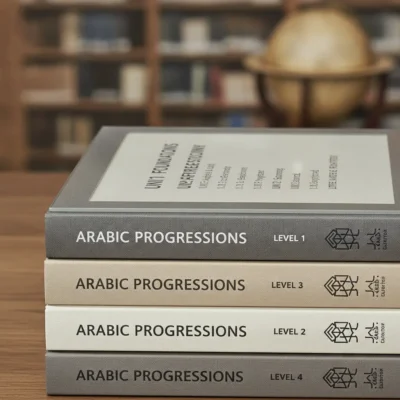
Paid apps or self-paced courses — You’re paying for better content structure than free, but there’s still no live feedback, no speaking practice, no real accountability. Better than random YouTube. Not as good as live instruction.
Pre-recorded courses — Similar issue. Great for grammar reference. Not great for actually developing skills you can use.
Live 1-on-1 classes with a qualified native teacher — This is where the real progress happens. Someone who can hear your pronunciation, correct your grammar in real time, adapt the lesson to what you specifically need, and hold you accountable.
At Alphabet Arabic Academy, we do live 1-on-1 classes with native Egyptian teachers. That’s it. No recordings you’ll never finish. No apps that can’t hear you. Real classes, real teachers, real progress. You can meet our teachers here and see who you’d be learning with.
So What Should a Beginner Do?
Here’s a realistic roadmap.
Month 1 — Free: Use free resources to learn the Arabic alphabet. Watch YouTube videos. Practice reading. Get comfortable with the script. Don’t pay for anything yet.
Month 2 — Assess: Not sure where you are? Take the free Arabic placement test to find out exactly what level you’re at and what you actually need to work on next.
Month 2 onward — Invest: If you’re serious about speaking, reading properly, or reaching any kind of functional level, start structured classes. The sooner the better. You’ll progress faster and you won’t build bad habits you have to fix later. Wondering how many hours a week you should be putting in? This guide breaks it down for you based on your actual life and schedule.
Ongoing — Mix: Keep using free resources for supplemental exposure. Listen to Arabic content. Use flashcard apps for vocabulary. But let your live classes be the core of your learning.
One More Thing

A lot of people ask: “Can I reach fluency with free resources?”
Technically? Maybe. With years of intensive self-study, immersion, and a lot of luck finding correction somewhere. But honestly — almost nobody does. Not with Arabic specifically.
Arabic is harder than most languages for English speakers. The script is right-to-left. The sounds don’t exist in English. The grammar is genuinely complex. The gap between written Arabic and spoken Arabic is real.
This isn’t to scare you. It’s to tell you: this is a language where guidance actually matters more than in most. A teacher isn’t a luxury. It’s just the efficient choice.
Ready to Stop Guessing?
If you’re at the point where free tools aren’t cutting it anymore — or you just want to start right from day one — take a look at our courses and pricing.
No long-term commitments. No massive upfront costs. Just live, structured classes with a real teacher who knows Arabic and knows how to teach it.