If you’ve ever written كتاب جميلة instead of كتاب جميل, don’t worry — almost every single Arabic student makes this exact mistake in their first few months. I’ve corrected it probably a thousand times. It’s not because you’re bad at Arabic. It’s because English adjectives never change, and your brain assumes Arabic works the same way. It doesn’t.
Here’s the thing — adjective agreement in Arabic isn’t actually complicated once you see the pattern. It just has more moving parts than English. English says “the beautiful books,” and “beautiful” stays exactly the same whether you’re talking about one book or a hundred, a man or a woman. Arabic adjectives shift shape to match the noun they’re describing. Once you learn the four things they have to match, the rest is just practice.
Let’s go through it properly, with real examples, not just grammar-textbook rules that make no sense until you see them in action.
The Basic Rule: Where Does the Adjective Go?
First thing to fix in your head: Arabic adjectives come after the noun, not before it like in English.
- English: the beautiful book
- Arabic: الكتاب الجميل (al-kitaab al-jameel) — literally “the book the beautiful”
That’s the opposite order from English, and it trips up beginners constantly. You’ll want to say جميل كتاب because your brain is still thinking in English word order. Fight that instinct. The noun always comes first, then the adjective right after it.
Once the word order is set, the adjective has to match the noun in four ways:
- Gender (masculine or feminine)
- Number (singular, dual, or plural)
- Definiteness (whether “the” is attached or not)
- Case (a more advanced topic — we’ll touch on it briefly, but it matters far less in everyday speech and writing than the first three)
Let’s break each one down.
Gender Agreement: Masculine and Feminine
Every noun in Arabic is either masculine or feminine. There’s no neutral option, unlike English “it.” And the adjective describing that noun has to match its gender.
Most feminine nouns end in ة (taa marbuta), and most feminine adjectives do too. So matching them up is often as simple as adding or removing that one letter.
- كتاب جميل (kitaabun jameel) — a beautiful book (masculine)
- سيارة جميلة (sayyaratun jameelah) — a beautiful car (feminine)
Notice the adjective جميل became جميلة just by adding ة, because سيارة (car) is feminine. That’s the whole trick for a huge chunk of adjectives — masculine form, then add ة for feminine.
A few more:
- ولد طويل (waladun taweel) — a tall boy
- بنت طويلة (bintun taweelah) — a tall girl
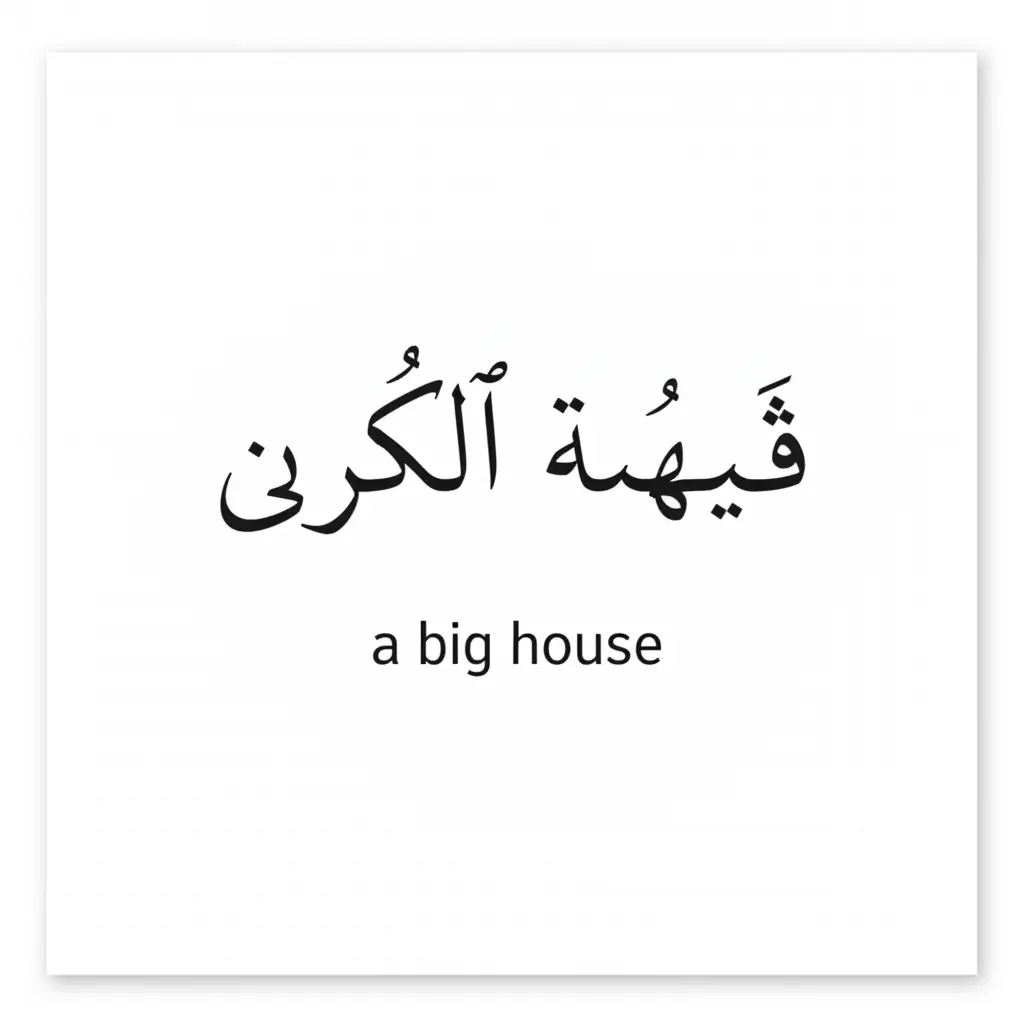
- بيت كبير (baytun kabeer) — a big house
- مدينة كبيرة (madeenatun kabeerah) — a big city
I’ll be straight with you — some adjectives don’t follow this neat “just add ة” pattern, especially color words and a handful of irregular ones. Those need to be memorized individually rather than derived from a rule. But for the vast majority of adjectives you’ll use as a beginner or intermediate learner, this pattern covers you.
Colors Are the Exception
Colors have their own separate masculine and feminine forms, and they don’t follow the simple “add ة” rule. This one catches a lot of students off guard.
- قلم أحمر (qalamun ahmar) — a red pen (masculine)
- سيارة حمراء (sayyaratun hamraa’) — a red car (feminine)
أحمر becomes حمراء, not أحمرة. Same pattern with other basic colors — أزرق (blue, masculine) becomes زرقاء (feminine), أصفر (yellow) becomes صفراء, and so on. There’s no shortcut here. You just learn each color pair as a set.
Definiteness Agreement: The Rule Nobody Warns You About
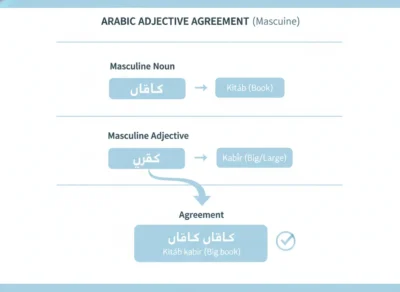
This is the one that genuinely surprises new students, and honestly, it’s the part most textbooks explain badly.
In English, “the” only attaches to the noun. “The beautiful book.” In Arabic, if the noun has ال (the definite article “the”) attached, the adjective needs ال too.
- الكتاب الجميل (al-kitaab al-jameel) — the beautiful book
Look closely — both الكتاب and الجميل have ال on them. If you only put ال on the noun and leave the adjective without it, you’ve actually changed the meaning of the sentence completely. كتاب جميل without any ال means “a beautiful book.” الكتاب جميل, with ال only on the noun, means “the book is beautiful” — that’s a full sentence, not just a described noun.
This is genuinely one of the most useful grammar facts in this whole article, because it explains something that confuses almost every beginner: why does the same phrase sometimes look like a sentence and sometimes look like just a noun phrase? The answer is entirely about where ال shows up.
- البيت الكبير — the big house (a noun phrase, describing “the house”)
- البيت كبير — the house is big (a full sentence)
Same words, same order, one tiny difference in ال placement, completely different grammatical function. If you want to go deeper into how Arabic builds sentences like this — the difference between phrases and full sentences and how word order signals meaning — our guide on nominal vs verbal sentences in Arabic walks through exactly this kind of pattern.
Number Agreement: Singular, Dual, and the Plural Trap
Singular is straightforward — you already saw it above. Match gender, match definiteness, done.
Dual (talking about exactly two of something) mostly just follows the noun’s dual ending, and the adjective takes the matching dual form too:
- كتابان جميلان (kitaabaani jameelaan) — two beautiful books
- سيارتان جميلتان (sayyarataani jameelataan) — two beautiful cars
Now here’s the part that actually breaks people’s brains the first time they hear it, so pay attention:
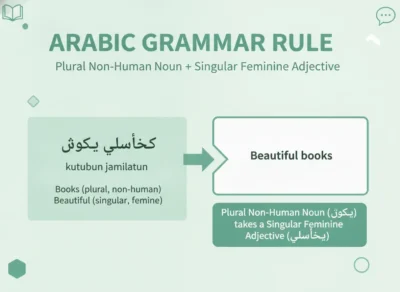
When you’re describing plural non-human nouns — objects, animals, places, things — the adjective doesn’t take a plural form. It takes the feminine singular form.
Read that again, because it goes against everything logic tells you.
- كتب جميلة (kutubun jameelah) — beautiful books
كتب (books) is plural. جميلة is feminine singular. Not a plural adjective. A feminine singular one. Even though we’re describing multiple books, and even though كتاب (a single book) is masculine.
Why? Classical Arabic grammar treats non-human plurals — anything that isn’t a group of people — as grammatically feminine singular, as a category. It’s an old rule that’s stuck around through every stage of the language, and it applies with total consistency to broken plurals (the irregular plurals where the whole word restructures, like كتاب becoming كتب) and most other non-human plurals.
More examples of this rule in action:
- بيوت جديدة (buyootun jadeedah) — new houses
- سيارات سريعة (sayyaaraatun saree’ah) — fast cars
- أقلام حمراء (aqlaamun hamraa’) — red pens
Compare that to a plural of people, where the adjective does become a proper plural:
- طلاب مجتهدون (tullaabun mujtahidoon) — hardworking students (male students, or a mixed group)
- طالبات مجتهدات (taalibaatun mujtahidaat) — hardworking students (female students)
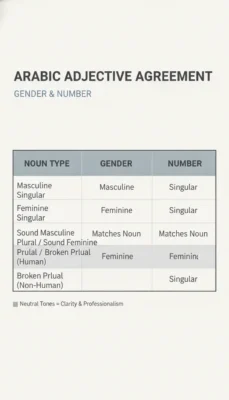
So the actual rule, stated plainly: plural humans get a real plural adjective, matching gender. Plural non-humans get a feminine singular adjective, no matter what gender the singular noun was. This is one of those quirks that feels arbitrary until you’ve used it a few dozen times, and then it becomes automatic. Our full guide to Arabic grammar and writing covers how rules like this one connect to the bigger picture of sentence building, if you want the wider context.
A Quick Word on Case
You’ll see case endings — the little vowel marks (ـُ ـَ ـِ) at the end of words — mentioned in more advanced grammar material, and technically adjectives agree with their nouns in case too. In practice, unless you’re reading fully vowelized text (Quran, poetry, some textbooks), you won’t encounter this much day to day, and spoken Arabic drops most of it anyway. I wouldn’t stress over case as a beginner or even intermediate learner. Get gender, number, and definiteness solid first. Case comes later, almost as a formality once the rest is automatic.
The Mistakes I See Most Often
After years of correcting the same handful of errors, here’s what actually trips people up:
Forgetting ال on the adjective. Students remember to put ال on the noun but forget the adjective needs it too when the noun is definite. البيت الجميل, not البيت جميل (unless you specifically mean “the house is beautiful” as a sentence).
Pluralizing the adjective for non-human plurals. This is the single most common mistake at the intermediate level. Writing كتب جميلات instead of كتب جميلة. The instinct to “match plural with plural” is strong, but for non-human plurals, feminine singular is correct.
Skipping gender agreement entirely. Especially early on, students default to the masculine form of every adjective because it’s usually the form they learned first in vocabulary lists. سيارة جميل instead of سيارة جميلة. This one just takes repetition to fix.
Mixing up color adjectives. Treating أحمر like a regular adjective and trying to add ة to make it feminine, landing on أحمرة instead of the correct حمراء.
If any of these feel familiar, that’s completely normal — they’re the exact patterns nearly every learner works through. The fix isn’t more theory, it’s exposure. Reading real sentences, writing your own, and getting corrected enough times that the right form starts to feel natural instead of memorized.
Practice Examples
Try covering the English and testing yourself on these before you check the translation:
- طالب ذكي (taalibun dhakiy) — a smart student (male)
- طالبة ذكية (taalibatun dhakiyyah) — a smart student (female)
- الطالب الذكي (al-taalib al-dhakiy) — the smart student
- طلاب أذكياء (tullaabun adhkiyaa’) — smart students (people, plural adjective)
- أفكار ذكية (afkaarun dhakiyyah) — smart ideas (non-human plural, feminine singular adjective)
If those five made sense without you needing to reread the explanation above, you’ve genuinely got the core pattern down. That’s most of what adjective agreement in Arabic actually is.
Questions People Actually Ask About This
Does the adjective always come right after the noun, with nothing in between? Yes, in a standard descriptive phrase. If there’s more than one adjective, they stack in order after the noun, each one agreeing separately: البيت الكبير الجميل — the big beautiful house.
Why do some sentences look identical to noun phrases? Because the only difference between “the big house” and “the house is big” is whether ال is on the adjective. It’s a small detail with a big effect on meaning, and it’s exactly the kind of pattern covered in our piece on nominal vs verbal sentences in Arabic.
Is the feminine-singular-for-plural-things rule really universal? For non-human plurals, yes, it’s extremely consistent — one of the more reliable rules in Arabic grammar, honestly. Human plurals are the exception, and they get proper plural adjectives.
Do I need to memorize case endings to speak correctly? No. Focus on gender, number, and definiteness first. Those three carry almost all the communicative weight in everyday MSA.
Building This Into How You Actually Study
Grammar rules like this one don’t stick from reading them once. They stick from seeing them over and over, in real sentences, until your brain stops translating and starts just knowing. If you’re looking for a simple way to fold grammar practice like this into a daily habit that actually fits your schedule, our 15-minute daily Arabic study routine is built around exactly that kind of short, consistent repetition. And if you’re newer to Arabic overall and want to see how agreement fits into the bigger beginner picture — including the other common mistakes people make early on — our guide to learning Arabic for beginners is a solid next stop.
Not sure exactly where your grammar stands right now? Take the free Arabic placement test — it takes a few minutes and tells you exactly what to focus on instead of guessing.
Learn the Practical Rules, Not Just the Theory
Reading about adjective agreement gets you halfway there. The other half comes from using it — writing real sentences, getting corrected by someone who catches the mistakes you can’t see yourself, and repeating it until it’s automatic instead of a mental checklist.
That’s what our Modern Standard Arabic courses are built for. Live, one-on-one classes with native teachers who catch exactly this kind of error in real time, at whatever level you’re starting from. Check out our pricing to find a plan that fits, or start with the placement test to see where you land first.