You said the shahada. Maybe last month, maybe last year. Now you’re in Egypt, or about to be, and everyone around you speaks a language you can’t follow. Not even a little.
I’ll be straight with you: that’s a strange feeling. You made the biggest decision of your life. And now you can’t even ask where the wudu area is.
Here’s the good news. You don’t need “all of Arabic.” Not this month. Not this year. You need one small, specific slice of it. This guide gives you that slice: the Egyptian Arabic that gets you through the street, the mosque, the family dinner, and your first Ramadan.
Quick note before we start. I teach Arabic. I’m not a scholar. For anything about religious rulings, ask a knowledgeable imam you trust. For the language side, that’s my job, so let’s get into it.
First, Take a Breath: You’re Not Behind
Most Egyptians around you have been hearing the adhan since before they could walk. You’ve had a few months. Of course it feels like a gap.
But a gap isn’t a failure. It’s just a starting line.
Your Arabic level doesn’t measure your faith. Read that again if you need to. People will sometimes be surprised that you don’t know a phrase everyone else uses, and nearly all of them will be kind about it. Egyptians are famously warm, and a new Muslim trying to speak Arabic gets even more of that warmth. That’s what I see again and again.
Which Arabic Do You Actually Need?
This is where most new Muslims get stuck. They Google “learn Arabic,” and suddenly there’s Modern Standard Arabic, Quranic Arabic, Egyptian Arabic, Gulf, Levantine. It’s overwhelming.
For life in Egypt, you really need three layers. Different amounts of each.
| Layer | Where you’ll use it | How much, and when |
| Street Arabic (Egyptian / Masri) | Shops, taxis, neighbors, coworkers, family, small talk at the mosque | Big dose, right now. This is what people actually speak to you. |
| Prayer and Quran Arabic | Salah, du’a, Quran reading, Friday khutbah | Steady, slow, with a teacher. Start with reading and pronunciation. |
| Shared Islamic words | Salah, sabr, du’a, halal, haram, and hundreds more | Comes free. These words mean the same in every dialect. |
Here’s the thing most courses get wrong. They sell you one Arabic and pretend the others don’t exist. But if you’re a new Muslim living in Egypt, you need Egyptian Arabic for the street and a separate, slower track for Quran and prayer.
The good news? Both use the same alphabet. Learn it once and it serves both tracks. If you want the full breakdown, we explain it in MSA vs Egyptian vs Quranic Arabic.
Real Questions New Muslims Keep Asking Online
Spend ten minutes on Reddit’s r/learn_arabic or Quora and you’ll see the same worries on repeat. Here are the ones that matter most for you, answered short.
“Do I have to learn MSA before Egyptian Arabic if I live in Egypt?”
No. Forums are full of people arguing about this, and honestly, both sides have a point. Some teachers swear by formal Arabic first because it helps with reading and the Quran. Others say dialect first, because that’s what you’ll hear all day.
For you, in Egypt, the answer is simple. Speak Egyptian for daily life. Learn the alphabet and Quran reading on a parallel track. You don’t need to finish one before starting the other.
“Will Egyptian Arabic help me understand the Quran or the Friday khutbah?”
Only partly. The Quran is in classical Arabic, and the khutbah is usually delivered in a more formal Arabic than the one people use on the street. Some vocabulary overlaps, and Egyptian grammar is a bit simpler, so it gives you a friendly entry point. But it won’t turn the khutbah into plain conversation.
Treat the khutbah as listening practice. Follow along with a translation, catch the repeated phrases, and let your ear get used to the rhythm.
“Do I need Arabic to pray?”
The words of the prayer are recited in Arabic, so most new Muslims start learning al-Fatiha and a few short surahs early on, step by step. How you handle the early weeks is a question for your imam, not for me. What I can tell you as a teacher: it’s far easier with a person correcting your pronunciation than with an app alone.
“How long until I can actually talk to people?”
A few weeks for greetings and mosque phrases. A few months of steady practice for basic conversations. In our survival guide for expats in Cairo I put “survival comfortable” at about two to three months, and the same applies here. Not fluency. Comfortable.
“Is Egyptian Arabic useful outside Egypt?”
Yes. Egyptian Arabic is understood across most Arabic-speaking countries, largely because of Egyptian cinema and music. So the time you spend on it isn’t wasted if you travel for Umrah, Hajj, or work later.
Phrase Set 1: Saying Who You Are
Start here. These sentences do a lot of work in your first week.
| English | Egyptian Arabic | Sounds like |
| I’m a new Muslim | أنا مسلم جديد / أنا مسلمة جديدة | ana muslim gedeed / ana muslima gedeeda |
| I became Muslim two months ago | أنا أسلمت من شهرين | ana aslamt min shahrein |
| I’m still learning Arabic | أنا لسه باتعلم عربي | ana lissa batʿallim ʿarabi |
| Please speak slowly | اتكلم براحة لو سمحت | ettakallem biraaha law samaht |
| Can you repeat that? | ممكن تعيد؟ | mumken te’eed? |
| I don’t understand | مش فاهم / مش فاهمة | mesh fahem / mesh fahma |
| What does this mean? | يعني إيه ده؟ | ya’ni eih da? |
| How do I say … in Arabic? | إزاي أقول … بالعربي؟ | izzay a’ool … bil-ʿarabi? |
If you’re speaking to a woman, say “اتكلمي” (ettakalemi) instead of “اتكلم.” Small detail, big difference in how natural you sound.
Phrase Set 2: At the Mosque
The mosque is where many new Muslims feel the language gap most. Everyone knows the routine, and you’re quietly guessing. These phrases fix that.
| English | Egyptian Arabic | Sounds like |
| Where’s the qibla? | فين القبلة؟ | fein el-‘ebla? |
| Where’s the wudu area? | فين الميضة؟ | fein el-mayda? |
| Has the prayer started? | الصلاة ابتدت؟ | is-salah ebtadet? |
| Can I pray here? | ممكن أصلي هنا؟ | mumken aSalli hena? |
| Can you teach me to pray? | ممكن تعلمني أصلي؟ | mumken te’allemni aSalli? |
| Can you correct my reading? | ممكن تصحح لي القراءة؟ | mumken teSaHHeHli el-‘eraa’a? |
| What time is Friday prayer? | الجمعة الساعة كام؟ | el-gom’a es-sa’a kam? |
Notice “الميضة” (mayda). That’s the everyday Egyptian word for the ablution area. You’ll hear it far more than “wudu” in casual speech. And notice how “قبلة” is pronounced “‘ebla” on the street. We’ll come back to that.
Honestly, the single most useful sentence on this list is “ممكن تعلمني أصلي؟” Egyptians love to help. Ask someone at the mosque to teach you, and you’ll often find yourself with three volunteers.
Phrase Set 3: What People Will Say (and What to Say Back)
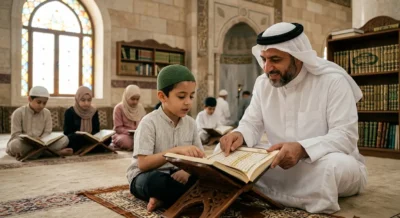
Here’s something nobody warns you about. When people find out you’re a new Muslim, they react. Loudly. Warmly. Sometimes with a lot of questions. It’s lovely, and it’s also a listening test.
| What they say | Egyptian Arabic | Your reply |
| Congratulations! | ألف مبروك! (alf mabrook) | الله يبارك فيك (Allah yebarek feek) |
| May God keep you firm | ربنا يثبتك (rabbena yesabbetak) | آمين (ameen) |
| Since when are you Muslim? | إنت مسلم من إمتى؟ (enta muslim min emta?) | أنا أسلمت من … (ana aslamt min …) |
| Why did you become Muslim? | ليه أسلمت؟ (leih aslamt?) | Prepare one short line (see below) |
| Do you pray? Do you fast? | بتصلي؟ بتصوم؟ (bet-Salli? bet-soom?) | آه / لسه باتعلم (aah / lissa batʿallim) |
That “why” question is the big one. You’ll get it from taxi drivers, shopkeepers, and relatives of relatives. So prepare one honest sentence in Arabic. Something simple like “الإسلام عجبني” (el-islam ʿagabni, “Islam spoke to me”). Practice it until it’s automatic. You don’t have to tell your whole story to every stranger, but a ready line saves you from freezing.
Phrase Set 4: Ramadan, Eid, and Eating at Someone’s House
Your first Ramadan in Egypt is something else. The lanterns, the late nights, the invitations. You’ll be invited to eat. A lot.
| English | Egyptian Arabic | Sounds like |
| Ramadan Kareem (reply: Allah is more generous) | رمضان كريم / الله أكرم | ramadan kareem / Allah akram |
| Happy holiday (Eid, Ramadan) | كل سنة وإنت طيب | kol sana w-enta tayyeb |
| May Allah accept (reply: from us and you) | تقبل الله / منا ومنكم | ta’abbal Allah / minna wa minkum |
| Come break fast with us | تعالى افطر معانا | ta’ala eftar ma’ana |
| Thank you for the invitation | شكراً على العزومة | shukran ‘ala el-‘azooma |
| Enjoy your meal (reply: God keep you) | بالهنا والشفا / الله يسلمك | bil-hana wish-shifa / Allah yesallemak |
One more tiny cultural gem. After someone gets a haircut or a shower, Egyptians say “نعيماً” (na’eeman), and the reply is “الله ينعم عليك.” It’s the kind of thing a textbook never teaches and everybody notices when you use it.
And a word on “إن شاء الله” (inshallah). Egyptians use it for sincere hope, and also as a polite “maybe.” Read the tone. If someone says it about dinner on Friday, it may or may not happen. If you want to see how Egyptians handle yes, no, please, and sorry, we cover it in Politeness in Egyptian Arabic.
The Pronunciation Trap Every New Muslim in Egypt Falls Into
I need you to read this one carefully, because it catches almost everyone.
On the street in Egypt, a few Arabic letters are pronounced differently from how you’ll pronounce them in the Quran. If you copy the street sound while reciting, you’ll learn the wrong habit. And fixing a habit is harder than building one.
| Letter | Street Egyptian | Quran recitation | Example |
| ج | “g” as in go | “j” as in jam | جميل: gameel on the street, jameel in recitation |
| ق | a glottal stop (like the break in “uh-oh”) | a deep “q” from the back of the throat | قلب: ‘alb on the street, qalb in recitation |
| ث | “t” or “s” | “th” as in think | ثلاثة: talata on the street, thalatha in recitation |
| ذ | “d” or “z” | “th” as in this | هذا: da on the street, hadha in recitation |
This is why I tell new Muslims to keep two mental boxes. One for how Egyptians talk. One for how the Quran is recited. Same letters, different rules.
A teacher makes this far easier, because they hear the mix-up before you do. There’s more on this in our guide to Egyptian pronunciation differences that surprise MSA learners.
Your First 4 Weeks: A Simple Starter Plan
Ten to fifteen minutes a day is plenty. The structure matters more than the time. (Our daily Arabic study routine shows the exact 15-minute format, and you can use it with these phrases.)
| Week | Focus | Goal |
| Week 1 | The alphabet and sounds, plus the greetings and Phrase Set 1 | Say who you are and ask someone to slow down |
| Week 2 | Phrase Set 2, the mosque phrases | Ask where things are and ask someone to teach you |
| Week 3 | Phrase Set 3 and your one-line “why” | Handle the congratulations and the questions without freezing |
| Week 4 | Phrase Set 4, plus taxis and shops from the expat survival guide | Accept an invitation and order food confidently |
Don’t try to learn 40 phrases at once. Five a day, said out loud, beats a long list you stare at on Sunday.
Mistakes That Slow New Muslims Down
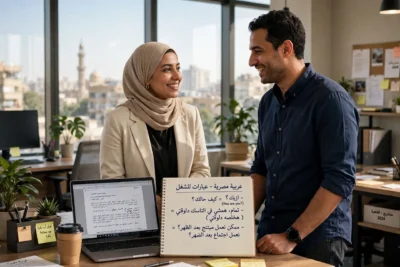
I see these patterns constantly.
Relying on transliteration only. Latin letters feel safe. But you can’t read a menu, a street sign, or a mushaf with them. Learn the alphabet in the first two weeks. It’s easier than you think.
Speaking formal Arabic in the street. Egyptians will understand you. You’ll also sound like a news anchor ordering falafel. It’s charming, honestly. It’s also confusing. Use Egyptian for daily life.
Hiding. You stay quiet at the mosque because your Arabic is “not good enough.” But the mosque is exactly where people want to help you. Speak badly. Speak anyway.
Trying to master everything in your first Ramadan. One month, a few new phrases. That’s a win.
Comparing yourself to people born Muslim. They had a lifetime of exposure. You’re building from scratch, and that takes real effort. Be patient with yourself.
Do You Need a Teacher?
Self-study works for phrases. It hits a ceiling with pronunciation, with Quran reading, and with the “why did I get a strange look when I said that?” moments. No app can answer that.
A teacher spots the mistakes you can’t hear yet. They also keep you focused on what you’ll use this week instead of an abstract syllabus.
At Alphabet Arabic Academy, our one-on-one live lessons are taught by native Egyptian teachers. Our Colloquial Egyptian Arabic course covers the street, the family, and the daily life side. For Quran reading and recitation, our Quran online classes and Islamic Arabic studies work well as a parallel track.
Not sure where to start? Take the free Arabic placement test first. It shows your level, so you don’t waste weeks on the wrong material. You can meet the people behind the lessons on our teachers page and check the options on the pricing page. If you married into an Egyptian family, our guide to talking to in-laws in Egyptian Arabic is a good next read.
One Last Thing
You made a huge decision, and you did it without a language head start. That takes guts.
Arabic won’t happen overnight. But the street Arabic that makes Egypt feel like home? That arrives faster than you think. A month from now, you could be answering “why did you become Muslim?” in Arabic. Without freezing.
Ready to stop feeling like a guest and start feeling at home? Start your path with the Colloquial Egyptian Arabic course.