
Spend ten minutes on r/Muslim or r/MuslimLounge and you’ll spot the same question. Different usernames. Same worry. “What’s the easiest surah to memorize?”
The replies are usually good. Start from the back of the Quran. Learn Al-Ikhlas, Al-Falaq and An-Nas first. Listen on repeat. Work backwards.
I agree with most of it. But I’ll be straight with you: it answers the wrong question.
Memorizing a surah and understanding a surah are two different jobs. And if you only do the first one, you’ll hit a wall. Usually around week three.
This guide is about the second job. How a complete beginner can start understanding short surahs, step by step, without a degree in Arabic and without feeling lost.
Why “Easiest to Memorize” Isn’t the Real Question
I’ve taught Quran and Arabic for years. Here’s a pattern I see all the time.
A student learns Al-Asr in two days. Three short verses. They’re proud, and they should be. Then I ask, “What does it say?”
Silence.
That’s not a failure. Nobody told them there was a next step. But here’s the thing: words you understand stick. Words you don’t understand slip away. Memory without meaning is fragile. A busy week, a missed day, and the surah starts to blur.
So the goal isn’t either memorize or understand. It’s to do them together, from day one. And short surahs are the perfect place to do that.
Why Short Surahs Are the Right Starting Point
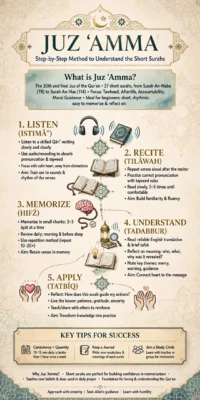
Most of the shortest chapters sit in the last part of the Quran, called Juz’ Amma. According to Wikipedia’s entry on the Juz’, it’s the 30th part, it covers chapters 78 through 114, and it’s the most commonly memorized part of the Quran.
Why does it work so well for beginners?
- The verses are short. You can hold a whole verse in your head at once.
- They rhyme and flow. The rhythm helps you remember.
- The vocabulary repeats. Learn a word in one surah and you’ll spot it in the next.
- You already hear them. Many of these surahs are recited in prayer, so your ear is half-trained.
That last point matters more than people think. Understanding is easier when the sound is already familiar.
Step 0: Can You Read the Arabic Script?
Quick honesty check before anything else.
If you can’t yet read Arabic letters, start there. Not with meanings. With the alphabet. Letters, short vowels, connecting letters into words. Teachers usually do this with the Noorani or Noor Al-Bayan method.
I know. You wanted to jump straight to the good stuff. But you can’t understand a word you can’t see. And sounding out a surah from transliteration builds habits you’ll have to undo later.
Not sure where you stand? Take the free Arabic level test. It takes a few minutes and tells you whether to start with letters or move on to meanings.
If you’re a complete beginner, our Quran online classes begin exactly here, with the alphabet and short surahs read independently.
Step 1: Pick One Surah. Just One.
This is where beginners go wrong first. They pick five surahs, feel overwhelmed, and quit by Friday.
Pick one. Here are the good starting options:
| Surah | Verses | The big idea |
|---|---|---|
| Al-Fatihah | 7 | Praise, and asking for guidance |
| Al-Ikhlas | 4 | Who Allah is: One, and self-sufficient |
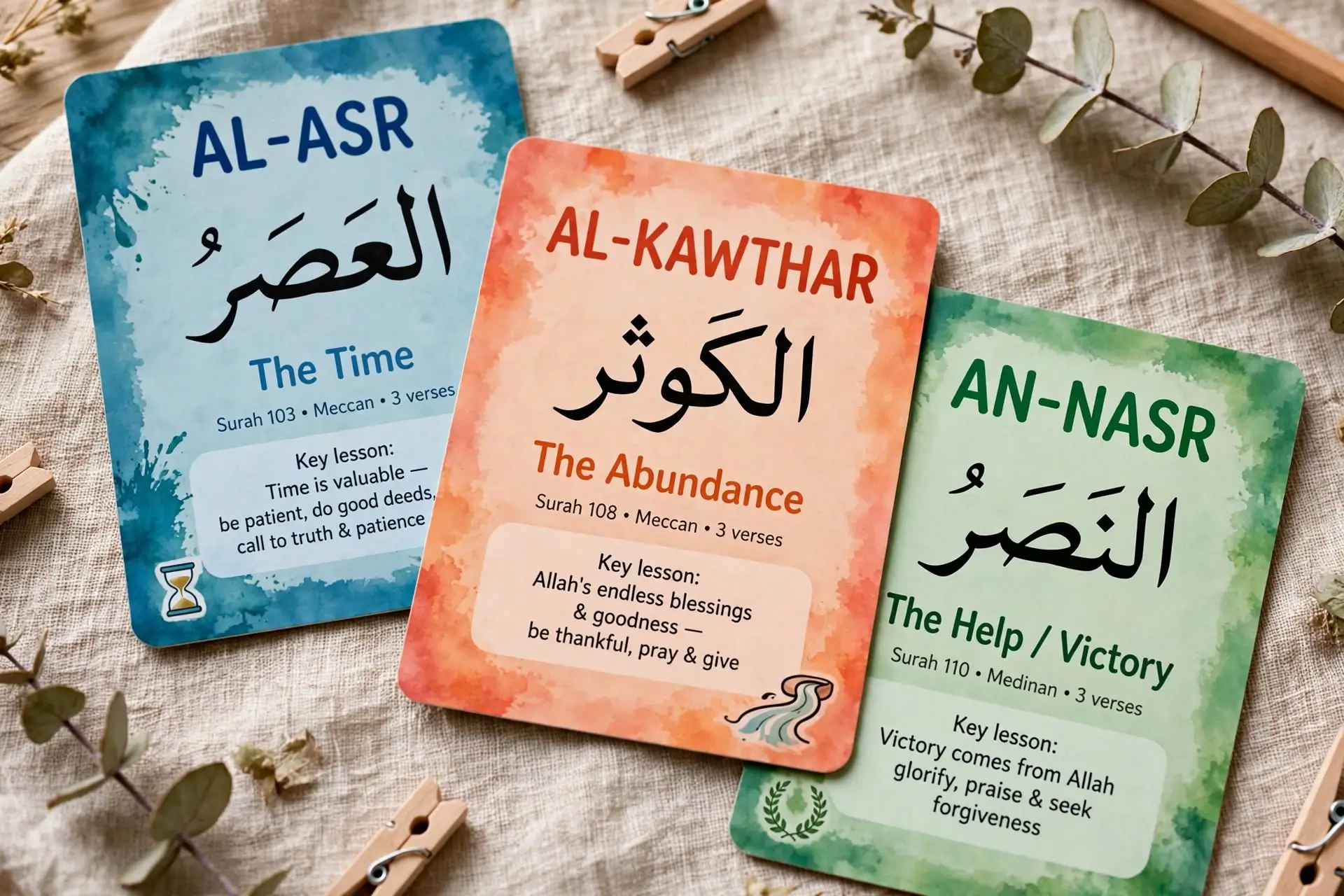
| Al-Asr | 3 | Time, loss, and the way out of it |
| Al-Kawthar | 3 | A gift, and the response: pray and give thanks |
| An-Nas | 6 | Seeking refuge in Allah |
| Quraysh | 4 | Gratitude for safety and provision |
| Al-Fil | 5 | A historical event told in a few lines |
My advice? Start with Al-Ikhlas. It’s four verses, the vocabulary is simple, and the idea is clear. Then move to Al-Asr. Don’t add a third until the first two feel solid.
Step 2: Read the Meaning First. All of It. Once.
Before you touch a single Arabic word, read the whole surah in a translation you can understand.
Read it twice if you like. Don’t take notes yet. You just want the overall picture, the way you’d read the back of a book before you start chapter one.
One small rule: pick one translation and stay with it for the whole surah. Hopping between five translations makes everything feel more confusing, not less.
Step 3: Go Word by Word
This is the step that changes everything. And honestly, it’s the step almost nobody tells beginners to do.
Take the first verse of Al-Ikhlas:
قُلْ هُوَ اللَّهُ أَحَدٌ
Break it up:
- قُلْ (qul): say
- هُوَ (huwa): He
- اللَّهُ (Allah): Allah
- أَحَدٌ (ahad): One
Four words. You now understand a full verse: “Say: He is Allah, One.”
Try the second verse of Al-Asr:
إِنَّ الْإِنسَانَ لَفِي خُسْرٍ
- إِنَّ (inna): indeed
- الْإِنسَانَ (al-insaan): mankind
- فِي (fi): in
- خُسْرٍ (khusr): loss
“Indeed, mankind is in loss.” And now you know the word khusr, which you’ll spot again outside this surah.
Do two or three verses a day. No more. A word-by-word translation app or a printed word-by-word Quran helps a lot here. And a teacher helps even more, which I’ll get to.
Step 4: Hunt for Repeated Words
Here’s a trick that feels like cheating.
Look at how four short surahs begin: Al-Kafirun, Al-Ikhlas, Al-Falaq and An-Nas. Every one of them opens with the same word, قُلْ (qul), meaning “say.”
Now look at قُلْ أَعُوذُ بِرَبِّ النَّاسِ from An-Nas:
- قُلْ: say
- أَعُوذُ (a’udhu): I seek refuge
- بِرَبِّ (bi-rabbi): in the Lord of
- النَّاسِ (an-naas): mankind
Al-Falaq has almost the same shape: I seek refuge in the Lord of the daybreak. Same opening. Same structure. Different ending.
Once you notice patterns like this, short surahs stop feeling like separate puzzles. They start feeling like one connected language. That’s how beginners go from “I know three surahs” to “I can read the next one without help.”
Step 5: Add Context, but Keep It Light

Why was this surah revealed? What’s the story behind it? Context makes meaning stick.
But keep this part simple at the start. Use one reliable source, ideally a trusted tafsir recommended by a teacher. Don’t fall down the rabbit hole of random videos with ten different opinions.
Tafsir is a real field of study. As a beginner, you don’t need all of it. You need enough to feel the surah, not enough to write a thesis on it.
Step 6: Listen, Recite, Then Use It in Prayer
Now bring the sound in.
- Listen to a reciter you like, with the text in front of you.
- Recite along, slowly.
- Recite alone, with the meaning in your head.
- Use it in salah. This is the big one.
On one Reddit thread, a commenter said they listen to a surah dozens of times before it sticks. That matches what I see. Repetition works. But repetition with meaning works better. When you’re reciting Al-Asr in prayer and you actually think “mankind is in loss, except…” that’s a different experience altogether.
And a reminder from the Quran itself: “We have made the Quran easy for remembrance” (54:17). Easy doesn’t mean effortless. It means doable.
A Simple 14-Day Plan
Fifteen minutes a day is enough. If you want help building that habit, read our 15-minute daily study routine. The same logic applies here.
| Days | What you do |
|---|---|
| 1–2 | Read the translation. Listen to the surah five or six times. |
| 3–4 | Read the Arabic slowly. Check the meaning of each verse. |
| 5–7 | Go word by word. Write the new words in a small notebook. |
| 8–10 | Memorize one verse at a time while holding the meaning in mind. |
| 11–12 | Recite in your prayers. Review without looking. |
| 13–14 | Review everything. Choose your second surah. |
Two weeks. One surah. And this time, you’ll know what it says.
Common Mistakes (I’ve Seen Every One)
Learning five surahs at once. One surah, done properly, beats five half-learned ones.
Reading only the translation. The translation tells you the idea. The Arabic gives you the words. You need both.
Ignoring pronunciation. Arabic has sounds that don’t exist in English. And one wrong letter can change a word completely. For example, قَلْب (qalb) means “heart,” but كَلْب (kalb) means “dog.” Same shape, different letter, different meaning.
Jumping between tafsir sources. Pick one. Stay with it.
Comparing yourself to someone else. Your friend learned a surah in three days. Good for them. Your pace is your pace.
And if you find it hard, hang in there. There’s a well-known hadith that the person who recites the Quran and struggles with it earns a double reward. Struggle isn’t a sign you’re failing. It’s part of the reward.
Real Questions Beginners Keep Asking
These come up again and again on Reddit and in my own classes.
What are some easy surahs to learn first?
Start with Al-Fatihah, then Al-Ikhlas, Al-Falaq and An-Nas. After that, Al-Asr, Al-Kawthar and Al-Kafirun. They’re short, rhythmic and heavily used in prayer.
What’s an easy surah to memorize that’s not in Juz’ Amma?
Al-Fatihah is in the very first part of the Quran and it’s only seven verses. After that, many people choose Al-Mulk from Juz’ 29, which you’ll often see recommended on Reddit. It’s longer, about thirty verses, so give yourself time and take it in small chunks.
Do I need to know Arabic to understand short surahs?
No, not to begin. You need to read the script, and you need a word-by-word or translated guide. But the more Arabic you pick up, the more each surah opens up. Many learners find our guide on MSA vs Egyptian vs Quranic Arabic helpful for seeing where Quranic Arabic fits.
Should I understand a surah before I memorize it, or after?
Both together. Read the meaning on day one. Memorize with the meaning in your head. It’s faster and it lasts longer.
Is memorizing without understanding wrong?
No, and I’m not saying that. Memorizing the Quran is a beautiful thing and every verse you learn matters. I’m only saying: don’t stop there. Meaning makes the memorization stronger and your prayer deeper.
How long until I can read a surah on my own?
It depends on where you start. At our academy, most complete beginners can read basic Quranic text independently within two to three months, with two lessons a week and ten to fifteen minutes of daily practice. If you can already read, you can start understanding your first surah in two weeks.
What if my child wants to learn too?
Same method, shorter sessions, more stories. Our Quranic Arabic for kids program is built for exactly that.
Why a Teacher Makes All of This Faster
Let me be honest about the limits of self-study.
You can do steps 1 to 5 on your own. Plenty of people do. But two things are hard to fix alone.
First, pronunciation. You can’t hear your own mistakes. An app can’t either. A teacher can, and will catch the ع that sounds like an أ, or the ق that slides into a ك, before it turns into a habit. If you want to understand why this matters, our complete guide to Tajweed courses explains it clearly.
Second, questions. When a word confuses you, a teacher answers in thirty seconds. Searching the internet takes thirty minutes and gives you five different answers.
That’s why I’d suggest one lesson a week, even if you mostly study alone. It makes the daily practice dramatically more effective. You can meet our teachers here, and see plans on the pricing page. If you’d like the bigger picture of Quran study, from reading to Tajweed to meaning, our complete guide to Quran courses walks through it.
Start With One Surah This Week
Here’s the whole thing in short.
Pick one surah. Read the meaning. Go word by word. Spot the repeated words. Listen, recite, and use it in prayer. Two weeks. Fifteen minutes a day.
And if you want someone beside you while you do it, someone who hears your recitation, fixes your pronunciation and explains every word, that’s what we do every day.
Ready to understand what you recite? Learn with a teacher