Try this tomorrow. Halfway through your prayer, stop and ask yourself one thing. What did I just say?
If the honest answer is “no idea, but I know the sounds,” you’re not alone. Not even close. Muslims recite Al-Fatiha at least 17 times a day in the obligatory prayers alone. And a huge number of them couldn’t tell you what the individual words mean. They learned it as kids. Or from a transliteration card after they converted. Or just from hearing a parent say it.
Here’s the good news. Al-Fatiha is tiny. Wikipedia’s article on Al-Fatiha describes seven verses, and if you count the Bismillah, the whole surah is 29 words. Twenty-nine. You can understand every one of them in about a week.
This guide shows you exactly how. We’ll go word by word, root by root. And I’ll show you the small grammar tricks that make the meaning click, so you’re not just memorizing English translations either.
Why a translation alone doesn’t cut it
Most people try to fix this by reading a translation. That’s a fine start. But it has a problem.
A translation gives you the meaning of the whole sentence. It doesn’t tell you which Arabic word means what. So the moment you’re standing in prayer, the English evaporates. You’re back to sounds.
Word by word is different. You attach one meaning to one Arabic word. Then, when you say رَبِّ, your brain says “Lord” right there. Not after the prayer. Right then.
And there’s a second reason. Arabic words are built from roots, usually three letters. Learn the root once and you’ll spot it all over the Quran. Al-Fatiha is the best place to start because every word you learn here comes back constantly. (We cover that idea in more depth in our guide to the first 50 Quranic words every beginner should learn.)
Quick facts before we start
You don’t need a lot of background. Just a few things that help the rest make sense.
- Al-Fatiha means “The Opening.” It’s the first surah in the mushaf, and the one you recite in every rak’ah.
- It has other names. Umm al-Kitab (Mother of the Book), As-Salah (The Prayer), and Al-Hamd (The Praise) are some of the best known.
- It’s a conversation. There’s a well-known hadith in Sahih Muslim where Allah says He has divided the prayer between Himself and His servant, and that He responds as the servant recites each part. We’ll come back to this, because it changes how you hear every verse.
Step 1: Make sure you can actually read it
I’ll be straight with you. If you’ve only ever read Al-Fatiha in transliteration, start here, because it matters more than any meaning.
Transliteration is a bridge. It’s not a road. English letters can’t capture sounds like ح, ع, ص, or ض. So you end up with an approximation, and you practice that approximation thousands of times until it’s locked in. That’s the hardest thing to fix later.
If you can’t read Arabic script yet, learn that first. A step-by-step reading method like Noor Al-Bayan takes you from single letters to full verses, and we explain how it works in What Is Noor Al-Bayan and Why Beginners Love It? Once you can read, pronunciation rules come next, and our guide to Tajweed courses walks through how to learn them in a sensible order.
Already reading? Good. Let’s get into the words.
Step 2: The word-by-word breakdown
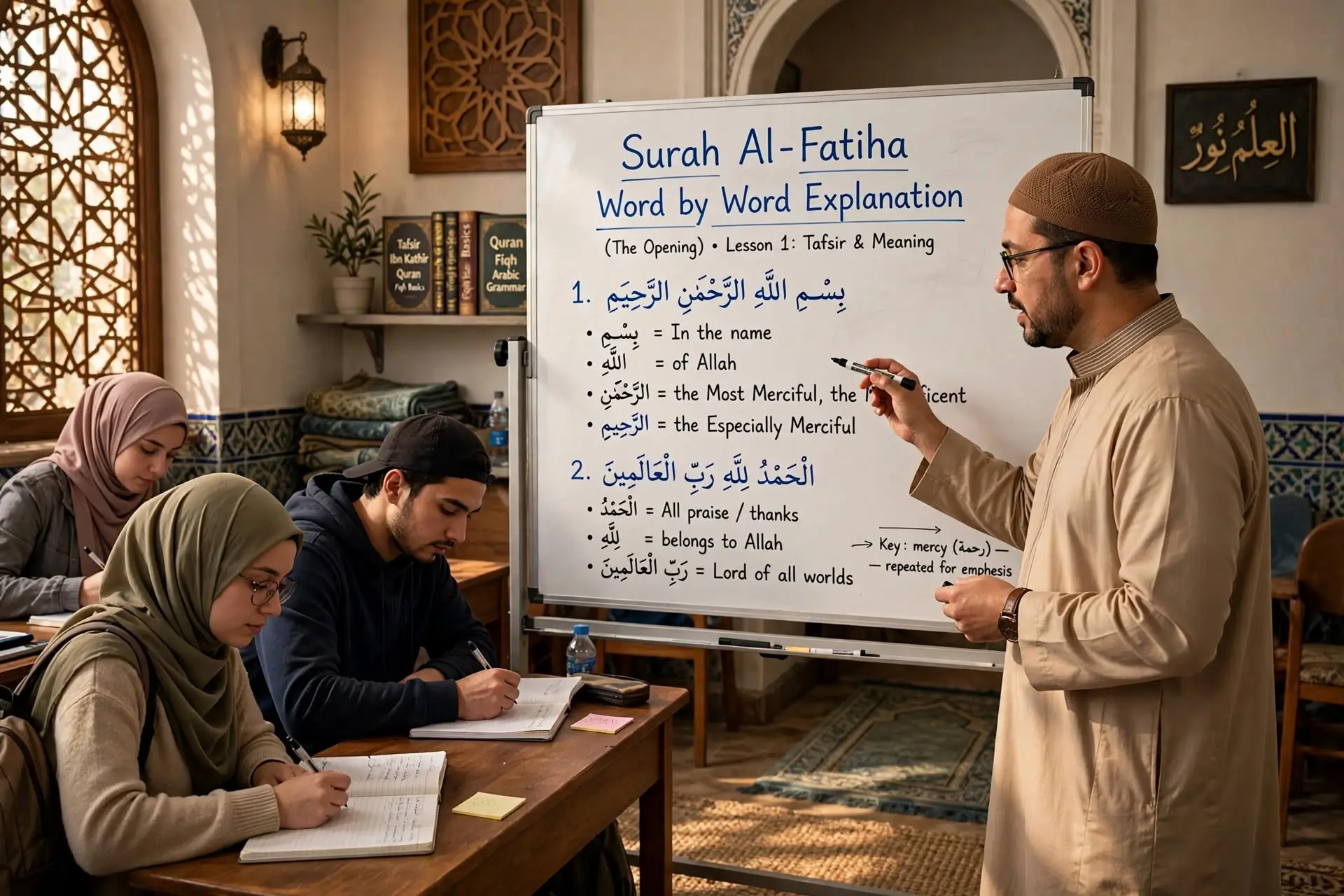
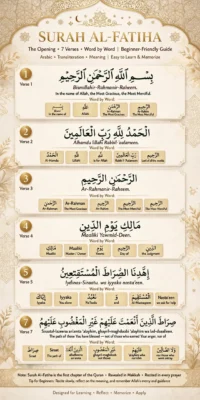
Go slowly here. Read each verse out loud first. Then read the table. Then say the verse again and try to hear the meanings as you go.
Verse 1: The Bismillah
بِسْمِ اللَّهِ الرَّحْمَٰنِ الرَّحِيمِ
| Arabic | How you say it | What it means | Root / note |
|---|---|---|---|
| بِسْمِ | bismi | in the name of | It’s two words glued together: bi (with/in) + ism (name) |
| اللَّهِ | Allahi | Allah | The ending changes because it follows “name of” |
| الرَّحْمَٰنِ | ar-Rahmani | the Most Merciful | Root ر-ح-م (mercy) |
| الرَّحِيمِ | ar-Raheemi | the Especially Merciful | Same root, different pattern |
Here’s something worth noticing. Rahman and Raheem both come from the same root, and both are intensive forms of “merciful.” Mercy is stated twice, right at the start. That’s not an accident, and it sets the tone for the whole surah.
Verse 2: All praise belongs to Allah
الْحَمْدُ لِلَّهِ رَبِّ الْعَالَمِينَ
| Arabic | How you say it | What it means | Root / note |
|---|---|---|---|
| الْحَمْدُ | al-hamdu | all praise | Root ح-م-د. The “al-” makes it total: all praise, not just some |
| لِلَّهِ | lillahi | belongs to Allah | li (for/belonging to) + Allah |
| رَبِّ | rabbi | Lord, Sustainer | Someone who owns, nurtures and takes care of something |
| الْعَالَمِينَ | al-‘alameen | the worlds | A plural. Not “the world.” All of creation |
Quick note on “praise.” The Arabic hamd isn’t just “thank you.” It’s praise for who Someone is, not only for what He’s given you. That’s a bigger idea than most English translations can carry in one word.
Verse 3: The mercy again
الرَّحْمَٰنِ الرَّحِيمِ
| Arabic | How you say it | What it means |
|---|---|---|
| الرَّحْمَٰنِ | ar-Rahmani | the Most Merciful |
| الرَّحِيمِ | ar-Raheemi | the Especially Merciful |
You already know these two words from verse 1. That’s the point. Right after saying “Lord of all the worlds,” which could feel big and distant, you’re reminded that this Lord is merciful. Awe and closeness, side by side.
Verse 4: The Master of the Day of Judgment
مَالِكِ يَوْمِ الدِّينِ
| Arabic | How you say it | What it means | Root / note |
|---|---|---|---|
| مَالِكِ | maaliki | Master, Owner | Root م-ل-ك (ownership, authority) |
| يَوْمِ | yawmi | (of the) Day | You’ll see this word everywhere in the Quran |
| الدِّينِ | ad-deen | the Recompense, the Judgment | Here it means accountability, not “religion” |
Heads up: الدِّين usually means “religion” in everyday Arabic. In this verse it means the day when everyone is repaid for what they did. This is a perfect example of why word-by-word study beats guessing. The same word, a different meaning, depending on where it sits.
Verse 5: The turning point
إِيَّاكَ نَعْبُدُ وَإِيَّاكَ نَسْتَعِينُ
| Arabic | How you say it | What it means | Root / note |
|---|---|---|---|
| إِيَّاكَ | iyyaka | You alone | “You” put at the front for emphasis |
| نَعْبُدُ | na’budu | we worship | Root ع-ب-د, same root as ‘abd (servant) |
| وَ | wa | and | One letter, one word |
| إِيَّاكَ | iyyaka | You alone | Repeated, on purpose |
| نَسْتَعِينُ | nasta’eenu | we ask for help | Root ع-و-ن (help, aid) |
This is the middle of the surah, and it’s where the conversation turns. Up to now you’ve been talking about Allah. Now you turn and talk to Him. “You.” Directly.
Notice two things. First, the word order. Normally Arabic would say “we worship You.” Putting “You” first is how Arabic says “You, and only You.” Second, it says we, not I. Even if you’re praying alone in your room, you’re speaking as part of everyone who worships.
Verse 6: The one thing you ask for
اهْدِنَا الصِّرَاطَ الْمُسْتَقِيمَ
| Arabic | How you say it | What it means | Root / note |
|---|---|---|---|
| اهْدِنَا | ihdina | guide us | Root ه-د-ي. It’s ihdi (guide!) + na (us) |
| الصِّرَاطَ | as-siraata | the path | A wide, clear road |
| الْمُسْتَقِيمَ | al-mustaqeema | the straight | Root ق-و-م, the same root as qiyam (standing upright) |
Out of everything you could ask for, this is what you ask for. Seventeen times a day, at minimum. Not wealth, not health. Guidance. Honestly, that tells you what the surah thinks matters most.
Verse 7: Whose path?
صِرَاطَ الَّذِينَ أَنْعَمْتَ عَلَيْهِمْ غَيْرِ الْمَغْضُوبِ عَلَيْهِمْ وَلَا الضَّالِّينَ
| Arabic | How you say it | What it means | Root / note |
|---|---|---|---|
| صِرَاطَ | siraata | the path of | Explains which path from verse 6 |
| الَّذِينَ | alladheena | those who | |
| أَنْعَمْتَ | an’amta | You have favored | Root ن-ع-م (blessing). The -ta ending means “You” (to Allah) |
| عَلَيْهِمْ | ‘alayhim | upon them | ‘ala (upon) + him (them) |
| غَيْرِ | ghayri | not, other than | |
| الْمَغْضُوبِ | al-maghdoobi | those who earned anger | Root غ-ض-ب (anger) |
| عَلَيْهِمْ | ‘alayhim | upon them | Same phrase as above |
| وَلَا | wa laa | and not | |
| الضَّالِّينَ | ad-daalleen | those who go astray | Root ض-ل-ل (to be lost, to stray) |
Read it again as one thought: The path of those You have favored. Not of those who earned anger, and not of those who went astray. You’ve just spelled out the road, and named the two ditches on either side of it.
A note on interpretation. Scholars have explained who these groups are in different ways, and the classical commentaries (tafsir) go into detail. If you want that layer, read a trusted tafsir or ask a qualified teacher. For word-by-word purposes, what matters is that you now know what each word says.
Step 3: Learn the roots (the real shortcut)
Here’s the thing most beginners miss. You’re not learning 29 separate words. You’re learning about a dozen roots, and each one pops up again and again.
| Root | Core idea | Where you’ve seen it |
|---|---|---|
| ر-ح-م | mercy | Rahman, Raheem |
| ح-م-د | praise | al-hamd (also the name Muhammad and Ahmad) |
| ع-ب-د | worship, servitude | na’budu (also ‘abd, servant) |
| ع-و-ن | help | nasta’een |
| ه-د-ي | guidance | ihdina (also hidaya, guidance) |
| ق-و-م | standing, being upright | mustaqeem (also qiyam in prayer) |
| ن-ع-م | blessing | an’amta (also ni’ma) |
See how that works? Next time you hear “ni’ma” somewhere, you already know it’s connected to “an’amta.” You’re not starting over. You’re building.
If this root idea is new to you, it helps to understand how Quranic Arabic differs from the Arabic taught in most courses. We break that down in Quranic Arabic vs Modern Standard Arabic: What’s the Difference?
Step 4: Hear it as a conversation
Now go back to that hadith I mentioned. In it, the prayer is divided between Allah and His servant, and Allah responds as you recite. Wikipedia’s article also quotes this narration, if you want to see the wording.
So try this when you pray. When you say “All praise belongs to Allah, Lord of the worlds,” picture that it’s heard. When you reach “You alone we worship,” you’ve turned and addressed Him directly. And when you say “guide us,” you’re asking for the one thing the whole surah has been building toward.
That’s the difference between reciting and talking. You can’t do it without knowing what the words mean. That’s why this is worth the effort.
Step 5: A 7-day plan to learn the whole surah
You don’t need hours. Fifteen minutes a day is plenty. If you want a structure for short daily sessions, our 15-minute daily Arabic study routine shows how to split your time between review, new material and speaking out loud.
| Day | What to do |
|---|---|
| Day 1 | Verse 1 (Bismillah). Learn the four words. Say it aloud five times, thinking the meaning on each word. |
| Day 2 | Verses 2 and 3. Review yesterday from memory first. Then add today’s words. |
| Day 3 | Verse 4. Pay attention to the word deen and why it means “judgment” here. |
| Day 4 | Verse 5. Focus on “You alone” and “we.” Say the verse slowly. |
| Day 5 | Verse 6. Learn the roots h-d-y and q-w-m. |
| Day 6 | Verse 7. It’s the longest. Break it into three chunks and learn them one at a time. |
| Day 7 | Recite the full surah, silently thinking the meaning. Then do it in your actual prayer. |
One rule. Don’t skip the review. Adding new words without reviewing old ones is like pouring water into a bucket with a hole in it.
Mistakes that cost you the meaning
These are the ones I see most often.
1. Relying on transliteration forever. We covered this. Use it for a week while you learn to read. Then drop it.
2. Translating word for word into English order. Arabic doesn’t follow English word order. “You alone we worship” feels odd in English, and that’s fine. The oddness is the emphasis.
3. Mixing up letters that sound alike to English ears. The ح in al-hamd isn’t the same as an English “h.” The ع in ‘alameen isn’t a vowel. The ص in siraat isn’t a plain “s,” and the ض in ad-daalleen is one of the hardest sounds in Arabic. Get these corrected by a person who can hear you.
4. Small vowel slips that change who’s speaking. Take an’amta. The ending -ta means “You” (Allah is the One who favored them). Change it to -tu and it becomes “I favored.” That’s a meaning change, not a style choice. This IslamQA answer on mistakes in Al-Fatihah discusses which errors matter and which don’t. For rulings about your own prayer, ask a qualified scholar. I’m a language teacher, not a mufti.
5. Trying to learn it all in one evening. Meaning sticks through repetition, not cramming. One verse a day beats a marathon.
Real questions people ask about this
These come up constantly in new-Muslim communities, Q&A sites and our own student chats. Here are straight answers.
“I’ve been praying with transliteration for years. Where do I even start?”
Start by learning to read the Arabic letters, then do the word-by-word work in this article. It’s never too late, and you don’t have to stop praying while you learn. Keep praying. Improve alongside it. If you’re worried about whether your past prayers were valid, take that question to a trusted scholar rather than guessing.
“I recite it 17 times a day and still feel nothing. Is something wrong?”
Nothing’s wrong with you. It’s a repetition problem. When you say something thousands of times without knowing what it means, your mind goes on autopilot. Meaning is what breaks the autopilot. Try focusing on just one verse per prayer for a week.
“Do I need to understand Arabic to pray?”
Correct recitation matters, and scholars discuss the details of what’s required for validity. Understanding is what turns the words into a real conversation. Ask your imam or a qualified scholar for the ruling in your school of thought. What I can tell you as a teacher is that understanding makes you pray differently.
“How long does it take to understand Al-Fatiha?”
The surah itself? About a week, following the plan above. Understanding the whole Quran in Arabic is a longer journey, measured in months and years. But Al-Fatiha gives you a head start, because so many of its words and roots show up again.
“Can’t I just use an app with word-by-word translation?”
Yes, and it’s helpful. Tools like Quran.com show the meaning under each Arabic word. Use them as your reference. But the app can’t hear you. It won’t catch that your ض sounds like a د. For that you need a person.
Why a teacher makes this faster
Let me be honest about the limits of reading an article.
You can learn the meanings from a page. You can’t learn the sounds. Your tongue needs feedback, and the only thing that gives it is a human listener who says “again, a little further back in the throat.” That’s the whole reason pronunciation takes people so long when they study alone.
At Alphabet Arabic Academy, our Quran and Tajweed teachers are Ijazah-certified native Egyptian Arabic speakers. Lessons are one-on-one and live, so your teacher hears every verse and corrects it on the spot. If you want to see who you’d be learning with, meet the teachers. If you want to compare plans, the pricing page lays it all out.
Not sure where you stand? Take the free Arabic level test. It takes a few minutes, and it tells you whether to start with letters, reading, or Quranic vocabulary.
Where to go from here
Al-Fatiha is seven verses and 29 words. You’ve now seen every one of them. You know the roots behind them. You know where the meaning turns in verse 5, and what you’re really asking for in verse 6.
So here’s your next step. Tonight, take verse 1. Just that. Read it, say each word’s meaning in your head, and pray with it tomorrow. Then verse 2. That’s the whole method.
Ready to go from reciting to understanding?
Join live, one-on-one lessons with Ijazah-certified teachers, and start with Al-Fatiha. Start Quranic Arabic