You know the letters. Maybe you know a handful of nouns — book, house, water, that kind of thing. And you’re stuck. Because nouns don’t make sentences. Verbs do.
Here’s the thing nobody tells beginners: you can memorize 500 nouns and still not be able to say a single real sentence in Arabic. “I want water.” “She went home.” “We ate dinner.” Every one of those needs a verb. And Arabic verbs work differently than English ones — once you get the pattern, though, it clicks fast.
So instead of throwing 500 random words at you, I picked 20. These are the verbs that show up constantly — in conversation, in the news, in textbooks, in literally every beginner course I’ve ever taught. Learn these first, and you’ll be building real sentences within days, not months.
Why These 20 and Not Some Random List
I didn’t grab these off a frequency chart and call it a day. I picked verbs a beginner actually needs — eating, going, wanting, seeing, speaking, sleeping. The stuff of daily life. And I made sure most of them follow the regular Form I pattern, so once you learn how one conjugates, you basically know how to conjugate all of them.
A few are irregular (Arabic calls them “weak” verbs — don’t worry, I’ll flag those). You’ll hit them eventually anyway, so better to meet two or three now than get blindsided later.
One more thing before we get into it — this list is Modern Standard Arabic (MSA). That’s the formal, grammatically consistent version of Arabic used in writing, news, and formal speech across the Arab world. If your goal is reading, writing, or having a solid grammar foundation, MSA is where you start. Dialects come easier once you have this base. If you’re not sure MSA is right for your goals, our MSA course page breaks down exactly what you’ll learn and why it matters.
Quick Refresher: How Arabic Verbs Actually Work
I won’t turn this into a grammar lecture. But you need three things in your head before the list makes sense.
1. Verbs come from roots. Most Arabic verbs are built from a three-letter root that carries a core meaning. كتب (k-t-b) means “writing” in some form. From it you get كَتَبَ (he wrote), كِتَاب (book), مَكْتَب (desk/office), مَكْتَبَة (library). Learn one root, unlock a whole family of words. This is genuinely one of the coolest things about Arabic — nothing in English works like this.
2. The dictionary form is “he did it.” When you look up a verb in an Arabic dictionary, you won’t find an infinitive like “to eat.” You’ll find أَكَلَ — literally “he ate.” That’s the base form every conjugation grows from. So when I list verbs below, I’m giving you the “he” form, because that’s the standard.
3. Present tense wraps the root in a pattern. Past tense كَتَبَ (he wrote) becomes present tense يَكْتُبُ (he writes) by adding a prefix and shifting the vowels. Once you see this happen with five or six verbs, your brain starts predicting it automatically.
That’s genuinely all you need to start. Don’t overthink it — the pattern teaches itself through repetition, not through rules you memorize in isolation.
The First 20 Arabic Verbs (With Present Tense)
Here they are. Each one shows the past tense (“he” form), the present tense (“he” form), the transliteration, and the meaning.
| # | Arabic (Past) | Arabic (Present) | Transliteration | Meaning |
|---|---|---|---|---|
| 1 | كَانَ | يَكُونُ | kāna / yakūnu | to be |
| 2 | ذَهَبَ | يَذْهَبُ | dhahaba / yadhhabu | to go |
| 3 | جَاءَ | يَجِيءُ | jāʾa / yajīʾu | to come |
| 4 | أَكَلَ | يَأْكُلُ | akala / yaʾkulu | to eat |
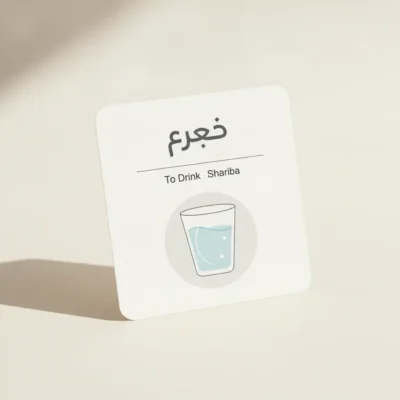
| 5 | شَرِبَ | يَشْرَبُ | shariba / yashrabu | to drink |
| 6 | قَالَ | يَقُولُ | qāla / yaqūlu | to say |
| 7 | رَأَى | يَرَى | raʾā / yarā | to see |
| 8 | سَمِعَ | يَسْمَعُ | samiʿa / yasmaʿu | to hear |
| 9 | عَرَفَ | يَعْرِفُ | ʿarafa / yaʿrifu | to know |
| 10 | فَهِمَ | يَفْهَمُ | fahima / yafhamu | to understand |
| 11 | أَرَادَ | يُرِيدُ | arāda / yurīdu | to want |
| 12 | أَحَبَّ | يُحِبُّ | aḥabba / yuḥibbu | to love / like |
| 13 | كَتَبَ | يَكْتُبُ | kataba / yaktubu | to write |
| 14 | قَرَأَ | يَقْرَأُ | qaraʾa / yaqraʾu | to read |
| 15 | دَرَسَ | يَدْرُسُ | darasa / yadrusu | to study |
| 16 | عَمِلَ | يَعْمَلُ | ʿamila / yaʿmalu | to work / to do |
| 17 | سَكَنَ | يَسْكُنُ | sakana / yaskunu | to live (reside) |
| 18 | لَعِبَ | يَلْعَبُ | laʿiba / yalʿabu | to play |
| 19 | نَامَ | يَنَامُ | nāma / yanāmu | to sleep |
| 20 | خَرَجَ | يَخْرُجُ | kharaja / yakhruju | to go out / leave |
A few of these are irregular — كَانَ, جَاءَ, رَأَى, and نَامَ have letters that shift or drop out because of weak sounds in the root. Don’t stress over why right now. Just notice the pattern breaks, and it’ll stop feeling random the more you see it repeated.
Watching One Verb Move Through the Persons
Tables are fine for memorizing meaning, but you actually learn a verb by seeing it change. Let’s take كَتَبَ (to write) — a clean, fully regular verb — and walk it through the present tense.
| Person | Arabic | Transliteration | Meaning |
|---|---|---|---|
| I | أَكْتُبُ | aktubu | I write |
| You (m.) | تَكْتُبُ | taktubu | You write |
| You (f.) | تَكْتُبِينَ | taktubīna | You write |
| He | يَكْتُبُ | yaktubu | He writes |
| She | تَكْتُبُ | taktubu | She writes |
| We | نَكْتُبُ | naktubu | We write |
| They | يَكْتُبُونَ | yaktubūna | They write |
See what happened? The root ك-ت-ب never moved. Only the prefix and suffix changed. That’s the whole system. Once this clicks for one verb, it clicks for most of the list above — swap in any regular root and the same prefixes and suffixes apply.
Honestly, this is the exercise I give every single beginner student in week two. Pick one verb from the list. Conjugate it through all seven persons, out loud, from memory. Do it daily for a week. It sticks faster than any app or flashcard deck.
How to Actually Practice These (Not Just Stare at Them)
Reading a list doesn’t teach you a verb. Using it does. Here’s what I tell my own students:
Build one sentence per verb. Not ten. One. أَنَا أَذْهَبُ إِلَى الْبَيْتِ. (I go home.) هِيَ تَشْرَبُ الْمَاءَ. (She drinks water.) Simple, real, usable.
Say it before you write it. Your mouth needs to make these sounds before your hand memorizes the shapes. Read each sentence out loud, twice, before you copy it down.
Rotate, don’t binge. Trying to learn all 20 in one sitting is a great way to remember none of them by Friday. Take four or five a day. Review yesterday’s before adding today’s. If you want a ready-made structure for this, our daily study routine guide lays out exactly how to fit this into 15 minutes.
Connect verbs to what you already know. If you learned the word بَيْت (house) last week, pair it with ذَهَبَ this week: ذَهَبْتُ إِلَى الْبَيْتِ (I went home). New verbs stick better when they’re doing something with old vocabulary instead of floating alone.
Mistakes I See Beginners Make With These Verbs
Memorizing meaning, skipping conjugation. Knowing that أَكَلَ means “to eat” is step one. If you stop there, you can’t actually say “I eat” or “she eats.” The conjugation is the whole point — don’t skip it.
Ignoring the weak verbs. كَانَ, جَاءَ, and رَأَى look scary because they don’t follow the neat pattern. Beginners quietly avoid them and lean on easier verbs instead. Bad idea — these four are some of the most common verbs in the entire language. You can’t avoid them for long.
Learning verbs in isolation from grammar. A verb list is a starting point, not a finish line. Sentence structure, subject-verb agreement, and how verbs shift with different pronouns — that’s what turns a memorized list into actual speech. If you want the fuller picture of where verbs fit into sentence-building, this rundown of common beginner Arabic mistakes is worth a read.
Not testing themselves out loud. Recognizing a verb when you see it written is a different skill than producing it from memory when you’re speaking. Quiz yourself out loud, not just on paper.
Frequently Asked Questions
What are the most common Arabic verbs to learn first? “To be,” “to want,” “to go,” “to eat,” “to say,” and “to see” cover an enormous share of daily speech. If you only had time for six verbs, those would be my pick. The full list of 20 above builds naturally on top of them.
Do I need to memorize verb conjugation tables, or will it come naturally? A bit of both. Seeing the pattern once won’t make it automatic — you need repetition. But you don’t need to sit and drill conjugation charts like homework either. Build sentences, say them out loud, and the pattern locks in through use far faster than through memorization alone.
How many Arabic verbs does a beginner actually need to know? Somewhere around 50–100 high-frequency verbs will get you through most everyday conversation. These 20 are your foundation — the ones that show up so often that everything else builds on top of them.
Is Arabic verb conjugation harder than English? Different, not harder. English conjugation is mostly invisible (I eat, you eat, we eat — barely changes). Arabic conjugation is more visible and more consistent once you learn the pattern, which honestly makes it more predictable, not less. The tricky part for English speakers is just that the change happens through prefixes and suffixes instead of separate helper words.
Should I learn MSA verbs or dialect verbs first? If your goal is reading, writing, or a real grammatical foundation, start with MSA — that’s what this list covers. Dialect verbs (Egyptian, Levantine, Gulf) often come from the same roots but conjugate a bit differently in casual speech. Learners who start with MSA generally pick up a dialect faster later, because the root logic is already in their head.
Where to Go From Here
Twenty verbs won’t make you fluent. Nothing does that overnight, and I’m not going to pretend otherwise. But twenty verbs, conjugated properly and used in real sentences, will get you saying and understanding actual Arabic — not just pointing at flashcards.
If you want to know exactly where you stand before diving deeper, take our free Arabic level test. It takes a few minutes and tells you precisely where to focus next, instead of guessing.
And if you’re ready to build real fluency with structure and a native teacher correcting you along the way, our Modern Standard Arabic course is built exactly for learners at your stage — starting from zero and moving at a pace that actually sticks. Check the pricing page for plans, or meet the native Egyptian teachers who’ll be walking you through it.
Twenty verbs down. Now go spread your vocabulary — one sentence at a time.