So you want to learn Arabic. Great. But you open Google, and suddenly you’re looking at a list of 500 “essential” words, and half of them are things like “pomegranate” and “diplomatic relations.”
Nobody needs that. Not on day one.
Here’s what actually matters: your first 100 Arabic words should make you functional. Not fluent — functional. You want words that show up in real conversations, real texts, real life. Words that, once you learn them, you’ll actually use.
That’s what this list is. No padding, no random vocab dumps. Just the words that matter most when you’re starting out.
First — Why 100 Words?
Because 100 is achievable. And because the right 100 words cover more ground than you think.
Studies on language acquisition keep showing the same thing: a small core of high-frequency words makes up the majority of what we read and hear every day. Arabic is no different. If you know the right 100 words in Modern Standard Arabic (MSA), you can already understand the skeleton of a sentence, get the gist of a news headline, and have a basic exchange with someone.
100 words won’t make you fluent. But they’ll make you feel like you’re actually moving. And that feeling? That’s what keeps you going.
What Kind of Arabic Are We Talking About?
Before we get into the words, let’s be clear. Arabic has dialects — Egyptian, Levantine, Gulf — and it also has Modern Standard Arabic (MSA), which is the formal, written form used in books, news, education, and official communication.
This list focuses on MSA. Why? Because MSA words are understood everywhere. Whether you’re talking to someone from Morocco or the UAE, MSA vocabulary is the common ground. It also forms the base of the Modern Standard Arabic course — which is where most serious learners start.
If you’re a total beginner, start here. Learn these words in MSA first. Dialects come later.
The First 100 Arabic Words (By Category)
I’m organizing these by theme because that’s how your brain actually stores language. Not alphabetically. By meaning.
1. Greetings and Basic Expressions (10 words)
These come first. Always. Because you need them before anything else.
| Arabic | Pronunciation | Meaning |
|---|---|---|
| مرحباً | Marhaban | Hello |
| السلام عليكم | As-salamu alaykum | Peace be upon you (Islamic greeting) |
| وعليكم السلام | Wa alaykum as-salam | And upon you peace (response) |
| شكراً | Shukran | Thank you |
| عفواً | Afwan | You’re welcome / Excuse me |
| نعم | Na’am | Yes |
| لا | La | No |
| من فضلك | Min fadlak | Please |
| مع السلامة | Ma’a as-salama | Goodbye |
| صباح الخير | Sabah al-khayr | Good morning |
2. Pronouns (8 words)
You can’t make a sentence without knowing who’s doing the action.
| Arabic | Pronunciation | Meaning |
|---|---|---|
| أنا | Ana | I |
| أنتَ | Anta | You (masculine) |
| أنتِ | Anti | You (feminine) |
| هو | Huwa | He |
| هي | Hiya | She |
| نحن | Nahnu | We |
| أنتم | Antum | You (plural) |
| هم | Hum | They |
3. Core Verbs (15 words)
These are the backbone. Learn these and you can start building actual sentences.
| Arabic | Pronunciation | Meaning |
|---|---|---|
| يريد / أريد | Yurid / Urid | He wants / I want |
| يذهب / أذهب | Yadhabu / Adhabu | He goes / I go |
| يأكل / آكل | Ya’kulu / Akulu | He eats / I eat |
| يشرب / أشرب | Yashrabu / Ashrabu | He drinks / I drink |
| يتكلم / أتكلم | Yatakallamu / Atakallamu | He speaks / I speak |
| يفهم / أفهم | Yafhamu / Afhamu | He understands / I understand |
| يعرف / أعرف | Ya’rifu / A’rifu | He knows / I know |
| يدرس / أدرس | Yadrusu / Adrusu | He studies / I study |
| يكتب / أكتب | Yaktubu / Aktubu | He writes / I write |
| يقرأ / أقرأ | Yaqra’u / Aqra’u | He reads / I read |
| يسمع / أسمع | Yasma’u / Asma’u | He hears / I hear |
| يرى / أرى | Yarā / Arā | He sees / I see |
| يأتي / آتي | Ya’ti / Ati | He comes / I come |
| يجلس / أجلس | Yajlisu / Ajlisu | He sits / I sit |
| يسأل / أسأل | Yas’alu / As’alu | He asks / I ask |
4. Numbers 1–10 (10 words)
Because you need numbers. To count, to tell time, to buy things.
| Arabic | Pronunciation | Number |
|---|---|---|
| واحد | Wahid | 1 |
| اثنان | Ithnan | 2 |
| ثلاثة | Thalatha | 3 |
| أربعة | Arba’a | 4 |
| خمسة | Khamsa | 5 |
| ستة | Sitta | 6 |
| سبعة | Sab’a | 7 |
| ثمانية | Thamaniya | 8 |
| تسعة | Tis’a | 9 |
| عشرة | Ashara | 10 |
5. Question Words (7 words)
You can’t have a real conversation without being able to ask questions.
| Arabic | Pronunciation | Meaning |
|---|---|---|
| ما / ماذا | Ma / Matha | What |
| من | Man | Who |
| أين | Ayna | Where |
| متى | Mata | When |
| كيف | Kayfa | How |
| لماذا | Limatha | Why |
| كم | Kam | How many / How much |
6. Common Nouns — People (8 words)
| Arabic | Pronunciation | Meaning |
|---|---|---|
| رجل | Rajul | Man |
| امرأة | Imra’a | Woman |
| ولد | Walad | Boy |
| بنت | Bint | Girl |
| أُمّ | Umm | Mother |
| أب | Ab | Father |
| صديق | Sadiq | Friend |
| معلم | Mu’allim | Teacher |
7. Common Nouns — Places (8 words)
| Arabic | Pronunciation | Meaning |
|---|---|---|
| بيت | Bayt | House |
| مدرسة | Madrasa | School |
| مدينة | Madina | City |
| شارع | Shari’ | Street |
| مطعم | Mat’am | Restaurant |
| مسجد | Masjid | Mosque |
| مكتب | Maktab | Office |
| سوق | Suq | Market |
8. Common Adjectives (10 words)
| Arabic | Pronunciation | Meaning |
|---|---|---|
| كبير | Kabir | Big |
| صغير | Saghir | Small |
| جديد | Jadid | New |
| قديم | Qadim | Old |
| جيد | Jayyid | Good |
| سيئ | Sayyi’ | Bad |
| سريع | Sari’ | Fast |
| بطيء | Bati’ | Slow |
| سهل | Sahl | Easy |
| صعب | Sa’b | Difficult |
9. Time Words (8 words)
| Arabic | Pronunciation | Meaning |
|---|---|---|
| اليوم | Al-yawm | Today |
| غداً | Ghadan | Tomorrow |
| أمس | Ams | Yesterday |
| الآن | Al-an | Now |
| دقيقة | Daqiqa | Minute |
| ساعة | Sa’a | Hour |
| يوم | Yawm | Day |
| أسبوع | Usbu’ | Week |
10. Essential Connecting Words (8 words)
These little words glue sentences together. Don’t skip them.
| Arabic | Pronunciation | Meaning |
|---|---|---|
| و | Wa | And |
| أو | Aw | Or |
| لكن | Lakin | But |
| في | Fi | In |
| على | Ala | On |
| من | Min | From |
| إلى | Ila | To |
| مع | Ma’a | With |
11. Useful Everyday Phrases (8 words/expressions)
| Arabic | Pronunciation | Meaning |
|---|---|---|
| لا أفهم | La afhamu | I don’t understand |
| أُعيد من فضلك | U’id min fadlak | Please repeat |
| كيف حالك؟ | Kayfa halak? | How are you? |
| بخير | Bikhair | Fine / Good |
| لا أعرف | La a’rifu | I don’t know |
| بالطبع | Bit-tab’ | Of course |
| ممتاز | Mumtaz | Excellent |
| ماذا يعني؟ | Matha ya’ni? | What does it mean? |
That’s your 100 words. Greetings, pronouns, core verbs, numbers, question words, nouns, adjectives, time, connectors, and everyday expressions.
Honestly, How Long Does It Take to Learn 100 Words?
I’ll be straight with you — it depends on how you study. If you’re just reading a list once and hoping it sticks? You’ll forget most of it in 48 hours. That’s not pessimism, that’s just how memory works.
But if you spread these out over 2–3 weeks, review them daily with spaced repetition, and actually try to use them in sentences? You’ll own them. They’ll become automatic.
Ten words a day. Two weeks. Done.
And if you’re not sure how to fit that into a busy schedule, we have a whole guide on exactly that: A 15-Minute Daily Arabic Study Routine for Busy Beginners. It breaks down how to study Arabic consistently without needing hours of free time.
The Biggest Mistake Beginners Make With Vocabulary
They learn words in isolation.
They memorize “كبير means big” and move on. Then when they see it in a sentence, they freeze. Because they’ve never seen it connected to anything.
Here’s the fix: always attach a word to a simple sentence when you learn it.
Don’t just learn كبير (big). Learn البيت كبير — “The house is big.” Don’t just learn أذهب — learn أذهب إلى المدرسة — “I go to school.”
This is how your brain actually stores vocabulary. In context. Not in isolation.
It’s the same approach we use in the Modern Standard Arabic course at Alphabet Arabic Academy. Every word you learn gets used in real sentences, real conversations, from the very first lesson.
What Comes After These 100 Words?
Once these are solid, you move to the next layer: basic sentence structure, verb conjugation, and thematic vocabulary (family, food, work, travel).
But don’t rush. These 100 words are your foundation. Get them right first.
If you want to know where you actually stand, take the free Arabic placement test. It takes about 10 minutes and tells you exactly which level you’re at. No guessing.
And if you’re ready to move from vocabulary into full structured lessons with a native teacher, check out the Modern Standard Arabic course or take a look at our pricing page to find a plan that fits.
Quick Tips to Make These Words Stick
Three things that actually work:
1. Use flashcards with spaced repetition. Anki is free and brutal in the best way. It keeps showing you the words you keep forgetting until they stick.
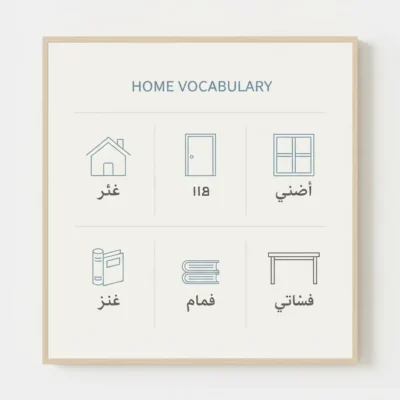
2. Label things in your home. Put Arabic sticky notes on your door, your fridge, your desk. You’ll see بيت every time you walk in. It’ll stick.
3. Say the words out loud. Every time. Not in your head. Out loud. Arabic pronunciation is one of those things that only improves if you actually practice it with your mouth.
For a more complete plan on how to structure your early learning, the beginner’s guide on our blog covers everything from the alphabet to your first conversations.
Start Here. Not Somewhere Fancier.
There’s a trap a lot of beginners fall into. They spend weeks looking for the perfect app, the perfect book, the perfect method. And they don’t actually learn anything.
Start with these 100 words. Ten a day. Use them in simple sentences. Review them the next morning.
That’s it. That’s literally where Arabic begins.
And when you’re ready to take it further with a real teacher who can correct your pronunciation, build your grammar, and actually push you forward — the Modern Standard Arabic course is the right next step.