

You want to Learn Quran Online: Complete Guide . But you’re not sure where to start, who to trust, or whether it actually works. Here’s the short answer: yes, it works—often better than in-person classes. And this guide covers everything you need to know to start, from absolute zero to advanced recitation, regardless of your age, location, or schedule.
Why Learning Quran Online Actually Works

Let’s be honest. A lot of people still have doubts. “Can a screen really replace a real teacher?”
For large group classes? Maybe not. But for one-on-one sessions with a qualified, ijazah-certified teacher? Online wins. Here’s why.
You Get Access to the Best Teachers—Not Just the Nearest Ones
The old model was simple and limiting: you learned from whoever happened to live near you. Maybe your local masjid had a great teacher. Maybe it had a volunteer struggling to manage 20 students at once.
Online flips that completely. You can learn from Al-Azhar-trained scholars in Egypt, certified Qaris in Saudi Arabia, experienced teachers with decades of teaching experience—all from your living room. A student in rural Montana gets the same quality instruction as someone living next to Al-Azhar University in Cairo.
Location no longer determines learning quality. That’s a big deal.
Flexible Scheduling That Fits Real Life
Masjid classes are Saturday 9 AM? You work Saturdays. Classes are 6 PM weekdays? You’re commuting. Sound familiar?
Online, you schedule when it works for you. Early morning before work. Late evening after the kids sleep. Different days each week if you need it. Teachers accommodate your life—not vice versa.
One-on-One Attention That Actually Corrects Your Mistakes
In a class of 15 students, your pronunciation mistakes go unnoticed. You practice the wrong thing over and over, and nobody stops you.
Online one-on-one classes change that. Every mistake gets corrected. Every question gets answered. Your pace is your pace. Students typically progress 2–3x faster with individual attention versus large group settings.
Learning From Home Reduces Anxiety and Increases Focus
Rushing to the masjid after work, tired and stressed, sitting in uncomfortable seating surrounded by distractions—that’s not an ideal learning environment.
Your home is. Your chair. Your preferred lighting. No pressure. This matters especially for children, women preferring privacy, elderly students, and anyone with anxiety.
Parents Can Actually Monitor Their Children’s Progress
With in-person classes, you drop your child off and hope for the best. With online classes—especially for younger kids—you can sit nearby, hear exactly what’s taught, and become a real partner in their Quranic education. That dramatically improves outcomes.
Who Is This For?
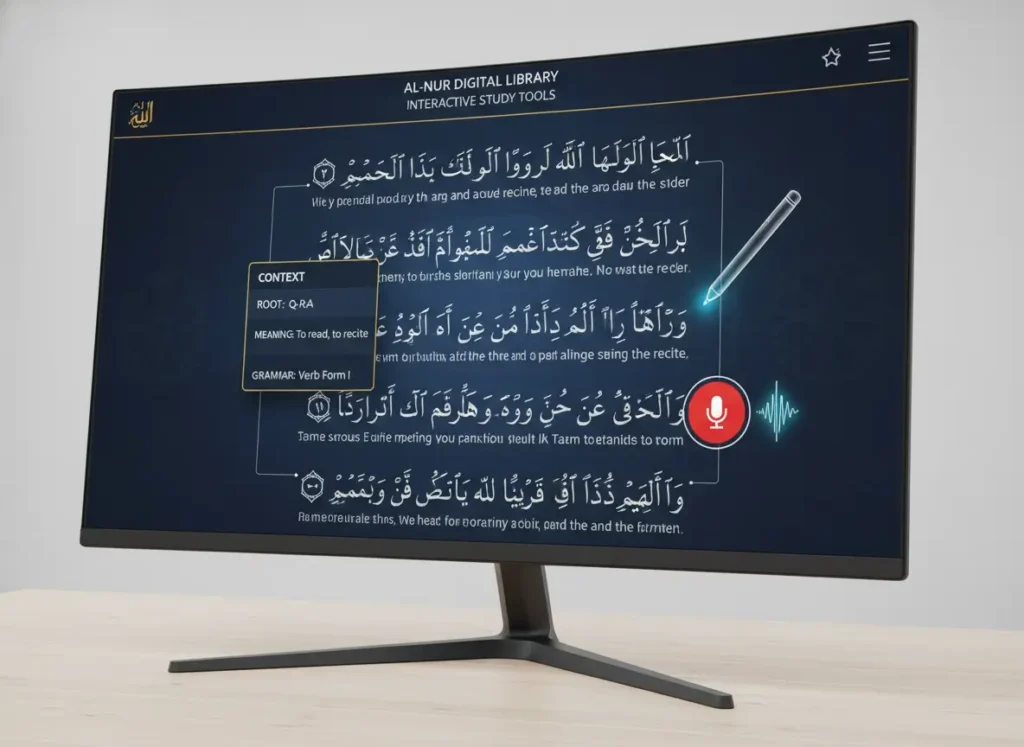
This is for you if:
- You’re a complete beginner who’s never read Arabic in your life
- You’re a new Muslim wanting to learn properly but have no local resources
- You’re a busy professional who can only study early morning or late evening
- You’re a woman wanting a female teacher in a private, comfortable setting
- You’re a parent wanting to monitor your child’s lessons and support their progress
- You’re an adult who learned as a child but lost the skill and wants to rebuild
- You travel frequently and need classes that travel with you
This is NOT for you if:
- You expect to learn without daily practice between sessions (classes alone won’t do it)
- You’re not willing to commit to at least 2 sessions per week consistently
- You want instant results without sustained effort
What You Can Learn Through Online Quran Classes

Online Quran programs today go far beyond basic recitation. Here’s what’s actually available:
Quran Reading (Qira’ah)
Starting point: Can’t read Arabic at all Destination: Reading any surah fluently
The process: Arabic alphabet (28 letters, all forms) → letter joining → short vowels → reading Quranic text → building speed and fluency.
Realistic timeline: 6–12 months for basic reading fluency, with 2–3 sessions per week plus daily practice.
Tajweed Mastery
Tajweed isn’t just an add-on—it’s how the Quran is supposed to be recited. Without it, you’re technically making errors in every ayah.
A complete Tajweed curriculum covers the 17 articulation points (makhaarij), letter characteristics (sifaat), noon and meem rules, elongation (madd) rules, qalqalah, stopping rules, and the distinction between heavy and light letters.
Realistic timeline: 12–18 months for complete Tajweed mastery.
For focused Tajweed training, check out our Quran Tajweed Classes Online.
Quran Memorization (Hifz)
Memorizing the Quran is one of the most rewarding undertakings in a Muslim’s life. Online Hifz programs use systematic techniques, daily memorization targets, structured revision schedules, and teacher verification.
Realistic timeline: 2–5 years for complete Quran memorization, depending on daily commitment.
Quranic Arabic Understanding
Most Muslims recite words they don’t fully understand. Quranic Arabic courses teach classical grammar, high-frequency Quranic vocabulary, sentence analysis, and direct comprehension of ayaat—so you connect with what you’re reading.
Realistic timeline: 18–36 months for functional understanding.
Tafseer (Quranic Exegesis)
Tafseer transforms your relationship with the Quran. Instead of surface-level reading, you understand historical context, linguistic nuances, and centuries of scholarly interpretation.
Online Tafseer courses typically cover:
- Classical methodology (tafseer bil-ma’thur and tafseer bil-ra’y)
- Asbab al-Nuzul (circumstances of revelation)
- Linguistic analysis and rhetorical devices
- Comparative Tafseer from scholars like Ibn Kathir, Al-Tabari, Al-Qurtubi
- Thematic studies (justice, mercy, prophethood, ethics)
Timeline: Tafseer is a lifetime study. Even a year of structured Tafseer classes will transform how you engage with every ayah.
Qira’at (Variant Recitation Styles)
This is advanced territory—and deeply fascinating. The Quran was revealed in seven ahruf and ten Qira’at have been preserved through unbroken chains (isnad) back to the Prophet ﷺ. Each Qira’ah represents authentic variations transmitted across 1,400 years.
Most students know only Hafs ‘an ‘Asim. Advanced students learn Warsh, Qalun, and others—connecting them to the living tradition of Quranic preservation.
Timeline: 3–7 years to master multiple Qira’at with proper ijazah.
Online Quran Learning for Adults: It’s Never Too Late
Here’s what most adults worry about: “I’m too old. My memory isn’t what it was. I should have started as a child.”
Let me be straight with you—that’s not how this works.
Adults actually bring advantages to Quran learning. Stronger motivation. Better discipline. The ability to understand why rules work, not just memorize them. And one-on-one online classes are built for adult learners with busy lives and individual starting points.
For complete beginners: Start with Noorani Qaida and Arabic letters. Your teacher meets you exactly where you are, with zero judgment.
For adults returning after years away: You haven’t forgotten as much as you think. A structured refresher course builds on what’s still there.
For professionals with busy schedules: Classes at 6 AM before work. 10 PM after the kids sleep. Weekends only. Online makes all of it possible.
Practical tips that work for adult learners:
- Schedule classes at the same time each week—consistency builds habit
- Practice 20 minutes daily between sessions (this is non-negotiable)
- Record yourself reciting and compare to expert recitation
- Tell your teacher your real goals and timeline upfront
- Don’t skip sessions—adults who miss 3+ consecutive classes almost always fall behind
For a deeper dive into adult-specific strategies, visit our guide on learning Quran online for adults.
Let me tell you about Yusuf.
He was 52 years old. A grandfather. He’d never learned to read the Quran properly. Growing up, there were no teachers where he lived. He learned some surahs by ear, but he knew his pronunciation was full of mistakes.
For years, he told himself: “I’m too old. It’s too late.”
Then his grandchildren started learning online. He watched them recite — and felt something shift.
He enrolled in our beginner program. No judgment. His teacher, Ustadh Hany, started with the alphabet. Week one, week two, week three. Yusuf practiced 20 minutes every day — during his lunch break, after Isha, before bed.
Six months later, he was reading the Quran fluently with Tajweed rules he never knew existed.
At a family gathering, he led the Maghrib prayer. His grandchildren listened. His son whispered afterward: “Baba, I’ve never heard you recite like that.”
Yusuf smiled. “I wasn’t too old,” he said. “I just hadn’t started.”
That’s the thing about learning Quran. It’s never too late. The only wasted time is the time you spend not starting.
Online Quran Learning for Women: Privacy, Choice, and Flexibility
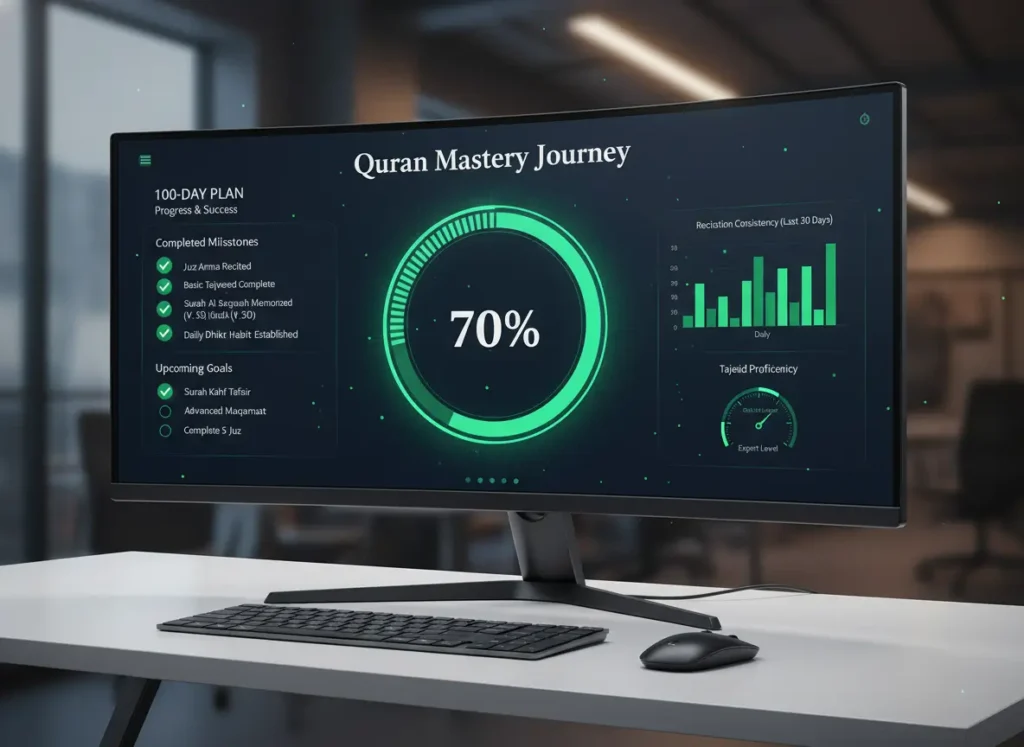
Women face specific challenges with in-person Quran classes: limited local options, scheduling conflicts around family responsibilities, privacy concerns, and difficulty finding qualified female teachers nearby.
Online learning addresses all of these directly.
Female Teachers Are Easily Available Online
Finding a qualified, certified female Quran teacher locally can be genuinely difficult. Online, it’s standard. When you enroll, simply indicate your preference—and you’ll be matched with a female instructor who holds proper ijazah and specializes in teaching women and girls.
This matters spiritually and practically. Many women learn better in a comfortable, private setting with a female teacher. Online delivers that, regardless of where you live.
Scheduling Around Family Life
You’re managing children, household responsibilities, work. Fixed class times at a masjid often don’t work. Online classes adapt to you—a session while children nap, early morning before the household wakes, or weekend afternoons when a family member can help.
The Comfort Factor
Learning from home, at your pace, without the social pressure of group settings is genuinely valuable. Women who struggled in group masjid classes often thrive in one-on-one online sessions. The learning environment is yours.
What Women Typically Study Online
- Beginners: Arabic alphabet, basic reading, foundational Tajweed
- Intermediate: Complete Tajweed rules, memorization of Juz Amma
- Advanced: Full Hifz programs, Quranic Arabic, Tafseer
- All levels: Islamic studies integration—Seerah, Fiqh, and Hadith connected to Quranic verses
Online Quran Learning for Men: Structure, Consistency, and Real Progress
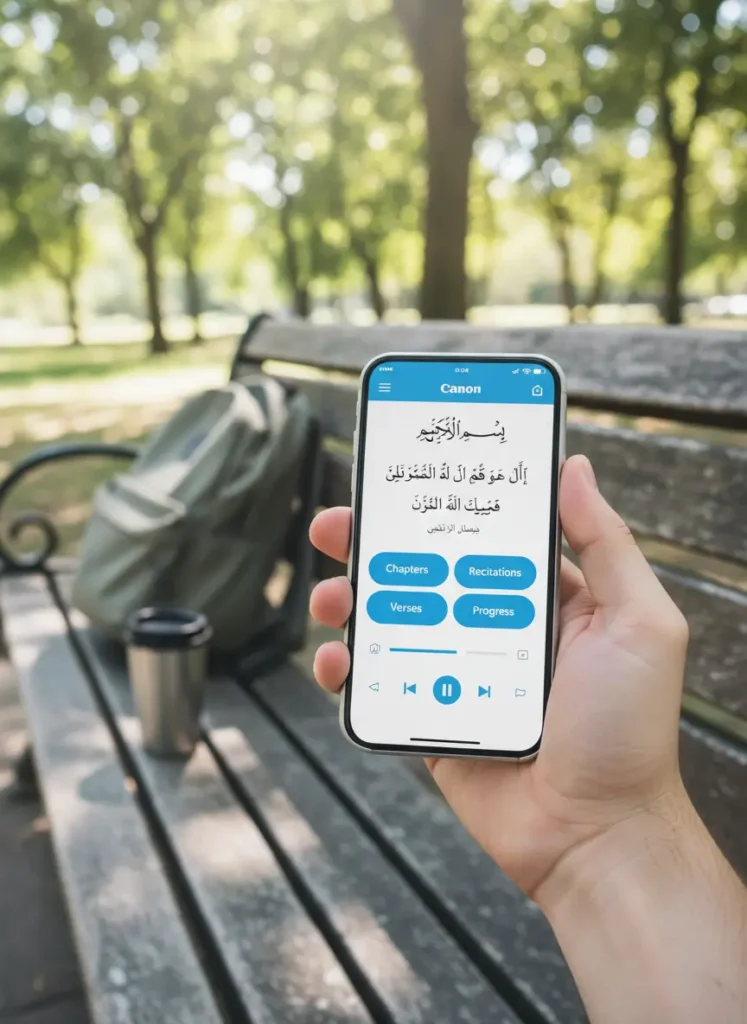
Men often struggle with a different set of challenges: irregular schedules, difficulty maintaining consistency, and uncertainty about which program actually leads to real progress (versus endlessly cycling through beginners’ material).
Here’s what actually works.
Build a Consistent Schedule—Then Protect It
The biggest obstacle for most men isn’t capability—it’s consistency. Work pressure, travel, and competing priorities chip away at learning time.
The fix is simple but requires commitment: treat your Quran session like a meeting you can’t cancel. Same days, same times, every week. Two sessions per week minimum. Three is better.
Choose the Right Starting Point
Men often underestimate what they already know—or overestimate it. Before starting any course, be honest about your current level:
- Complete beginner: Can’t read Arabic. Start with Arabic letters and Noorani Qaida.
- Can read slowly: Focus on fluency and foundational Tajweed.
- Can read but without Tajweed: Intensive Tajweed correction course.
- Can read with some Tajweed: Advanced Tajweed + Hifz or Arabic understanding.
Not sure where you fall? Take the free Arabic placement test and get an honest assessment.
The Practice Structure That Actually Builds Mastery
Classes teach. Practice builds mastery. Two sessions per week with zero practice between them is a waste of everyone’s time.
The minimum effective dose: 20 minutes daily. Not 2 hours on Sunday. Twenty minutes, every single day. That’s 140 minutes per week—enough to see real progress within a month.
What to do in those 20 minutes:
- Review what was taught in the last session
- Recite assigned verses 5–10 times each
- Record yourself and compare to a qualified Qari
- Practice the specific articulation points your teacher flagged
How to Choose the Right Online Quran Program
Not all programs are equal. Here’s how to evaluate before committing.
Step 1: Verify Teacher Qualifications
Non-negotiable requirements:
✅ Ijazah (formal authorization) with traceable chain back to the Prophet ﷺ ✅ Native or near-native Arabic pronunciation ✅ 3+ years of teaching experience ✅ Tajweed mastery—their recitation should be flawless ✅ Islamic knowledge and professional character
How to verify: Ask to see the ijazah certificate. Ask about their sheikh and chain of transmission. Listen to them recite. Take a trial class.
Step 2: Assess Teaching Methodology
Quality programs have a structured, progressive curriculum—not “we’ll teach whatever you want today.” Look for:
- Clear progression from beginner to advanced
- Regular assessments and feedback
- Assigned homework and practice
- Progress tracking and reporting
Red flag: vague structure, no milestones, no systematic approach.
Step 3: Understand Class Format Options
One-on-one: Best for maximum progress. 100% teacher focus, flexible pacing. Most serious students should choose this.
Small group (3–5 students): Lower cost, some peer motivation. Only works if the teacher gives individual correction time.
Large group (10+ students): Fine for theory. Not acceptable for learning proper pronunciation. Avoid for primary Quran learning.
Step 4: Fair Pricing in 2026
One-on-one sessions: $20–35/session (45–60 minutes) Small group: $10–20/session Monthly packages: often discounted for 8–12 sessions
Very cheap (<$10/hour) almost always means unqualified teachers. Very expensive (>$50/hour) should justify itself with exceptional credentials.
At Alphabet Arabic Academy, our Quran and Tajweed courses start at $40/month—certified teachers, one-on-one attention, flexible scheduling. See exact pricing on our Arabic courses pricing page.
Step 5: Check Flexibility and Policies
Life happens. Look for programs offering reasonable rescheduling, pause options for illness or travel, and the ability to change teachers if needed.
Rigid no-refund, no-reschedule policies are a red flag—especially for families with children.
Proven Strategies for Success
Taking classes isn’t enough. These strategies separate students who succeed from those who stall.
Daily Practice—20 Minutes, Every Day
This is the single most important factor in your progress. Two or three classes per week with no practice between sessions means you’re relearning the same material every time.
Twenty minutes of daily practice between sessions means you arrive at each class genuinely ready to go further.
What to practice: review last session’s material, recite assigned verses repeatedly, focus on specific problem sounds, listen to expert recitations.
Record and Review Your Own Recitation
You can’t hear your mistakes while you’re making them. Recording reveals what needs fixing.
After each practice session: record yourself, listen back immediately, compare to Sheikh Mishary or Al-Sudais, identify the specific mistake, practice the correction. This self-awareness accelerates improvement faster than anything else.
Set Clear, Measurable Goals
“I want to learn Quran” is not a goal. “I will read Juz Amma fluently with basic Tajweed within 8 months” is a goal.
Work with your teacher to define specific outcomes, realistic timelines, monthly milestones, and weekly tracking. This creates direction, motivation, and accountability.
Communicate Openly With Your Teacher
Tell your teacher when something’s too fast. Tell them when you’re struggling. Tell them what your actual goals are—not what you think they want to hear.
The teacher-student relationship works only with honest communication. Check in every few sessions. Adjust when needed. Don’t silently struggle.
For more tactics and techniques, see our detailed breakdown of the top 10 tricks to learn Quran online effectively.
Common Mistakes to Avoid

Mistake 1: Skipping practice between classes Classes without daily practice produce minimal progress. Committing to 20 minutes daily is more important than adding an extra weekly class.
Mistake 2: Prioritizing speed over accuracy Students who rush through material to “get to the Quran faster” build bad habits that take months to correct. Foundations matter. Slow is smooth. Smooth is fast.
Mistake 3: Choosing a teacher based on price alone The cheapest option often means unqualified teaching. Correcting bad pronunciation habits later takes 2–3x longer than learning correctly from the start. Invest in a qualified teacher from day one.
Mistake 4: Inconsistent attendance Missing 3+ consecutive sessions almost always results in significant regression. Treat your Quran time as non-negotiable.
Mistake 5: No clear goals Students without specific goals drift. They learn a little of everything, master nothing, and eventually stop. Define what you want to achieve and by when.
Frequently Asked Questions
Is learning Quran online as effective as in-person classes?
For most students, online one-on-one classes are more effective than large in-person group classes. You get personalized attention, access to qualified teachers globally, and flexible scheduling that enables consistency. Success depends on teacher quality and student commitment—not the format.
How long does it take to learn to read Quran online?
Complete beginners typically need 6–12 months for basic reading fluency, with 2–3 sessions weekly plus daily practice. Adding proper Tajweed: 12–18 months. Understanding Quranic Arabic: 18–36 months. Speed varies by age, practice consistency, and natural aptitude.
Can adults really learn Quran online, even if they’re starting from scratch?
Absolutely. Adults learn well one-on-one because instruction adapts to their pace, goals, and existing knowledge. Age isn’t an obstacle. Inconsistent practice is. Adults who commit to daily practice often progress faster than unmotivated younger students.
How much should online Quran classes cost?
Fair 2026 pricing: one-on-one $20–35/session, small group $10–20/session, with monthly packages often discounted. Below $10/hour usually indicates unqualified teachers. Above $50/hour should be justified by exceptional credentials.
Is there a female teacher option for women and girls?
Yes—at quality academies, female instructors are available and can be requested directly upon enrollment. This is standard for reputable online programs.
What do I need technically to start?
Reliable internet (5+ Mbps minimum), a laptop or tablet (phone screens are too small), and headphones with a microphone ($20–40). A quiet space to focus. That’s it.
What if I travel frequently for work?
Online learning is ideal for frequent travelers. Take your laptop and continue from wherever you are. Most platforms offer flexible rescheduling. Inform your teacher about travel in advance.
Why Alphabet Arabic Academy for Online Quran Learning
We’re based in Cairo, with 47 certified teachers, 5,000+ students across 80 countries, and a 4.9/5 rating on Trustpilot.
Here’s what actually makes the difference:
Certified teachers with authentic ijazah. Every Quran instructor holds formal ijazah with documented chains tracing back to the Prophet ﷺ. Graduates of Al-Azhar University, Dar El-Ulum, and Cairo University’s top programs.
True one-on-one instruction. No group classes. Your teacher’s attention is 100% yours for the entire session. That’s what accelerates real learning.
Female teachers available. Simply indicate your preference during enrollment.
Comprehensive curriculum for all levels. Complete beginners to advanced students. Children to seniors. Reading, Tajweed, Hifz, Arabic, and Tafseer—all available.
Flexible global scheduling. Teachers available 7 days a week across all time zones. Morning, afternoon, evening, weekends.
Transparent, affordable pricing. Quran and Tajweed courses starting at $40/month. Monthly packages available. Free trial class—no credit card required.
Explore all available Quran and Arabic programs on our all courses page.
Not sure which level to start at? Take the free Arabic placement test and get matched with the right program.
Start Your Online Quran Learning Today
Every person reciting the Quran beautifully today started at the beginning—uncertain, possibly overwhelmed, wondering if they could do it.
They started anyway.
The distance that once separated students from qualified teachers no longer exists. The schedule conflicts that made consistency impossible are now solvable. The cost barrier that put private instruction out of reach has dropped.
What remains is the decision to begin.
Your next steps:
- Clarify your goal. What do you want to achieve? By when? Write it down.
- Take the placement test. Know your starting level before choosing a program.
- Book a free trial class. Experience the teaching before committing to anything.
- Set your schedule. Choose 2–3 sessions per week at consistent times.
- Commit to 20 minutes of daily practice. Classes teach. Practice builds mastery.
- Start today. Not next week. Today.
👉 Book your free trial class with Alphabet Arabic Academy and begin.
“إِنَّ هَٰذَا الْقُرْآنَ يَهْدِي لِلَّتِي هِيَ أَقْوَمُ”
“Indeed, this Quran guides to that which is most suitable.” [17:9]
The guidance is ready. The teachers are waiting. بسم الله.