
Tajweed courses teach you to recite the Quran exactly as the Prophet ﷺ recited it—not approximately, not “close enough,” but with the precise articulation that preserves Allah’s words from distortion. Most beginners see meaningful improvement in 3–4 months with consistent daily practice and a qualified teacher.
This guide covers everything: why Tajweed is obligatory, what you’ll actually learn in a structured course, how to choose the right program, the strategies that separate fast learners from slow ones, and how to overcome every common obstacle.
Why Tajweed Is Not Optional

Ahmed had been reciting the Quran for fifteen years. Every Ramadan, he’d complete the entire Quran. His friends praised his “beautiful voice.” But deep down, something felt off.
One day he recited Surah Al-Fatihah to a visiting Egyptian sheikh. The sheikh listened, then gently said: “Mashallah, you recite with contemplation. But you’re making mistakes that change meanings.”
Ahmed was shocked. “Fifteen years—what mistakes?”
The sheikh explained: “Your ‘ha’ (ه) sounds like ‘kha’ (خ). Your ‘nun’ in Ar-Rahman lacks ghunnah. In ‘Maliki yawm id-deen,’ you’re stopping incorrectly, breaking the meaning.”
Fifteen years. Fundamental mistakes. How many prayers had he led incorrectly?
That day, Ahmed enrolled in a structured Tajweed course. Within eighteen months, the sheikh smiled and said: “Now you’re reciting as the Prophet ﷺ recited. Now you’re preserving Allah’s words exactly as they were revealed.”
Tears flowed from Ahmed’s eyes.
What Tajweed Actually Means
The word Tajweed (تجويد) comes from the root j-w-d (ج-و-د), meaning “to improve, to perfect, to complete.”
Technically: Tajweed is the complete system of rules governing proper Quranic pronunciation—ensuring every letter is recited from its correct articulation point (makhraj) with its appropriate characteristics (sifaat), applying all rules of elongation, nasalization, connection, and stopping exactly as the Prophet ﷺ recited.
Simply: Reciting the Quran correctly. Not approximately. Exactly.
The Obligation—Backed by Quran, Hadith, and Scholarship
Allah commands: ﴿وَرَتِّلِ الْقُرْآنَ تَرْتِيلًا﴾ — “Recite the Quran with measured recitation (tarteel).” [Al-Muzzammil: 4]
Tarteel means clear, distinct, correct recitation. That is Tajweed.
Angel Jibreel taught the Prophet ﷺ precisely how to pronounce every letter. The Companions learned by listening and imitating exactly. Islamic scholars are unanimous: learning basic Tajweed rules is fard al-ayn—an individual obligation for every Muslim who recites the Quran.
Why Pronunciation Errors Are Serious
This isn’t about aesthetic preference. Mispronunciation can change meaning entirely:
- ق (Qaf) vs. ك (Kaf): قَلْب = heart. كَلْب = dog. One letter. Different word entirely.
- ع (‘Ayn) vs. أ (Hamzah): عَلِمَ = he knew. أَلِمَ = he suffered pain. Completely different meaning.
- Wrong stopping: ﴿إِنَّمَا يَخْشَى اللَّهَ مِنْ عِبَادِهِ الْعُلَمَاءُ﴾ [Fatir: 28]. Correct reading: “Only those with knowledge fear Allah.” Wrong stopping: “Only Allah fears the scholars.” Astaghfirullah.
Tajweed isn’t just about beautiful sound—though correct recitation is beautiful. It’s about preserving Allah’s words without distortion.
The Chain of Transmission (Isnad)
Every authentic Tajweed teacher carries an unbroken chain back to the Prophet ﷺ:
Allah → Angel Jibreel → Prophet Muhammad ﷺ → Companions → Successors → Scholars across centuries → Your teacher → You
When you learn from a qualified teacher with ijazah, you join this 1,400-year chain. That’s not historical trivia. It’s a spiritual connection no app can replicate.
What You Actually Learn: The Complete Tajweed Curriculum

Structured Tajweed courses aren’t just rule memorization. They transform how your tongue, lips, and throat produce sound. Here’s exactly what a comprehensive program covers.
Module 1: The Science of Sound Production (Makhaarij al-Huroof)
The 17 specific points in your vocal apparatus where Arabic letters originate. This is practical training, not theory—it changes your physical articulation.
The major articulation zones:
- The Oral Cavity (Al-Jawf): Elongated vowels — ا، و، ي
- Deepest Throat: ء، ه
- Middle Throat: ع، ح
- Upper Throat: غ، خ
- Back of tongue with soft palate: ق
- Back of tongue with hard palate: ك
- Middle of tongue with hard palate: ج، ش، ي
- Side edges of tongue: ض
- Front of tongue: ل، ن، ر
- Tip of tongue against teeth: ط، د، ت
- Tip of tongue between teeth: ظ، ذ، ث
- Lower lip to upper teeth: ف
- Both lips: و، ب، م
- Nasal cavity: غنة (Ghunnah/nasalization)
Why this matters: pronouncing from the wrong location doesn’t just create an accent. It potentially creates a different letter, altering Allah’s words.
Module 2: Characteristics of Letters (Sifaat al-Huroof)
The 17 characteristics that give each letter its unique personality. Think of these as the DNA of Arabic phonetics.
The 5 major opposing pairs:
- Hams vs. Jahr: Whispered (voiceless) vs. voiced letters
- Shiddah vs. Rakhawah: Strong (stopped) vs. soft (flowing) sounds
- Isti’laa vs. Istifaal: Heavy (elevated) vs. light (lowered) letters
- Itbaaq vs. Infitah: Thick vs. thin sounds
- Idhlaaq vs. Ismaat: Fluent vs. heavy articulation
Additional critical characteristics:
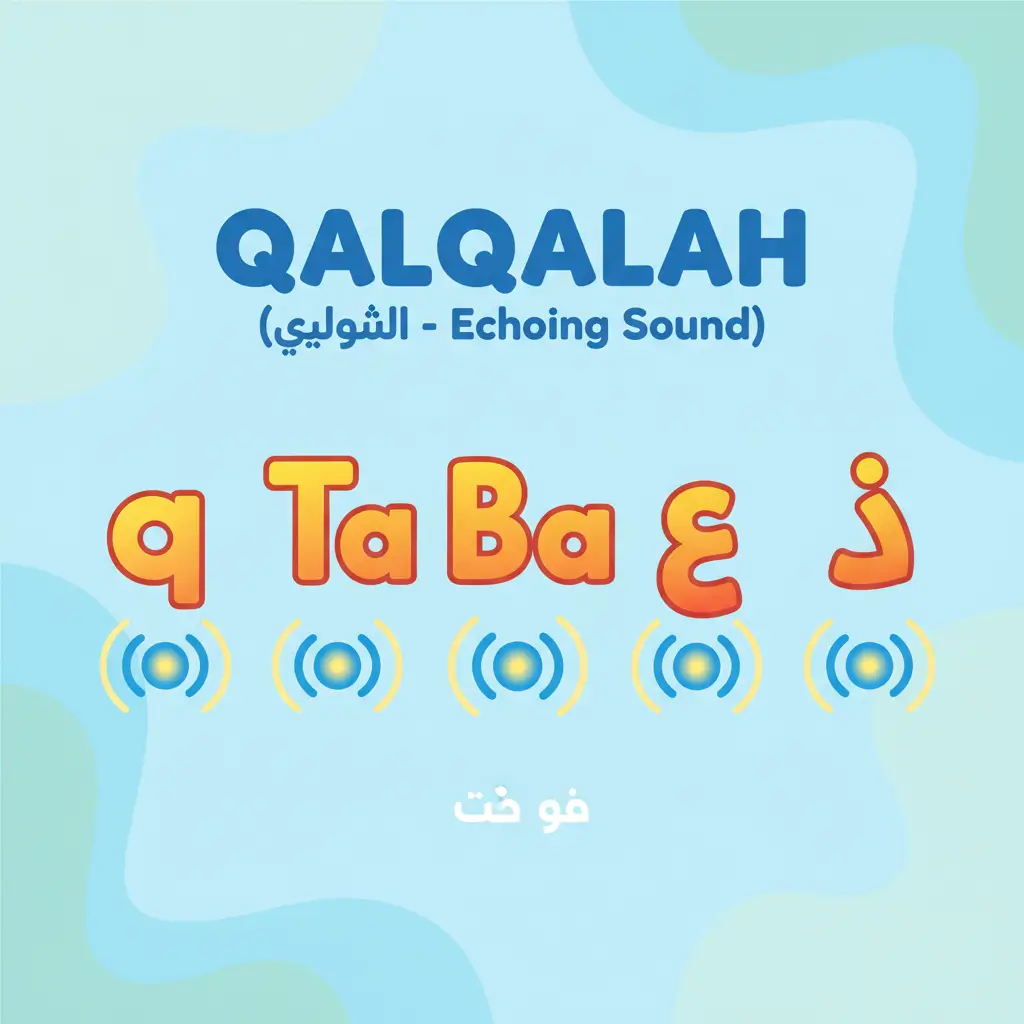
- Qalqalah (Echoing): ق، ط، ب، ج، د — these letters bounce when they have sukoon
- Tafkheem vs. Tarqeeq: The seven heavy letters always carry weight: خ، ص، ض، غ، ط، ق، ظ
Module 3: The Core Rules That Transform Your Recitation
Rules of Noon Sakinah and Tanween (The Four Transformations):
- Izhar (Clarity): Clear pronunciation before throat letters (ء، ه، ع، ح، غ، خ)
- Idgham (Merging): Complete merging with YARMALOON letters (ي، ر، م، ل، و، ن)
- Iqlab (Conversion): Changing noon to meem before ب
- Ikhfa (Hiding): Nasalized hiding before the remaining 15 letters
Rules of Meem Sakinah:
- Ikhfa Shafawi: Hiding before ب
- Idgham Shafawi: Merging before م
- Izhar Shafawi: Clarity before all other letters
Madd (Elongation)—The Heart of Melody:
- Natural Madd: 2 vowel counts
- Compulsory Madd: 4–5 counts (hamzah after elongation)
- Permissible Madd: 2, 4, or 5 counts
- Necessary Madd: 6 counts (sukoon after elongation)
The Art of Stopping (Waqf):
- Complete Stop (تام): Meaning is finished
- Sufficient Stop (كافي): Grammatically complete
- Good Stop (حسن): Better to continue
- Impermissible Stop (قبيح): Breaks the meaning
Module 4: Practical Application in Actual Quranic Text
Many courses stop at theory. Good Tajweed courses ensure you apply every rule to real Quranic verses immediately.
The “Hear, Recite, Correct” cycle:
- Listening: Hear perfect pronunciation from a qualified teacher
- Attempting: Try to replicate the sound
- Correction: Immediate, specific feedback on what to adjust
- Repetition: Repeat until muscle memory develops
Brother Yusuf from Toronto memorized 15 juz without Tajweed. When he started formal courses, his teacher had him re-learn the first juz completely. “It was humbling but transformative. Now when I recite, the rules flow naturally—I don’t have to think about them.”
Module 5: Self-Assessment and Continuous Improvement
Learning to hear your own mistakes is a game-changing skill.
The Recording Method:
- Record your recitation
- Listen critically
- Compare with expert recitation
- Identify specific errors
- Practice corrections
- Record again
Fatima, a 45-year-old doctor: “I thought I was pronouncing ‘ra’ (ر) correctly. Listening back, I heard the mistake clearly. Without recording, I would have continued unknowingly.”
Types of Tajweed Courses: Which One Is Right for You?

Not all Tajweed courses are equal. Understanding your options before you choose saves months of misdirected effort.
Type 1: Foundation Tajweed for Absolute Beginners
Who this is for:
- Complete beginners who can read Arabic script but have zero Tajweed knowledge
- Those who learned as children but never studied proper pronunciation
- New Muslims starting their Quranic recitation correctly from day one
What you learn: Basic articulation points (10 most essential makharij), Noon and Meem rules introduction, simple elongation principles, Qalqalah fundamentals, correct pronunciation of commonly mispronounced letters.
Timeline: 6–9 months with twice-weekly classes, 20–30 minutes of daily practice.
Aisha, 28, new Muslim: “I could sound out Arabic words, but they felt flat. My foundation course taught me that each letter has a ‘home’ in my mouth. For the first time, my recitation felt authentic.”
Type 2: Corrective Tajweed for Long-Time Reciters
Who this is for:
- Muslims who’ve been reciting for years but suspect errors
- Those who learned from parents or local teachers without formal training
- Hafiz who memorized quickly but want to perfect pronunciation
This is often the most difficult—and most rewarding—path. You’re not just learning; you’re unlearning years of muscle memory.
Common corrections: Throat letters (ع، ح، غ، خ), heavy/light letter confusion, native language accent influences, bad stopping habits.
Timeline: 9–12 months. Progress feels slower initially as you break old habits. The breakthrough usually comes around month 4–5.
Type 3: Comprehensive Tajweed Mastery Programs
Who this is for:
- Serious students seeking complete theoretical and practical mastery
- Those aspiring to teach Tajweed
- Students preparing for Ijazah certification
What it covers: All 17 articulation points in detail, complete characteristics (sifaat) with exceptions, advanced Madd rules, Waqf with grammatical context, introduction to the ten Qira’at.
For those pursuing Ijazah, this becomes a 2–3 year path involving complete mastery of all rules, reciting the entire Quran to a qualified teacher, studying chain of narration history, and final certification.
Type 4: Specialized Courses for Specific Needs
Tajweed for Children (ages 5–12): Shorter sessions (25–30 minutes), gamified learning with reward systems, color-coded Quran methods, parental involvement encouraged.
Tajweed for Busy Adults: Focused on high-frequency rules, flexible scheduling, intensive weekend workshops, mobile app integration for practice between sessions.
Tajweed for Non-Arabic Speakers: Extra emphasis on sounds not existing in native language, comparative phonetics (English/Urdu/French vs. Arabic), slower pace with more repetition, cultural context.
For a structured starting point, explore our Quran online classes or our dedicated program for adults learning Quran online.
One-on-One with an Egyptian Sheikh: Why It’s Different

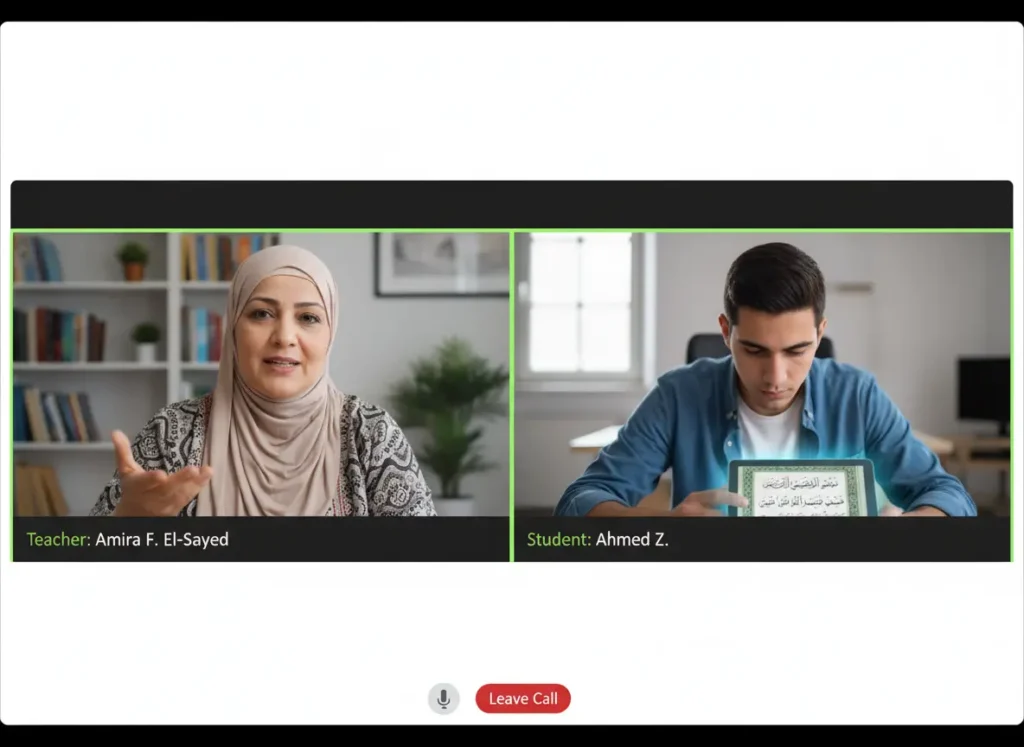
sheikh teaching student Quran recitation online via screen Alt text: One-on-one Tajweed lesson with Egyptian Sheikh online
Here’s something nobody tells you about online Tajweed: access to an Egyptian sheikh certified by Al-Azhar is now easier than finding a qualified local teacher in most cities outside the Arab world.
And that matters. A lot.
Why Egyptian Teachers Specifically
Historical pedigree. Egypt has maintained unbroken Quranic teaching chains for over 1,000 years. Al-Azhar University’s Ijazah system is the gold standard globally—not because of marketing, but because of a track record that spans centuries.
Pedagogical philosophy. The Egyptian teaching tradition is built on three principles that are genuinely hard to find together:
- Rifq (Gentleness): Creating a safe environment where you’re not afraid to make mistakes
- Itqan (Precision): Insisting on technical accuracy without compromise
- Hikmah (Wisdom): Knowing when to correct and when to encourage
The physical transmission element. In one-on-one sessions, an Egyptian sheikh observes your recitation with an ear trained on the Quran from childhood. They don’t just hear whether the rule was applied—they hear whether the sound is coming from the right place. That distinction takes years to develop. Apps don’t have it.
What One-on-One Tajweed Actually Delivers
- 100% teacher focus. No group class competing for correction time. Every mistake gets caught.
- Pace adapts to you. Some students need a week on a single sound. Others move faster. Your sessions adapt in real time.
- Spiritual transmission. When you recite correctly to your teacher and they confirm it—that moment of “now you’re reciting as the Prophet ﷺ recited”—carries a weight that no self-study achievement replicates.
- Accountability. You show up differently when your teacher is waiting, when they’ll notice you didn’t practice.
Online One-on-One vs. In-Person: The Honest Comparison
The honest answer: for most adult learners, online one-on-one produces equivalent or better results because of access to more qualified teachers.
Online advantages:
- Access to Al-Azhar-certified Egyptian teachers regardless of your location
- Flexible scheduling (mornings, evenings, weekends, across time zones)
- Recording capability—review exactly what your teacher said about a specific Makharij
- Female teachers available on request
- Lower cost per session without travel overhead
In-person advantages:
- Physical demonstration of mouth positions is easier to observe
- Teacher can feel your throat placement in some cases
- Community atmosphere in group settings
The practical recommendation: for adults and teenagers, online one-on-one with a certified Egyptian teacher consistently outperforms in-person with an unqualified local teacher. Quality beats format every time.
Common Mistakes That Cost Students Months of Progress
Mistake 1: Practicing Without a Teacher First
This is how Ahmed spent fifteen years. Apps and YouTube videos can introduce concepts. But they can’t hear you. They can’t tell you your ع is coming from the wrong place. By the time you find a teacher, the wrong muscle memory is so embedded that unlearning takes months.
Start with a teacher. Use apps to supplement. Not the other way around.
Mistake 2: Focusing on Rules Before Sounds
Many students try to learn Ikhfa and Idgham before they can correctly produce the basic letters. That’s backwards. Noun and Meem rules don’t matter if your ن and م aren’t coming from the right place.
Sequence matters: sounds first, rules second.
Mistake 3: Marathon Practice Sessions Instead of Daily Consistency
Two hours on Saturday does less than 20 minutes every day. This isn’t motivational advice—it’s neuroscience. Tongue, lip, and throat muscles develop through repetition, not duration. Daily consistency is the variable that separates fast learners from slow ones.
Mistake 4: Skipping the Recording Step
You hear yourself differently than your teacher hears you. Recording and listening back is the closest you can get to an external ear when your teacher isn’t present. Students who record daily practice improve 40–60% faster than those who don’t.
Mistake 5: Quitting at the 3-Month Slump
Around months 3–4, almost every learner hits a wall. Progress feels invisible. Old errors keep reappearing. Many students quit here—right before the breakthrough.
What’s actually happening: neural pathways are consolidating. The acceleration comes at month 4–6. Push through the slump.
Mistake 6: Choosing a Teacher by Price
Very cheap almost always means unqualified. And correcting six months of ingrained errors takes far longer than learning correctly from day one. The cheapest option is usually the most expensive in the long run.
Who Is This For?

This is for you if:
- You recite Quran but suspect your pronunciation has errors
- You’ve been reciting the same way for years and want confirmation it’s correct
- You’re a new Muslim wanting to build correct foundations from the start
- You want your Salah to feel like genuine recitation, not sounds you’re producing
- You’re a parent who wants to learn correctly before teaching your children
- You’re a Hafiz who memorized quickly but never studied formal Tajweed
This is NOT for you if:
- You’re not willing to practice 15–20 minutes daily between sessions
- You want to “try it out” for two weeks and move on
- You’re looking for a course where nobody corrects you
One important note for adults: age is not your obstacle. Sister Maryam started Tajweed at 65 after 40 years of incorrect recitation. The first three months were frustrating. Gradually, her mouth learned. Now her grandchildren ask her to teach them. If she can do it at 68, the age excuse doesn’t hold.
Not sure where your recitation currently stands? Take the free Arabic level test to get an honest baseline before choosing any program.
7 Strategies That Separate Tajweed Masters from Everyone Else
Strategy 1: Daily Micro-Practice Over Weekly Marathon Sessions
20–30 minutes daily creates stronger neural pathways than 3-hour sessions once a week. The muscles of your tongue, throat, and lips develop through repetition, not duration.
A practical daily structure:
- Morning (10 minutes): Articulation point exercises
- Afternoon (15 minutes): Rule application on 5–10 verses
- Evening (5 minutes): Listen to a master reciter
Brother Khalid, 42, switched from weekend sessions to 25 minutes daily. His teacher noticed the difference in three weeks.
Strategy 2: The Recording Method
Record a specific verse. Listen back immediately with the Quran open. Compare against a master reciter (Sheikh Al-Husary is excellent for this). Re-record incorporating what you heard.
Create a “Tajweed Progress” folder on your phone with dated recordings. Every month, compare your first recording to your latest. The audible improvement is deeply motivating—especially during the 3-month slump.
Strategy 3: One Rule Per Month, Mastered Completely
Instead of trying to learn everything at once, dedicate each month to mastering one rule completely:
- Month 1: Articulation points of throat letters (ع، ح، غ، خ، ء، ه)
- Month 2: Noon Sakinah and Tanween rules
- Month 3: Meem Sakinah rules
- Month 4: Basic Madd (elongation)
- Month 5: Qalqalah
- Month 6: Stopping rules (Waqf)
For each rule: understand it theoretically, find 10+ examples in the Quran, practice in isolation, apply to actual Quranic verses, then explain it to someone else.
Strategy 4: Multisensory Learning
Most Tajweed courses are purely auditory. But incorporating multiple senses accelerates mastery.
Visual learners: Use a color-coded Tajweed Quran, create mind maps of rules, watch videos of mouth formations, use a mirror to observe your own articulation.
Kinesthetic learners: Touch your throat to feel vibration differences during voiced vs. voiceless letters, use hand gestures to represent letter characteristics, write rules repeatedly while saying them aloud.
Auditory learners: Record lessons and replay them, use spaced repetition audio, create rhymes for rules, practice echo recitation (repeat after recordings with precise timing).
Strategy 5: Spiritual Integration
The students who progress fastest are the ones who connect Tajweed rules to meaning, not just technical application.
When practicing elongation (Madd), reflect: “This extended sound gives me time to contemplate this profound word.” When applying stopping rules (Waqf): “This pause lets the previous meaning settle before I continue.”
Before each practice session, take 5 minutes: renew your intention, make du’a for understanding and retention, begin with Basmalah. Tajweed practiced as worship accelerates differently than Tajweed practiced as skill.
Strategy 6: The Teaching Method
You don’t need an Ijazah to start sharing what you’ve learned. Teaching even one rule to one person reveals gaps in your own understanding faster than any self-assessment.
Explain a rule you just learned to your child, spouse, or a friend. Preparing to teach forces you to understand more deeply. Brother Tariq, 48, started teaching his 10-year-old daughter one rule per week. “Explaining rules to her revealed gaps in my own understanding. Now she corrects me sometimes—and it’s the proudest I’ve ever been.”
Strategy 7: The Four-Level Progression
Understanding where you are helps you know where you’re going:
- Level 1 – Mechanical obedience: Following rules because you’re told to
- Level 2 – Intellectual appreciation: Understanding why rules exist
- Level 3 – Emotional connection: Feeling the beauty of properly recited words
- Level 4 – Spiritual unity: Rules become transparent—you see through them to the Divine Speaker
Most course graduates sit between levels 2 and 3. Level 4 typically develops around year 2–3 for consistent learners. It’s worth understanding—because knowing the destination helps you recognize the path.
Overcoming the 7 Most Common Challenges

“I’m Too Old to Change My Pronunciation”
Adults have real advantages: better discipline, deeper understanding of why rules matter, life experience that gives Quranic meanings personal resonance.
Yes, tongue muscles take longer to retrain as an adult. The timeline: 6–8 weeks of consistent daily practice for muscle memory to develop. It’s not instant—but it works.
“I Don’t Have an Arabic Background”
The non-native advantage: you’re learning sounds consciously, not through unconscious habit. This often leads to more precise understanding than native speakers who absorbed pronunciation without analysis.
For English speakers specifically, focus first on the sounds that don’t exist in your language: ع، ح، ص، ض، ط، ظ، ق. Master these before anything else. Everything else will follow.
“I Get Discouraged by Slow Progress”
Every learner hits plateaus around months 3–4 and 8–9. This is normal and actually indicates integration—your brain is consolidating, not failing.
When progress slows, apply the 4 R’s: Review (go back to basics for a week), Rest (2–3 days completely off), Record (compare to earlier recordings to see invisible progress), Reconnect (remember why you started).
“I Don’t Have Time”
Everyone has 168 hours weekly. The issue isn’t time—it’s priority.
The 15-minute daily minimum:
- 5 minutes morning: articulation exercises while preparing breakfast
- 5 minutes commute: listen to Tajweed rule examples
- 5 minutes evening: apply one rule to 2–3 verses
That’s 15 minutes. Non-negotiable. The transformation happens in those 15 minutes, compounded daily over months.
“I Feel Embarrassed Being Corrected”
Reframe this: correction isn’t criticism—it’s mercy. Every correction brings you closer to preserving Allah’s words properly.
The Prophet ﷺ said: “The one who recites the Quran and struggles with it will have a double reward.” (Bukhari & Muslim)
Each identified error is a hidden treasure. An opportunity for reward when corrected.
“Rules Contradict or Confuse Me”
Tajweed rules have a hierarchy. When they seem to contradict, there’s usually a priority system. When confused, check three sources: your teacher’s explanation, two reliable Tajweed texts, and how master reciters actually recite it. The third one often resolves what the first two couldn’t.
“I Know the Rules But Forget Them During Recitation”
The theory-practice gap is the most common frustration in Tajweed learning. The solution is three phases:
Phase 1 – Conscious application: Recite at 3x slower than normal speed. Stop before each word to recall applicable rules. Gradually increase speed while maintaining awareness.
Phase 2 – Marked practice: Use a pencil to mark rules in your Mus’haf. Different symbols for different rules. Recite while seeing visual reminders.
Phase 3 – Natural integration: Through repetition, rules become automatic. You’ll start to feel when something sounds “wrong” rather than consciously checking each rule.
Choosing the Right Tajweed Course: The Non-Negotiables
Teacher Qualifications (Non-Negotiable)
- Ijazah with traceable chain: Not just a “certificate”—a documented sanad back to the Prophet ﷺ
- Teaching experience: Minimum 3–5 years specifically teaching Tajweed (not general Arabic)
- Pronunciation perfection: Their own recitation should be flawless
- Pedagogical skill: Ability to explain complex concepts simply and correct gently
- Language bridge: Understanding your background and ability to explain in your language
Red Flags to Avoid
- Teachers who claim “complete Tajweed mastery in 30 days”
- No trial lesson or placement assessment offered
- Can’t provide verifiable credentials
- Emphasis on “beautiful voice” over correct pronunciation
- Vague curriculum: “We’ll just read Quran together”
Realistic Pricing (2026)
- Online one-on-one sessions: $25–50 per hour
- Small group online (3–5 students): $15–30 per student
- In-person private: $30–70 per hour
- Mosque/community classes: Often donation-based
Very cheap (under $10/session) almost always indicates undertrained teachers. The cost of correcting ingrained mistakes later is always higher than investing in quality from the start.
For transparent pricing options, see our course pricing page.
The Trial Session: What to Evaluate
Pre-session: prepare specific verses you want to recite, note your current challenges, set evaluation criteria.
During the session, observe:
- Does the teacher correct errors immediately and specifically?
- Do they explain the why behind rules, not just the what?
- Do you feel comfortable making mistakes in front of them?
- Is the pace appropriate for your level?
After the session: Did you feel respected? Can you envision working with this person for 12–18 months?
The 72-hour rule: after research and trials, wait 72 hours before committing. Let emotional excitement settle. Make istikhara.
Integrating Tajweed Into Your Daily Life

Salah as Your Practice Laboratory
Each prayer becomes a focused practice session when you approach it intentionally:
- Fajr: Focus on clarity (Izhar) in shorter surahs
- Dhuhr: Practice elongation (Madd) in medium-length recitations
- Asr: Work on merging (Idgham) in flowing verses
- Maghrib: Concentrate on stopping rules (Waqf) in varying lengths
- Isha: Integrate everything in longer recitations
Keep a small notebook by your prayer space. After each prayer, note one Tajweed observation: “Today in Fajr, my ق was clearer.” This habit accelerates progress because your practice happens five times daily, not just during lessons.
The Monthly Focus Cycle
- Week 1: Reinforce articulation points, record baseline, identify one weakness
- Week 2: Choose one rule, practice in isolation, find 50 examples in the Quran
- Week 3: Apply the rule in flowing recitation, get teacher feedback
- Week 4: Test yourself, compare to Week 1 recording, set next month’s goal
Becoming a Link in the Chain
The ultimate goal of Tajweed isn’t just personal correctness. It’s transmission.
The Prophet ﷺ said: “The best of you are those who learn the Quran and teach it.”
Even before formal certification, start sharing:
- Teach your children one rule per week
- Lead a family Tajweed circle on Fridays
- Volunteer at your mosque for beginner sessions
- Explain rules to friends who ask
Brother Tariq started teaching his 10-year-old daughter weekly. Two years later, she corrects him sometimes. That’s the chain continuing.
The Ijazah Path—Is It Right for You?
Formal Ijazah typically takes 2–3 years from intermediate Tajweed:
- Year 1: Complete mastery of all rules, consistent recitation to teacher
- Year 2: Recite entire Quran with corrections, learn chains of narration
- Year 3: Final examination, receive Ijazah, begin teaching under supervision
Not everyone needs formal certification. But completing a full recitation of the Quran to your teacher—even without Ijazah—is a meaningful milestone worth pursuing.
Frequently Asked Questions
How long does it take to learn Tajweed properly?
Basic foundation (most common letters and Noon/Meem rules): 6–9 months with consistent daily practice. Comprehensive mastery: 18–24 months. Ijazah-level certification: 2–3 years. Speed depends primarily on daily practice consistency—not just session frequency.
Can I learn Tajweed online, or do I need in-person instruction?
For most adult learners, online one-on-one produces equivalent results to in-person—and often better, because of access to more qualified Egyptian teachers. The critical factor is live correction from a qualified teacher, not physical location. For comprehensive guidance on learning Quran online, see our beginner’s guide to learning the Quran.
I’ve been reciting for 20 years. Is it too late to correct my Tajweed?
No. Corrective Tajweed for long-time reciters is one of our most common programs. It takes longer than learning fresh—typically 9–12 months—because you’re retraining muscle memory. But it works. Students who started in their 50s and 60s have corrected decades of errors and described it as transformative. See our flexible Quran online lessons for options that work around existing schedules.
What’s the difference between Tajweed courses and general Quran recitation classes?
Tajweed courses focus specifically on the technical rules of correct pronunciation—articulation points, letter characteristics, elongation rules, and stopping rules. General Quran recitation classes focus on reading fluency and memorization. Both are valuable. The ideal approach combines both with a teacher who integrates Tajweed into every recitation session from day one.
How much should I practice between sessions?
Minimum: 15–20 minutes daily. Optimal: 25–30 minutes daily. The single most important factor in your progress speed is not how many sessions you have per week—it’s whether you practice daily between them. Two sessions a week with daily practice will outperform four sessions a week with no practice between them, every time.
What do I need technically for online Tajweed classes?
Reliable internet connection, laptop or tablet (phone screen is too small for sharing Quranic text), headphones with a microphone (quality matters—your teacher needs to hear you clearly), and a quiet space. That’s everything.
Why Alphabet Arabic Academy for Tajweed Courses
We’re based in Cairo. All teachers are Al-Azhar University graduates or hold certifications from Egypt’s top classical Arabic institutions. Every Quran teacher carries Ijazah with a documented, traceable chain.
What makes this different in practice:
- Ijazah-certified teachers for every Tajweed course. Not just native speakers. Not just people who know the rules. Scholars who carry the chain.
- True one-on-one instruction. Your session is yours. No group class competing for the teacher’s attention. Every mistake caught. Every question answered.
- Correction without embarrassment. Our teachers are trained in the Egyptian tradition of rifq—gentleness. You’ll be corrected consistently and kindly. That combination is rarer than it sounds.
- Flexible global scheduling. 7 days a week across all time zones. Morning, evening, weekends.
- Transparent pricing from $60/month. Free trial lesson, no commitment required.
5,000+ students from 80 countries. 4.9/5 on Trustpilot.
Not sure where your recitation stands right now? Take the free Arabic placement test to get an honest starting point before committing to any program.
Conclusion
Ahmed recited the Quran for fifteen years before discovering he’d been making fundamental mistakes. Not because he didn’t care—because he never had a qualified teacher catch what he couldn’t hear himself.
You don’t have to spend fifteen years finding out.
The rules of Tajweed are learnable. The chain of transmission is accessible. The teachers are available. The reward is promised.
“The one who recites the Quran and struggles with it will have a double reward.” (Bukhari & Muslim)
Every effort you make in correct recitation carries that promise. The struggle is the point.
👉 Book your free trial lesson with Alphabet Arabic Academy and begin reciting Allah’s words as they were revealed.
وَرَتِّلِ الْقُرْآنَ تَرْتِيلًا
“And recite the Quran with measured recitation (tarteel).” [73:4]
Allah commanded tarteel. Tarteel is Tajweed.
بسم الله.