Last updated: April 2026
You’ve Compared Enough. Let’s Actually Settle This.
Alphabet Arabic Academy vs Coursera Udemy Preply At some point in your Arabic learning journey, you’ve probably opened six browser tabs simultaneously. One for Coursera. One for Udemy. Maybe a Reddit thread comparing Preply tutors. A review of Transparent Language. A YouTube video about LingQ. And somewhere in the middle of all that, you’ve thought: why is this so complicated?
Here’s the thing — it doesn’t have to be.
This guide exists to give you one clear, honest comparison of every major platform people use to learn Arabic, laid out side by side without the marketing spin. We’ll tell you what each platform actually does well, where each one genuinely falls short, and how live instruction with a specialized Arabic academy fits into the picture.
By the end, you’ll know exactly which combination of tools makes sense for your specific goal — whether that’s conversational fluency, Quranic Arabic, helping your children, or professional use. Let’s go.
First: What Actually Makes Arabic Learning Work?
Before comparing platforms, it helps to understand what the research and real-world experience both consistently show about language acquisition.
Speaking a language fluently requires four things working together: comprehensible input at the right level, regular output practice with correction, accountability that keeps you showing up, and cultural and contextual understanding that makes the language feel alive rather than academic.
The reason most Arabic learners stall — and there are many of them, scattered across half-finished Udemy courses and abandoned Duolingo streaks — is that they get some of these things but not all of them. Apps are excellent at providing input. Almost none of them provide meaningful output practice with correction. And without correction and accountability, most learners plateau within a few months and quietly give up.
Keep these four requirements in mind as we walk through each platform.
The Platforms, One by One
Coursera Arabic — University Polish, Human Gap
Coursera is the first place many serious adult learners look when they want structured Arabic instruction, and the reasons are understandable. The platform carries academic credibility, hosts courses from recognized institutions including Khalifa University and Al-Azhar-affiliated programs, and offers the kind of organized, module-based structure that appeals to people who are used to university-style learning.
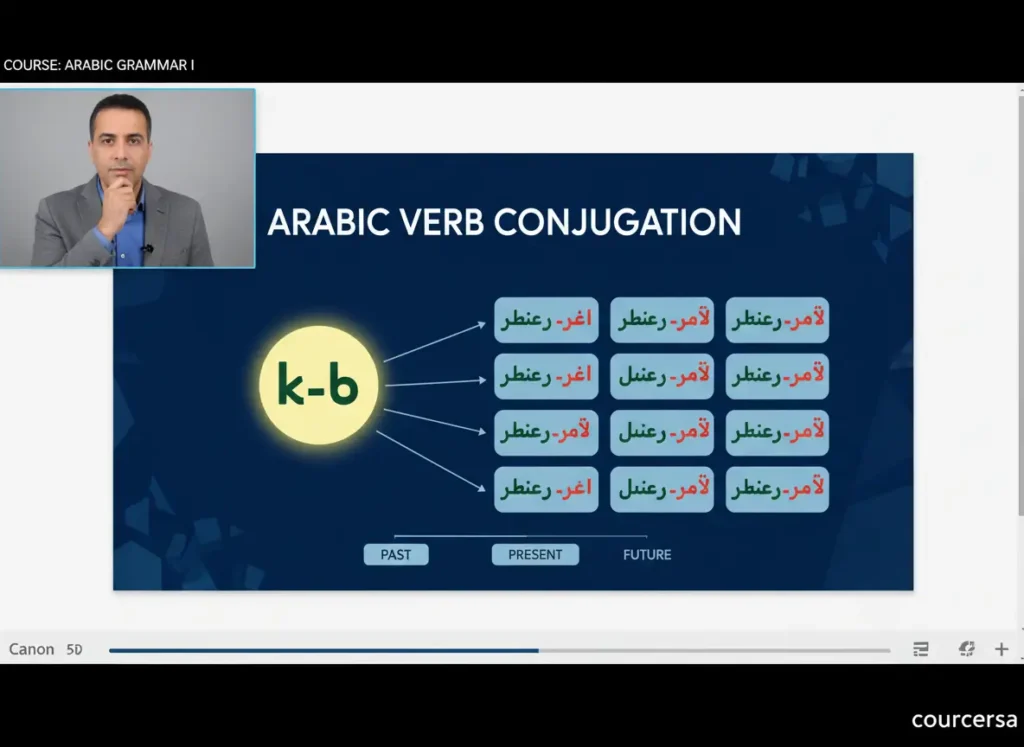
What you actually get on Coursera is a well-produced series of video lectures, self-paced assignments, automated quizzes, and in many cases a certificate you can add to a LinkedIn profile. For MSA reading and writing at a foundational level, Coursera courses are genuinely competent. The production quality is high. The academic content is solid.
The problem is structural, not incidental. Coursera is built for scale. A course that serves 50,000 simultaneous learners cannot provide real-time speaking feedback, cannot correct your pronunciation, cannot notice that you’ve been guessing at verb conjugations and getting them right by accident without actually understanding the rule. You are, in every meaningful sense, alone with a screen.
For learners who want a recognized certificate for professional or academic purposes, Coursera is worth considering as a supplement to live instruction. As a standalone Arabic learning program, it produces a specific kind of learner: one who can read and write at a basic level and has no idea how to hold a conversation.
Best for: Certificate seekers, academic MSA foundation, structured self-study alongside a live program. Not for: Conversational fluency, Quranic Arabic, pronunciation, or anyone who needs human feedback.
Udemy Arabic — Affordable Entry, Hard Ceiling
Udemy occupies a different space. Where Coursera positions itself as academic, Udemy is more honestly a marketplace — a platform where individual instructors sell their courses, with quality ranging from genuinely excellent to actively misleading. The good news is that strong Arabic courses do exist on Udemy, and they can be found for $10 to $20 during the platform’s perpetual sale cycle.
The best Udemy Arabic courses cover the alphabet thoroughly, introduce foundational grammar with clear explanations, and provide dialect-specific content — Egyptian Arabic, Levantine Arabic, Gulf Arabic — that Coursera largely ignores. For someone in the first four to six weeks of learning who wants structured, affordable, self-paced content, the right Udemy course is a genuinely useful starting point.
The ceiling, however, is low and it arrives quickly. Udemy courses are entirely pre-recorded. There is no instructor feedback, no pronunciation correction, no adaptation to your specific confusion. Many learners finish a beginner Udemy course feeling like they’ve learned a lot, then sit down with a native speaker and realize they cannot form a single sentence under pressure. The information went in but the language didn’t stick, because it was never actually practiced in context.
The other issue with Udemy is quality variance. For every strong Arabic course, there are several that overpromise, underdeliver, and leave learners more confused than when they started. Always check reviews carefully, preview the first few lessons before buying, and treat it as a supplement rather than a program.
Best for: Affordable first exposure, alphabet and basic grammar, dialect-specific vocabulary, supplementing a live program. Not for: Speaking practice, intermediate and advanced progression, accountability, or anyone serious about fluency.
Preply Arabic — Flexible Tutoring, Inconsistent Results
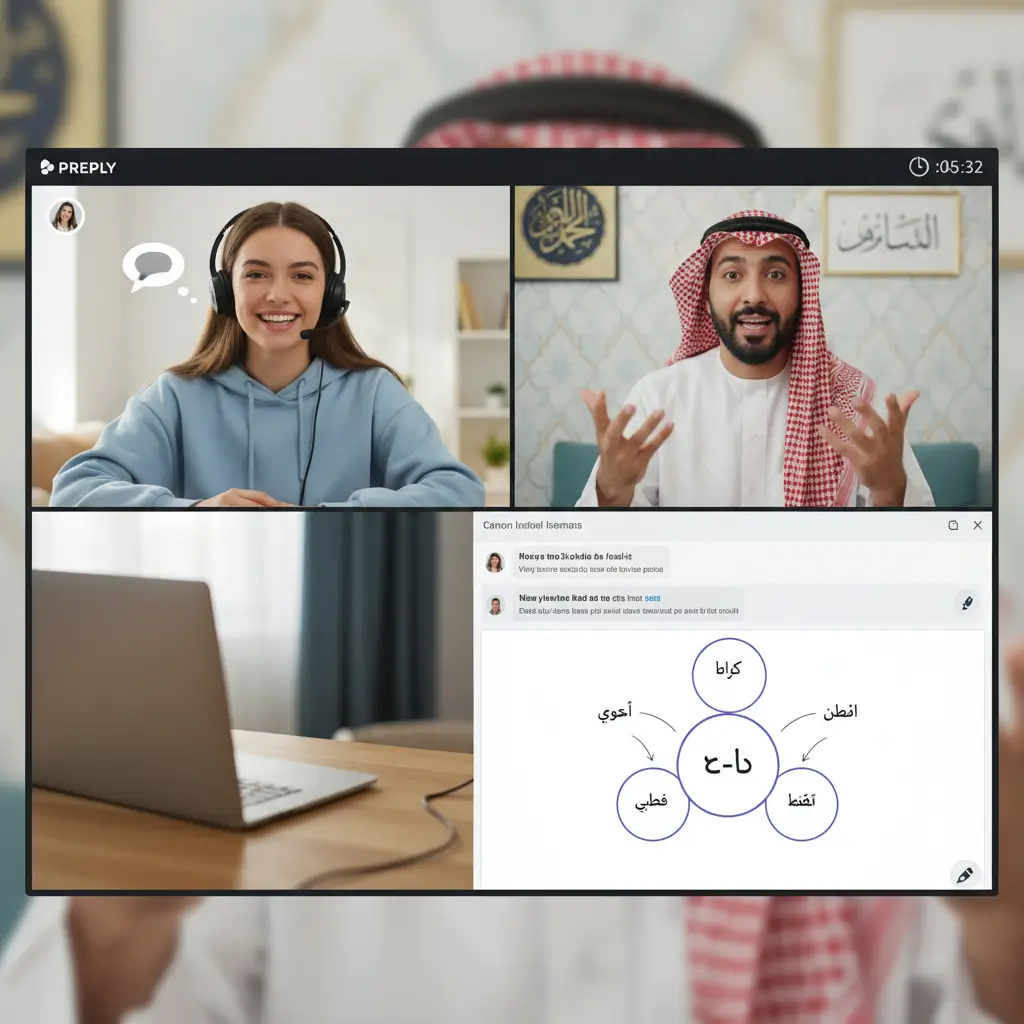
Preply operates as a marketplace connecting learners with independent tutors who set their own rates, teach on their own schedule, and determine their own approach. The appeal is obvious: you can browse hundreds of Arabic tutors, filter by dialect, read reviews, try a trial lesson, and switch tutors if it doesn’t work. The flexibility is genuine.
For certain learners in certain situations, Preply works well. If you’re at an intermediate level, you know what you want to practice, and you have the self-discipline to direct your own learning, a good Preply tutor can provide exactly the live conversation practice you need. Some tutors on the platform are excellent — qualified, experienced, genuinely engaging.
The inconsistency is the platform’s defining weakness. Because tutors are independent contractors rather than trained faculty within a structured program, the experience varies enormously from one tutor to the next. You might find someone exceptional. You might find someone who is a native speaker but has never studied pedagogy and doesn’t know how to explain why something sounds wrong. You have no guarantee of curriculum coherence across sessions, no institutional accountability, and no structured progression from one level to the next.
For beginners especially, this is a significant problem. Without a structured curriculum guiding the lessons, many beginner learners don’t know what they don’t know — and a tutor without a clear framework can end up reinforcing confusion rather than resolving it.
Best for: Intermediate learners who want conversation practice, people who already have a curriculum and need speaking time, flexible one-off sessions. Not for: Beginners who need structure, Quranic Arabic, children’s programs, or anyone who wants guaranteed curriculum quality.
Transparent Language Arabic — Recognition Without Production
Transparent Language is a software product originally built for military and government language training that has since expanded to general consumer use. It takes a vocabulary-first approach, using spaced repetition, voice recognition, and structured review cycles to build word recognition over time.
For vocabulary retention and reading comprehension at a basic level, Transparent Language does what it promises. The spaced repetition methodology is sound, the interface is clean, and the progress tracking is satisfying in a way that keeps some learners engaged.
What Transparent Language cannot do is teach you to speak. Voice recognition technology in 2026 has improved but it is not equivalent to a human ear. It cannot tell you that your pronunciation is technically close enough to pass the software’s threshold while being completely unintelligible to a native speaker. It has no mechanism for grammar explanation, conversational context, or cultural nuance. It will not tell you that the phrase you just learned is technically correct but sounds stiff and formal in a context where everyone would use the colloquial alternative.
As a vocabulary supplement during early learning, Transparent Language is a reasonable tool. As a path to Arabic fluency, it produces learners who recognize words they cannot use.
Best for: Vocabulary building as a supplement, government or military foundational training, structured word recognition. Not for: Conversation, grammar depth, Quranic Arabic, cultural immersion, or any speaking skill.
LingQ Arabic — Input-Rich, Output-Poor
LingQ is built around a compelling and research-backed theory: that language acquisition happens primarily through massive amounts of comprehensible input — reading and listening to content slightly above your current level, in context, over extended periods. Its founder Steve Krashen’s ideas about input-based learning have genuine empirical support, and LingQ implements them with real thoughtfulness.
For Arabic specifically, LingQ offers a growing library of graded reading and listening content, a vocabulary tracking system that highlights unfamiliar words in context, and tools for importing your own content to study. For intermediate and advanced learners who want to develop reading comprehension and expand vocabulary through authentic Arabic content, LingQ is one of the better tools available.
The Arabic-specific limitations are worth knowing. Arabic’s root-based morphology and the significant difference between written MSA and spoken dialects make the input-based approach more complex than it is for, say, Spanish. A learner absorbing MSA content on LingQ will still be surprised by how different spoken Egyptian Arabic sounds in practice. The platform also provides no speaking practice, no correction, and no human interaction of any kind.
LingQ works best as a reading and listening complement to live instruction — not as a standalone program.
Best for: Intermediate and advanced learners, reading comprehension, vocabulary expansion through authentic content. Not for: Beginners, speaking practice, Quranic Arabic, children, or structured level progression.
LingoHut Arabic — Simple, Free, Shallow
LingoHut is a free vocabulary and phrase platform with a clean interface and zero barrier to entry. It covers basic Arabic vocabulary categories — colors, numbers, food, greetings — through simple flashcard-style exercises with audio.
There is not much to say critically about LingoHut because it doesn’t promise very much. It is free, simple, and gets your eyes and ears accustomed to basic Arabic vocabulary. For an absolute beginner spending ten minutes before their first real lesson, it serves a purpose.
Beyond that first week, LingoHut has nothing more to offer. It has no grammar instruction, no cultural context, no progression beyond basic vocabulary, and no speaking practice. Think of it as a brief appetizer, not a meal.
Best for: The first few days of learning, supplementary vocabulary review. Not for: Anything beyond absolute beginner vocabulary.
Duolingo Arabic — The Most Honest Summary in 2026
Duolingo’s Arabic course has improved meaningfully over the past two years. It now covers more grammar, the exercises are more varied, and the overall experience is more polished than it was. For what it is — a free, gamified, low-commitment introduction to a language — it does its job.
What it still cannot do in 2026 is teach you to speak Arabic. The “speaking exercises” on Duolingo are not pronunciation correction; they are voice recognition thresholds that a wide range of sounds will pass. Duolingo’s Arabic grammar explanations are thin by design, because the platform is built around habit formation and engagement, not linguistic depth.
Use Duolingo for two or three weeks at the very beginning to get familiar with the script and basic vocabulary. Don’t stay longer than that if you have a real fluency goal.
Best for: First exposure to the script, basic vocabulary habits, zero-cost introduction. Not for: Grammar, speaking, anything beyond beginner level.
The Full Comparison at a Glance
| Platform | Live Teacher | Speaking Practice | Curriculum Structure | Quranic Arabic | Kids’ Programs | Price Range |
|---|---|---|---|---|---|---|
| Coursera | ✗ | ✗ | ✅ Strong | ✗ | ✗ | $39–99/month |
| Udemy | ✗ | ✗ | Varies | Limited | Limited | $10–30 one-time |
| Preply | ✅ (varies) | ✅ (varies) | ✗ | Limited | Limited | $15–60/session |
| Transparent Language | ✗ | ✗ (auto only) | Partial | ✗ | ✗ | $25/month |
| LingQ | ✗ | ✗ | Partial | ✗ | ✗ | $12–36/month |
| LingoHut | ✗ | ✗ | ✗ | ✗ | ✗ | Free |
| Duolingo | ✗ | ✗ (auto only) | ✗ | ✗ | ✗ | Free |
| Alphabet Arabic Academy | ✅ Always | ✅ Every session | ✅ Structured | ✅ Dedicated | ✅ Ages 4–12 | From $40/month |
What Alphabet Arabic Academy Does Differently
This isn’t the section where we list features. It’s the section where we explain the philosophy, because philosophy is what actually determines outcomes.
Every platform described above was built to scale. They serve thousands or millions of users simultaneously, which means the product is designed for the average user in the average situation. You are not average. Your goal, your schedule, your current level, your reason for learning Arabic — these are specific to you, and they matter.
Alphabet Arabic Academy is built around a different premise: that Arabic is best learned the way it was always transmitted — from a knowledgeable person to a student, in real time, with the lesson adapting to what the student actually needs in that moment.
Our teachers are native Egyptian Arabic speakers with formal training in language instruction for non-native learners. They are not freelancers managing fifteen different platforms and a calendar full of strangers. They are part of a structured faculty with a shared curriculum, shared standards, and shared accountability for your progress.
Every student who joins us goes through a placement process — not to sort you into a category, but to understand your specific goal and match you with the right teacher and the right program. A mother who wants her seven-year-old to love Arabic starts somewhere completely different from a professional who needs business Arabic for a Gulf posting, even if they’re both technically “beginners.”
Our programs span beginner to advanced MSA, Egyptian spoken dialect, dedicated Quranic Arabic and Tajweed, children’s courses from age four through twelve, teen programs, adult conversational Arabic, and business Arabic. Sessions run thirty to sixty minutes, scheduled around your life. If you miss a class, we reschedule. If you’re progressing faster than expected, we move forward. If something isn’t clicking, your teacher adjusts — because they can see your face and hear your hesitation in a way that no software ever will.
And the price starts at $40 per month. Not as a promotional rate. As the actual price.
The Smartest Approach: Combining Tools Intentionally
We are not going to tell you that every app and platform on this list is worthless. That would be dishonest, and unhelpful.
The truth is that the learners who make the fastest progress are the ones who use multiple tools intentionally — with a live structured program at the center and everything else in a supporting role.
A strong approach might look like this: live sessions with Alphabet Arabic Academy two to three times per week as your primary learning method, Duolingo or LingoHut for five minutes of daily vocabulary review between sessions, a LingQ reading exercise at the intermediate level to build reading comprehension alongside your spoken practice, and an occasional Udemy course on a specific topic — a dialect feature, a grammar point — that supplements what you’re working on in live sessions.
What you want to avoid is the opposite pattern: half an hour of Duolingo, a Udemy course you haven’t opened in two weeks, a Preply session you booked once and never rebooked, and a Coursera certificate that proves you completed a module but can’t actually help you say anything. That pattern — and it’s extremely common — produces the feeling of learning without the reality of progress.
A Word on Quranic Arabic Specifically
For Muslim learners, Quranic Arabic deserves its own mention because it is frequently mishandled by the platforms above.
Quranic Arabic is not simply MSA with religious vocabulary. It has its own grammatical structures, its own register, its own phonological precision requirements. Tajweed — the rules governing correct recitation — cannot be learned from software. Voice recognition cannot tell you that your makharij al-huruf is slightly off in a way that would be immediately audible to any qualified teacher. This is a domain where live human instruction is not a preference but a requirement.
Alphabet Arabic Academy’s Quranic Arabic and Tajweed program is taught by instructors with dedicated training in Islamic pedagogy. Sessions are thirty minutes, focused, and available for both children and adults. We also offer female teachers for students who prefer them.
If Quranic Arabic is your primary goal, it should be your primary filter — and most of the platforms above will not pass it.
Frequently Asked Questions
Can I use Udemy or Coursera alongside Alphabet Arabic Academy? Absolutely, and for many learners, this is the optimal approach. Use structured self-paced content to review grammar rules and vocabulary between live sessions. The key is keeping live instruction at the center and treating everything else as supplement.
Is Preply a competitor to Alphabet Arabic Academy? They serve different purposes. Preply is a tutor marketplace where quality and curriculum coherence vary by individual. We are a structured academy with a shared curriculum, professional faculty, and institutional accountability. For beginners especially, the difference in outcome is significant.
What if I’ve already tried several platforms and given up? This is the most common situation we encounter. Most people who contact us have already tried at least one app and at least one self-paced course. They haven’t failed at Arabic — they’ve used tools that weren’t designed to get them where they wanted to go. Starting with live instruction typically produces noticeable progress within the first few weeks.
Which dialect does Alphabet Arabic Academy teach? We teach Modern Standard Arabic, Egyptian Arabic, and Quranic Classical Arabic. For most learners, we recommend starting with MSA as a foundation and adding a spoken dialect based on your specific goal. Your placement session will help determine the right track.
How quickly will I see real progress? Most students report meaningful progress — being able to form sentences, understand simple spoken Arabic, hold a short exchange — within four to eight weeks of consistent weekly sessions. The pace depends on frequency and how much practice you put in between classes. Two sessions per week produces faster results than one.
The Bottom Line
The platform landscape for Arabic learning in 2026 is richer than it has ever been, and that’s genuinely good news. You have more tools available than any previous generation of Arabic learners. The challenge is using them wisely rather than collecting them.
Every platform in this guide has a legitimate use. Duolingo for the first week. Udemy for affordable supplementary content. LingQ for intermediate reading practice. Coursera if you specifically need academic MSA certification. Preply for occasional conversation practice at the intermediate level. Transparent Language, LingoHut — brief roles, limited scope.
None of them, alone or in combination, replace what a qualified native teacher in a structured live program provides. And none of them start at $40 per month with full access to that level of instruction.
Visit AlphabetArabicAcademy.com to book your placement session, explore pricing for adults, teens, kids, and Quranic Arabic, or reach out directly to the team.
You’ve done the research. Now do the learning.
Follow us on social media for Arabic tips, student success stories, and cultural content. AlphabetArabicAcademy.com
- “If you’re still deciding between local classes and online, read our [full guide here “Arabic Classes Near Me vs Online“).