You’ve said الْحَمْدُ لِلَّهِ رَبِّ الْعَالَمِينَ thousands of times. Maybe tens of thousands. But if someone asked you what each word in it means, could you answer?
Most people can’t. And I’ll be straight with you — that’s not a faith problem. It’s a vocabulary problem. Nobody ever sat you down and handed you the words.
Here’s the good news. The Quran repeats itself. A lot. It has roughly 77,000 words in total, but a small group of them shows up on almost every page. Learn those, and verses stop looking like a wall of letters. You start spotting pieces. “That’s Lord. That’s those who believe. That’s the Day.”
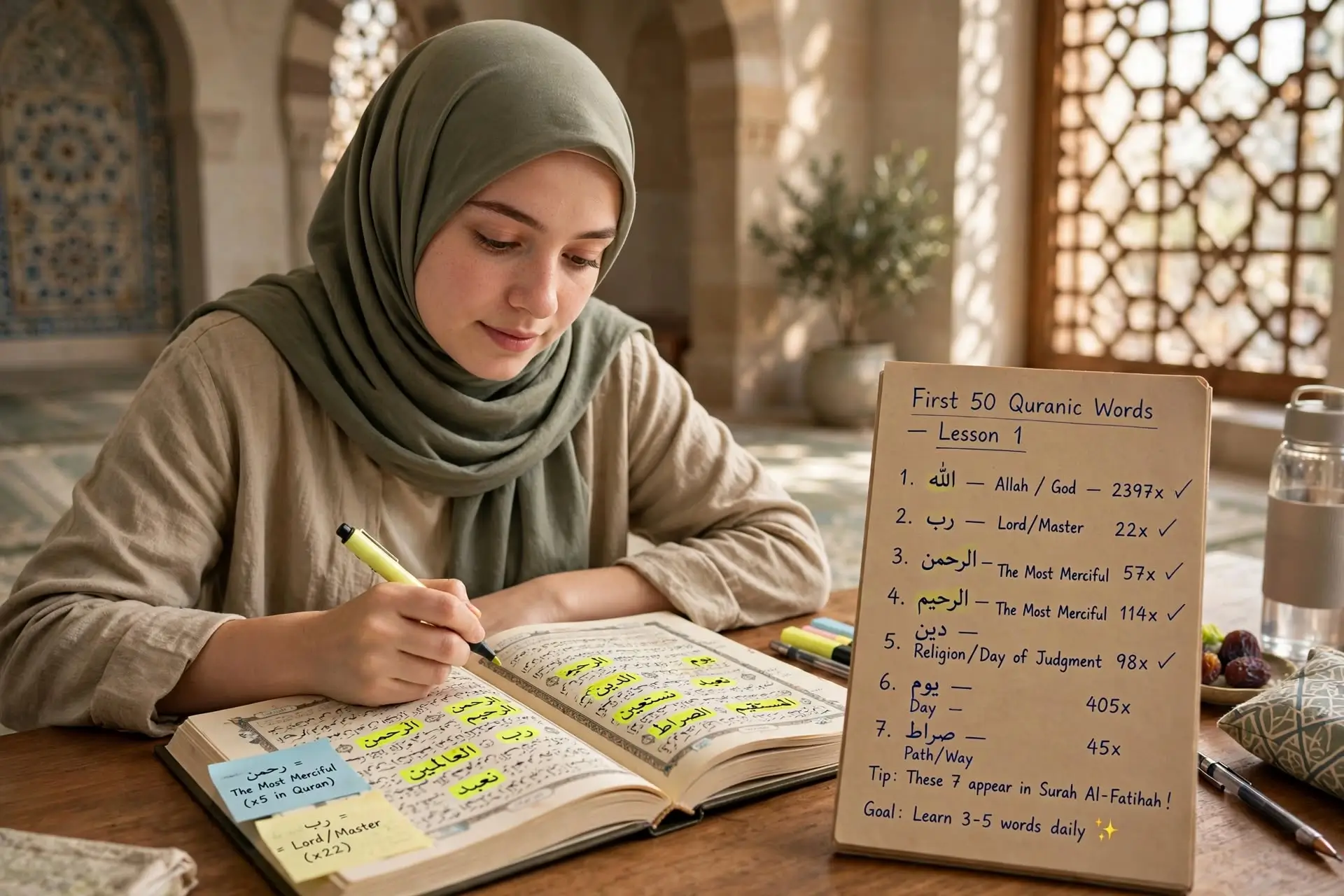
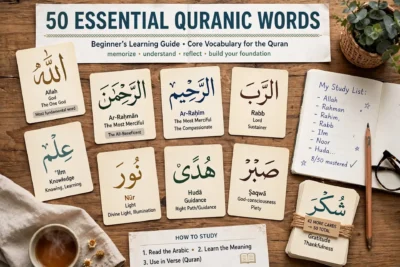
That’s what this list is for. 50 words. Each one comes with the Arabic, how to say it, what it means, and a verse where you’ll meet it. Five words a day, and you’re done in ten days.
Why Start With Words and Not Grammar?
Because grammar without vocabulary is just rules about nothing. Once you recognize a handful of words, grammar finally has something to hold onto. You see a pattern and think, “Oh, that’s why it looks different here.”
There’s also the repetition factor. Researchers have mapped every single word of the Quran. The best-known example is the Quranic Arabic Corpus from the University of Leeds (Wikipedia overview, the corpus itself). And the pattern is clear: a few hundred word families cover most of the text.
Exact percentages change depending on how you count — word forms, roots, or lemmas — so be skeptical of anyone selling you one neat number. The ballpark you’ll see most often: around 100 high-frequency words cover about half the Quran, and a few hundred get you to roughly 70–80%.
Honestly? 50 words won’t get you to half. I won’t pretend they will. What they give you is the skeleton — the little connecting words and the big ideas that keep coming back. Everything else hangs on that.
How These 50 Words Were Picked
This isn’t a raw frequency chart. I picked words that appear constantly and teach you something. They’re short, they show up in surahs you already know, and they snap together into real verses fast. I split them into four groups: small words, big ideas, verbs, and everyday nouns.
Two quick notes before the lists. The Quran is printed with full vowel marks, so you can read each word exactly as it’s shown. And “Seen in” means Surah:Ayah — it’s one place you’ll find the word, not the only one.
Group 1: Small Words With Big Jobs (1–12)
These look boring. They’re not. They glue every verse together, which is why they come first. Skip them and you’ll recognize a few nouns but never follow the sentence.
| # | Arabic | Say it | Meaning | Seen in |
| 1 | مِنْ | min | from, of | 96:2 |
| 2 | فِي | fī | in | 2:2 |
| 3 | عَلَىٰ | ʿalā | on, upon, over | 2:20 |
| 4 | إِلَىٰ | ilā | to, toward | 2:28 |
| 5 | مَا | mā | what; also “not” | 93:3 |
| 6 | لَا | lā | no, not | 2:2 |
| 7 | إِنَّ | inna | indeed, surely | 94:6 |
| 8 | هُوَ | huwa | he, it | 112:1 |
| 9 | هُمْ | hum | they | 2:5 |
| 10 | ذَٰلِكَ | dhālika | that | 2:2 |
| 11 | الَّذِينَ | alladhīna | those who | 2:25 |
| 12 | كُلّ | kull | every, all | 3:185 |
One more: وَ (wa) means “and.” It sticks to the front of the next word, like وَرَبُّكَ. It’s everywhere. It’s not in the 50 because it’s a prefix, but learn it today anyway.
Group 2: The Big Ideas (13–20)
These are the ideas the whole book keeps circling back to. If you only had eight words to start with, these would be a strong choice.
| # | Arabic | Say it | Meaning | Seen in |
| 13 | اللّٰه | Allāh | God | 1:1 |
| 14 | رَبّ | rabb | Lord, sustainer | 1:2 |
| 15 | إِلٰه | ilāh | god, deity | 7:59 |
| 16 | رَحْمَة | raḥma | mercy | 21:107 |
| 17 | هُدًى | hudā | guidance | 2:2 |
| 18 | حَقّ | ḥaqq | truth, what is right | 17:81 |
| 19 | كِتَاب | kitāb | book, scripture | 2:2 |
| 20 | آيَة | āya | sign; also a verse | 41:53 |
A warning, though. Don’t let one-word English meanings fool you. Ḥaqq isn’t only “truth.” It’s also “what’s right,” “what’s due,” “reality.” Single English words flatten Arabic. Treat my meanings as a doorway, not the whole room.
Group 3: Verbs (21–32)
Arabic verbs are listed in the “he did” form. In the Quran you’ll see them with extra bits attached — “they said,” “you did,” “We sent down.” Don’t panic. Learn the base first. The changes come later.
And here’s something that makes life easier: Arabic words grow from three-letter roots. The root خ-ل-ق gives you created, creator, creation. One root, a whole family of words. That’s why learning one word often gets you two or three for free.
| # | Arabic | Say it | Meaning | Seen in |
| 21 | قَالَ | qāla | he said | 7:59 |
| 22 | قُلْ | qul | say! (command) | 112:1 |
| 23 | كَانَ | kāna | was, used to be | 4:11 |
| 24 | آمَنَ | āmana | he believed | 2:285 |
| 25 | عَمِلَ | ʿamila | he did, he worked | 99:7 |
| 26 | كَفَرَ | kafara | he rejected, disbelieved | 109:1 |
| 27 | خَلَقَ | khalaqa | he created | 96:1 |
| 28 | أَنزَلَ | anzala | he sent down | 97:1 |
| 29 | جَعَلَ | jaʿala | he made, he placed | 2:22 |
| 30 | عَلِمَ | ʿalima | he knew | 96:5 |
| 31 | جَاءَ | jāʾa | he came | 110:1 |
| 32 | ذَكَرَ | dhakara | he remembered, he mentioned | 2:152 |
Group 4: Things, People, and Places (33–50)
The last group is the biggest. These are the nouns that fill the Quran’s world: the sky and the earth, people and their hearts, this life and the next.
| # | Arabic | Say it | Meaning | Seen in |
| 33 | يَوْم | yawm | day | 1:4 |
| 34 | أَرْض | arḍ | earth, land | 2:22 |
| 35 | سَمَاء | samāʾ | sky, heaven | 2:22 |
| 36 | نَاس | nās | people, mankind | 114:1 |
| 37 | نَفْس | nafs | self, soul | 3:185 |
| 38 | قَوْم | qawm | people, nation, folk | 7:59 |
| 39 | رَسُول | rasūl | messenger | 48:29 |
| 40 | جَنَّة | janna | garden, paradise | 2:25 |
| 41 | نَار | nār | fire | 2:24 |
| 42 | أَمْر | amr | matter, command | 16:1 |
| 43 | شَيْء | shayʾ | thing | 2:20 |
| 44 | مَاء | māʾ | water | 2:22 |
| 45 | آخِرَة | ākhira | the hereafter | 2:201 |
| 46 | دُنْيَا | dunyā | this world, this life | 2:201 |
| 47 | عَذَاب | ʿadhāb | punishment, torment | 2:7 |
| 48 | قَلْب | qalb | heart | 13:28 |
| 49 | صَلَاة | ṣalāh | prayer | 2:43 |
| 50 | خَيْر | khayr | good, goodness | 99:7 |
Try It: Read Real Verses With Your 50 Words
Here’s where it gets fun. Let’s read actual verses and see how much you already recognize.
Example 1: Surah Al-Ikhlas
قُلْ هُوَ اللَّهُ أَحَدٌ (112:1)
Four words. You know three: qul (say), huwa (he), Allāh. Only aḥad (one) is new. So the verse reads: “Say: He is Allah, the One.” You just read a verse by yourself.
Example 2: The Last Surah
قُلْ أَعُوذُ بِرَبِّ النَّاسِ (114:1)
You know qul, rabb, and nās. Notice that rabb looks a little different here — بِرَبِّ, with a bi- (“in, with”) stuck on the front. The new bit is aʿūdhu, “I seek refuge.” Put together: “Say: I seek refuge in the Lord of mankind.”
Example 3: A Verse Packed With Your Words
الَّذِي جَعَلَ لَكُمُ الْأَرْضَ فِرَاشًا وَالسَّمَاءَ بِنَاءً وَأَنزَلَ مِنَ السَّمَاءِ مَاءً (2:22)
Count them. Alladhī (the one who — the singular of alladhīna), jaʿala (made), al-arḍ (the earth), al-samāʾ (the sky), anzala (sent down), min (from), māʾ (water). That’s seven words from your list in a single verse. You’d only need lakum (for you), firāsh (a bed) and bināʾ (a structure) to get the whole thing: He made the earth a bed for you and the sky a canopy, and sent down water from the sky.
See that? Words change shape a little. Rabb becomes rabbi. A noun picks up an al- (“the”). A prefix shows up. That’s normal. Your eye learns to look past the extras, and it happens faster than you’d think.
Three Pairs That Confuse Beginners
Some words look like they overlap. They don’t. Sort these out early and you’ll save yourself a lot of head-scratching.
- Allāh, rabb, and ilāh. Allāh is the name of God. Rabb is “Lord” in the sense of one who owns, nurtures, and sustains. Ilāh is a general word for “a god” — which is why lā ilāha illā Allāh is so powerful. It denies every other deity, then affirms the One.
- Nās and qawm. Both can be translated as “people.” Nās usually means people as humankind, everyone. Qawm is a particular folk, tribe, or nation, like the people a prophet was sent to. You’ll see yā qawmi (“O my people”) again and again in the stories of earlier prophets.
- Dunyā and arḍ. Arḍ is the physical earth, the ground under your feet. Dunyā is this life, as opposed to the ākhira. One is a place. The other is a stage.
A 10-Day Plan: 5 Words a Day
Take the table in order. Five words a day. Fifteen minutes. Here’s how to spend them:
- Minutes 1–3: Say yesterday’s five words from memory. No peeking.
- Minutes 4–8: Learn today’s five. Say each one out loud, then write it by hand.
- Minutes 9–13: Open the verse in “Seen in” for each word and read the whole thing aloud. Find the word inside it.
- Minutes 14–15: Write down one thing you noticed. A prefix. A pattern. A word you already knew.
If that structure looks familiar, it’s the same one in our 15-minute daily Arabic study routine. It works for Quranic vocabulary just as well as for anything else. On day 11, review all 50. Then go get the next 50.
Mistakes That Slow Beginners Down
- Memorizing lists with no verses. A word you’ve only seen on a flashcard disappears in a week. A word you’ve found in three verses sticks.
- Skipping the small words. Everyone wants the exciting nouns. But min, fī, and alladhīna are what make sentences make sense.
- Trusting one English meaning. Translation is a guide, not a replacement. Words like nafs and amr stretch across several meanings depending on the verse.
- Ignoring pronunciation. The difference between قَلْب (heart) and كَلْب (dog) is one letter. Say it wrong and you’ve said something else entirely. That’s where Tajweed comes in.
- Treating vocabulary like tafsir. Knowing words helps you follow what you recite. It doesn’t make you an interpreter of the Quran. For deeper meaning you still need context and qualified teachers.
Questions Beginners Keep Asking
These come up again and again in Reddit threads and Quora answers from people starting Quranic Arabic. Here are straight answers.
Can I understand the Quran by learning vocabulary alone?
You can follow the gist of a lot of verses, yes. But not all of them, and not deeply. Vocabulary gets you recognition. Grammar gets you precision. Most learners do the first 100 or so words, then add basic grammar. Do both, in that order.
How many words do I need to understand the Quran?
It depends on what “understand” means to you. Commonly cited figures say about 100 high-frequency words cover roughly half the text, and 300–500 word families get you to around 70–80%. Reading it comfortably without a translation takes longer — usually 12 to 24 months of steady study.
I’ve recited for years and still don’t understand a word. Why?
Because reciting and understanding are different skills. Most of us were taught the first one and never the second. It’s a curriculum gap, not a personal failure. Our complete guide to Quran courses explains how reading, Tajweed, and understanding fit together.
Should I learn Quranic Arabic or Modern Standard Arabic first?
If your goal is the Quran, start with Quranic Arabic. If you also want to read news, books, or work in Arabic, add MSA after. We break this down properly in MSA vs Egyptian vs Quranic Arabic: which one should you start with?
Do I need Tajweed before I learn these words?
No. You can learn vocabulary and Tajweed side by side. But pronunciation matters from day one, because a wrong sound can change a word. If you’re learning alone, record yourself and compare to a reciter you trust. Better still, have a teacher listen.
Can my kids learn these words too?
Absolutely. Children pick up Arabic sounds quickly. Keep sessions short, make it playful, and use two or three words a day instead of five. We have a whole programme built for this: Quranic Arabic for kids.
What to Do After the First 50
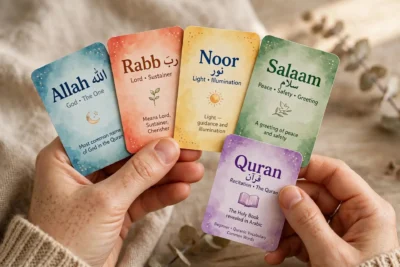
Keep going. Seriously. The next 50 are easier than these, because you’ll already recognize half the patterns. Aim for 100 words in the first month or so, then 300 over the following months. Along the way, add basic grammar: how sentences are built, how verbs change, what the common prefixes do.
Not sure where you stand right now? Take the free Arabic placement test. It takes a few minutes and tells you exactly where to begin.
And here’s the thing about self-study: it’s great, but it has limits. Nobody can hear your mistakes for you. A teacher can fix a pronunciation slip in thirty seconds that would take you months to notice. Even one class a week speeds everything up. You can meet our teachers and check the pricing page to see what fits your schedule.
Start Understanding the Quran
You already have the first 50 words in your hands. The next step is turning them into understanding — with a teacher who listens to your recitation, corrects it gently, and builds your vocabulary verse by verse.
[Start understanding the Quran]with our one-on-one online Quran classes, built for beginners from the very first letter.