

Learn Egyptian Arabic the best full guide ! Do you know what that means? A comprehensive guide means you won’t need to look for any information anywhere else. For your convenience, everything is here in one place. We also offer free consultations and answers to any questions you may have about learning the Egyptian dialect.
Egyptian Arabic (Masri) is the most widely understood Arabic dialect in the Arab world—and the fastest path to real conversations with real people. Most beginners hold basic exchanges within 4–6 weeks of focused daily practice with a native teacher.
This guide covers everything: what Egyptian Arabic actually is, why it’s different from MSA, pronunciation secrets that make you sound natural, essential grammar that won’t fight you, daily learning strategies that work, cultural intelligence you can’t skip, and a clear roadmap from zero to confident conversations.
What Is Egyptian Arabic—And What It Isn’t

Let me tell you about James.
James spent nine months mastering Modern Standard Arabic. He could read news articles, understand formal speeches, write grammatically perfect essays. Then he landed in Cairo for his new job.
Day one: The taxi driver asked him “إنت رايح فين؟” (Where are you going?). James froze. His MSA training offered nothing.
Day two: He tried ordering coffee in MSA. The barista smiled and responded in Egyptian. Again—nothing.
Day three: James called, frustrated. “Why did nobody tell me Egyptians don’t actually speak the Arabic I learned?”
That’s the gap. And it’s bigger than most people expect.
Egyptian Arabic Is a Complete Language System
Egyptian Arabic (also called Masri or Ammiya) isn’t “broken” Arabic. It’s not simplified or corrupted. It’s a fully developed language variety with its own consistent grammar, vocabulary, and musicality—used by 100 million Egyptians in homes, streets, workplaces, movies, music, and social media every single day.
The biggest misconception: you must choose between “proper” Arabic (MSA) and “street” Arabic (Egyptian). That’s a false choice. They’re different tools for different jobs.
| Feature | Egyptian Arabic (Masri) | Modern Standard Arabic (Fusha) |
|---|---|---|
| Primary use | Daily conversation and media | Formal writing and news |
| Grammar | Flexible and intuitive | Complex and rule-based |
| Pronunciation | Musical and flowing | Clear and formal |
| Learning curve | Fast (speaking quickly) | Slow (mastery takes years) |
| Emotional range | High (jokes, sarcasm, warmth) | Limited (formal tone) |
Simple example: MSA says كيف حالك؟ (Kayfa haluk?). Egyptian says إزيك؟ (Izzayyak?). The Egyptian version isn’t wrong. It’s how humans actually connect.
Why Egyptian Arabic Specifically
Not all Arabic dialects are equal when it comes to being understood beyond their home region.
Egyptian Arabic scores about 9/10 for regional comprehensibility—understood virtually everywhere in the Arab world because of Egypt’s cultural dominance. Egyptian cinema, music, and social media created this reach over a century.
Levantine Arabic scores around 7/10 through TV dramas. Gulf Arabic around 6/10 from economic influence. Maghrebi Arabic around 3/10, largely confined to North Africa.
Egypt has been the “Hollywood of the Middle East” since the 1930s. 90% of classic Arab films are Egyptian. Umm Kulthum, Amr Diab, and countless modern creators built Egyptian Arabic’s global reach. Learn it, and you’re understood from Dubai to Casablanca.
That’s a superpower no other dialect gives you.
Pronunciation: The Secrets That Make You Sound Egyptian
This is where most learners get stuck. And where you’ll get ahead.
Egyptian pronunciation follows consistent patterns. Once you master them, you sound instantly more natural—not like someone reading from a textbook.
The Three Big Sound Shifts
Shift 1: The Famous “G” Sound
In MSA, ج = “J” as in “jam.” In Egyptian, ج = “G” as in “game.”
- جميل (beautiful) → “gameel” not “jameel”
- جاي (coming) → “gay” not “jay”
- جنة (paradise) → “ganna” not “janna”
This single shift makes you sound immediately Egyptian. Master it first.
Shift 2: The Missing “Q”
In MSA, ق = deep throaty “Q.” In Egyptian, ق = a glottal stop—like the pause in the English expression “uh-oh.”
- قهوة (coffee) → “ahwa” not “qahwa”
- قلب (heart) → “alb” not “qalb”
- قال (he said) → “aal” not “qaal”
Egyptians drop the “Q” sound almost entirely. Trying to use the MSA “Q” in casual conversation marks you immediately as someone reading from a book.
Shift 3: The Softened “TH”
In MSA, ث = “th” as in “think.” In Egyptian, ث = just “t.”
- ثلاثة (three) → “talata” not “thalatha”
- ثاني (second) → “tani” not “thani”
The Musical Quality of Egyptian Arabic
Here’s something no pronunciation guide tells you enough: Egyptian Arabic has a distinct rhythm and melody that’s part of the language.
Questions rise at the end with a specific pattern. Surprise is expressed through pitch changes. Enthusiasm stretches vowels. The word “يا سلاааам!” (ya salaaam—expressing amazement) means almost nothing without the melody that carries it.
Spend five minutes daily just mimicking the music—without worrying about the words. Listen to how Egyptians express emotion through sound. That musicality is what separates someone who speaks Egyptian Arabic from someone who says Egyptian Arabic words.
Grammar That Doesn’t Fight You
If you’ve ever struggled with MSA’s complex case endings (الإعراب) or felt overwhelmed by conjugation tables—relief is coming.
Egyptian Arabic grammar is built for actual human conversation. It’s evolved over centuries of daily use to prioritize speed, clarity, and connection. Think of the difference between writing a legal document and texting a friend. Same underlying language. Completely different registers.
No More Dual Overcomplication
MSA requires separate forms for singular, dual, and plural nouns. Egyptian uses just singular and plural—like English.
“Two books” in MSA requires a special dual form with specific case endings. In Egyptian, you say كتابين (keta-been). Done.
The Simplified Verb System
Egyptian uses prefixes that are beautifully consistent across hundreds of verbs:
- Present/continuous: بـ (b-) prefix → أنا باكل (ana bakul) = I eat / I’m eating
- Future: هـ (ha-) prefix → أنا هاكل (ana hakul) = I will eat
- Negation: ماـ…ـش (ma-…-sh) → أنا ماكلتش (ana makalsh) = I didn’t eat
Learn this pattern once. Apply it to hundreds of verbs. Immediately.
The Egyptian Negation Pattern (ما…ش)
This might be the most satisfying grammar rule you’ll learn. Instead of different negation words for different contexts, you wrap the verb:
- عارف (I know) → ما عارفش (I don’t know)
- فهمت (I understood) → ما فهمتش (I didn’t understand)
- رحت (I went) → ما رحتش (I didn’t go)
- شفت (I saw) → ما شفتش (I didn’t see)
One pattern. Every verb. Systematic, musical, unmistakably Egyptian.
Question Words That Work Immediately
- إيه؟ (eh?) — What?
- فين؟ (feyn?) — Where?
- إزاي؟ (izzay?) — How?
- ليه؟ (leh?) — Why?
- مين؟ (meen?) — Who?
- امتى؟ (emta?) — When?
- بكام؟ (bekam?) — How much?
Seven words. Immediate access to most everyday questions.
Essential Egyptian Arabic: Phrases You’ll Actually Use

Forget textbook phrases nobody says. Here’s what Egyptians actually use.
Social Connectors—Make Instant Friends
| Situation | Egyptian Arabic | Pronunciation | What It Actually Means |
|---|---|---|---|
| Greeting a friend | عامل إيه؟ | 3amel eh? | How are you doing? |
| Responding positively | الحمد لله | el-7amdu lillah | Praise God (I’m good) |
| Friendly address | يا باشا | ya basha | Hey boss (warm and casual) |
| Expressing thanks | تسلم | teslam | May you be safe (thanks) |
| Softening a request | لو سمحت | law sama7t | If you please |
| Amazing! | يا سلام! | ya salaam! | How wonderful! |
Market Arabic—Shopping and Bargaining
- السلام عليكم — Start friendly, always
- بكام ده؟ (bekam da?) — How much is this?
- دي غالية قوي (di ghalia awi) — This is very expensive
- آخر سعر كام؟ (akher se3r kam?) — What’s your final price?
- خلاص هشوف حاجة تانية (khalas hashoof 7aga tanya) — Okay, I’ll look elsewhere
That last phrase is your most powerful bargaining tool. Use it and start walking.
Food Essentials—Order Like a Local
At a juice stand:
- عصير فراولة (3aseer frawla) — Strawberry juice
- عصير مانجو باللبن (3aseer mango bel laban) — Mango smoothie
- بدون سكر (bedoon sukkar) — Without sugar
Ordering food:
- عايز (m) / عايزة (f) — I want…
- ده زاكي أوي! (da zaki awi!) — This is delicious!
- الحساب من فضلك (el-7esab law sama7t) — The bill please
For a comprehensive list of 50 essential phrases with pronunciation and cultural context, see our dedicated Egyptian Arabic phrases guide.
Daily Habit Phrases—Build Them Into Your Routine
Morning:
- صباح الخير (saba7 el-kheir) — Good morning
- Reply: صباح النور (saba7 el-noor) — Morning of light
Throughout the day:
- إن شاء الله (inshallah) — God willing (layers: definite yes / maybe / probably not—the tone tells you everything)
- معلش (ma3lesh) — Sorry / No problem / It’s okay / Don’t worry about it (possibly the most useful word you’ll learn)
- خلاص (khalas) — Done / Finished / Okay / Enough
- يعني (ya3ni) — I mean / Kind of / Sort of (used constantly, like “like” in English)
- طيب (tayyeb) — Okay / Alright / Fine
Daily Habits That Build Real Fluency

Here’s the truth about fluency: it’s built in 25-minute daily sessions, not 3-hour weekend marathons. Consistency beats intensity. Every time.
The 25-Minute Daily Routine That Actually Works
Minutes 0–10: The Listening-Speaking Loop
Take one 1-minute Egyptian dialogue. Listen three times:
- First time: just absorb the sounds
- Second time: catch words you recognize
- Third time: read the transcript while listening
Then shadow—pause after each phrase and repeat exactly, mimicking intonation. Not just the words. The music.
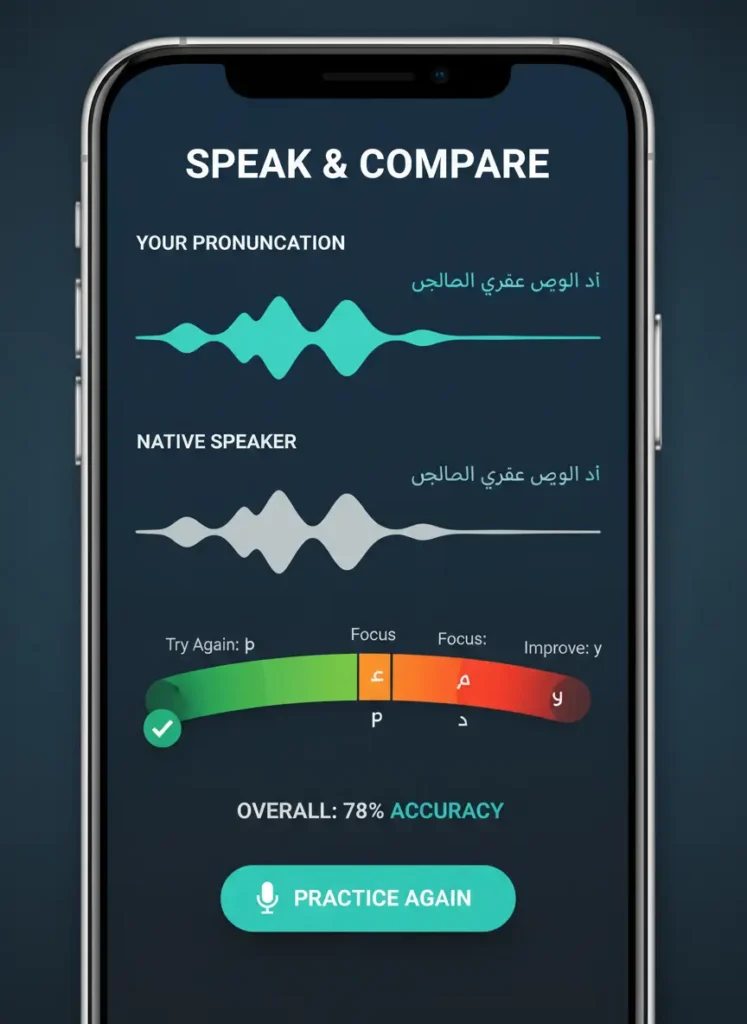
Minutes 10–20: Record and Compare
Say the dialogue from memory. Record yourself. Compare to the original.
This single step reveals what your ear hasn’t caught yet. Students who record daily improve 40–60% faster than those who don’t. You hear yourself differently than you think you sound.
Minutes 20–25: Active vocabulary review
Five new words from your session, plus five from yesterday. Say each out loud with a simple example sentence. Not reading—speaking.
That’s it. 25 minutes. Non-negotiable daily commitment.
Weekly Structure That Compounds Progress
| Day | Focus |
|---|---|
| Monday | New vocabulary + flashcard review |
| Tuesday | Listening + shadowing |
| Wednesday | Conversation practice with tutor or partner |
| Thursday | Watch Egyptian series episode (subtitles on) |
| Friday | Review week’s phrases + self-recording |
| Saturday | Culture immersion (music, film, social media) |
| Sunday | Light review—20 minutes only |
The Thursday Egyptian series session deserves special mention. Don’t try to understand everything. Listen for words you already know. Train your ear to the rhythm of authentic speech. After 4–6 weeks of this, you’ll start catching phrases without consciously trying.
The Contextual Learning Method
Bad approach: learning 50 random animal names. Smart approach: learning all phrases around one daily situation.
Build Language Clusters—everything you need for a specific context:
The Coffee Shop Cluster:
- عايز قهوة (3ayez ahwa) — I want coffee
- سكر قد إيه؟ (sukkar ad eh?) — How much sugar?
- فيها لبن؟ (feeha laban?) — Does it have milk?
- هاتها هنا (hattha hena) — I’ll have it here
- هاخدها معايا (hakhudha ma3aya) — I’ll take it to go
The Taxi Cluster:
- فين التاكسي؟ (feyn el-taksi?) — Where’s the taxi?
- رايح… (raye7…) — Going to…
- كام؟ (kam?) — How much?
- في زحمة؟ (fi za7ma?) — Is there traffic?
- على اليمين (3al yemeen) — To the right
- على الشمال (3al shemal) — To the left
When you learn in clusters, your brain builds stronger neural connections—making recall faster and more natural in real situations.
The 80/20 Rule Applied to Egyptian Arabic
Focus on what gives you 80% of results with 20% of effort.
The high-yield 20%:
- 100 most common verbs (عايز، راح، جه، قال، عمل، شاف، قدر، عرف، اتكلم، اشترى)
- The negation pattern (ما…ش)—master this and you sound Egyptian immediately
- Question words (إيه، فين، إزاي، ليه، مين، امتى)
- Daily connectors (بس، يعني، خلاص، طيب، أما)
Learn these deeply before moving to anything else. Five verbs a day with pronunciation, negation form, and three example sentences each. This builds faster fluency than any other approach.
For structured daily practice approaches, our learn Arabic dialect at home guide covers additional home immersion strategies.
The Cultural Code You Can’t Skip
You can’t truly learn Egyptian Arabic without understanding الدَمّ الخَفيف (el-damm el-khafeef)—literally “light blood,” meaning the Egyptian approach to life that values humor, flexibility, and social warmth.
Language without culture is like food without flavor. The words are technically there. But you’re missing everything that makes them alive.
Humor as Social Glue
Egyptians joke in situations where other cultures might complain. A three-hour traffic jam becomes comedy material. Power goes out—someone makes a joke. This isn’t just personality. It’s a cultural survival mechanism that Egyptians are genuinely proud of.
When you can laugh with Egyptians—in Egyptian—you’ve crossed from “foreigner” to “friend.” That transition is worth more than any vocabulary list.
The Layers of إن شاء الله
In Egypt, inshallah has at least three meanings, distinguished entirely by tone and context:
- Certain yes: Said with a firm, direct tone—”Of course, definitely.”
- Hopeful maybe: Said with warmth but slight hesitation—”We hope so.”
- Gentle no: Said with a particular drawn-out tone—”That’s probably not happening.”
The first time an Egyptian tells you “inshallah” and you understand which meaning they’re conveying without asking—that’s a real milestone.
معلش (Ma3lesh)—The Most Useful Word
Possibly the single most useful Egyptian Arabic word:
- “Sorry” (when you bump into someone)
- “No problem” (when someone apologizes to you)
- “It’s okay” (when things go wrong)
- “Don’t worry about it” (countless situations)
- A general emotional reset after any awkwardness
Learn this word. Use it early and often.
Egyptian Communication Style
Three things that differ from what most Westerners expect:
Directness with warmth. Egyptians can be very direct about some things (prices, opinions, assessments) while deeply indirect about others (refusals, criticisms, disappointments). This isn’t inconsistency—it’s cultural calibration.
Relationship before transaction. Before any business or favor, there’s typically a personal check-in. “How’s the family? How are you really?” Skipping this feels abrupt. It signals you’re not invested in the relationship.
Volume and animation are warmth. A loud, animated conversation isn’t an argument—it’s enthusiasm. Quiet, measured speech can actually read as cold or disinterested in Egyptian social contexts.
Common Mistakes That Slow Beginners Down

After working with thousands of students, these are the traps that slow down 90% of learners.
Mistake 1: The MSA-Egyptian Hybrid
What happens: you learn Egyptian pronunciation but use MSA vocabulary. It creates an unnatural Frankenstein dialect that sounds strange to every Egyptian.
Example: Saying أريد (MSA for “I want”) with an Egyptian accent instead of عايز.
The fix: commit fully. When you learn a concept, learn the Egyptian version first. Keep Egyptian and MSA intentionally separate until you have a strong foundation in both.
Mistake 2: Waiting Until It’s Perfect Before Speaking
What happens: you refuse to speak until you can say something perfectly. Meanwhile, months pass.
The reality: Egyptians are incredibly forgiving of mistakes. They value the attempt over perfection. An imperfect sentence with genuine effort gets a warm response. Silence gets nothing.
The fix: implement the 70% rule. If you’re 70% sure of a sentence, say it. The feedback you get from a real Egyptian is worth more than three weeks of silent study.
Mistake 3: App-Only Learning
What happens: you complete Arabic apps but can’t understand a real Egyptian speaking at normal speed.
Why it fails: apps teach generic, often MSA-heavy Arabic. They can’t teach Egyptian-specific patterns, cultural context, or the natural rhythm of authentic speech. No app can hear you mispronounce a sound.
The fix: use apps for vocabulary reinforcement only. For actual learning, combine structured lessons with real conversations with a native teacher and daily Egyptian media consumption. For colloquial Arabic specifically, our colloquial Egyptian Arabic course is structured around spoken patterns from day one.
Mistake 4: Ignoring the Music
What happens: you learn words but not the musicality of Egyptian Arabic.
The secret: Egyptian Arabic has a distinct rhythm that carries meaning. The way a question rises, the way surprise is expressed, the length a vowel is held—these aren’t decorative. They’re semantic.
The fix: five minutes daily of just mimicking the sound without worrying about words. Listen to how Egyptians say يا سلام! or آه! The emotion is in the melody.
Mistake 5: Weekend Marathons Instead of Daily Practice
What happens: four hours on Saturday, nothing all week. The brain works against you this way.
The neuroscience: language learning benefits dramatically from daily, shorter sessions over weekly marathons. Neural pathways for language need daily reinforcement, not occasional flooding.
The fix: 25 minutes daily beats 4 hours weekly. Same time every day. Non-negotiable. Set the appointment and treat it like a meeting you can’t cancel.
Mistake 6: Learning Without Cultural Context
What happens: you learn phrases technically but use them in the wrong situations, creating awkward moments or sending the wrong message.
The fix: learn every phrase in context. Not just “what does this mean” but “when do Egyptians say this, to whom, and with what tone.” For a deep dive into authentic conversational patterns, see our Egyptian Arabic conversation guide.
Who This Is For
This is for you if:
- You’re living in Egypt or planning to, and want to actually feel at home there
- You love Egyptian movies, music, and media and want to stop watching with subtitles
- You want to connect with Egyptians—not just communicate with them
- You’ve learned some MSA and hit the gap between textbook Arabic and real life
- You’re a professional or academic working in Egypt or with Egyptians
- You want the Arabic dialect that gets you understood across the entire Arab world
This is NOT for you if:
- Your primary goal is reading the Quran or formal Arabic documents (start with MSA or Quranic Arabic instead)
- You’re not willing to practice 20–25 minutes daily
- You want to just “try it for a week” without real commitment
Not sure where to start? Take the free Arabic placement test to get an honest baseline before choosing any program.
Let me tell you about James.
(I mentioned him earlier. Here’s the rest of his story.)
After that first week of frustration in Cairo, James almost gave up. He called me and said: “I wasted nine months. I should have started with Masri from the beginning.”
I told him: “You didn’t waste time. You built a foundation. Now let’s build on it.”
We switched him to Egyptian Arabic. One-on-one lessons with a native Cairene teacher. Twenty-five minutes daily practice. Focus entirely on speaking — not grammar rules.
Week one: He learned the “G” sound for ج. Week two: He mastered the negation pattern ما…ش. Week three: He had his first full exchange with his teacher — completely in Egyptian Arabic.
Month two: He understood his taxi driver. Month three: He debated politics with a Cairo cabbie. Month six: His Egyptian colleagues stopped complimenting his Arabic — they just talked to him, like any other person.
James told me recently: “I spent nine months learning Arabic. I spent six months learning to *live* in Arabic.”
That’s the difference. And it’s available to you.
Your First 30 Days: A Realistic Roadmap
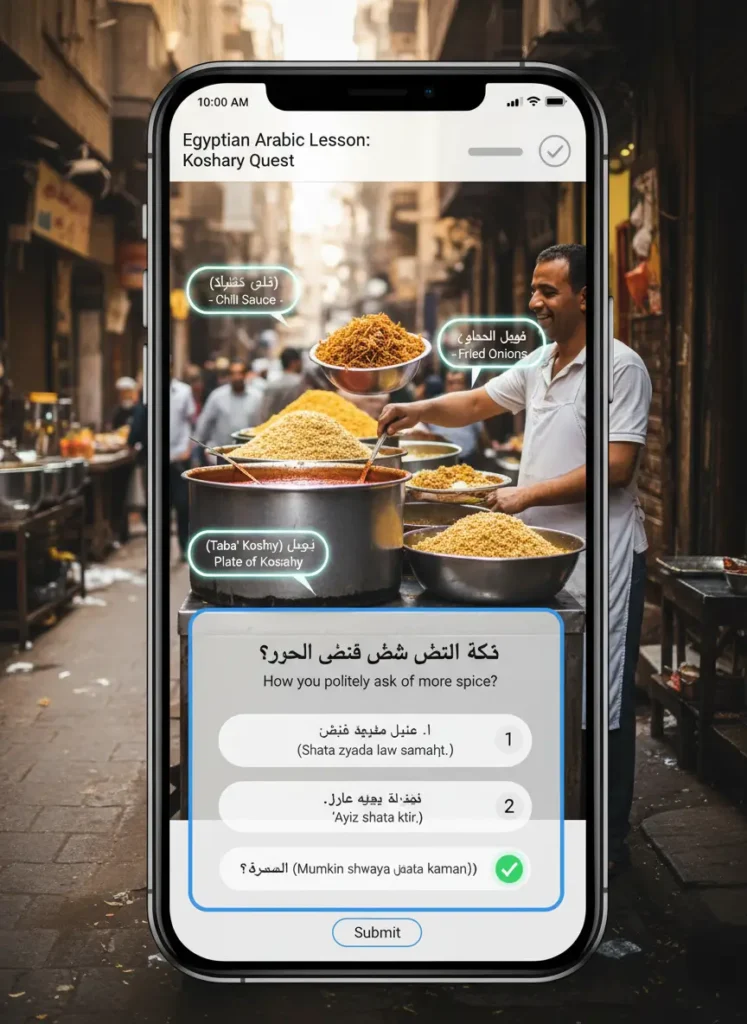
Most learners fail because they try to learn all the grammar before speaking. That’s backwards. Speak first, refine later.
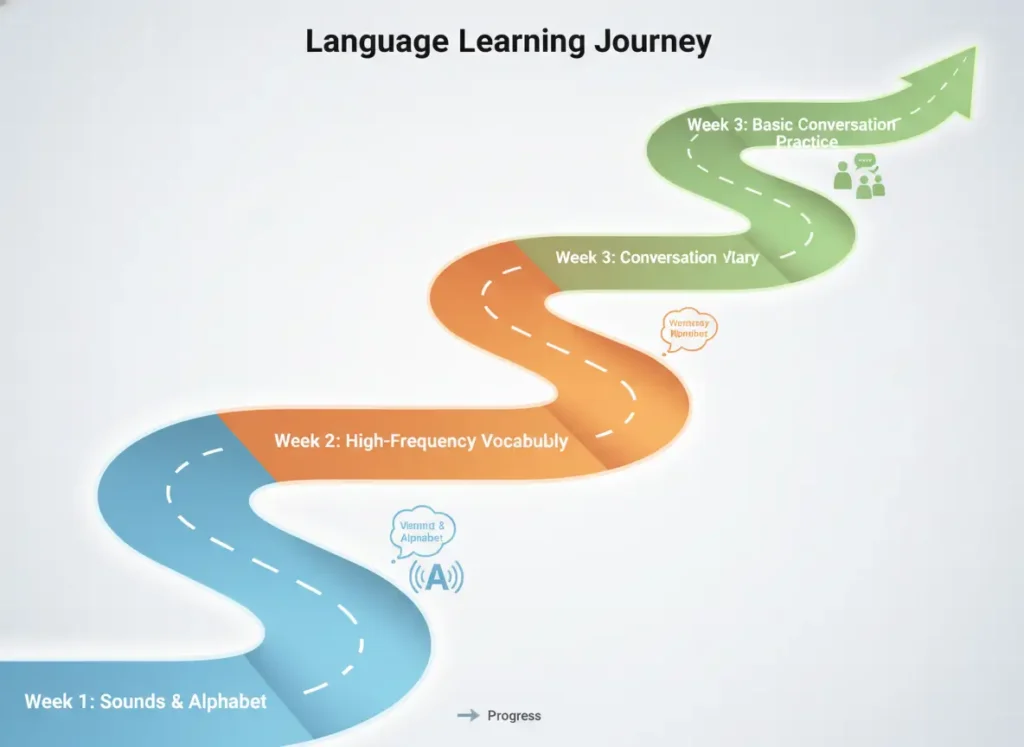
Week 1–2: Sound and Rhythm Foundation
Goal: Master the Egyptian accent and 50 essential words.
Daily practice (20 minutes):
- 5 minutes: pronunciation drills—focus on ج=G and ق=glottal stop
- 10 minutes: flashcards for survival phrases
- 5 minutes: listen to one Egyptian song or short video
Key phrases to lock in first:
- ازيك؟ — How are you?
- عايز/عايزة — I want (m/f)
- فين؟ — Where?
- بكام؟ — How much?
- مش فاهم/مش فاهمة — I don’t understand (m/f)
Don’t worry about reading Arabic script yet in week one. Focus entirely on listening and repeating. Script comes in month 2.
Week 3–4: First Real Conversations
Goal: Handle five daily situations confidently.
Daily practice (30 minutes):
- 10 minutes: role-play with a tutor or language partner
- 10 minutes: watch Egyptian content with subtitles
- 10 minutes: “self-talk” in Egyptian Arabic
Five situations to master:
- Ordering food and drinks
- Taking a taxi (directions and price)
- Shopping basics (asking for items and prices)
- Social greetings beyond hello
- Asking for help (“Where is…?”)
The breakthrough moment: around day 18–21, most students experience their first real exchange—where they understand and respond without consciously translating. That’s the language beginning to function naturally. It’s not fluency yet. But it’s the signal that everything is working.
Realistic Timeline After Month 1
| Timeframe | What You’ll Be Able to Do | Daily Practice |
|---|---|---|
| 1 month | Basic transactions, simple conversations | 25 minutes |
| 3 months | 15-minute conversations on familiar topics, understand media with subtitles | 20–25 minutes |
| 6 months | Comfortable daily communication, understand most conversations, express opinions | 20 minutes |
| 12 months | Near-fluent daily contexts, understand humor and cultural references | 15–20 minutes (maintenance) |
The magic number: approximately 150 hours to reach basic conversational fluency. That’s 25 minutes daily for a year, 50 minutes daily for six months, or 2 hours daily for three months in an intensive approach.
How to Choose the Right Egyptian Arabic Program
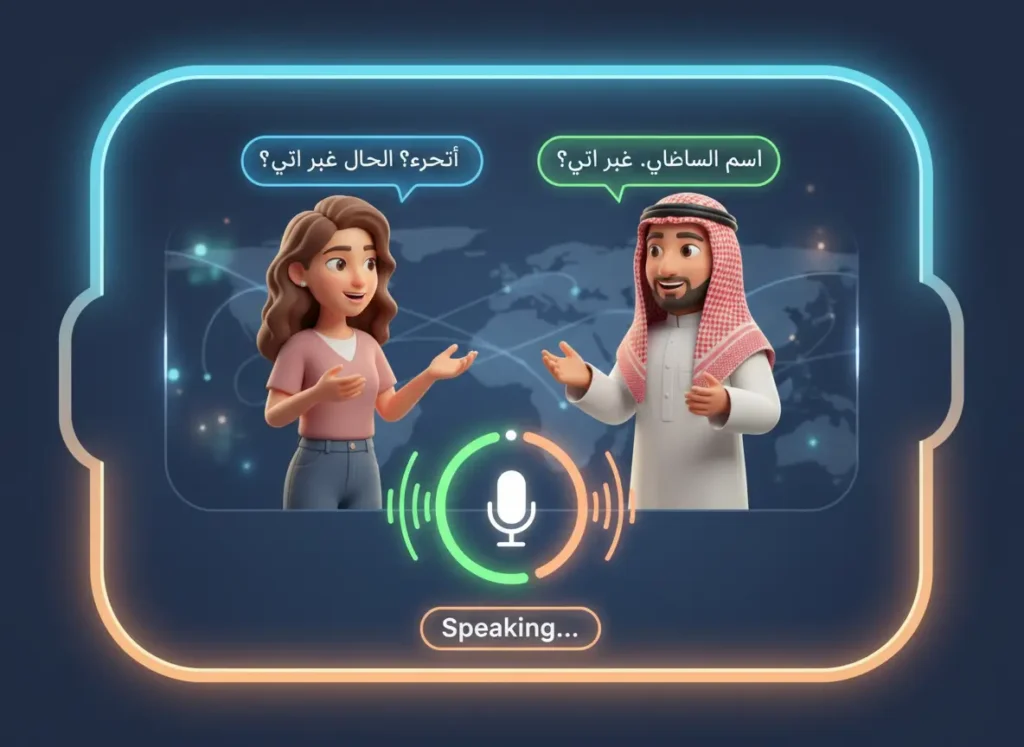
Not all Egyptian Arabic courses are the same. Here’s what actually matters.
What a Quality Program Must Have
- Native Egyptian teachers—not near-native, not “I lived in Egypt for a year.” Born and raised Egyptians who know the language from the inside.
- Live conversation from day one—not grammar lectures for the first three months
- Cultural context integrated into every lesson—not bolted on as an afterthought
- Structured progression—not “we’ll cover whatever you feel like this week”
- Individual correction in real time—this is non-negotiable
At Alphabet Arabic Academy, our Egyptian Arabic teachers are native Cairenes with formal training in teaching Arabic to non-native speakers. Every teacher is certified, and you can browse verified profiles and student reviews before booking. See our teachers page.
Online vs. In-Person for Egyptian Arabic
Honestly, for most learners online is better—not because of technology, but because of access. Online gives you access to native Cairene teachers who are specifically trained to teach foreigners, regardless of where you live.
In-person has one genuine advantage: if you’re actually in Egypt, you can supplement lessons with constant real-world exposure. The combination is unbeatable.
If you’re outside Egypt, online one-on-one with a native teacher is the clear choice.
Trial Session: What to Evaluate
Before committing to any program, take a trial lesson. Ask yourself:
- Does the teacher make you speak from minute one?
- Do they correct naturally, not embarrassingly?
- Do they explain cultural context, not just grammar rules?
- Can you imagine learning with this person for six months?
For transparent pricing and package options, see our Arabic courses pricing page.
Frequently Asked Questions
I’m overwhelmed. Where do I actually start?
Start with sounds, not vocabulary lists. Spend your first week on three things: the Egyptian “G” (ج), the glottal stop for ق, and the musical rise at the end of questions. Everything builds from there. Get those three sounds right and you immediately sound like you know what you’re doing.
How many hours do I actually need to reach conversational fluency?
About 150 hours to hold basic confident conversations. That’s 25 minutes daily for a year, 50 minutes daily for six months, or 2 hours daily for three months intensive. Consistency matters far more than total hours. For detailed timeline expectations across all goals, our Arabic learning FAQ covers every level.
Should I learn to read Arabic script?
Yes—but strategically. Months 1–3: focus entirely on speaking and listening. Month 4: introduce Arabic script alongside speaking practice. Why? Because Egyptians text in Arabic script. Not being able to read it eventually cuts you off from written communication, social media, and signs. But it shouldn’t slow your speaking progress in the early months.
Can I learn Egyptian Arabic if I already know MSA?
Yes—but you need to switch mental modes. MSA is your “formal writing” brain. Egyptian is your “chatting with friends” brain. Many of our most successful students learned MSA first and then felt the gap between textbook Arabic and real conversation. The transition is actually fast once you understand what’s different. For a structured comparison, see our guide to learning Arabic from Egypt.
Do I need to know MSA before starting Egyptian Arabic?
No. Many successful learners start directly with Egyptian dialect without any MSA background. Egyptian Arabic is more practical for daily communication, travel, and connecting with people. MSA can come later if your goals include formal or academic Arabic.
What’s the single most important factor for success?
Emotional connection. Students who succeed fastest are those who love Egyptian music, are genuinely fascinated by Egyptian culture, or have Egyptian friends or family they want to communicate with. Find your “why” beyond just “I should learn Arabic.” That emotional motivation is what sustains the daily 25 minutes when life gets busy.
Why Alphabet Arabic Academy for Egyptian Arabic
We’re based in Cairo. Native Egyptian teachers—born and raised—trained specifically to teach the dialect to foreigners. 5,000+ students from 80 countries. 4.9/5 on Trustpilot.
What matters for Egyptian Arabic specifically:
Native Cairene teachers. Not just “Egyptian teachers”—teachers from Cairo who understand the specific dialect, slang, and cultural references that make up authentic spoken Masri.
Conversation from lesson one. No three months of grammar before you’re allowed to speak. You produce Egyptian Arabic in your first session.
Cultural intelligence integrated. Every lesson includes context—when this phrase is used, what tone it carries, how Egyptians actually communicate beyond the literal words.
Flexible scheduling. 7 days a week, every time zone. Mornings, evenings, weekends.
Free trial lesson. One session with a real native teacher before any commitment. No charge if it’s not right.
Egyptian Arabic courses from $60/month. Free trial lesson, no long-term commitment required.
Conclusion
James—our student from Cairo—called me frustrated after three days. Within three months of focused Egyptian Arabic study, he was debating politics with taxi drivers, making his Egyptian colleagues laugh, and understanding the lyrics of his favorite Amr Diab songs.
The transformation wasn’t about learning more grammar. It was about switching from the Arabic of books to the Arabic of life.
That’s what Egyptian Arabic actually delivers:
- Confusing streets become familiar neighborhoods
- Transactions become conversations
- “Foreigner” status becomes “friend” status
- Observing Egyptian culture becomes participating in it
The language is learnable. The cultural connection is real. The path is clear.
Start with 25 minutes a day. Start with the sounds. Start with a native teacher who can hear when you get it right.
👉 Book your free trial lesson with Alphabet Arabic Academy—and have your first real Egyptian Arabic conversation this week.
أهلاً وسهلاً في رحلتك المصرية
The Arabic of books waits in libraries.
The Arabic of life waits in Cairo’s cafes, Alexandria’s corniche, and in the warmth of 100 million Egyptians.
Which will you choose?