Noorani Qaida Lessons: A Complete Beginner Roadmap

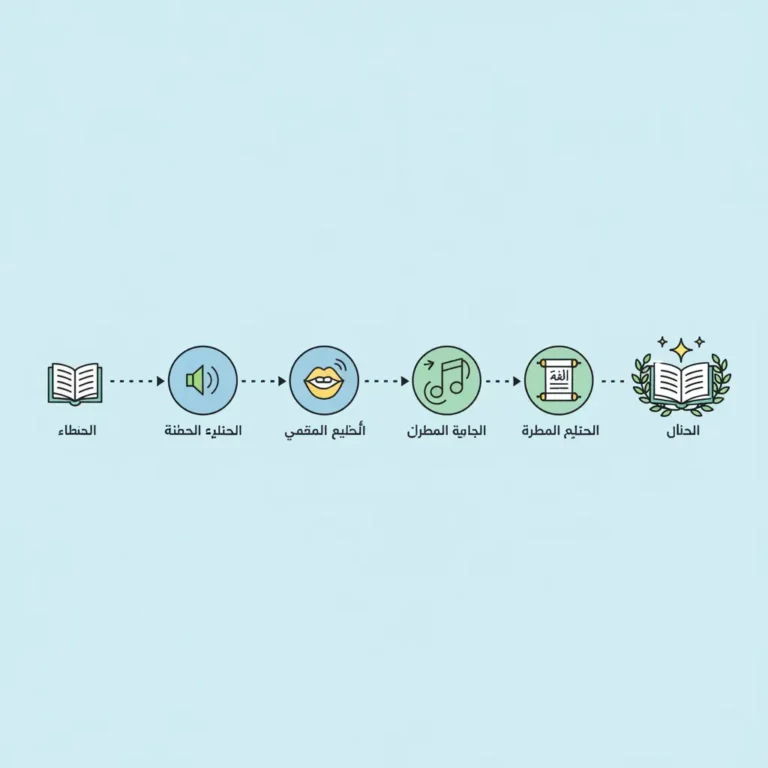
Noorani Qaida is a beginner’s book that teaches you to read the Quran correctly, one small skill at a time. Most editions have about 17 lessons: single letters, joined letters, short vowels, tanween, long vowels, sukoon, shaddah, then reading practice. Go in order. Skip nothing.
| Stage | What you learn | You’re ready to move on when |
|---|---|---|
| 1. Single letters | Each letter’s sound and where it comes from in the mouth | You can say any letter without looking at a chart |
| 2. Joined letters | How letters change shape inside words | You spot a letter at the start, middle or end of a word |
| 3. Short vowels and tanween | Fatha, kasra, damma and the doubled endings | You read بَ بِ بُ without guessing |
| 4. Long vowels and soft letters | Stretching sounds (madd) and the soft waw and ya | You hold a stretch steadily, not too short, not too long |
| 5. Sukoon and shaddah | Silent letters and doubled letters | You stop on a silent letter without adding a vowel |
| 6. Putting it together | Longer words, a few tajweed rules, short Quran lines | You read a line smoothly while someone listens |

Each stage trains your mouth and ears for the next one. That’s why the order matters, and why people who jump ahead usually end up coming back.
That’s the map. The table hides the hard parts though, so let’s go through them properly.
What Noorani Qaida actually is
It’s a small primer. Nothing more mysterious than that. It was written by Sheikh Noor Muhammad Haqqani, a scholar from India, and it has become one of the most common first books for Quran reading around the world.
What makes it different from a plain alphabet book? The practice words come from the Quran itself. An Arabic-language commentary on the book, published on Quranpedia, describes it as teaching spelling and tajweed through Quranic words, and says it has spread through most Muslim countries. So from the first page you’re already training on the sounds you’ll meet in the mushaf.
It also matters in classrooms. Researchers at Qatar University published an evaluative study of how the Noorani Qaida curriculum is used in Quran teaching in Qatar. That tells you something: this isn’t a trend. It’s a method institutions actually use.
Before you start
Three quick things.
Get one edition and stick with it. Prints differ. Some have 16 lessons, some 17, a few more. The early order is almost always the same, but later lessons get split or merged. So don’t panic if a video says “lesson 9” and your book says something else. Follow the order of topics, not the numbers.
Set aside 15 to 20 minutes. Not two hours. Short and daily beats long and rare. I’ll say more on that below.
Read out loud. Always. Reading silently is how people think they’ve learned a lesson when they haven’t.
Stage 1: Single letters
This is where you learn each letter on its own, with its correct sound. Not just the name. The sound, and where in your mouth or throat it comes from. Those points of exit are called makharij, and they’re the foundation of everything after.
AUDIO/VIDEO: a teacher reading the single-letters lesson slowly
The mistake I see most: treating similar letters as the same. For many learners, س and ص, or ت and ط, sound identical at first. They aren’t. If your ear can’t hear the difference yet, that’s normal, but it’s also exactly why you need to listen to a real voice and repeat.
Ready to move on when: you can name and say every letter in random order, without peeking.
Stage 2: Joined letters
Arabic letters change shape depending on where they sit in a word. Beginning, middle, end. Same letter, slightly different look. This stage drills all those shapes, including لا, which beginners often misread because it looks like one letter and is actually two.
AUDIO/VIDEO: a teacher reading the joined-letters lesson
The mistake: learning only the isolated shape, then freezing when the same letter shows up joined to another. It happens to nearly everyone. Slow down here. Point at each letter with your finger and say it.
Ready to move on when: a joined word doesn’t look like a wall of lines anymore. You can break it into letters quickly.
Stage 3: Short vowels and tanween
Now the letters start to make sounds you can read. Three small marks do the job:
- Fatha: a small line above the letter, the “a” sound. بَ
- Kasra: a small line below, the “i” sound. بِ
- Damma: a small curl above, the “u” sound. بُ
Then tanween, the doubled marks that add an “n” sound at the end of a word: بً بٍ بٌ
AUDIO/VIDEO: a teacher reading the short-vowels and tanween lessons
Here’s the thing: this stage feels easy. You read a few lines, you feel good, and you rush. Then the weak spots show up two stages later. If you’re shaky on fatha, kasra and damma, everything after gets harder. Spend extra time here.
Ready to move on when: you can read a full line of vowelled letters at a steady pace, without stopping to decode each one.
Stage 4: Long vowels and soft letters
So far every sound has been short. Now you learn to stretch. Madd means holding a sound longer when alif, waw or ya follows a matching vowel, like in بَا بُو بِي. The usual natural stretch is about two beats, which is why teachers often tap the table or count on their fingers.
This is also where you meet the soft letters (leen): waw or ya with a sukoon after a fatha, as in أَوْ and أَيْ. They sound gentle. They don’t get stretched like a full madd.
AUDIO/VIDEO: a teacher reading the long-vowels and leen lessons
The mistake: stretching everything, or stretching nothing. Both are wrong. Too short changes the word, and too long sounds unnatural. Timing is much easier to learn by ear than from a description, which is a polite way of saying: this is where a live teacher helps most.
Ready to move on when: your stretches feel even from line to line.
Stage 5: Sukoon and shaddah
Two marks, and they’re the ones that quietly separate people who read from people who memorised their way through the book.
Sukoon means the letter carries no vowel. You close the syllable and stop: أَبْ. For English speakers this is surprisingly hard, because English rarely asks you to hold a consonant cleanly without letting a little vowel sneak out after it.
Shaddah means the letter is doubled. Your tongue presses, holds, and releases: بَّ. Many editions also introduce qalqalah around here, the small “bounce” on certain letters when they carry a sukoon.
AUDIO/VIDEO: a teacher reading the sukoon and shaddah lessons
I’ll be straight with you: this is the stage where most people get stuck. Not because it’s complicated, but because you can’t see your own mistakes. You think you’re saying it right. Someone else hears a stray vowel. Record yourself and compare it with a teacher’s voice, or book a lesson and let a teacher listen.
Ready to move on when: you can read a line full of silent and doubled letters and no extra vowels creep in.
Stage 6: Putting it together
The final lessons mix everything. Longer words. Combinations of shaddah, sukoon and madd. And, depending on the edition, the first tajweed rules for noon sakinah and tanween, meem sakinah, heavy and light letters, and where to stop when you’re reading. Then short pieces of the Quran itself.
This is the part most people were waiting for. And it’s a good moment, because lines that looked impossible three weeks ago now come out smoothly.
AUDIO/VIDEO: a teacher reading a closing revision lesson or short Quranic lines
Ready to finish when: you can read a new line you’ve never seen, at an even pace, with a teacher listening and only small corrections.
How long does it take?
Honestly? Nobody can give you one honest number. It depends on your age, how many minutes you practise, whether you have a teacher, and how much Arabic you’ve seen before. Some lessons take one sitting. Others take weeks. Anyone who promises “you’ll finish in X days” is selling something.
What I can tell you is what works in practice. Fifteen to twenty focused minutes a day, out loud, beats a two-hour weekend session. Your mouth needs repetition, not endurance.
Can you learn it without a teacher?
You can start. Audio and videos are a fine way to meet the early stages, and it costs nothing to try. If you’re curious, listen to a few lessons and read along.
But you hit a ceiling. The hardest parts, makharij, madd timing, sukoon, shaddah, are all things you do with your mouth. And you can’t hear your own mistakes as clearly as someone else can. A recording can’t stop you and say “again, but softer.” A person can.
There’s some evidence the method itself works in a classroom. A 2019 master’s study at the University of Eloued in Algeria, described here, tried a program based on Noorani Qaida with 15 fourth-grade pupils who struggled with reading, and found statistically significant improvement in the group that used it. It’s a small study of school children, so I wouldn’t treat it as proof for every adult beginner. But it fits the idea behind the book: small steps, in order, with guidance.
If you’d like to see what guided practice feels like, here’s what happens in a free Quran trial class. It’s a real lesson, and it shows you where you are before you spend anything.
5 mistakes that slow beginners down

- Skipping ahead. Each lesson assumes the last one is solid.
- Reading silently. If it isn’t out loud, it isn’t practice.
- Rushing the easy stages. The vowels stage feels simple. It isn’t, quite.
- Memorising the page. You know the page by heart, so you stop reading. Try a new line, or point to random words.
- Practising wrong. Repeating a mistake ten times just teaches you the mistake. Get your reading checked.
A simple daily routine
Nothing fancy. Twenty minutes.
- Warm up (3 minutes). Re-read yesterday’s last few lines, out loud.
- Listen (5 minutes). Hear a teacher read today’s section, slowly, once or twice.
- Read (10 minutes). Read it yourself, out loud, with your finger under each word.
- Mark it (2 minutes). Put a pencil dot by anything that felt shaky. That’s tomorrow’s warm-up.
Do this for a few weeks and you’ll be surprised. Not because it’s clever, but because it’s consistent.
Ready for a real teacher?
When you want someone to listen to your reading, correct your makharij and set the pace for you, you can start with our Noorani Qaida online lessons. Prefer to see the whole programme first? Read about our Quran and Tajweed course. Or just book a free Quran trial lesson and a teacher will check your level.
FAQ
How many lessons are in Noorani Qaida? Most editions have around 17. Some prints have fewer or more, because later lessons are split or combined differently.
Who wrote Noorani Qaida? Sheikh Noor Muhammad Haqqani, a scholar from India.
Do I need to know Arabic before I start? No. The book starts from the letters. That’s the whole point of it.
Can adults learn Noorani Qaida? Yes. It’s often described as a book for children, but adults use it all the time, especially when they never learned to read the Quran properly.
How long does it take to finish? It depends on how much you practise, your age and whether you have a teacher. There’s no honest single number.
Should I learn Noorani Qaida before reading the Quran? If you can’t yet read the Quran correctly, it’s a sensible first step. It builds the sounds and habits that make Quran reading smoother later.
Can I learn it for free online? You can start with free audio and videos. For correct pronunciation, sukoon and shaddah, a teacher who listens to you is much better.
Sources
- Quranpedia, Arabic commentary on Al-Qa’idah An-Nuraniyyah: quranpedia.net
- Qatar University, evaluative study of the Noorani Qaida curriculum in Quran teaching in Qatar (2022): qspace.qu.edu.qa
- University of Eloued, master’s study on a Noorani Qaida-based reading program (2019): archives.univ-eloued.dz