What Happens in a Free Quran Trial Class? (Plus What to Ask)

[Reviewed by Sheikh Muhammed Adly, Quran & Tajweed Teacher ]
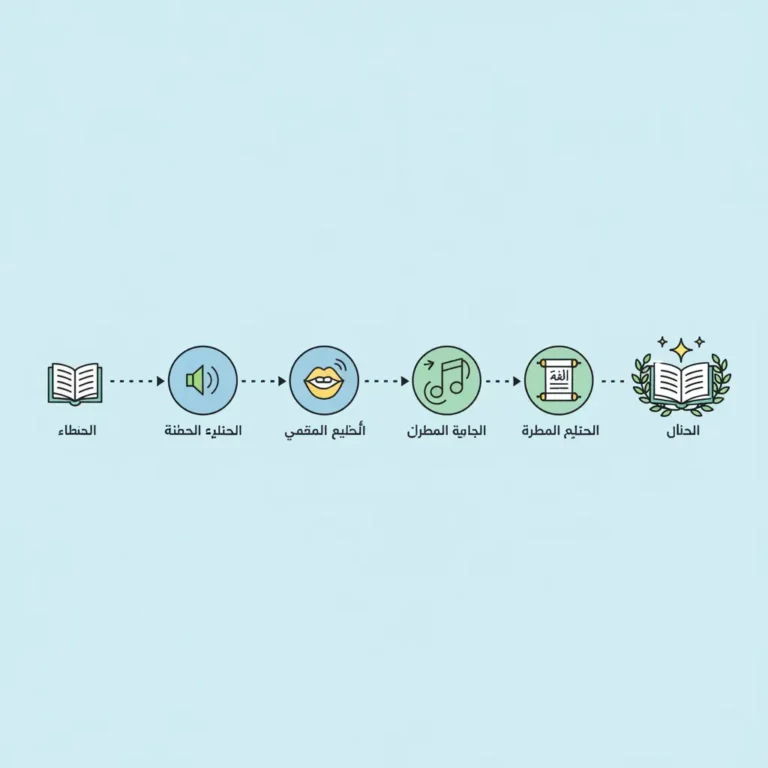
A free Quran trial class is a live, one-to-one lesson with a real teacher, 30 minutes, no payment. You say hello, tell him what you’ve studied, and read aloud. He checks your reading, tajweed and makharij, then teaches you something real at your level. You leave knowing exactly where to start.

| Step | What happens | Why it matters |
| 1. Hello | You and your teacher get to know each other | Nerves drop fast |
| 2. Your background | He asks what you’ve studied before, if anything | No time wasted repeating old stuff |
| 3. Your reading | You read aloud | He hears where you really are |
| 4. Tajweed and makharij | He checks the rules and where each letter comes from | Most reading mistakes hide here |
| 5. Real work | You practise at your level | You feel what a real lesson is like |
| 6. Recommendation | You get the right course and plan | You decide what happens next |
That’s the short version. Here’s the longer one, because I know what’s going on in your head. Maybe you’re nervous about reading out loud. Maybe you’re booking for your child. Maybe an academy wasted your time before and you’re not keen to repeat it.
Fair enough. Let’s walk through the whole thing, from the booking form to the last minute of the class.
Before the class: booking takes two minutes
The form on our free trial page is short. Your name, email, who’s learning (you or your child), your country, the course you want, and the best days and times with your time zone. That’s it.
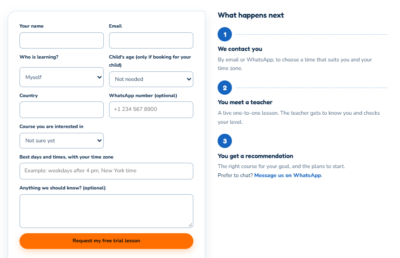
Pick “Quran and Tajweed” in the course menu. Not sure yet? Choose “Not sure yet.” That’s fine too. The teacher will sort it out with you in the class.
After you send it, we contact you by email or WhatsApp. We pick a time that suits your time zone. You don’t pay anything to request a trial.
On the day, you need a phone, tablet or computer with a camera and microphone, and a stable internet connection. Keep a mushaf nearby if you own one. If you don’t, that’s okay.
Inside the class, step by step
Every student is different, so no two classes look exactly the same. But the flow is the same. Here it is.
1. Breaking the ice
The first few minutes aren’t about the Quran at all. They’re about people.
Your teacher introduces himself and asks about you. Where you live, why you want to learn, how you feel about it. Adults get shy about reading aloud. Kids freeze in front of a camera. Teachers know this. So the first job is simple: make you comfortable.
Sounds small. It isn’t. A relaxed student reads better, and a teacher who’s heard your real voice can teach you better.
2. What have you studied before?
Next, he asks about your background. Did you learn Noorani Qaida as a child? Some tajweed at a mosque class? Years of self-study from YouTube? Nothing at all?
Anything is a fine answer. Complete beginners are welcome. Just be honest, because honest answers save time. Nobody’s judging you.
3. Listening to you read
Now you read. Whatever you can. Letters, a short surah, a page from the mushaf. The teacher listens carefully and notes what he hears.
Here’s the thing: almost everyone reads worse in a trial class than they do alone at home. That’s normal. Your heart’s beating a bit faster, a stranger’s listening. Teachers expect it. This isn’t an exam and there’s no grade.
4. Checking tajweed and makharij
Then he looks closer. Two things.
Makharij are the points of exit: where each Arabic letter comes from in your mouth and throat. Tajweed is the set of rules for reciting properly: how long to hold a sound, when to blend letters, when to stop.
This is where a live teacher earns his place. A book can’t hear that your ع sounds like an أ. An app can’t tell that you’re rushing a elongated vowel. A person can, and he can show you the fix right there, in real time.
Honestly, this part is the most valuable thing in the whole trial. Even if you never sign up, you’ll walk away knowing something real about your own reading.
5. Real work at your level
And then the class turns into an actual lesson. Not a sales pitch. Work.
What that looks like depends on you. For example:
- Starting from zero: letters, sounds and correct pronunciation first.
- Reading slowly: smoother reading, plus the most common mistakes.
- Already reading well: tajweed rules and polishing the makharij.
The goal is correct reading and correct tajweed, built from where you are now. Not where a textbook says you should be.
6. What you get at the end
The teacher recommends the right course for your goal, and the plans to start. You decide what happens next. Prefer to talk it over first? Message us on WhatsApp and we’ll answer your questions.
If you’d like to see how the full programme works, here’s our Quran online classes page.
5 questions parents and adults ask before booking

These are the questions we get most. Straight answers.
1. What nationality are the teachers? Egyptian. Our teachers are from Egypt, and the academy is based in Cairo. We’ve been teaching online since 2017.
2. Are they qualified? Our Quran teachers hold ijazah and are approved by Al-Azhar. teacher credentials / ijazah documentation page,
3. Do they speak English? I don’t know Arabic, and neither do my kids. You don’t need Arabic to start. Complete beginners, adults and children, are welcome. yes of course: teachers explain in English — edit this line to match reality]
4. How much do the courses cost? It depends on three things: lesson length (30 or 60 minutes for Quran and Tajweed), lessons per week, and how many months you book. Longer bookings get a discount: 10% off for 3 months, 20% off for 6 months. from $35 per month 4 classes 30 minutes You can calculate your exact total on the pricing page. The trial itself costs nothing.
5. Do you teach in the morning, and on Fridays, Saturdays and Sundays? Yes to all of it. We work 24 hours, and yes, weekends too. Tell us your time zone and the times that suit you, and we’ll match a teacher to your schedule.
Questions worth asking any Quran academy

Even us. Especially us. A trial class is your chance to check, so use it.
- Who exactly will teach me, or my child?
- Can I see their ijazah or credentials?
- Is the lesson one-to-one, or a group?
- Will the teacher listen to my reading and correct tajweed live?
- What’s the total monthly cost in my currency?
- What happens if I want to stop or change my plan? (Ours is on the refund policy page.)
I’ll be straight with you: if an academy dodges the ijazah question, you’ve got your answer. Ask it plainly and watch how they respond.
Booking for your child?
Select “My child” on the form and add their age. The form covers ages 5 to 17. Our child safety policy explains how we look after younger students.
Parents, one practical tip: sit nearby for the first class. Children often relax faster when they can see you in the room.
Ready to try it?
No payment. No long form. Just a real teacher and a real lesson.
Request your free Quran trial lesson
Still choosing? Read about our Quran and Tajweed course first, then book when you’re ready.
FAQ
How long is the free Quran trial class? It’s a 30-minute live, one-to-one lesson.
Do I need to pay or enter a card to book? No. No payment is needed to request a trial.
Do I need to know Arabic to join? No. Complete beginners are welcome in our Quran and Tajweed course.
What if I can’t read Arabic letters yet? Say so at the start. Your teacher begins at your level, with letters and sounds.
Can my child take the trial class? Yes. Choose “My child” on the booking form and enter their age.
Can I book an evening or weekend slot? Yes. We work around the clock, including Fridays, Saturdays and Sundays. Put your best days and time zone in the form.
Is the trial just a sales call? No. It’s a real lesson. You also get a recommendation for the right course, and you decide what to do with it.
Reviewed by Sheikh Muhammed Adly, Quran & Tajweed Teacher