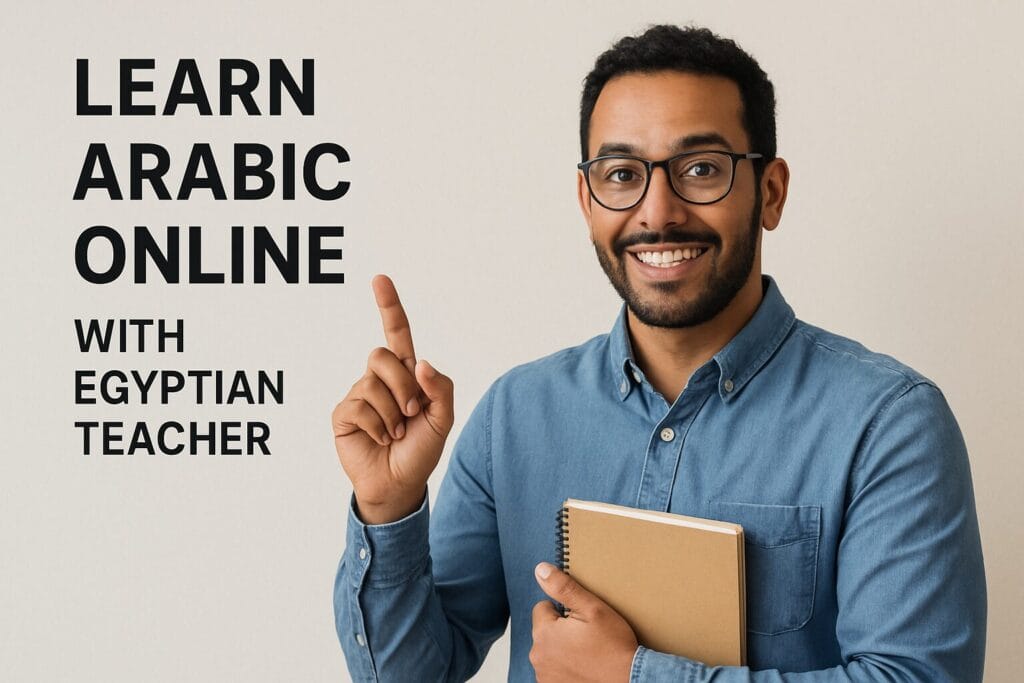
One-on-one Arabic lessons with a native Egyptian teacher from Egypt . These interactive and very easy lessons are scheduled to suit your work and your children’s needs. We offer specialized curricula for children. Of course, we will experience the atmosphere of Egypt in all its details. We will engage in daily life through our conversations and enjoy studying together as if it were a tour of the streets and neighborhoods of Greater Egypt. Whether you want to learn for living, work, or even for tourism and culture, you will find what you need in this course.
One-on-one Arabic lessons with a native Egyptian teacher are the fastest way to go from studying Arabic to actually speaking it. Most students who switch from apps or group classes to private lessons with an Egyptian teacher start holding real conversations within 4–6 weeks.
This guide covers why private lessons with an Egyptian teacher beat every other format, what actually happens inside a real session, how to choose the right teacher, what mistakes slow people down, and exactly how to get started—whether you’re an absolute beginner or someone who’s been “studying” for years with nothing to show for it.
Why One-on-One Arabic Lessons Beat Every Other Format
Let’s be honest for a second. Most people don’t fail at learning Arabic because the language is hard. They fail because they’re learning it the wrong way—apps that throw random vocabulary at them, group classes moving at the speed of the slowest student, prerecorded videos that can’t hear them mess up.
One-on-one lessons fix all of that at once.
The Group Class Problem
Group classes sound nice on paper. In reality, they move at the speed of whoever needs the most help—which is rarely you. You spend 40 minutes waiting for other students to catch up. The teacher can’t correct your specific pronunciation because they’re managing five people at once. And you get maybe 10 minutes of actual speaking time per session.
Language is a muscle. If you’re not using it constantly, it doesn’t grow. Group classes don’t give you nearly enough reps.
What Actually Changes in Private Lessons
In a one-on-one session:
- The entire lesson revolves around you—your level, your goals, your pace
- Your mistakes get fixed immediately, not ignored or glossed over
- You speak for 80–90% of the session, not 20%
- The teacher adapts in real time based on what you’re struggling with
- You ask questions without feeling like you’re slowing anyone down
That last one is underrated. The number of questions people swallow in group classes because they don’t want to hold up the class—those are exactly the questions that matter.
The Psychological Edge
Here’s something nobody talks about: in one-on-one lessons, you’re not afraid to sound stupid. You experiment more. You try things out. You ask “wait, how do Egyptians actually say this?” without 10 people watching you.
Confidence builds fast when there’s no audience. Arabic stops feeling like a wall and starts feeling like something you can actually do.
Why a Native Egyptian Teacher Specifically

Here’s something textbooks won’t tell you: Arabic isn’t one language. It’s a family of dialects with a formal written standard holding everything together.
A native Egyptian teacher gives you two advantages that nobody else can.
Real Pronunciation—Not Classroom Arabic
Egyptian teachers teach you how Arabic is actually spoken. The rhythm, the shortcuts, the tone, the sounds that disappear in fast speech, the way syllables run together in real conversation. Not robotic Modern Standard Arabic with zero soul.
This matters enormously for comprehension. You can know all the vocabulary in the world and still understand nothing when a real Egyptian speaks to you at normal speed—because you’ve only ever heard textbook Arabic.
The Most Widely Understood Dialect
Egyptian Arabic is everywhere. Movies, TV shows, music, social media, news commentary. Because of Egypt’s cultural output, Egyptian Arabic has become the most widely understood dialect across the Arab world. Learn it, and you’ll be understood from Morocco to Kuwait.
That’s a massive practical advantage that learning Levantine, Gulf, or Moroccan Arabic can’t match.
What Cairo Teachers Bring That Others Don’t
Native Cairo teachers don’t just know Arabic—they grew up inside it. Cultural context, idioms, expressions that evolved on the streets of Cairo, slang that shows up constantly in media but never in textbooks. That authentic knowledge is the difference between sounding like a textbook and sounding like a person.
Egyptian Arabic programs from Cairo instructors combine modern teaching techniques with authentic content—folktales, cultural anecdotes, historical references that help language stick because it’s connected to something real.
What Happens Inside a Real One-on-One Arabic Session
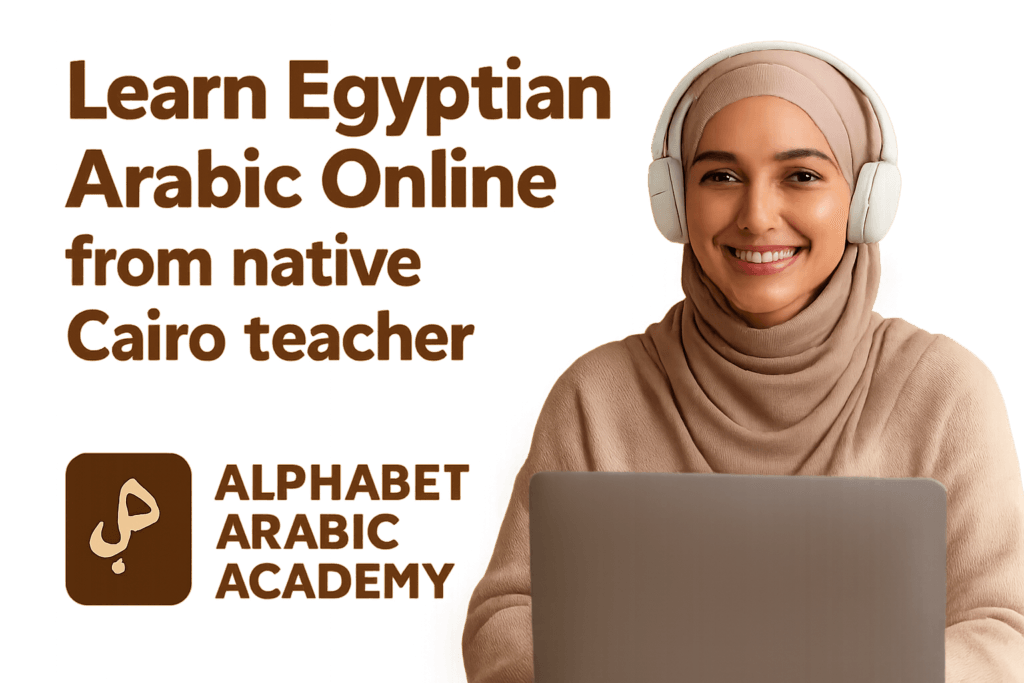
No chaos. No guessing what page you’re on. No sitting silently while someone else gets corrected.
A proper private session with a native Egyptian teacher usually looks like this:
From Day One: Live Conversation
Good teachers don’t make you wait six months before you’re “allowed” to speak. You speak in lesson one. Even if it’s just “meen inta” (who are you) and “izzayak” (how are you)—you’re using the language in a real exchange.
This matters because speaking is the skill. Everything else—grammar, vocabulary, pronunciation—supports the speaking. Start there.
Targeted Grammar—Only What You Need
One of the biggest wastes of time in traditional Arabic classes is learning grammar rules you won’t use for months. Private teachers teach grammar when you need it, anchored to a real conversation you just had.
You won’t sit through a 45-minute lecture on verb conjugation. You’ll be in the middle of a sentence, get stuck, and your teacher will say: “Here’s why that verb works like that—and here are three more you’ll use constantly.” That sticks.
Immediate Correction That Actually Helps
The good kind of correction, not the embarrassing kind. In a one-on-one setting, every mispronounced letter, every wrong tense, every confused preposition gets caught right away. Not next week. Right there.
And crucially—your teacher explains why it’s wrong, not just that it’s wrong. That’s the difference between fixing a mistake once and never making it again versus fixing it in class and making it again at home.
Cultural Context Woven In
Words don’t exist in a vacuum. When you learn ahlan wa sahlan, a good Egyptian teacher tells you when Egyptians actually say it, what situations it fits, what the more casual version is, and what the expression literally means. Language and culture are inseparable. The best teachers teach both simultaneously.
The Egyptian Advantage: Learning Arabic from Egypt

Egypt has the Arab world’s oldest and strongest tradition of teaching Arabic as a foreign language. That’s not a marketing claim—it’s a historical fact.
Egypt’s top universities—Al-Azhar, Dar El-Ulum, Cairo University, Al-Alsun—have been producing Arabic teachers for over a thousand years. Graduates of these institutions don’t just speak Arabic. They know how to teach it to people who didn’t grow up with it. That’s a completely different skill.
What Learning Arabic “From Egypt” Actually Means
It means you have access to:
- Authentic pronunciation shaped by Cairo’s centuries of linguistic tradition
- Both dialects and MSA in one teacher—Egyptian colloquial for conversation, Modern Standard Arabic for reading and formal contexts, taught by someone who uses both daily
- Cultural immersion even online—folktales, idioms, street expressions, media references that make vocabulary stick
- A living language, not a preserved version of it
Egypt’s cultural output—movies, music, TV shows, social media—means Egyptian Arabic is constantly evolving and constantly relevant. Your teacher isn’t teaching you a static language. They’re teaching you the one people actually speak today.
MSA and Egyptian Dialect: Do You Need Both?
Honest answer: it depends on your goal.
If you want to travel, watch Egyptian TV, talk to Egyptians, understand Arab media—start with Egyptian dialect. You’ll communicate comfortably within 3–6 months of consistent lessons.
If you want to read newspapers, study the Quran, work in formal Arab contexts, or access classical texts—you need Modern Standard Arabic.
The good news: a qualified Egyptian teacher teaches both, explains when to use each, and builds your understanding of how they relate. You don’t have to choose a path and abandon the other. For a detailed comparison, see our full guide to learning Arabic from Egypt.
Common Mistakes That Keep Arabic Learners Stuck for Years

Mistake 1: Spending Years on Apps Before Getting a Teacher
Apps are exposure. They’re not instruction. After six months of Duolingo, most people can recognize some vocabulary and produce zero sentences in conversation. That’s not learning a language—that’s learning about a language.
Apps don’t hear you mispronounce a letter. They don’t explain why a rule works. They don’t adjust when you’re consistently making the same mistake. Get a teacher first. Use apps to supplement.
Mistake 2: Choosing Based on Price Alone
Very cheap almost always means unqualified. And here’s the real cost: spending eight months with an undertrained teacher means spending months unlearning what they taught you incorrectly before you can actually progress. The cheapest option is usually the most expensive in the long run.
Mistake 3: Only Practicing During Lessons
If you’re only speaking Arabic for one hour per week, you’re not learning Arabic—you’re relearning the same material every session. Minimum effective daily practice: 20 minutes. Same time every day. This matters more than how many sessions you book per week.
Mistake 4: Starting with Grammar Instead of Speaking
Arabic grammar is genuinely complex. Many learners spend months studying noun cases and verb forms before they’ve held a single real conversation. That’s backwards. Grammar should support speaking, not precede it. A good teacher introduces grammar as you need it, not as a prerequisite.
Mistake 5: Avoiding the Difficult Sounds
ع، ح، ص، ض، ق، خ، غ—these sounds don’t exist in English and most European languages. A lot of learners avoid them, substitute approximations, and build habits that become increasingly difficult to break. Address them head-on from day one. They’re learnable. They just take focused work.
Mistake 6: Quitting at the Plateau
Around weeks 6–8, almost every beginner hits a wall. New vocabulary slows down. Grammar feels overwhelming. The initial excitement has worn off. Most people quit here—right before things start clicking.
What’s actually happening: your brain is consolidating. The acceleration comes at month 3–4. Push through.
Who One-on-One Arabic Lessons Are Actually For
This is for you if:
- You’ve tried apps and group classes and have little real progress to show for it
- You’re a busy professional who needs flexible scheduling and efficient lessons
- You’re a Muslim learning Arabic to understand the Quran and Salah directly
- You want to travel to Egypt or Arab countries and actually communicate
- You’re a parent who wants serious results for your child, not cute worksheets
- You started Arabic once before and stopped—and want to actually finish this time
This is NOT for you if:
- You’re not willing to practice 20 minutes daily between sessions
- You want to “try it out” for a week with no real commitment
- You’re looking for the absolute cheapest option regardless of teacher quality
One important thing: adults are often better at this than they expect. Stronger motivation, better discipline, the intellectual capacity to understand why grammar rules work rather than just memorize them. The students at Alphabet Arabic Academy who see the fastest results are often in their 30s, 40s, and 50s—not kids.
Let me tell you about Yusuf.
He lives in Canada. He’d been “studying” Arabic for three years. He knew hundreds of words. He could read the script slowly. But when an Egyptian colleague asked him a simple question in Arabic, he froze. Couldn’t answer. Couldn’t think.
He told me: “I feel like I know Arabic but I don’t speak it.”
He was learning the wrong way.
We started one-on-one lessons with a native Egyptian teacher. No apps. No group classes. Just him and the teacher, speaking from lesson one.
The first session was rough. He stumbled over every sentence. By week four, he was having short conversations. By month six, he called his Egyptian colleague and held a 15-minute conversation entirely in Arabic.
“You fixed three years,” he told me. “In six months.”
That’s the difference between learning about Arabic and actually learning to speak it.
What Real Progress Looks Like—and How Fast

Let’s cut the fake promises. You won’t be fluent in 30 days. Anyone who tells you that is selling something.
But with consistent one-on-one lessons and daily practice, here’s what actually happens:
Weeks 1–4: You learn to hold a basic back-and-forth conversation. Greetings, introductions, simple questions. You understand that Egyptian Arabic has a logic to it. You stop feeling lost.
Months 2–3: You start catching words in Egyptian TV shows and music. You can talk about daily life—your work, your family, where you’re from, what you like. You’re not translating everything in your head anymore.
Months 4–6: You’re having real conversations. Not perfect ones—real ones, with actual misunderstandings and improvisation and moments where you figure out what you meant to say. That’s fluency beginning. That’s the language clicking.
Months 6–12: You can watch Egyptian media without subtitles for most of it. You understand jokes. You can navigate most situations you’d encounter in Egypt or talking to Egyptians.
That’s real progress. And it compounds.
How to Choose the Right Teacher: The Checklist
Not every “native Egyptian teacher” delivers the same thing. Quality varies enormously. Here’s how to evaluate before you commit.
Non-Negotiable Qualifications
- University degree in Arabic or related field—from a recognized institution like Al-Azhar, Dar El-Ulum, Cairo University, or Al-Alsun
- Specific experience teaching non-native speakers—speaking a language and teaching it are completely different skills
- Fluency in English (or your language)—your teacher needs to explain concepts clearly, not just demonstrate them
- Clear, documented teaching methodology—ask how they structure lessons, how they track progress, how they adapt to different learners
- Verifiable references or reviews—not just a profile, but actual student feedback
At Alphabet Arabic Academy, all 47 teachers are graduates of Egypt’s top universities and are trained specifically in teaching Arabic to non-native speakers. You can browse verified profiles and reviews before booking. See our full teacher profiles page.
Red Flags to Avoid
- “I’m a native speaker” as the only qualification
- No trial session offered
- Vague curriculum: “we’ll see what you need”
- Guaranteed fluency in unrealistic timeframes
- No structured progression or milestones
The Trial Lesson Test
Never commit to a course without a trial lesson. In one session you can assess:
- Does the teacher explain clearly or just demonstrate?
- Do they correct you immediately and constructively?
- Do they make you speak, or do they lecture?
- Do you feel comfortable asking stupid questions?
- Can you imagine working with this person for 6–12 months?
A good teacher won’t mind being evaluated. They’ll welcome it.
Online vs. In-Person: The Honest Answer

Honestly? For most adults, online one-on-one lessons produce better results than in-person—not because of technology, but because of access.
Your city probably has a handful of Arabic teachers with varying qualifications. Online, you have access to 47 certified Egyptian teachers from top universities, available 7 days a week across every time zone.
Online advantages:
- Access to genuinely qualified teachers regardless of your location
- Flexible scheduling: mornings, evenings, weekends, whatever works
- Recording capability—review exactly what your teacher said
- No commute means fewer cancellations
- Often more affordable per session because of no facility costs
In-person advantages:
- Physical demonstration of pronunciation is slightly easier to observe
- Some people find it easier to focus away from home
The practical recommendation: start online. If you’re near Cairo and want in-person sessions, that’s an option. But don’t let geography limit your teacher quality.
For online options that fit any schedule, see our Egyptian Arabic course formats.
Your Daily Practice Structure: What Actually Works
Two sessions a week with your teacher means nothing without consistent practice in between. Here’s a daily structure that actually works—and takes 20 minutes, not 2 hours.
The 20-Minute Daily Minimum
Morning (7 minutes): Review vocabulary from your last session. Not just reading—say it out loud. Cover the translation, try to recall it, check yourself.
Afternoon (8 minutes): Take one sentence or exchange from your last lesson and practice it until it flows naturally. Variations, different pronouns, different scenarios.
Evening (5 minutes): Listen to 5 minutes of Egyptian media—a YouTube clip, a song, a short video. Don’t try to understand everything. Train your ear to the rhythm.
That’s it. 20 minutes. Non-negotiable.
Between-Session Habits That Compound
- Keep a vocabulary notebook organized by topic (not alphabetically—by situation)
- Watch Egyptian movies and TV shows with Arabic subtitles, not English
- Change your phone language to Arabic once you can read the script confidently
- Find an Egyptian Arabic podcast and listen on commutes
- If you have any Egyptian friends or acquaintances—use them
The goal between sessions isn’t to learn new material. It’s to consolidate what you already learned so your next session can move forward instead of backwards.
Realistic Pricing: What to Expect in 2026

One-on-one Arabic lessons from qualified Egyptian teachers:
- Online private sessions: $20–40 per session (45–60 minutes)
- Monthly packages (8 sessions): typically $60–120 depending on teacher level
- Small group online (3–4 students): $15–25 per session
Very cheap (under $10/session) almost always indicates unqualified teachers or very short sessions. Quality matters more than quantity—four good sessions per month will outperform eight bad ones every time.
At Alphabet Arabic Academy, one-on-one classes start from $60/month with a free trial lesson, no commitment required. For full pricing details, see our course pricing page.
How to Actually Get Started
Here’s the honest path—no fluff.
Step 1: Know your current level. Not sure? Take the free Arabic placement test before choosing any program. Knowing your starting point prevents you from enrolling in the wrong level and wasting weeks.
Step 2: Define your goal specifically. “Learn Arabic” is not a goal. “Hold a 10-minute conversation in Egyptian Arabic about daily life within 3 months” is a goal. Give your teacher something concrete to build toward.
Step 3: Book a trial lesson. One session with the actual teacher you’re considering. Evaluate them. See if the style fits. Don’t commit based on a profile.
Step 4: Set your daily practice time. Decide now: when are your 20 minutes every day? Same time, every day. This matters more than almost anything else.
Step 5: Start today. Not next week. Not after you finish the Arabic app you’re on. Today.
Frequently Asked Questions
Is Egyptian Arabic suitable for beginners, or should I start with Modern Standard Arabic?
Either works as a starting point, depending on your goal. If you want to communicate with people, watch Egyptian media, and travel in Arab countries—start with Egyptian Arabic. If your primary goal is the Quran, classical texts, or formal writing—start with MSA. Most students benefit from both eventually. A qualified Egyptian teacher teaches both and explains when to use each. For more detailed answers, check our comprehensive Arabic learning FAQ.
How many lessons per week do I need for real progress?
2–3 sessions per week is the sweet spot. One session a week works, but the progress is significantly slower. Four or more sessions work well if you also practice daily. The critical variable isn’t sessions per week—it’s daily practice between sessions.
Can I learn Arabic online as effectively as in-person?
Yes, when sessions are live, interactive, and conversation-focused. The research is consistent: live online instruction with a qualified teacher produces equivalent results to in-person. The key word is live—recorded courses without a real teacher are a different category entirely.
How quickly can I start speaking Egyptian Arabic with real conversations?
With consistent one-on-one lessons and 20 minutes of daily practice, most students hold basic real conversations within 4–6 weeks. Confident everyday communication—navigating most situations in Egypt, understanding most of what you hear—typically happens around months 3–6.
Do I need Modern Standard Arabic to understand Egyptian Arabic?
No. Many successful learners start directly with Egyptian Arabic without any MSA background. The two systems share vocabulary and grammar structures, so learning Egyptian Arabic actually builds your MSA foundation simultaneously. You don’t need one before the other.
What do I need technically for online Arabic lessons?
Reliable internet connection, a laptop or tablet (phone screen is too small for sharing materials), headphones with a microphone (quality matters—your teacher needs to hear your pronunciation clearly), and a quiet space. That’s everything.
Why Alphabet Arabic Academy
We’re based in Cairo. 47 teachers, all graduates of Egypt’s top universities—Al-Azhar, Dar El-Ulum, Cairo University, Al-Alsun. 5,000+ students from 80 countries. 4.9/5 on Trustpilot.
But here’s what actually matters for your learning:
100% one-on-one. No group classes. Your teacher’s full attention for every minute of every session. Every mistake caught. Every question answered.
Teachers who know how to teach—not just speak. Native Arabic is table stakes. Our teachers have degrees in teaching Arabic as a foreign language. They’ve studied how people learn this language. That’s different.
Egyptian Arabic and MSA in one place. Whether you want conversational dialect, formal Arabic, Quranic Arabic, or all three—we have qualified teachers for each track, and they can integrate them intelligently.
Flexible scheduling that actually works. 7 days a week, every time zone. Morning before work, evening after dinner, weekends. You pick what actually fits your life.
Free trial before any commitment. One session with a real teacher before you decide anything. If it’s not the right fit, no charge and no obligation.
One-on-one Arabic lessons from $60/month. Free trial lesson. No long-term commitment required.
Conclusion
Most people don’t fail at Arabic because of the language. They fail because of the format—apps that don’t correct them, group classes that don’t move at their pace, prerecorded videos that can’t hear them get something wrong.
One-on-one lessons with a native Egyptian teacher fix every one of those problems simultaneously.
Real language. Real correction. Real progress.
The students who succeed aren’t the ones who study the hardest. They’re the ones who practice consistently, with a qualified teacher, and don’t quit at the first plateau.
You can be that person. You just need to start.
👉 Book your free trial lesson with Alphabet Arabic Academy—and have your first real conversation in Arabic this week.
Arabic isn’t impossible. It’s just been taught badly for a long time.
That ends now.