Teaching children is never easy; it requires dedicated effort to achieve the right approach. Leave it to us, our specialized children’s teachers. Do you know that with us, a teacher can become your child’s friend? This is no easy feat. We make learning an exciting, enjoyable, and even beloved journey for children.
Want your child to learn Arabic — and actually enjoy it? Here’s the truth: kids don’t need textbooks and drills. They need games, songs, silly stories, and a teacher who makes every lesson feel like playtime. This guide covers everything — from Arabic games and rhymes to writing practice and preschool activities — so your child builds real skills without ever dreading class.
Why Arabic for Kids Works Differently Than Adult Learning
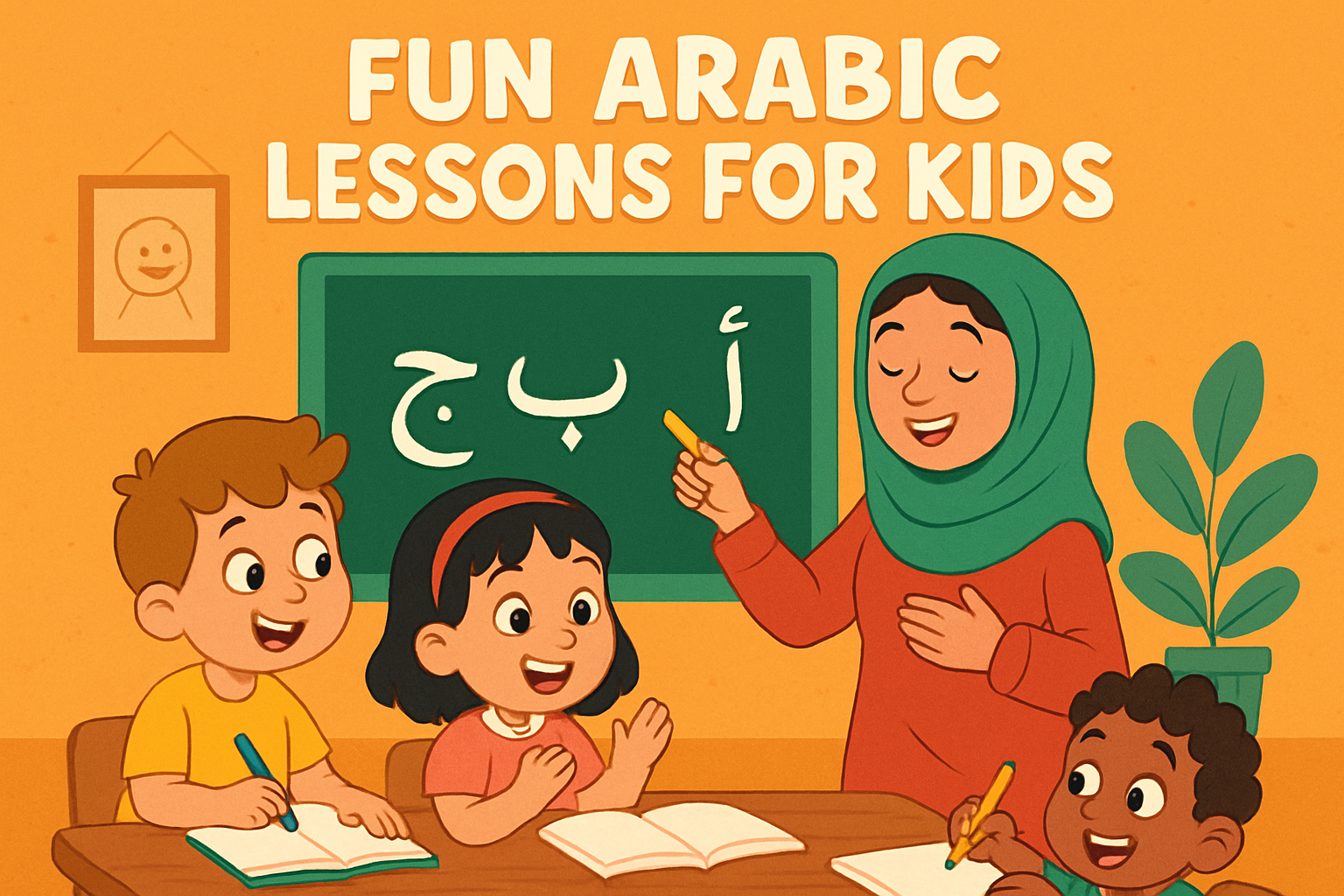
Kids are not small adults. And that’s actually great news.
A child’s brain is wired for language absorption. Before age 10, children pick up sounds, patterns, and rhythm far more naturally than teenagers or adults. Arabic — with its 28 letters and right-to-left script — can feel intimidating to a grown-up learner. But to a 6-year-old? It’s just another puzzle to figure out. And puzzles are fun.
Here’s the thing: the method matters enormously at this age. Boring, grammar-heavy lessons will kill a child’s interest fast. But a well-designed game? A catchy song? An illustrated story? Those stick.
That’s why every approach in this guide is built around one principle: learning should feel like playing.
At Alphabet Arabic Academy, our Arabic language for kids program is designed by Al-Azhar-trained teachers who specialize in young learners. No boring lectures. Just interactive, joyful sessions that actually work.
Arabic Learning Games for Kids: Where Fun Meets Real Progress
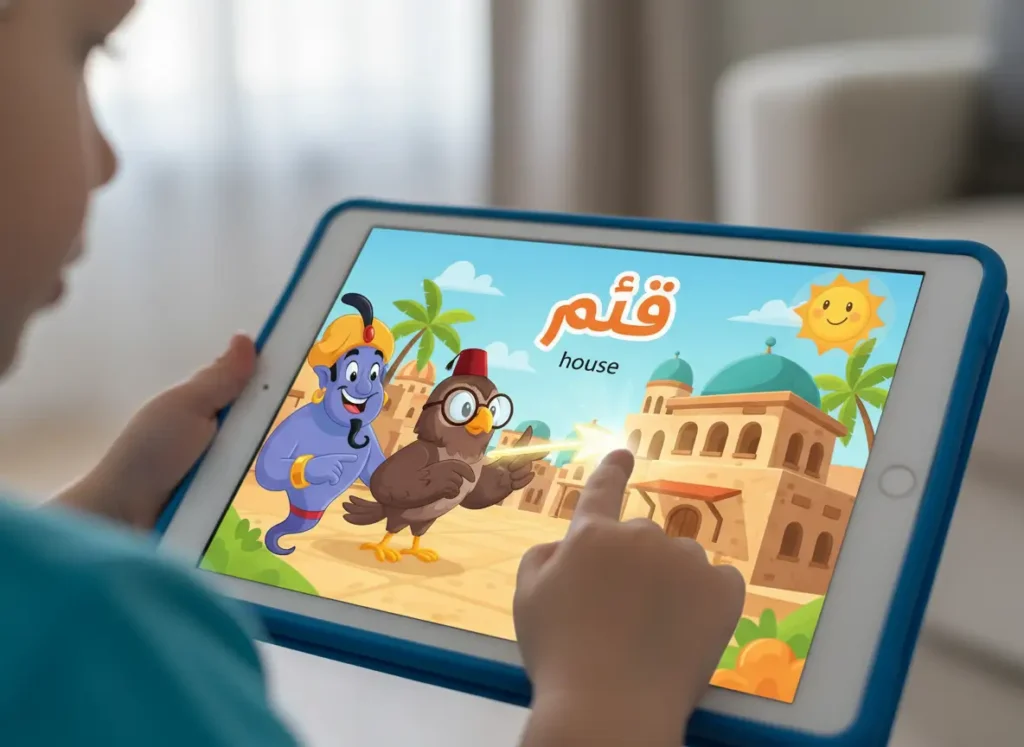
Games aren’t a break from learning. They ARE the learning.
When a child plays an Arabic matching game, they’re doing vocabulary practice. When they finish a word puzzle, they’re reinforcing spelling. When they win a quiz, they get a hit of dopamine — and they want to do it again.
So. What games actually work?
Letter Recognition Games
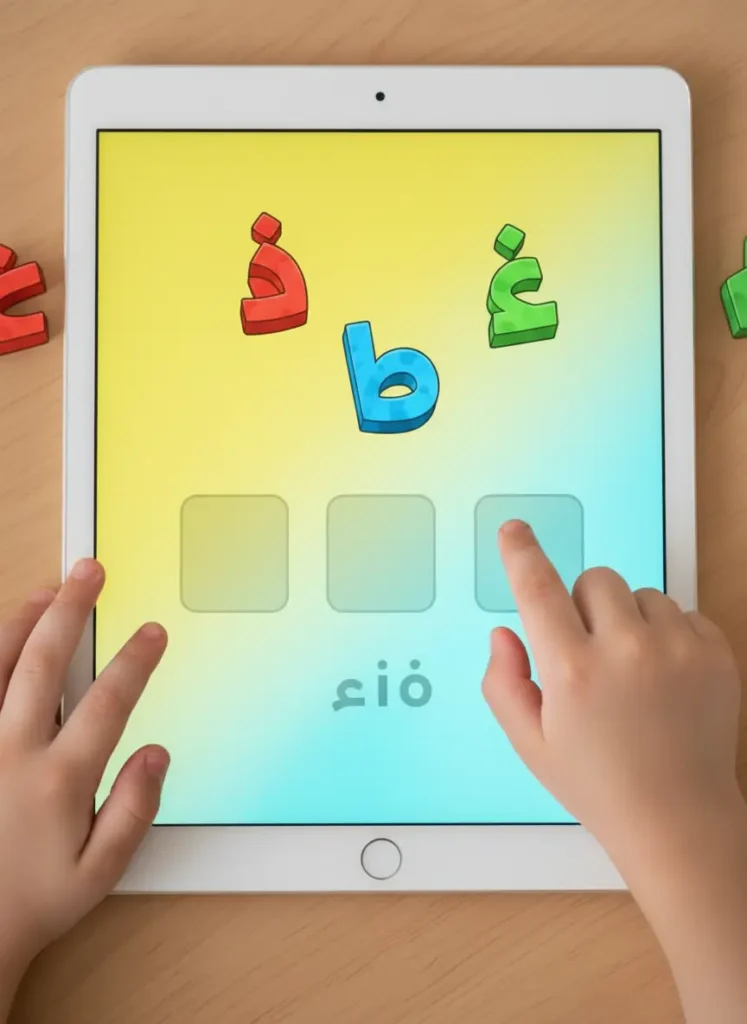
Start with the Arabic alphabet. There are 28 letters, and many have similar shapes. That sounds hard. It isn’t — when you make it a game.
- Flashcard matching: Show a letter, your child finds the matching one from a pile. Start with 5 letters, then grow.
- Letter fishing: Write letters on paper “fish,” use a magnet on a string to catch them. Name each one out loud.
- Alphabet bingo: Make bingo cards with Arabic letters. Call them out and have your child cover them.
By week 3 of consistent practice, most kids can recognize 10–15 letters.
Vocabulary Games
Once letters are familiar, vocabulary games open up fast:
- Arabic-English memory cards: Pairs of cards — one with the Arabic word, one with the English meaning. Flip and match.
- I Spy in Arabic: “أنا أرى شيئاً أحمر” (I see something red). Kids look around the room and guess in Arabic.
- Word of the day jar: Pull a new Arabic word every morning. Use it in a sentence at dinner.
Digital Games and Apps
Apps like AlifBee and Arabee are built for young Arabic learners. They use animation, games, and rewards to keep kids engaged. These work best as a supplement — not a replacement — for live instruction.
Honestly, 15 minutes of app-based play plus two weekly lessons with a real teacher is a winning combination.
Arabic Songs and Rhymes for Children: The Secret Weapon
You know what’s wild? A kid can memorize a 30-word song in one afternoon but forget 5 vocabulary words from a worksheet by the next day.
That’s not laziness. That’s neuroscience.
Music activates multiple parts of the brain simultaneously. Melody, rhythm, and repetition create memory pathways that are much stronger than rote memorization. This is why Arabic songs are one of the most powerful tools in any children’s program.
Songs That Actually Teach Something
Not all children’s songs are created equal. The best ones are:
- Thematic: A song about animals teaches animal names. A song about the body teaches body parts.
- Repetitive in the right way: The same word appears in multiple verses, building familiarity.
- Singable: If the tune is catchy, kids will sing it in the shower. Free practice.
Some categories that work brilliantly:
Alphabet songs — Alif, Baa, Taa in a rhythm your child can’t get out of their head.
Daily routine songs — “Good morning” (صباح الخير), getting dressed, breakfast time. Language they’ll actually use.
Nature and animal songs — قطة (cat), كلب (dog), أسد (lion). Animals are universally loved by children.
Numbers songs — Counting to 10 in Arabic takes about a week with the right rhyme.
How to Use Songs at Home
You don’t need to be a musician. Pull up Arabic children’s songs on YouTube, sing along with your child, and don’t worry about perfect pronunciation. The exposure alone is valuable.
Our teachers at Alphabet Arabic Academy integrate songs and rhymes into every preschool and kindergarten session. By week 4, most children can sing the alphabet and identify the letters they’re singing.
Arabic Stories for Kids to Learn: Building Real Comprehension
Stories do something games and songs can’t quite do on their own.
They teach Arabic in context. A child who reads or hears a story about a rabbit going to the market doesn’t just learn the word “rabbit” (أرنب) — they learn it connected to actions, places, emotions, and other words. That context is how real fluency is built.
What Makes a Good Arabic Story for Kids?
Illustrations. Lots of them. Images carry meaning when words are still new.
Simple sentence structures. Subject + verb + object. Short and clear.
Familiar themes. Home, family, animals, food, school. Topics your child already understands in their native language.
A little repetition. “The rabbit went to the market. The rabbit bought an apple. The rabbit went home.” Repetition is not boring — it’s reinforcement.
Story Types That Work by Age
- Ages 3–5: Picture books with 1–2 Arabic words per page. Point, name, repeat.
- Ages 5–7: Simple illustrated stories with short sentences. Read together.
- Ages 7–10: Stories with a full plot. Can begin reading independently with some guidance.
- Ages 10+: Short chapter books or Quranic stories with explanation.
At our academy, storytelling sessions are built into our Arabic for kids curriculum because we’ve seen what a great story can do for a child’s engagement and retention. One of our 9-year-old students went from refusing to read Arabic to asking for “one more chapter” after 3 months of story-based sessions.
Arabic Writing for Kids: Making It Easy (Not Scary)
Here’s where a lot of parents get nervous.
Arabic writing is right-to-left. Letters change shape depending on where they appear in a word. That sounds complicated. And honestly? It is — for an adult starting from scratch.
For a kid? It’s just how writing works. They don’t have years of left-to-right habit to unlearn.
A Step-by-Step Approach to Arabic Writing for Kids
Step 1: Tracing (ages 4–6) Before writing independently, children trace dotted Arabic letters. This builds muscle memory for the correct direction and shape. Printable worksheets are excellent here.
Step 2: Copying (ages 5–7) Write a letter or word clearly, and have your child copy it. Focus on one letter at a time. Don’t rush.
Step 3: Writing from memory (ages 6–8) Say a letter out loud. Your child writes it without looking at a model. Start with the easiest letters — like أ, و, ز — that have simple, distinct shapes.
Step 4: Writing words and short sentences (ages 7+) Connect letters into words. Then build simple sentences. By this stage, a child who’s had consistent practice for 6–9 months can usually write 20–30 common words independently.
Pro Tips for Writing Practice at Home
Use a whiteboard. Mistakes erase easily, which removes pressure and fear. Kids are much more willing to try when there’s no “ruining the paper.”
Keep sessions short. 10–15 minutes of focused writing practice beats 45 minutes of tired frustration every time.
Celebrate progress, not perfection. A slightly wobbly أ from a 5-year-old is a WIN.
Arabic for Preschool: Where It All Begins
Can a 3-year-old really learn Arabic?
Yes. Not grammar. Not writing. But vocabulary, sounds, rhythm, and basic phrases? Absolutely.
Preschool is actually the golden window. Children at this age are language sponges. Their brains are literally wired to absorb language with minimal effort. Starting at 3–5 years old gives your child a significant head start compared to beginning at 7 or 8.
What Preschool Arabic Looks Like
It’s not a desk. It’s not a worksheet (well, maybe one). It looks like:
- Circle time with Arabic greetings: “مرحبا!” (Hello!), “كيف حالك؟” (How are you?)
- Colorful letter posters on the wall that children point to and name
- Short, animated songs about colors, animals, and food
- Simple picture books read aloud by the teacher
- Art activities where children color letters or trace them with paint
The goal at preschool level isn’t fluency. It’s familiarity. It’s comfort. It’s planting the seed so that when formal instruction begins at age 5–6, the language already feels familiar and friendly.
Our specialist teachers at Alphabet Arabic Academy adapt every lesson to the child’s age and attention span. A 3-year-old gets 20-minute playful sessions. A 6-year-old gets slightly longer, more structured classes. The method always matches the child.
Arabic for Kids and Family Learning: Making It a Shared Experience

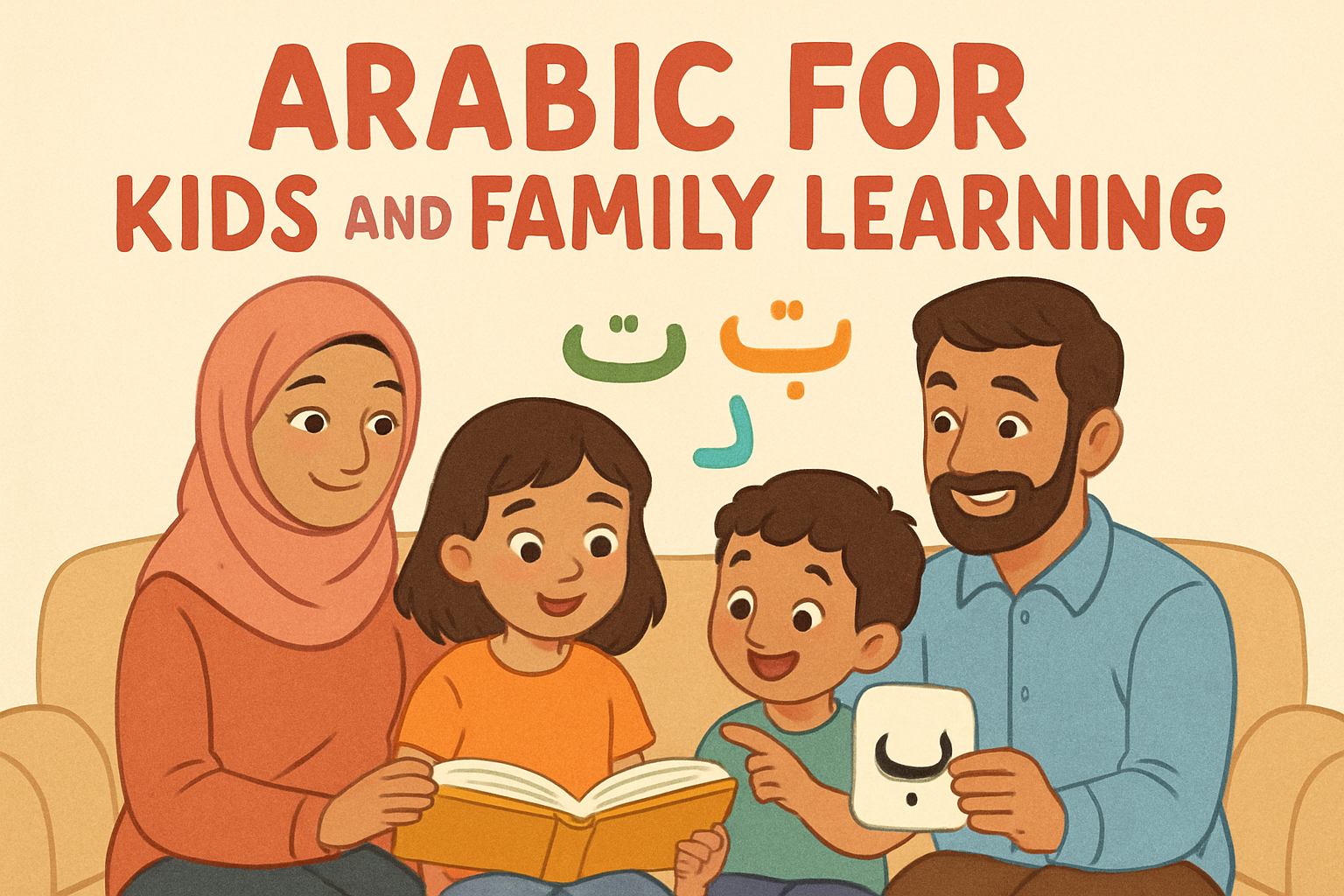
This might surprise you: parents who learn alongside their children — even just a little — see dramatically better results.
You don’t need to become fluent. You don’t need to study Arabic yourself. But if you can say “أرنب” (rabbit) at dinner, ask “ما لون هذا؟” (what color is this?), or count with your child to عشرة (ten) — you’re creating a language environment at home.
And language environments are where real learning happens.
Simple Ways Families Can Support Arabic Learning
Label things around the house. Sticky notes with Arabic words on the fridge, the door, the bathroom mirror. Passive exposure adds up.
Watch Arabic cartoons together. Shows like “Taratoota” or “Bakkar” are designed for Arabic-speaking children. Even if your child doesn’t understand everything, they’re absorbing sounds and patterns.
Make Fridays “Arabic day.” One day a week where you try to use a few Arabic phrases throughout the day. It doesn’t have to be perfect — it has to be consistent.
Celebrate milestones. Your child read their first Arabic word? That’s a big deal. Mark it. Frame it. Let them feel proud.
When to Enroll in a Structured Program
Home activities are powerful. But they work best alongside proper instruction. Our Arabic for kids program starts at $40/month with flexible scheduling, live 1-on-1 sessions with certified native Egyptian teachers, and lesson plans built around each child’s age and learning style.
You can also take our free Arabic placement test to figure out exactly where your child stands and what level to start from.
Common Mistakes Parents Make When Teaching Kids Arabic
Honestly, most of these mistakes come from a good place. Parents want their children to succeed. But good intentions plus the wrong approach = frustration for everyone.
Mistake 1: Starting with Grammar
Grammar is the enemy of early language learning in children. Start with vocabulary, phrases, and sounds. Grammar comes later — naturally — as the child has enough language to notice patterns.
Mistake 2: Making Sessions Too Long
A 5-year-old has a focused attention span of maybe 10–15 minutes. A 7-year-old can do 20–25 minutes. Anything beyond that stops being learning and starts being endurance.
Short, frequent sessions beat long, infrequent ones. Every time.
Mistake 3: Drilling Without Context
Repeating “أ أ أ أ” fifty times doesn’t help if there’s no word attached to it. “أسد” (lion), “أرنب” (rabbit), “أكل” (ate). Letters in context stick. Letters in isolation don’t.
Mistake 4: Expecting Native-Level Pronunciation Immediately
Arabic has sounds that don’t exist in English — the ع, the خ, the غ. These take time, and that’s completely normal. Don’t correct constantly or your child will stop trying. Celebrate approximations.
Mistake 5: Giving Up After One Bad Week
Some weeks your child will be enthusiastic. Some weeks they’ll be resistant. That’s normal. Stay consistent. The children who make the most progress are not the most naturally gifted — they’re the ones whose parents stayed the course.
Who Is This For?
This guide is for you if:
- Your child is between 3–12 years old and has never learned Arabic
- You’re a Muslim family who wants your child to read the Quran in Arabic
- Your child has Arabic heritage and you want them to connect with the language
- You’ve tried apps and YouTube but want something more structured
- You’re homeschooling and looking for a complete Arabic curriculum for kids
This is NOT for you if:
- You’re looking for a teenager or adult program (check our Arabic for teenagers page instead)
- You want a fully self-paced, no-teacher app experience
- Your child is already at an intermediate or advanced level and needs something more challenging
Let me tell you about dania.
She was five years old. Her parents spoke Arabic at home, but Lean always answered in English. Her grandmother would ask her a question in Arabic. dania would understand perfectly — and reply in English.
Her parents tried everything. Flashcards. Apps. Weekend classes. Nothing worked. Lean resisted every time.
Then they changed the approach. No pressure. No drills. Just 10 minutes a day — songs, tracing, and pointing to letters in her favorite storybook.
Week one, she learned Alif, Ba, Ta. Week two, she pointed to “mama” and said “Alif… Meem… Ya!” Week three, she wrote her name for the first time.
Her mother sent me a video. dania was reading a sentence from her book — slowly, carefully — and then she looked up and smiled.
That smile is why we do this.
The Arabic alphabet is not a test. It’s a door. And every child can open it. They just need the right key — and a parent who believes they can.
Frequently Asked Questions
Q1: What is the best age to start Arabic for kids?
The earlier, the better — but there’s no bad time to start. Children between ages 3–6 absorb language fastest. That said, children who start at 7, 8, or even 10 with good instruction and consistency make excellent progress too. Don’t let a late start discourage you.
Q2: How long does it take for a child to learn Arabic?
It depends on intensity and consistency. With 2–3 live lessons per week plus at-home practice, most children can read the Arabic alphabet within 6–8 weeks. Basic conversation takes 6–12 months. Full reading fluency with comprehension usually takes 1.5–2 years of consistent study.
Q3: Can my child learn Arabic and Quran at the same time?
Yes, and they actually complement each other well. Quran reading reinforces letter recognition and pronunciation. Arabic vocabulary supports Quran comprehension. Many families at our academy combine both from the beginning with great results.
Q4: Do I need to speak Arabic myself to help my child learn?
Not at all. Many of our most successful student families speak zero Arabic at home. What matters is consistency, encouragement, and a good teacher. You can support your child simply by being interested in their progress and practicing together in small, fun ways.
Q5: Are online Arabic lessons effective for young children?
Yes — when designed properly. Our lessons use screen-sharing, interactive games, whiteboards, and real-time engagement. Most children adjust to online sessions within 1–2 classes. Many kids actually prefer it because they’re learning from the comfort of their own home with no travel stress.
Q6: How much do kids’ Arabic lessons cost?
Our Arabic for kids program starts at $40/month. That includes live 1-on-1 sessions with a certified native Egyptian teacher, materials, and lesson planning tailored to your child’s age and level.
Conclusion
Arabic doesn’t have to be hard for kids. It just has to be fun.
The right mix of games, songs, stories, writing practice, and consistent live instruction creates something remarkable: a child who not only learns Arabic but genuinely loves learning it. That’s the goal.
At Alphabet Arabic Academy, our Al-Azhar-trained teachers have worked with children from over 80 countries. We know what works for a 4-year-old in New Jersey, a 7-year-old in London, and a 10-year-old in Toronto. The method adapts. The results speak.
Not sure where your child should start? Take the free Arabic placement test — it takes 10 minutes and gives you a clear picture of your child’s current level and the right starting point.